
Healthcare Staffing M&A Trends: A Strategic 2026 Guide for Owners and Investors
Did you know that private equity sponsors comprised half of all healthcare staffing acquisitions last year? With the U.S. currently facing a shortfall of over 4 million healthcare workers, the demand for agile agencies has never been higher. You've likely noticed that scaling your business feels more complex as credentialing requirements tighten and labor gaps persist. Understanding the current healthcare staffing m&a trends is the first step toward turning these challenges into a significant strategic advantage for your firm's future.
We understand that weighing an exit or seeking an investment partner can feel like a daunting journey. It's why we've prepared this guide to help you navigate the 2026 market with confidence and clarity. You'll learn how to maximize your exit value by leveraging the Joint Commission's new performance goals and see where your agency fits within current EBITDA multiples. We'll also examine the role of private equity and the high-margin niches that are attracting the most attention from strategic buyers right now.
Key Takeaways
- Understand how persistent clinical shortages are fueling market consolidation and creating a prime environment for platform acquisitions in 2026.
- Identify the high-multiple niches currently attracting intense buyer interest, specifically the surge in demand for Allied Health, Locum Tenens, and Behavioral Health staffing.
- Learn how to evaluate your firm's worth by analyzing current healthcare staffing m&a trends alongside key metrics like recruiter productivity and account concentration.
- Protect your deal by prioritizing compliance and credentialing, ensuring these critical areas don't become red flags during the due diligence process.
- Discover the strategic advantage of partnering with a specialized M&A advisor to navigate complex deal structures and secure a seamless transition for your team.
The State of Healthcare Staffing M&A in 2026: Market Consolidation
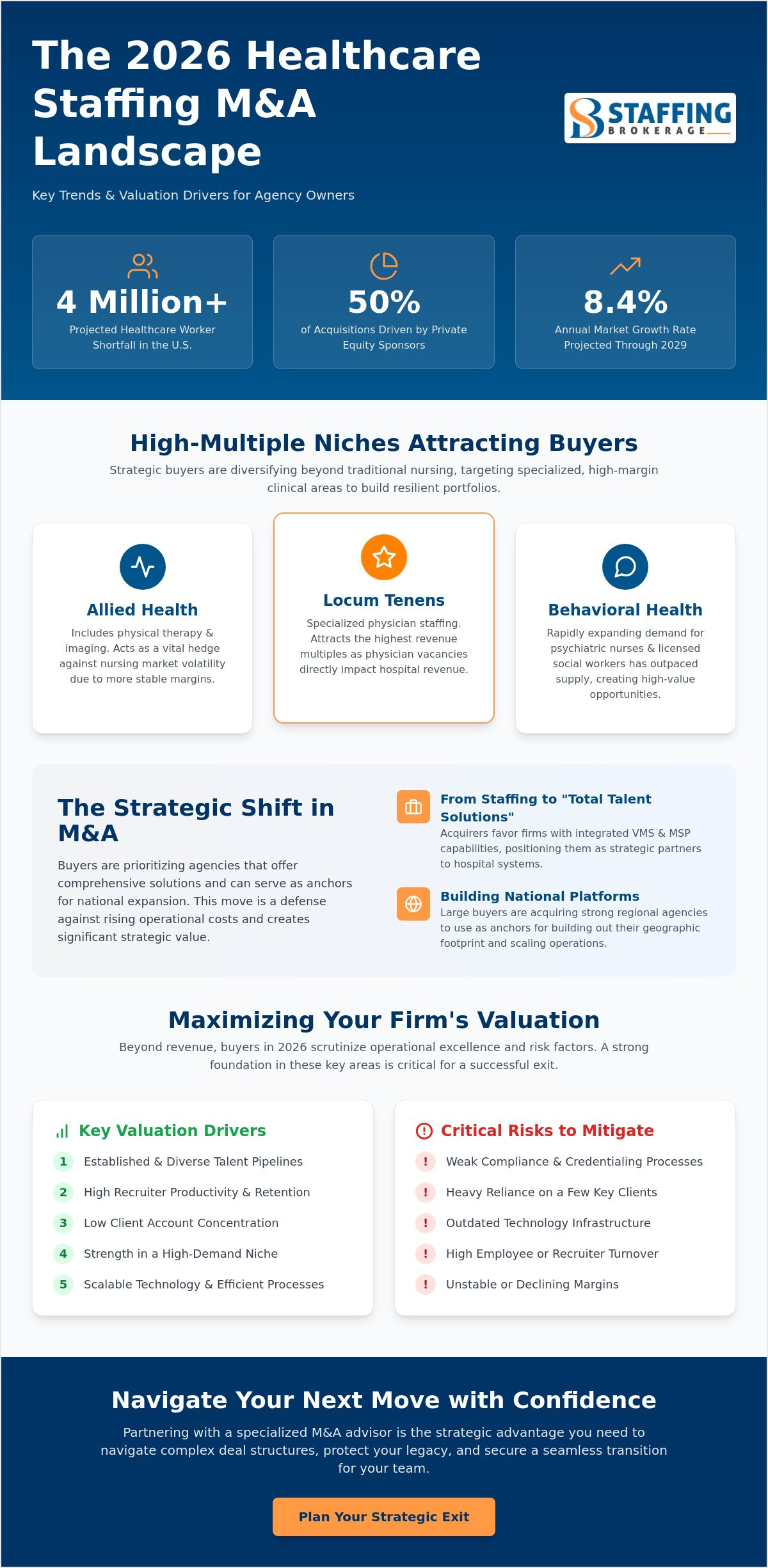
The healthcare sector is witnessing a period of intentional, steady growth in deal activity. Following a 16.7% increase in transactions during 2025, the 2026 market has matured into a landscape where quality and strategic alignment take center stage. Current healthcare staffing m&a trends show that buyers are no longer just chasing top-line revenue. They're looking for resilient businesses that can help solve the most pressing issue in the industry: the projected shortfall of over 4 million healthcare workers. This massive talent gap has transformed clinical access into a premium asset, making agencies with established talent pipelines highly attractive targets for platform acquisitions.
Consolidation is accelerating particularly among mid-market firms. For many owners, the rising costs of insurance, technology, and complex credentialing have made independent scaling more difficult. Merging with a larger partner or a well-funded peer provides the resources needed to compete in a market that's expected to grow at an 8.4% annual rate through 2029. This environment favors mergers that create operational efficiencies while maintaining the high-touch service that healthcare facilities require.
Macroeconomic Drivers for Healthcare Acquisitions
Several factors have aligned to make 2026 a favorable year for transitions. Aging demographics continue to push long-term demand to record highs as the healthcare needs of the population expand. Additionally, interest rate stability in 2026 has provided private equity firms with the predictability they need to deploy capital. We've moved past the era of pandemic-related crisis staffing and into a phase of sustainable, long-term growth. Investors are now focused on firms that demonstrate a "steady hand" and a commitment to ethical, high-quality placement models.
The Shift Toward National Platform Strategies
Large national buyers are actively seeking regional anchors to build out their geographic footprints. By acquiring a strong regional player, these buyers gain immediate access to local hospital relationships and a proven recruiter base. Scale is becoming a primary defense against rising operational costs. A larger organization can spread the burden of compliance and administrative overhead across a broader revenue base. Our staffing company buy-side advisory services help these growing organizations identify the right regional partners that align with their long-term vision. These healthcare staffing m&a trends suggest that being part of a larger national platform is often the most effective way to secure a firm's legacy and ensure continued service excellence.
Key Market Trends Shaping Healthcare Staffing Acquisitions
The acquisition landscape is shifting as buyers look beyond traditional travel nursing to build more resilient portfolios. While nursing remains a core pillar, the most aggressive healthcare staffing m&a trends in 2026 involve a move toward specialized clinical niches. Investors are specifically targeting firms that offer "total talent solutions" by integrating Vendor Management Systems (VMS) and Managed Service Provider (MSP) capabilities. This evolution allows staffing firms to act as comprehensive partners for hospital systems rather than just filling individual shifts. In 2026, the strategic pivot toward subsegment diversification allows healthcare staffing firms to mitigate risk by balancing high-volume nursing with high-margin specialties like behavioral health and radiology.
Behavioral health has emerged as a particularly high-multiple niche this year. As mental health services expand nationwide, the demand for specialized psychiatric nurses and licensed social workers has outpaced supply. This scarcity creates a protective "moat" around agencies that have mastered this specific credentialing process. If you're considering your firm's position, a professional business valuation and assessment can clarify how these niche strengths impact your market appeal.
The Dominance of Locum Tenens and Allied Health
Specialized physician staffing, or locum tenens, continues to attract some of the highest revenue multiples in the industry. Because physician vacancies directly impact a hospital's billable revenue, buyers view these agencies as essential infrastructure. Allied health segments, including physical therapy and imaging, also serve as a vital hedge against the volatility seen in the nursing market. These subsegments often enjoy more stable margins and longer contract durations. When calculating your staffing company valuation, having a diversified mix of allied health and locum tenens can significantly elevate your final exit price.
Private Equity and the "Platform" Model
Private equity sponsors remained highly active through 2025, accounting for half of all sector transactions. This momentum has carried into 2026 with a focus on "bolt-on" acquisitions. PE firms are increasingly looking down-market to find founder-led agencies that can be integrated into their larger national platforms. They value the local relationships and "steady hand" culture that independent owners provide. Transitioning from a founder-led model to a PE-backed structure requires a thoughtful approach to ensure your team's culture remains intact. We focus on finding a strategic fit that respects your legacy while providing the capital needed for the next phase of growth.
What Drives Valuation: Critical Metrics for 2026 Deals
Determining the worth of your agency is more than a simple calculation of profit. In the current market, buyers look for the story behind the numbers. Current healthcare staffing m&a trends show a significant premium for firms that demonstrate operational maturity and predictable growth. While the average EV/EBITDA multiple for the sector sits around 9.9x, your specific value depends heavily on your scale and niche. Small, local operators typically see multiples between 2.5x and 5x, while larger regional firms with revenue between $5 million and $50 million often command 5x to 10x. If you've built a high-growth tech platform or a dominant national presence, those numbers can climb even higher, sometimes reaching 12x or beyond.
Buyers want stability. They aren't just buying your past; they're buying your future's predictability. High account concentration, where a single hospital system represents more than 30% of your revenue, can often lead to valuation discounts. Conversely, having long-term, exclusive contracts with major health systems acts as a powerful value driver. These relationships signal to investors that your revenue is secured by deep-rooted partnerships rather than just transactional shifts.
Operational Metrics That Move the Needle
In 2026, efficiency is a primary indicator of value. While fill rates are important, buyers are increasingly focused on time-to-fill as a measure of your team's agility. A major differentiator we're seeing this year is the role of technology in automating credentialing and compliance. Agencies that leverage AI-driven tools to speed up the onboarding process see significantly higher recruiter productivity. This technological edge reduces administrative drag and improves redeployment rates. When clinicians stay within your ecosystem for multiple assignments, it proves your brand's loyalty and lowers your customer acquisition costs, making your firm much more attractive to strategic buyers.
Financial Health and Revenue Mix
Your revenue mix tells a story about your risk profile. A healthy balance between travel and per diem staffing suggests you can weather various market shifts. During the process of negotiating the sale of a staffing agency, identifying "add-backs" is essential. These are one-time or non-recurring expenses that, when added back to your earnings, provide a clearer picture of your true EBITDA. Managing your working capital and payroll float is also critical. A firm that handles its cash flow with precision demonstrates the kind of "steady hand" management that private equity firms and strategic acquirers value most for mutual success.
Navigating Risks: Compliance, Credentialing, and Deal Structure
Compliance has moved from a back-office function to the very center of the negotiation table. In the current market, buyers view clinical compliance as a primary indicator of a firm's total value. Gaps in clinician files aren't just administrative hurdles. They're significant liabilities that can lead to immediate price re-negotiations or even cause a deal to collapse entirely. As healthcare staffing m&a trends continue to favor high-quality clinical outcomes, investors are willing to pay a premium for agencies that treat credentialing as a core strategic asset rather than a necessary burden.
During the due diligence phase, buyers look for specific indicators of operational health. We often see transactions stall when teams discover red flags buying a staffing agency, such as inconsistent background checks or expired certifications. These issues suggest a lack of oversight that could lead to legal exposure or loss of hospital contracts. To protect your hard-earned value, you must ensure your internal processes are beyond reproach before you ever sign a Letter of Intent.
Credentialing as a Strategic Asset
The 2026 standard for excellence is defined by digital credentialing and strict adherence to Joint Commission guidelines. Since the Joint Commission officially integrated nurse staffing levels into its National Performance Goals in January 2026, buyers have become hyper-vigilant about file accuracy. You should audit your own clinician files months before a potential sale to address any discrepancies in a calm, methodical manner. Proactive compliance audits are essential for maximizing exit value because they eliminate the uncertainty that leads to price re-negotiations or deal fatigue. If you want to ensure your agency is fully prepared for this level of review, our staffing company sell-side representation provides the expert oversight needed to secure a successful close.
Structuring the Deal for Long-Term Success
Modern deal structures are rarely just about the cash at close. Most 2026 transactions involve a combination of upfront payment, performance-based earn-outs, and equity rollovers. An earn-out allows you to benefit from the future growth of the company, while a rollover keeps you invested in the success of the new, larger entity. This approach is common in strategic staffing company mergers where the buyer wants to ensure the founder's "steady hand" remains during the transition. Crafting a staffing company deal structure that protects your legacy requires balancing your immediate financial goals with the long-term potential of the partnership. We focus on creating alignment between both parties to ensure the transition feels like a shared victory rather than a simple hand-off.
Strategic Exit or Acquisition: Partnering for a Seamless Transition
The decision to sell or acquire a business is one of the most significant milestones in an entrepreneur's life. It represents years of hard work, late nights, and a commitment to clinical excellence. In a market as specialized as this, working with a generic business broker often isn't enough. A generalist might understand a balance sheet, but they often lack the deep industry knowledge required to navigate specific healthcare staffing m&a trends, such as the impact of the Joint Commission's new standards or the nuances of allied health margins. Engaging a specialized staffing company M&A advisory ensures that your business is presented in the best possible light to the right audience.
Staffing Brokerage acts as a dedicated partner throughout this transition. We don't just facilitate transactions; we build bridges between qualified buyers and verified sellers who share a vision for the future of healthcare. By leveraging our national network, we identify "hidden" buyers who may not be active on public listing sites but are hungry for strategic acquisitions that align with their platform goals. Our role is to provide a "steady hand," ensuring that every step of the process is grounded in transparency and mutual success.
Finding the Right Strategic Fit
While the highest offer is always tempting, a successful exit often depends on finding the right cultural alignment. You've built a team and a reputation; you want to know that your legacy is in good hands. We guide you through a collaborative journey that prioritizes strategic fit as much as financial gain. This involves looking at how a buyer manages their recruiter talent, their approach to clinician retention, and their long-term growth plans. When these elements align, the transition becomes a shared accomplishment rather than just a deal. Preparing your 2026 staffing agency exit strategy early allows you to vet these partners without the pressure of a rushed timeline.
Your Next Steps in the 2026 Market
The first step toward a successful transition is understanding exactly where you stand. This begins with a comprehensive business assessment to ensure your valuation is based on current healthcare staffing m&a trends and concrete data. We'll help you identify areas where you can strengthen your operational metrics, from recruiter productivity to compliance automation, before going to market. Our goal is to make sure you're fully prepared for the due diligence process and ready to capture the maximum value for your firm. If you're ready to explore your options, we're here to help you Partner with Staffing Brokerage for your strategic exit and navigate this complex journey with confidence.
Securing Your Legacy in the 2026 Healthcare Market
The current landscape offers a unique window of opportunity for agency owners who have prioritized clinical quality and operational precision. By staying ahead of healthcare staffing m&a trends, you can position your firm as a premium asset in a market that values stability and strategic alignment. Whether you're looking to capitalize on high-multiple niches like behavioral health or seeking a national partner to help you scale, the right preparation is everything.
We're here to guide you through this collaborative journey with our specialized staffing industry expertise and a national network of qualified buyers. We've seen firsthand how a "steady hand" approach leads to proven results in complex healthcare transactions. It's about more than just a transaction; it's about finding the right fit for your team and your personal milestones. Start your strategic exit journey with a professional valuation to see how your hard work translates into long-term value. We look forward to helping you navigate your next chapter with confidence and peace of mind.
Frequently Asked Questions
What is the average revenue multiple for healthcare staffing agencies in 2026?
Valuation multiples are primarily based on EBITDA and vary significantly by firm size. Small, local operators with under $5 million in revenue typically see multiples between 2.5x and 5x EBITDA. Larger regional agencies with revenue up to $50 million often command 5x to 10x, while high-growth technology platforms can reach between 10x and 20x EBITDA. The average EV/EBITDA multiple across the sector has recently stabilized at approximately 9.9x.
How does the current nursing shortage affect the value of my staffing agency?
The projected shortfall of over 4 million healthcare workers by 2026 has made established talent pipelines a premium asset. Buyers are willing to pay more for firms that have mastered recruitment and retention in this difficult climate. Your ability to reliably supply clinicians directly impacts a hospital's billable revenue, which makes your agency essential infrastructure rather than just a service provider.
What is the difference between a strategic and a financial buyer in healthcare staffing?
Strategic buyers are usually other staffing companies looking to expand their geographic reach or clinical specialties. They seek synergies that can reduce overhead costs. Financial buyers, such as private equity firms, look for agencies with strong cash flow that can serve as a platform for future acquisitions. Both types of buyers are currently active, though their goals for your firm's post-sale operations may differ.
How long does the healthcare staffing M&A process typically take in 2026?
Most transactions take between six and nine months from the initial assessment to the final close. This timeline allows for a methodical approach to business valuation, marketing to qualified buyers, and the rigorous due diligence process. Because clinical compliance is so critical, the audit of credentialing files often represents the most time-intensive phase of the journey.
Is private equity still active in the healthcare staffing sector this year?
Private equity remains a primary driver of healthcare staffing m&a trends, comprising half of all transactions in the sector during 2025. This momentum has continued into 2026 as sponsors seek "bolt-on" acquisitions to grow their national platforms. They are particularly interested in founder-led agencies that offer a "steady hand" and deep-rooted local relationships.
Can I sell my healthcare staffing agency if I have high client concentration?
Yes, you can certainly sell, but high concentration may influence your deal structure. If a single client represents more than 30% of your revenue, buyers might mitigate their risk through larger performance-based earn-outs. We often work with owners to highlight the strength and longevity of these key relationships to maintain a strong valuation despite the concentration.
What role does technology play in a 2026 staffing company valuation?
Technology is a major value multiplier because it directly impacts recruiter productivity and compliance accuracy. Agencies that use AI-driven platforms for credentialing can onboard clinicians faster and with fewer errors. Buyers view this automation as a way to scale the business without a proportional increase in administrative costs, which often leads to higher EBITDA multiples.
How much does it cost to hire an M&A advisor for a staffing agency sale?
Most specialized advisors work on a success-fee basis, which means their compensation is directly tied to the final sale price of your business. This structure ensures that your interests are perfectly aligned for mutual success. Some advisors may also utilize a retainer to cover the upfront costs of business valuation and the development of a personalized marketing strategy.