
Staffing Company Succession Planning: The 2026 Strategic Guide for Owners
What if your agency is actually just a high-paying job rather than a sellable asset? It’s a heavy question, but it’s one every owner must face to truly secure their future. You’ve worked hard to build a firm that connects thousands of people with work, yet the fear that everything relies on your personal relationships can be paralyzing. Effective staffing company succession planning isn't just a retirement task; it’s a vital de-risking strategy that transforms your daily operations into a lasting, independent legacy.
We understand the uncertainty that comes with choosing between selling to loyal employees or finding an external buyer. You want to ensure your staff and clients are taken care of while maximizing the valuation you’ve earned through years of dedication. This 2026 guide provides a clear roadmap to help you navigate the current tax environment and shifting interest rates. We’ll show you how to build a business that operates independently, giving you the peace of mind to transition on your own terms with a steady, confident hand.
Key Takeaways
- Discover how proactive staffing company succession planning transforms your agency from a personal job into a high-value, sellable asset.
- Compare the strategic paths of grooming internal management versus seeking an external financial or strategic buyer for your firm.
- Learn to apply the "Hit by a Bus" test to ensure your agency maintains operational continuity and protects client relationships without your daily input.
- Identify the financial steps required to maximize your exit value, including balance sheet cleanup and identifying critical EBITDA add-backs.
- Understand why industry-specific M&A expertise is vital for navigating the technical and emotional complexities of a staffing business transition.
Building a Sustainable Legacy: What is Staffing Company Succession Planning?
Succession planning is often misunderstood as a simple "handing over of the keys." In reality, it's a meticulous process of leadership development designed to protect your life's work. When exploring the foundational question of What is Succession Planning?, it's helpful to view it as an insurance policy for your agency's future. It involves identifying and preparing high-potential talent to step into critical roles when you eventually decide to retire or step back. For a staffing firm, this means more than just filling a seat. It requires a deep, systematic transfer of client trust and operational nuance that can't be documented in a simple handbook.
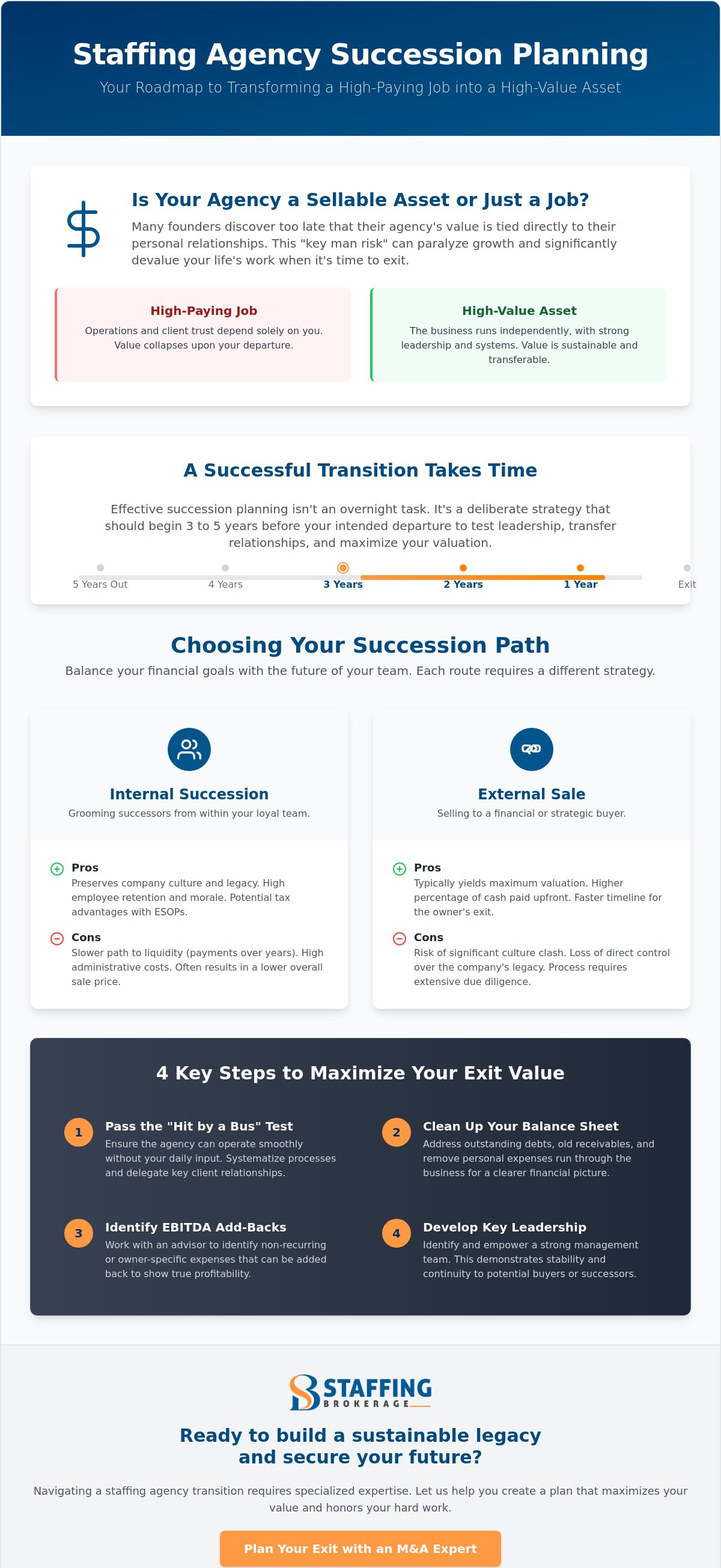
A successful transition doesn't happen overnight. Most owners find that effective staffing company succession planning begins three to five years before they intend to depart. This timeline allows you to test leadership in real-world scenarios while you're still available to provide a steady hand. It's a central pillar of your broader staffing agency exit strategy, ensuring the business remains a living entity rather than a house of cards that collapses the moment you leave the building.
The High Cost of Failing to Plan
Many founders discover too late that their personal charisma is the only thing keeping the lights on. Without a plan, your agency faces "key man risk," where the departure of a single person triggers a domino effect. You risk losing institutional knowledge that your best recruiters and managers have spent years accumulating. Even more dangerous is client attrition. If your top accounts only have a relationship with you, they'll likely look for a new partner the moment you step away. This lack of continuity leads to a significant reduction in business valuation, as buyers are hesitant to pay a premium for a firm that depends entirely on its founder.
Succession vs. Exit Planning: Understanding the Difference
While people often use these terms interchangeably, they serve different purposes in your journey. Succession planning focuses on the people. It's about leadership roles, culture, and internal stability. Exit planning is more technical; it focuses on your personal financial objectives and the mechanics of the transaction itself. You need both to be perfectly aligned to achieve a successful staffing agency ownership transition. When your leadership team is ready to take the reins, the financial deal becomes much easier to finalize because the business is already operating with a sense of independent momentum. Strategic staffing company succession planning bridges the gap between your career and your retirement, turning your hard work into a lasting legacy.
Internal vs. External Succession: Choosing Your Agency’s Path
Choosing the right path for your staffing company succession planning is a deeply personal decision. It balances your financial needs with the future of your team. You might decide to keep the legacy within your walls or seek a fresh start through an outside acquisition. Both routes offer distinct advantages, but they require different preparation styles. The choice between these paths often hinges on three specific factors:
- Your desired retirement timeline.
- The leadership readiness of your current managers.
- Your need for immediate liquidity versus long-term payments.
While internal buyouts often involve "earnout" structures that pay out over several years, external sales typically offer a higher percentage of cash upfront.
Grooming Internal Successors
Keeping your agency in-house is a powerful way to reward the team that helped you build it. This process starts with identifying high-potential recruiters and account managers who show leadership traits early. To keep these key players from jumping ship, many owners implement a long-term incentive plan (LTIP). This aligns their financial success with the firm's growth. You might also consider an Employee Stock Ownership Plan (ESOP). These plans offer tax advantages under the stable 2026 tax code, thanks to the One Big Beautiful Bill Act, and boost employee morale. Consider the trade-offs of an ESOP:
- Pros: Tax deferrals on capital gains and high employee retention.
- Cons: High administrative costs and a slower path to full liquidity.
De-Risking Your Transition through internal development ensures the culture remains intact long after you've moved on.
Preparing for an External Sale
Selling to an outside party often yields a higher multiple of EBITDA. You're tapping into a broader market of investors who are eager to enter a US staffing industry projected to reach $183 billion in 2026. These buyers don't just look at revenue. They view your management team as a "ready-made" asset that can drive future growth. You'll need to understand the different motivations of a staffing company strategic buyer vs. financial buyer. Strategic buyers look for synergy with their existing operations. Financial buyers, like private equity firms, focus on your standalone growth potential. This choice is a critical part of your staffing company succession planning journey. If you're unsure which path fits your timeline, a professional business valuation can provide the clarity you need to move forward with confidence.
De-Risking Your Agency: The Key to a Successful Transition
The "Hit by a Bus" test is the ultimate benchmark for any staffing owner. Could your agency operate smoothly for 30 days without your direct input? If the answer is no, your business is likely a high-paying job rather than a sellable asset. Effective staffing company succession planning focuses on removing you as the single point of failure. This process starts with diversifying your revenue streams. If a single client represents more than 15% to 20% of your total billings, a buyer will see a massive risk. They'll worry that the relationship exists only with you and will vanish once you depart. Spreading that influence across your management team early is a vital step in protecting your legacy.
Standardizing your operations is equally vital for a clean transition. You need clear, written procedures for recruitment, sales, and compliance that any qualified leader can follow. This creates a predictable environment where quality doesn't fluctuate based on who is in the office. Protecting your intellectual property is also a non-negotiable step. Ensure every key employee has signed updated non-compete and non-solicitation agreements. These documents provide a necessary safety net for a future owner, proving that the business's core value won't walk out the door the day you stop showing up. It's about building a fortress around your agency's future.
Transferring the "Secret Sauce"
Every successful agency has a unique way of finding talent and closing deals. You must document these specific recruitment workflows and candidate sourcing strategies so they don't leave when you do. Move away from owner-led business development by formalizing the sales process into a repeatable system. Use your CRM to institutionalize every client preference and historical interaction. When your agency's "secret sauce" lives in a shared system rather than your head, the business becomes infinitely more attractive to a buyer. This transparency builds trust and shows that the firm's success is systemic, not accidental.
Protecting the Recruiter Engine
In the staffing world, your people are your primary asset. Recruiter flight during a leadership transition can destroy your valuation overnight. You need a professional culture that survives your personality and keeps your top billers engaged. Focus on building a brand that employees feel proud to represent, rather than just a company they work for. By creating an environment where recruiters feel valued and secure, you protect the engine that drives your revenue. Buyers aren't just looking at your past numbers; they're looking for a stable team that will continue to produce. A steady, well-prepared team is the hallmark of successful staffing company succession planning.
Financial Preparation: Steps to Maximize Exit Value
Your agency's financial health is the ultimate proof of its success. While previous sections focused on people and operations, this stage of staffing company succession planning is about the hard data that drives your final check. A buyer's first look at your books tells them how much risk they're taking on. Cleaning up your balance sheet is a vital first step. You must separate personal expenses from business operations. This transparency allows you to identify "add-backs," which are expenses like personal travel or one-time legal fees that don't reflect the firm's true earning potential. By normalizing your earnings, you present a much stronger EBITDA to potential buyers.
Setting realistic expectations is equally important. You should understand your current staffing company valuation early in the process. This creates a "gap analysis" that shows exactly how much growth you need before you can comfortably step away. Modern buyers also look for scalable operations. Investing in a robust ATS or CRM demonstrates that your agency uses modern, data-driven workflows. Finally, review all vendor contracts and office leases. Ensure they don't have "change of control" clauses that could derail a sale at the last minute. Being proactive here prevents expensive surprises during due diligence.
The Role of Financial Transparency
Moving from "cash-basis" to "accrual-basis" accounting is a necessary shift for any owner eyeing an exit. Accrual accounting provides a more accurate picture of your agency's long-term performance. Most buyers require at least three years of clean, verifiable financial statements to move forward. This level of clarity significantly reduces the "risk premium" a buyer applies to your firm. When your numbers are easy to track and verify, the path to a high-value transition becomes much smoother for everyone involved.
Setting Your "Freedom Number"
Your "freedom number" is the net proceeds you need from a sale to support your post-exit lifestyle. It's the point where your business's value aligns perfectly with your personal retirement goals. You don't want to reach the finish line only to realize the math doesn't work for your future. Transferable Value is the price a buyer pays for a business that functions without the owner. Focus on building this value so you can walk away with the confidence that your financial future is secure. If you're ready to see where your firm stands today, start with a professional business valuation and assessment to map out your next steps.
Executing the Plan: The Role of a Specialized M&A Advisor
General business brokers often lack the specific data needed for staffing deals. They might understand basic multiples, but they often struggle with the nuances of bill rates, gross margin spreads, or the specific risks associated with different staffing verticals. A specialized advisor brings industry-specific insights to the table. This expertise is vital for staffing company succession planning because it ensures your valuation reflects the true market demand for your particular niche. You've built a specialized firm; you deserve an advisor who speaks your language and understands the intricacies of your balance sheet.
The transition process is as much about people as it is about profits. You need an advisor who acts as a steady hand, managing both the technical hurdles and the emotional weight of stepping away. They help you identify the right retiring staffing agency owner resources and connect you with buyers who value your agency's culture. Throughout this journey, confidentiality is paramount. A specialized firm knows how to vet potential buyers and manage information flow so your recruiters and clients remain focused and secure until the deal is finalized.
From Planning to Market
At some point, your internal preparation must shift toward active sell-side representation. This is when a broad national network becomes your greatest asset. Finding the right strategic buyer often requires looking beyond your local market to find a partner who sees the synergy in your operations. A professional advisor ensures a strategic fit that protects your legacy and provides a stable future for your employees. They navigate the complexities of the 2026 market, from shifting interest rates to the latest AI-driven valuation trends, so you don't have to manage those details alone.
Your Next Chapter
As you prepare to transition into retirement and enjoy the rewards of your hard work, you might learn more about The Russell Travel Team (Lightning Travel) to begin planning a celebratory luxury vacation.
Your next chapter is entirely up to you. Some owners prefer a full "clean break" exit to enjoy the fruits of their labor immediately. Others choose to stay on in a consulting role for a set period to guide the new leadership and ensure a smooth hand-off. Both paths are valid and depend on your personal goals and the needs of the buyer. Successfully transferring ownership is a shared accomplishment that deserves to be celebrated. You've transformed a vision into a lasting, independent asset that will continue to thrive. If you're ready to explore your options, contact Staffing Brokerage for a confidential assessment of your succession readiness.
Securing Your Legacy and Future Growth
Your agency is more than a business; it's the result of years of dedication and relationship-building. By prioritizing staffing company succession planning today, you're transforming that hard work into a durable asset that can thrive without your daily oversight. Whether you choose to groom internal leaders or seek an external buyer, the keys to success remain the same: de-risk your operations, clean up your financials, and lean on specialized expertise to navigate the complexities of the 2026 market.
Transitioning your life's work is a significant milestone that requires a steady, experienced hand. At Staffing Brokerage, we combine specialized staffing M&A expertise with a national network of qualified buyers to ensure you find the perfect strategic fit. Our proven results in staffing sell-side representation mean you can move forward with confidence, knowing your legacy is protected and your financial goals are within reach.
Start Your Succession Journey with a Confidential Valuation
You've built something remarkable. Now, let's work together to ensure it continues to flourish for years to come.
Frequently Asked Questions
How far in advance should I start staffing company succession planning?
You should ideally begin the process 3 to 5 years before your intended exit date. This timeframe allows you to transition key client relationships and groom a leadership team that can operate without your daily input. Starting early ensures you aren't forced into a rushed decision, giving you the leverage to maximize your agency's value and secure your financial future through proactive staffing company succession planning.
Can I sell my staffing agency to my employees?
Yes, you can sell your agency to your employees through an internal buyout or an Employee Stock Ownership Plan (ESOP). This path is often rewarding as it preserves the company culture you've built and rewards the team that helped you succeed. While these deals often involve earnouts or longer payment structures, they provide a stable transition that keeps your legacy in the hands of those who know the business best.
What is the biggest mistake owners make during succession?
The most common mistake is waiting too long to start the process or failing to delegate "owner-only" relationships. If your top clients only deal with you, a buyer will see your departure as a massive risk to future revenue. You must institutionalize these connections across your team well before you step away. Waiting until you are ready to retire to begin planning often leads to a lower valuation and a stressful exit.
How does succession planning affect my staffing agency’s valuation?
A structured plan significantly increases your valuation by proving the business is a "transferable asset" rather than just a job for the owner. Buyers pay a premium for agencies that demonstrate operational independence and a stable management team. When you engage in staffing company succession planning, you reduce the perceived risk for a buyer, which often leads to higher EBITDA multiples and better deal terms during a sale.
What happens if I don’t have a successor identified?
If you don't have an internal successor, your best path is often an external sale to a strategic or financial buyer. These buyers frequently have their own leadership teams or are looking to keep your current management in place while providing the necessary resources for growth. You can also focus on hiring a professional manager or COO a few years before your exit to fill the leadership gap and make the firm more attractive.
Will my clients leave if they find out I am planning to exit?
Clients generally won't leave if you have properly transitioned their relationships to other team members before the news breaks. The key is to make your exit feel like a natural evolution rather than a sudden abandonment. By introducing your leadership team as the primary points of contact early, you prove that the quality of service isn't tied solely to your presence, which maintains trust and continuity.
Should I tell my recruiters about my succession plan?
Timing is everything when it comes to informing your staff. You should involve your top leaders early to ensure they are aligned with the transition, but broader announcements should wait until the plan is solidified. Sharing the news too early can cause "recruiter flight" due to uncertainty. When you do share the plan, frame it as a positive step for the firm's growth and stability to keep your best billers engaged.
What is the role of an M&A advisor in succession planning?
An M&A advisor acts as a steady hand to manage the technical and emotional complexities of the transition. They provide industry-specific data to ensure your valuation is accurate and use their national network to find the right strategic fit for your agency. By handling the heavy lifting of the sale and maintaining strict confidentiality, they allow you to stay focused on running your business while they secure your next chapter.