
Staffing Agency Exit Strategy: The 2026 Owner’s Guide to a Seamless Transition
What if the most profitable day of your career isn't the day you land a massive contract, but the day you hand over the keys? For many owners, the idea of leaving feels more like a threat to their legacy than a reward for their hard work. Developing a comprehensive staffing agency exit strategy is the only way to ensure your business thrives long after you've stepped back. It's about moving from being the engine of the company to becoming the architect of its future.
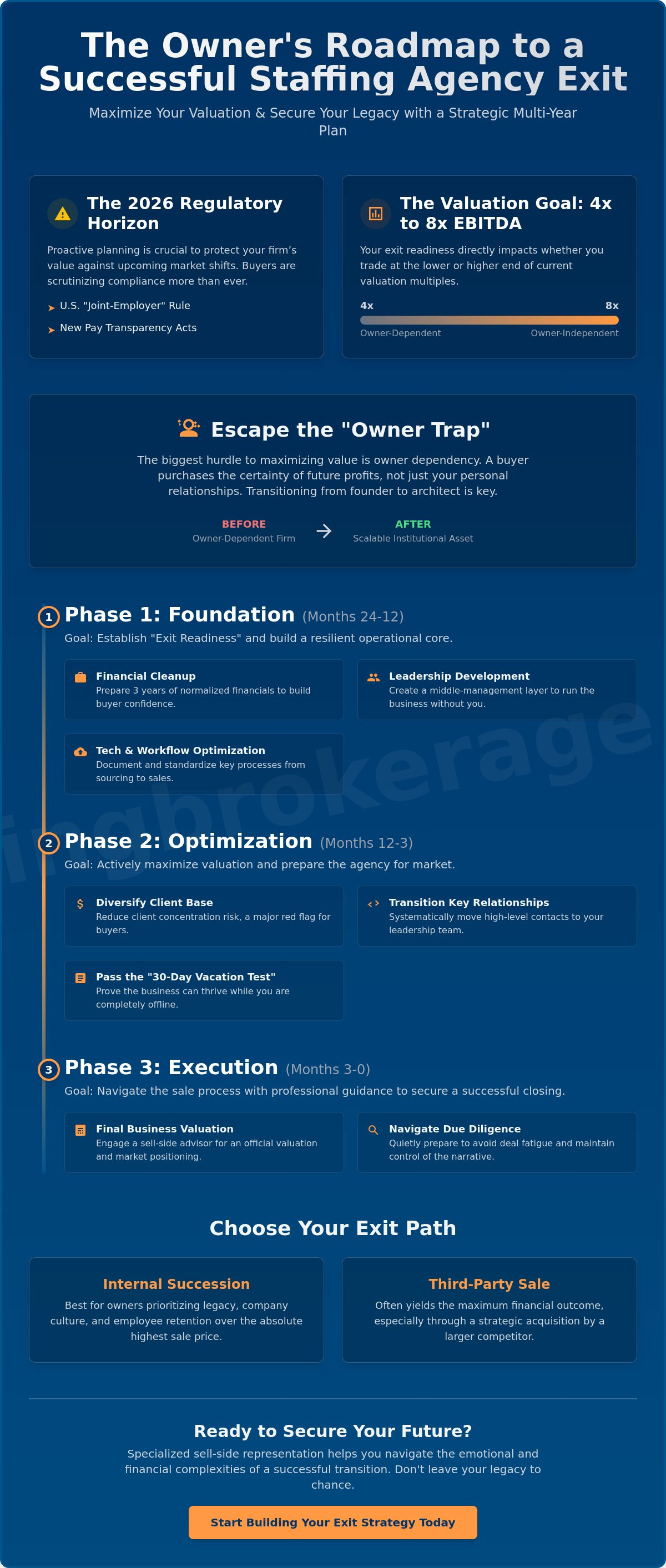
We know it's difficult to step away when so many client relationships depend on your personal touch. You've built something valuable, and you deserve to see that value reflected in a maximized sale price. This guide will show you how to build a multi year plan that addresses the 2026 regulatory landscape, including the new joint employer rules and pay transparency acts. We'll explore how to shift leadership responsibilities and use current 4x to 8x EBITDA valuation multiples to your advantage. You'll gain a clear roadmap to financial security and a business that runs profitably without your daily involvement.
Key Takeaways
- Identify why 2026 market conditions require a proactive approach to transition planning to protect your firm's value.
- Discover how to increase your agency's valuation by escaping the "Owner Trap" and building a self-sustaining leadership team.
- Evaluate the strategic differences between internal succession plans and third-party sales to find the best fit for your legacy.
- Master a 24-month roadmap for your staffing agency exit strategy that focuses on financial audits and tech stack optimization.
- Learn how specialized sell-side representation helps you navigate the emotional and financial complexities of a successful transition.
What is a Staffing Agency Exit Strategy?
A staffing agency exit strategy is a comprehensive, multi-year roadmap that defines how you'll transition out of your recruitment firm while protecting the value you've built. It isn't just a document you file away. It's a living framework that aligns your personal goals with the operational reality of the business. In 2026, the stakes for this planning have never been higher. With the U.S. Department of Labor's "Joint-Employer" rule proposed on April 22, 2026, and new pay transparency laws taking effect, buyers are more scrutinizing than ever. They aren't just looking for revenue; they're looking for compliance, stability, and a business that can survive without its founder.
Understanding the difference between an "exit plan" and "exit readiness" is vital. An exit plan is your intent, the Exit Strategy document itself. Exit readiness, however, is the actual state of your agency. It's the health of your EBITDA, the strength of your middle management, and the cleanliness of your financial records. True readiness means your agency is attractive to a buyer today, even if you don't plan to sell for years. This state of being prepared requires a focus on three key pillars: financial cleanup, leadership development, and clear market positioning.
The Strategic Importance of Early Planning
We often recommend a three-year lead time for a truly seamless transition. This window allows you to optimize your financial performance and potentially push your valuation toward the higher end of the current 4x to 8x EBITDA multiples. Early preparation also helps you avoid "deal fatigue." When a buyer asks for three years of normalized financials or client concentration reports, having them ready creates a sense of confidence. It shows you're a professional partner, not a reactive seller. Quietly preparing behind the scenes ensures you maintain control of the narrative. This protects you from the employee turnover or client anxiety that often follows a rushed, public announcement.
Common Exit Objectives for Staffing Owners
Every owner's journey is unique. Some seek a full divestiture to pursue a new chapter, while others prefer retaining a minority stake to benefit from future growth under new leadership. You might prioritize your legacy and employee retention over the highest possible cash-at-close. For instance, a strategic acquisition by a larger competitor might offer the best price, but a lifestyle exit through an internal management buyout might better preserve the culture you've built. Identifying these objectives early allows us to tailor your business valuation and assessment to match your specific goals. It's about finding the right fit for your future and the future of the team that helped you build the business.
Maximizing Business Value: The Owner-Independent Model
The most significant hurdle in any staffing agency exit strategy is often the owner themselves. We call this the "Owner Trap." If you're the primary point of contact for your top three clients or the only person who knows how to close a major deal, your agency's value is capped. A buyer isn't just purchasing your current cash flow; they're purchasing the certainty that those profits will continue after you've moved on. Transitioning these high-level relationships to a capable team of account managers is a non-negotiable step in maximizing your sale price. Understanding how these operational shifts affect your market price starts with a professional business valuation and assessment.
To move beyond this trap, you must document your specific workflows. Whether it's your candidate sourcing methodology or your sales outreach process, these actions need to be standardized. By creating a middle-management layer that understands these systems, you prove to potential buyers that the business can survive a change in ownership. This layer of leadership acts as a buffer, ensuring that the institutional knowledge remains within the company even after you've exited. Buyers are willing to pay a premium for agencies where the systems, not the founder, drive the results.
Decoupling the Founder from Operations
Start by auditing your daily tasks. If you're still approving every payroll run or interviewing every internal hire, it's time to delegate those responsibilities to a Branch Manager or COO. You can test your progress with the "Vacation Test." If your agency can thrive while you are completely offline for 30 days, you've achieved a high level of exit readiness. Owner-independence is the primary driver of M&A interest because it transforms a person-dependent firm into a scalable, low-risk institutional asset. This shift directly impacts whether you trade at the lower or higher end of the current 4x to 8x EBITDA multiples.
Diversifying Your Client Base
Client concentration is a major red flag during due diligence. We recommend the 20% Rule: no single client should account for more than a fifth of your total revenue. If a major client leaves right after a sale, the buyer's investment is at risk. Beyond just numbers, sector diversification is equally important. While light industrial staffing is stable, balancing it with high-margin verticals like Healthcare or IT can significantly boost your valuation. In the medical niche, for instance, providing candidates with access to specialist resources like Mortgages for Doctors can improve retention and firm value. Ensure your Master Service Agreements (MSAs) are up to date and assignable. Clear, well-documented contracts provide the legal stability buyers need to move forward with confidence.
Succession Planning vs. Third-Party Sale: Choosing Your Path
Deciding who will lead your firm into the future is the most personal step of your staffing agency exit strategy. While many owners equate "exiting" with "selling to the highest bidder," the reality is more nuanced. You have several distinct paths, each with its own financial and emotional weight. Whether you choose an internal handover or a strategic merger, the goal remains the same: ensuring the business you've built continues to thrive while you secure your financial future.
- Internal Succession: This involves selling to key employees or family members through management buyouts or Employee Stock Ownership Plans (ESOPs).
- Strategic Sale: You sell to a larger competitor or a national firm looking to expand into your specific geographic market or niche.
- Financial Sale: Partnering with Private Equity firms allows you to take some chips off the table now while retaining equity for a larger payout down the road.
- Mergers: Combining with a peer-level agency can provide the scale and operational efficiency required to attract top-tier institutional buyers.
Pros and Cons of Internal Transitions
Internal transitions are often the most rewarding for owners who value their company culture. You get to reward the loyal staff who stood by you during growth periods. This path typically allows for a much slower, more comfortable transition period. However, funding can be a hurdle. Most employees don't have the liquid capital for a seven-figure acquisition, which may require you to provide seller financing. For mid-sized firms, an ESOP can be a powerful tool, providing tax advantages and a clear path to ownership for the entire team, provided the firm has the cash flow to support it.
The Strategic Buyer Landscape in 2026
In 2026, national firms are aggressively seeking boutique acquisitions that offer specialized expertise. They aren't just looking for volume; they want agencies that have mastered the current regulatory environment, specifically the April 2026 joint-employer rules and new pay transparency requirements. A strategic buyer might pay a premium over a financial investor because they can immediately cut redundant costs and cross-sell to your client base. It's vital to evaluate the cultural fit during this process. We focus on finding partners who will respect your team's hard work rather than liquidating the staff post-sale. Our Staffing Company Sell-Side Representation is designed to help you weigh these offers and find the perfect match for your legacy.
The 24-Month Roadmap to a Successful Staffing Firm Transition
Executing a successful staffing agency exit strategy requires a disciplined approach to timing. While it's possible to sell a business quickly, a 24 month roadmap allows you to identify and fix operational gaps that would otherwise lead to a lower valuation. This period is about transformation. You aren't just selling a company; you're polishing an asset to ensure it stands out in a competitive 2026 M&A market. By following a chronological plan, you can move from daily operations to a position of strength at the negotiating table.
- Months 24-18: Focus on financial audits and "EBITDA normalization." This involves identifying and removing non-business expenses, such as personal travel or club memberships, to reveal the true profitability of the firm.
- Months 18-12: Direct your energy toward strengthening the management team and upgrading your tech stack. Buyers in 2026 prioritize firms with modern ATS and CRM platforms that provide clean, actionable data.
- Months 12-6: This is the time to engage an M&A advisor to perform a professional business valuation and assessment. Knowing your worth before you hit the market is essential.
- Months 6-0: The final phase involves marketing the firm, vetting potential buyers, and navigating the intense due diligence process.
Phase 1: Financial and Operational Cleanup
Standardizing your financial reporting is the first major hurdle. Most small agencies operate on a "cash basis," but sophisticated buyers expect "accrual basis" accounting. This shift ensures that revenue and expenses are matched in the period they occur, providing a clearer picture of your agency's health. Operationally, you must clean up your "bench." Buyers will scrutinize the quality and turnover rate of your temporary workforce. If your turnover is higher than the industry average, it suggests a lack of engagement or poor matching processes. Additionally, ensure every internal recruiter has signed updated non-compete and non-solicitation clauses to protect the firm's intellectual property during the transition.
Phase 2: Market Engagement and Negotiation
Once your house is in order, we begin the process of finding the right partner. We start with a "Teaser," a one-page anonymous document that generates interest without revealing your identity. If a buyer is interested and signs a Non-Disclosure Agreement, they receive the Confidential Information Memorandum (CIM). This detailed packet tells the full story of your agency's success. In 2026 deals, the Letter of Intent (LOI) often includes complex structures like "Earn-outs" or "Clawbacks." These terms tie a portion of the sale price to the firm's performance over the first 12 to 24 months post-sale. Understanding these nuances is vital to ensuring you actually receive the full value of your hard work.
How Staffing Brokerage Secures Your Legacy and Future
Generalist business brokers often struggle to capture the true value of a recruitment firm because they don't understand the nuances of our industry. They see a spreadsheet; we see the strength of your candidate pool, the stability of your Master Service Agreements, and the long term potential of your niche. A successful staffing agency exit strategy requires more than just a financial transaction. It requires a partner who understands that your agency is a living entity built on years of relationships and trust. Our "Steady Hand" approach ensures we navigate the financial complexities and emotional milestones of M&A with transparency and integrity.
By leveraging our national network of verified buyers, we find the strategic fit that matches your firm's culture and growth potential. We prioritize confidentiality at every stage of the journey. We know that an unmanaged rumor can lead to employee turnover or client anxiety. We protect your staff and your reputation with a methodical, secure process that keeps your transition private until the time is right.
Specialized M&A Advisory for the Recruitment Industry
We calculate your true market value based on current industry-specific multiples, ensuring you don't leave money on the table. Our team understands the specific impact of VMS/MSP contracts and complex billing cycles on your valuation. This expertise allows us to defend your price during tough negotiations. Staffing Brokerage acts as a mentor, not just a broker, providing the strategic guidance you need to feel confident in every decision.
Your Journey from Owner to Accomplished Seller
Your first consultation with us is a professional assessment designed to provide clarity, not pressure. We'll look at your current readiness and help you identify the best path forward. Once the process begins, we handle the heavy lifting of due diligence. This allows you to stay focused on running your business profitably so it remains an attractive asset. We're here to ensure you cross the finish line with your financial security and your legacy intact.
Plan your exit with the experts at Staffing Brokerage.
Your Journey Toward a Successful Transition Starts Now
Building a robust staffing agency exit strategy isn't just about the final sale; it's about creating a business that stands on its own merits. By focusing on owner-independence and following a disciplined 24 month roadmap, you ensure that your agency remains an attractive, high value asset in any market. Whether you choose an internal succession or a strategic sale to a national buyer, the preparation you do today will define the financial security of your tomorrow. This security should extend to personal estate planning; for owners with unique health or professional risk factors, Special Risk Term provides the specialized life insurance solutions needed to protect your family's future.
You don't have to navigate these complex waters alone. Our team of specialized staffing M&A experts provides confidential and honest advisory to help you find the perfect strategic fit through our national reach of verified buyers. We are committed to protecting what you've built while maximizing your return. Take the first step toward a seamless transition today and Get a Professional Valuation of Your Staffing Agency. Your legacy is valuable, and we're here to help you secure it with confidence.
Frequently Asked Questions
When is the best time to start planning my staffing agency exit strategy?
The ideal time to begin planning is three years before your target departure date. This window provides enough time to transition client relationships and optimize your financial records. Starting early ensures you aren't forced into a reactive sale, allowing you to build a leadership team that can sustain the business without your daily presence.
How much is my staffing agency worth in the 2026 market?
Your firm's value depends on your EBITDA, niche specialization, and client diversity. While industry multiples provide a general range, your specific operational health and compliance with recent joint employer regulations will influence the final price. A professional business valuation and assessment is the most reliable way to determine your agency's current market worth.
What is the difference between a strategic buyer and a financial buyer?
Strategic buyers are typically larger competitors looking to expand their geographic reach or service offerings. They often pay a premium because they can eliminate redundant costs. Financial buyers, such as private equity firms, focus on your agency's standalone profitability and growth potential. They often prefer that the owner remains involved for a transition period to ensure continuity.
Can I sell my staffing agency if I am still the main person bringing in sales?
You can sell, but it will likely lead to a lower valuation or a more restrictive earn-out. Buyers view founder-dependent sales as a significant risk. To strengthen your staffing agency exit strategy, you should begin delegating sales responsibilities to account managers at least 18 months before going to market to prove the revenue is portable.
How long does the actual sale process take once I find a buyer?
The process typically takes six to nine months from the initial Letter of Intent to the final closing. This period includes intense due diligence, where the buyer scrutinizes your financials, contracts, and internal processes. Having your documentation organized in advance can significantly speed up this timeline and reduce the risk of deal fatigue for both parties.
What are the biggest mistakes staffing owners make when exiting?
The most common mistakes are waiting too long to plan and having high client concentration. If one client accounts for a large portion of your revenue, buyers will see your firm as a risky investment. Additionally, failing to document your internal workflows makes it difficult for a buyer to feel confident that the business can operate successfully without you.
Do I need to tell my employees that I am planning to sell?
Confidentiality is vital to protect your firm's stability. Most owners wait until a deal is nearly finalized before informing the broader staff to prevent anxiety or turnover. However, it's often necessary to bring a small group of key managers "under the tent" early on to help gather data for due diligence and ensure a smooth leadership transition.
What is an earn-out, and should I accept one in my deal?
An earn-out is a contractual provision where a portion of the purchase price is paid later, contingent on the business hitting specific performance goals. It's a common feature in a staffing agency exit strategy to bridge valuation gaps. You should consider an earn-out if you're confident in your agency's post-sale growth and want to maximize your total payout.