
Healthcare Staffing Agency Acquisition: The 2026 Strategic Resource Guide
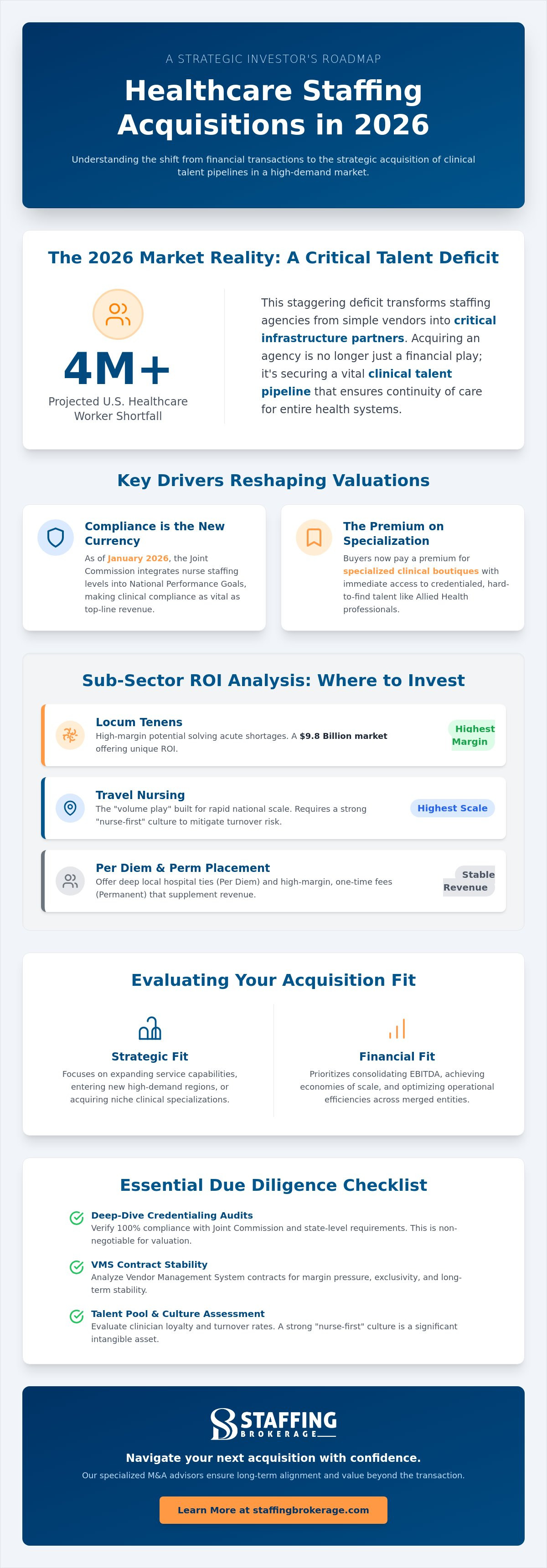
Did you know that as of January 2026, the Joint Commission now officially integrates nurse staffing levels into its National Performance Goals? This shift has transformed what was once a background operational concern into a primary indicator of clinical quality. With the U.S. currently facing a projected shortfall of over 4 million healthcare workers, the stakes for a successful healthcare staffing agency acquisition have never been higher. It's a landscape where clinical compliance is now just as vital to a firm's value as its top-line revenue.
You probably understand that while the demand for specialized talent is surging, the path to a profitable deal is often blocked by complex credentialing requirements and the margin pressures of VMS platforms. It's natural to feel the weight of these technicalities when you are looking for a stable investment. This guide is designed to help you master those complexities with a comprehensive framework for evaluation and strategic alignment. We will provide a clear roadmap for healthcare-specific due diligence, analyze why the $9.8 billion locum tenens market currently offers unique ROI opportunities, and show you how to find a target that fits your long-term vision.
Key Takeaways
- Understand why healthcare staffing remains a resilient, recession-proof investment in 2026 by viewing firms as clinical talent pipelines.
- Compare the high-margin potential of locum tenens against traditional nursing and per diem models to identify the best ROI for your portfolio.
- Master the technical complexities of a healthcare staffing agency acquisition by performing deep-dive credentialing audits and evaluating VMS contract stability.
- Learn to distinguish between a strategic fit that expands your service capabilities and a financial play focused on consolidating EBITDA.
- Discover how a specialized M&A advisor uses strategic matching to ensure long-term alignment and value beyond the initial transaction.
The Landscape of Healthcare Staffing Agency Acquisition in 2026
A healthcare staffing agency acquisition in 2026 is far more than a simple financial transaction. It's the strategic purchase of a clinical talent pipeline. In a year where the U.S. faces a projected shortfall of over 4 million healthcare workers, these agencies serve as the essential bridge between patient needs and provider availability. Understanding what is a healthcare staffing agency reveals its role as a critical infrastructure partner. These firms don't just provide labor; they provide the continuity of care that keeps hospital systems functional. This essential nature makes healthcare staffing a resilient, recession-proof target for investors who value stability and long-term growth.
We've seen a distinct shift in the market recently. Generalist firms are seeing lower multiples, while highly specialized clinical boutiques are commanding a premium. Buyers aren't just looking for revenue. They're looking for immediate access to credentialed talent that is already vetted and ready to work. Building a database of specialized clinicians from scratch can take years of marketing and relationship building. Acquiring an established firm allows you to bypass that timeline and gain an immediate competitive edge in high-demand regions.
The Role of Specialized Talent Pools
Travel Nursing and Locum Tenens pipelines currently represent the most valuable assets in the M&A space. These sectors offer high-margin potential because they solve the most acute staffing shortages. When you evaluate a target, the specialized recruitment team is often your most significant intangible asset. These recruiters have spent years building trust with clinicians who are notoriously difficult to reach. Furthermore, the scarcity of Allied Health professionals, such as respiratory therapists and imaging technicians, has turned these niche pools into primary drivers for 2026 deals. If an agency has a lock on these professionals, its strategic value increases exponentially.
Market Drivers for 2026 Acquisitions
The aging population is no longer a future concern; it's a structural reality driving agency valuations upward. As patient volumes increase, healthcare systems are moving toward "total talent solutions." They want a single partner who can manage diverse staffing needs rather than managing dozens of small contracts. This shift is fueling a wave of consolidation. We've noted that private equity staffing acquisitions are increasingly focused on firms that can offer this kind of comprehensive scale. By aligning with a firm that has strong contract diversity, you position yourself to capture a larger share of a hospital's total spend while mitigating the risks associated with any single clinical specialty.
Key Healthcare Sub-Sectors Driving M&A Value
When planning a healthcare staffing agency acquisition, you'll quickly find that the market is divided into distinct sub-sectors. Each has its own valuation profile. The trend of consolidation in the healthcare industry has made it clear that buyers favor firms with specialized footprints. While travel nursing provides the volume necessary for rapid growth, models like per diem and permanent placement offer different benefits. Per diem agencies often boast deeper local hospital ties. Permanent placement firms provide high-margin, one-time fees that supplement recurring revenue.
Beyond nursing, the focus has shifted toward high-margin niches like specialized surgical staffing. These agencies often command a valuation premium. They provide clinicians for high-revenue hospital departments where precision is non-negotiable. If you're looking for a steady hand to help you navigate these choices, our team at Staffing Brokerage provides expert buy-side advisory to ensure your target aligns with your financial goals.
Nursing Staffing: The Volume Play
Travel nursing agencies are built for scale. They operate on a national level, allowing you to capture market share across multiple states quickly. However, this model carries a risk of high clinician turnover. This can negatively impact your acquisition price if the target lacks a loyal talent pool. When we vet targets, we look for a "nurse-first" culture. Agencies that prioritize the clinician experience tend to have higher retention rates. This stability makes a healthcare staffing agency acquisition much more attractive to long-term investors.
Locum Tenens and Allied Health: The Margin Play
Locum tenens, or physician staffing, is the margin leader in the industry. These firms often command higher revenue multiples because physician bill rates are significantly higher. The complexity of physician credentialing creates a protective moat around these businesses. It's a barrier to entry that rewards established players. Similarly, allied health segments like radiology and physical therapy are experiencing rapid growth in 2026. These niches are less saturated than nursing. They offer excellent opportunities for portfolio diversification and higher overall profitability.
Evaluating Strategic Fit vs. Financial Fit
Success in a healthcare staffing agency acquisition depends on your primary motivation. Are you looking to add new clinical capabilities, or are you aiming for a pure financial play? A strategic acquisition focuses on synergy. It adds specific value, such as a new geographic footprint or a niche clinical service line like radiology or physical therapy. In contrast, a financial acquisition is centered on consolidating EBITDA and identifying cost-cutting opportunities within the back office. Identifying your path early ensures that your search is targeted and your valuation is grounded in reality.
Integration styles vary significantly between these two paths. Strategic buyers often prefer a "light-touch" approach. This preserves the target's unique culture and recruitment "secret sauce." Financial buyers typically lean toward "full absorption." They merge the target into their existing infrastructure to maximize operational efficiency. Current Healthcare M&A Trends suggest that many successful firms are finding a middle ground, prioritizing cultural alignment to prevent talent flight during the transition.
To assess cultural match, we recommend a simple framework. Look at the target's clinician retention rates and internal staff turnover. A firm with high internal stability usually has a leadership style that can survive an acquisition. If the target's culture is built on high-pressure sales and yours is built on supportive partnership, the integration will likely struggle regardless of the financial numbers.
The Strategic Buyer Framework
A strategic buyer looks for targets that fill a specific clinical gap. If your current portfolio is heavy on travel nursing, acquiring a firm with established physician staffing expertise provides immediate diversification. You should also assess the target's existing VMS and MSP relationships. These contracts are the lifeblood of steady revenue. If you're unsure how to vet these complex agreements, our staffing company buy-side advisory can help you identify targets that offer the best strategic alignment for your long-term goals.
Financial Metrics for Healthcare M&A
When evaluating the numbers, you must look beyond top-line revenue. Revenue concentration is a critical risk factor. If a target firm gets 80% of its business from a single hospital system, your investment is vulnerable to that one contract's renewal. You'll also need to scrutinize "add-backs." These are non-recurring expenses that can artificially inflate EBITDA. Finally, analyze the spread between bill rates and pay rates. In 2026, margins are under pressure from VMS platforms. Understanding the specific spread across different specialties helps you predict future profitability and ensure you aren't overpaying for a firm with shrinking margins.
The 2026 Healthcare Staffing Due Diligence Checklist
Moving from high-level valuation to the granular details of a healthcare staffing agency acquisition requires a steady hand and a sharp eye for clinical compliance. While financial health is essential, clinical integrity is what protects your investment from long-term legal exposure. You must verify that the target firm isn't just generating revenue, but is doing so through ethical and compliant placement practices. Credentialing Integrity is the primary safeguard against post-acquisition liability.
Legal compliance in 2026 also demands a thorough check for independent contractor misclassification. If a target firm treats its clinical staff as 1099 workers without meeting strict federal criteria, you could inherit massive tax liabilities and penalties. We also recommend a deep technology assessment of their ATS and CRM systems. You need to ensure data integrity and scalability, especially if you plan to integrate the firm into a larger national platform or use AI-driven matching tools. If you're ready to move forward with confidence, our team provides professional Business Valuation and Assessment services to ensure every technical box is checked before you sign.
Clinical and Regulatory Compliance
Joint Commission (TJC) certification is often the first thing a sophisticated buyer looks for during a healthcare staffing agency acquisition. It signals that the firm has met rigorous national standards for patient safety and clinical quality. For travel nursing agencies, you must also verify compliance with the Nurse Licensure Compact (NLC). This allows nurses to work across state lines without licensing delays, which is critical for maintaining high fill rates. For a broader look at operational risks beyond the clinical scope, you can reference our comprehensive due diligence checklist.
Concentration and Contractual Risks
Risk management in healthcare staffing often starts with the "10% Rule." Ideally, no single hospital or healthcare system should represent more than 10% of the target's total revenue. High client concentration makes the business fragile and vulnerable to contract cancellations. You also need to scrutinize "Change of Control" clauses in existing VMS and MSP agreements. Some contracts allow hospitals to terminate the relationship if the agency is sold. Finally, evaluate the longevity of the recruiter base. These individuals hold the "Intellectual Capital" of the firm. If the recruiters leave after the deal closes, the talent pipeline you just purchased will quickly dry up.
Navigating Your Acquisition with a Specialized M&A Partner
Choosing to move forward with a healthcare staffing agency acquisition is a significant professional milestone. It shouldn't feel like a high-pressure sales process. At Staffing Brokerage, we position ourselves as your strategic guide and dedicated ally. We aren't just here to facilitate a transaction; we are here to ensure that your investment leads to long-term value. Our approach frames the transition as a collaborative journey. We strike a balance between high-level strategic advice and hands-on support, aiming to build trust through a commitment to integrity and precision.
Our process of "Strategic Matching" goes beyond standard financial vetting. We look for deep alignment in organizational culture and clinical standards. This ensures that the agency you buy today remains a high-performing asset tomorrow. We value transparency above all else, focusing on qualitative outcomes that a standard broker might overlook. By prioritizing the human element alongside the financial metrics, we help you secure a firm that fits your specific vision for growth in the national healthcare market.
From Initial Assessment to Deal Closure
We help you develop a personalized acquisition strategy from day one. You'll likely face various emotional and financial hurdles during the negotiation phase. Having an advisor who has seen these patterns before provides the perspective you need to stay focused. We ensure that post-acquisition integration is a primary part of the conversation long before the final papers are signed. This proactive planning is what differentiates a successful transition from a chaotic one. A "Steady Hand" is essential during the final stages of staffing agency deal closure, ensuring that all parties remain aligned as the transaction crosses the finish line.
Why National Expertise Matters
A national network is your greatest advantage when sourcing "off-market" healthcare targets. Many of the most profitable agencies aren't publicly listed for sale. They require a partner who has deep roots in the industry to uncover them. Our expertise prevents you from overpaying for "empty" revenue. This is revenue that looks good on a spreadsheet but lacks the contractual stability or clinical compliance needed to survive a change in ownership. We focus on proven results so that your next healthcare staffing agency acquisition is built on a foundation of growth and ethical conduct.
Ready to take the next step in your investment journey? Partner with Staffing Brokerage for your next healthcare acquisition and let us guide you through the process with confidence and clarity.
Securing Your Future in the Healthcare Market
A successful healthcare staffing agency acquisition requires more than just a look at the balance sheet. It demands a deep commitment to credentialing integrity and a clear understanding of how specialized clinical niches drive long-term value. By focusing on strategic alignment and performing rigorous due diligence on VMS contracts and Joint Commission compliance, you position yourself for sustainable growth in an essential industry. It's about finding a target that doesn't just add revenue, but enhances your clinical reputation.
You don't have to navigate these complex waters alone. Our team at Staffing Brokerage brings years of experience as specialized staffing industry M&A experts. We leverage a national network of qualified buyers and sellers to find the perfect match for your specific goals. With our proven results in strategic deal matching, we act as the steady hand you need to move from initial exploration to a confident closing. We're here to ensure your transition is a collaborative journey built on integrity and mutual success.
Explore Buy-Side Advisory Services with Staffing Brokerage today and let's build your healthcare legacy together.
Frequently Asked Questions
What is the typical EBITDA multiple for a healthcare staffing agency in 2026?
Valuation multiples in 2026 vary significantly based on the size and specialty of the firm. Small, local operators with under $5 million in revenue typically see multiples of 2.5x to 5x EBITDA. Larger national agencies often command multiples between 8x and 12x, while high-growth, niche service providers can reach 10x to 20x EBITDA due to their specialized talent pools.
How does VMS/MSP reliance affect the valuation of a healthcare staffing firm?
High reliance on Vendor Management Systems (VMS) or Managed Service Providers (MSP) usually leads to lower valuations because these platforms often compress profit margins. Buyers look for a healthy balance of direct-to-facility contracts and VMS agreements. A firm with diverse, direct relationships is seen as more stable and less vulnerable to sudden platform policy changes or fee increases.
What are the biggest red flags to look for when buying a clinical staffing agency?
The most significant warning signs include high internal recruiter turnover and disorganized clinical credentialing files. If a firm can't prove 100% compliance with state licensing requirements, you face massive legal risks. Additionally, a healthcare staffing agency acquisition becomes much riskier if a single hospital system represents more than 20% of the total revenue, creating a dangerous concentration of risk.
Is it better to buy a generalist agency or a specialized healthcare boutique?
Specialized boutiques generally offer a better return on investment in the current market. While generalist firms provide higher volume, specialized niches like locum tenens or allied health command higher margins and have deeper competitive moats. These specialized firms often have more loyal clinician databases, which are harder and more expensive for competitors to replicate from scratch.
How long does the healthcare staffing acquisition process usually take?
You should expect the healthcare staffing agency acquisition process to take between six and nine months. This timeline accounts for the initial target sourcing, several rounds of negotiations, and a thorough due diligence period. Clinical audits and the verification of Joint Commission standards often add time to the process compared to acquisitions in other non-regulated industries.
What is the difference between an asset purchase and a stock purchase in staffing M&A?
In an asset purchase, you buy specific items like the clinician database, brand name, and hospital contracts while leaving behind the seller's legal liabilities. A stock purchase involves buying the entire legal entity, including its history and potential hidden debts. Most buyers prefer asset purchases to minimize risk, although sellers often favor stock sales for tax advantages.
How do you handle the transition of clinical staff after an acquisition?
Success depends on maintaining a sense of stability for the clinicians. Communication should be transparent and focus on the benefits of the new partnership, such as better technology or expanded placement opportunities. It's vital to retain the internal recruitment team during this period, as they hold the personal relationships that keep nurses and physicians loyal to the agency.
Does a healthcare staffing agency need Joint Commission certification to be valuable?
While not strictly required, certification adds immense value and serves as a badge of clinical quality. Since the Joint Commission integrated nurse staffing into its 2026 National Performance Goals, hospital systems prioritize partners who meet these rigorous standards. An agency with existing certification is viewed as a "turnkey" investment that is already prepared for high-level clinical partnerships.