
Red Flags When Buying a Staffing Agency: A 2026 Due Diligence Checklist
Would you still sign the purchase agreement if you knew half the revenue was tied to a single client likely to leave next month? It's a question that keeps many entrepreneurs awake at night during an acquisition. You've worked hard to reach this stage, and the last thing you want is to inherit a ticking time bomb of legal liabilities or inflated earnings. Identifying the red flags buying a staffing agency is essential to ensuring your investment creates long-term value rather than immediate headaches.
We know that the due diligence process can feel overwhelming, especially with the 2026 regulatory landscape shifting. You're likely concerned about the Department of Labor's latest joint employer rules or whether the real EBITDA is as solid as it looks on paper. This article provides a clear checklist of the deal-breakers you must identify before closing. You'll learn how to verify client concentration, assess worker classification risks, and evaluate founder dependency. By the end, you'll have the clarity needed to lead a successful transition and achieve the strategic growth you've planned.
Key Takeaways
- Learn how to analyze the true quality of earnings to ensure the reported EBITDA isn't inflated by one-time placements or unrealistic seller add-backs.
- Identify the critical red flags buying a staffing agency, including high founder dependency and a lack of assignability clauses in major client contracts.
- Protect your investment by uncovering hidden legal liabilities like worker misclassification and elevated workers' compensation insurance rates.
- Evaluate internal operational stability by benchmarking recruiter turnover and assessing the depth of the existing management team.
- Gain the confidence to use due diligence findings as strategic leverage during the final stages of the negotiation process to ensure a fair valuation.
Financial Red Flags: Beyond the EBITDA Surface
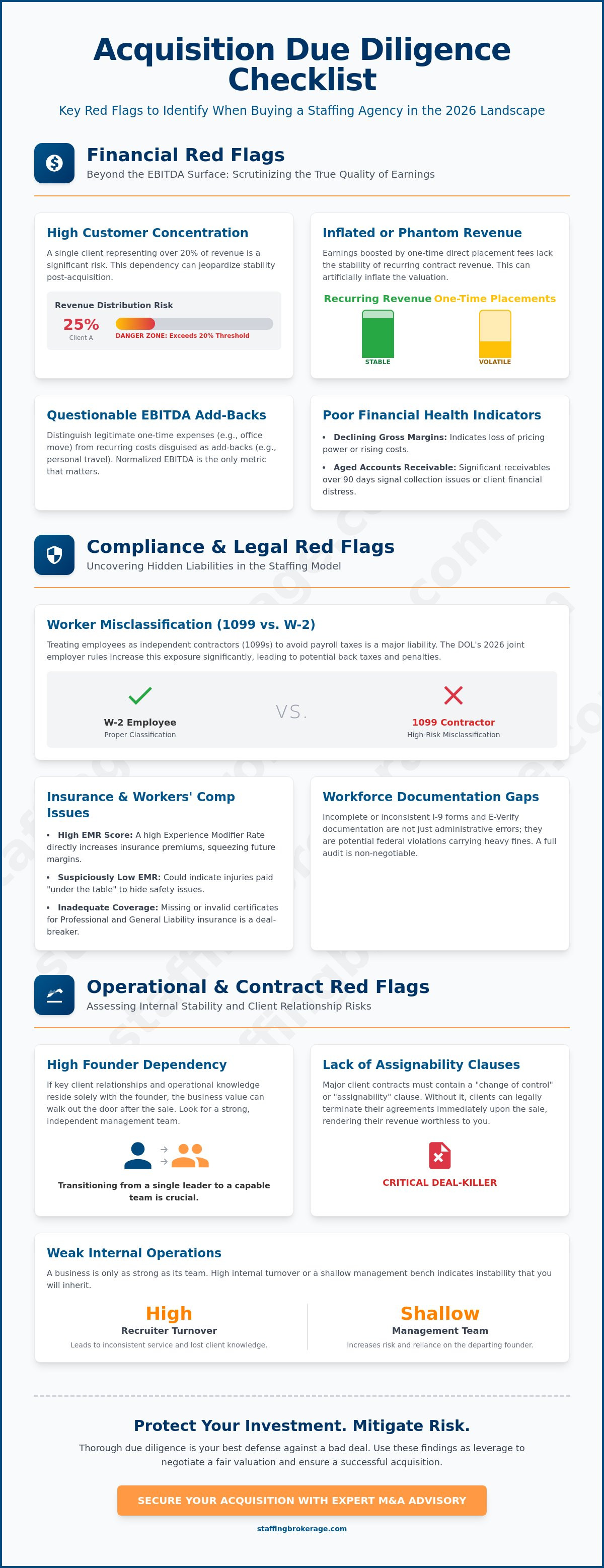
One of the most critical red flags buying a staffing agency is a financial statement that looks too good to be true. While a healthy bottom line is attractive, the quality of those earnings determines the actual value of your acquisition. To understand the core risks, you must first look at the fundamental structure of what is a staffing agency and how it generates its profit. Many firms rely on "phantom revenue" from one-time direct placements. While these fees provide quick cash, they don't offer the stability of recurring contract revenue. If a firm's growth is driven by one-off placements rather than long-term billable hours, the valuation multiple should be adjusted downward.
You should also scrutinize the gross margins of key accounts over at least a three-year period. Declining margins often indicate that the agency is losing pricing power or that labor costs are rising faster than bill rates. This trend is a warning sign that the business model is under pressure. Additionally, verify the accounts receivable aging report. If a significant portion of receivables is over 90 days old, it may suggest poor collections processes or, worse, clients who are struggling to pay. These "hidden" bad debts can quickly erode your post-closing cash flow.
Dangerous Customer Concentration Levels
The 20% rule is a standard benchmark for a reason. If a single client represents a fifth or more of the total revenue, your investment is at the mercy of that client's procurement team. You must assess the "stickiness" of these top-tier accounts. Ask yourself if the relationship is with the agency or specifically with the current owner. Another major red flag involves change of control clauses. Review contracts carefully to see if they allow for immediate termination when the ownership changes. If the top three clients can walk away the moment you sign the deal, the valuation is likely inflated.
Unexplained EBITDA Adjustments and Add-Backs
Sellers often present a list of "add-backs" to justify a higher EBITDA. You must distinguish between legitimate one-time expenses, such as a localized office move, and recurring operational costs. Some owners attempt to mask a struggling business by running excessive personal expenses through the company. While items like a personal vehicle or family travel are common in private firms, they must be meticulously documented to be accepted. Normalized EBITDA is the only metric that matters in 2026 because it strips away non-recurring anomalies to reveal the true cash-generating power of the operation.
Compliance and Legal Red Flags in the Staffing Model
Legal liabilities can be far more damaging than a temporary dip in revenue. While financial books tell you where the company has been, compliance records tell you where it's headed. One of the most dangerous red flags buying a staffing agency involves worker misclassification. The Department of Labor (DOL) issued a Notice of Proposed Rulemaking on April 22, 2026, to establish a single national standard for joint employer status. This proposal significantly increases liability exposure for staffing firms and their clients. If the target agency has been treating workers as independent contractors (1099s) to avoid payroll taxes or benefits, you could inherit a massive bill for back taxes and penalties once the public comment period closes on June 22, 2026.
Verification doesn't stop at tax status. You must audit I-9 forms and E-Verify documentation for the entire workforce. Inconsistencies here aren't just administrative errors; they're potential federal violations that carry heavy fines. Checking for "quiet" DOL investigations is also vital. Sometimes, a seller won't disclose an ongoing inquiry until it becomes a formal lawsuit. Engaging a professional staffing company buy-side advisory partner can help you uncover these hidden risks before they become your legal burden.
Workers' Compensation and Insurance Irregularities
A staffing agency's Experience Modifier Rate (EMR) is a window into its safety culture and future profitability. A high EMR score directly increases insurance premiums, which can squeeze your margins for years. Conversely, be wary of an agency with a suspiciously perfect claims history. This might indicate the seller is paying for injuries "under the table" to keep their EMR artificially low. You should also verify that the agency carries adequate Professional Liability (Errors and Omissions) and General Liability insurance. An inability to produce a valid certificate of insurance is a major warning sign that should stop a deal in its tracks.
Labor Law Compliance and Wage-and-Hour Risks
Wage-and-hour litigation is a growing threat in 2026. You need to look for inconsistencies in how overtime is calculated, especially if the agency operates across state lines. Each state has unique mandates that can lead to class-action lawsuits if ignored. For those looking at healthcare staffing, which is projected to grow at a CAGR of 7.8% through 2034, compliance with specific medical staffing mandates is mandatory. Finally, review non-compete and non-solicitation agreements for the internal recruitment team. If these aren't enforceable or are missing entirely, your key recruiters could leave and take their clients with them the day after the acquisition concludes.
Operational Red Flags: The Founder-Dependency Trap
A staffing firm's value relies on its ability to function without its creator. One of the most overlooked red flags buying a staffing agency is a business model built entirely around a single personality. If the current owner holds the primary relationship with the top five clients, those accounts are at high risk of churning the moment a new face takes over. You aren't just buying a book of business; you're buying a machine that should generate profit regardless of who sits in the corner office. With 35 major staffing transactions recorded in the first quarter of 2026 alone, the market is competitive, and buyers are increasingly prioritizing firms with decentralized leadership.
A mature agency should have a robust Applicant Tracking System (ATS) and CRM data that any trained professional can navigate. If the "data" is mostly stored in the owner's head or a series of unorganized spreadsheets, your transition will be chaotic. You should also look for a solid layer of middle management. A firm with no clear succession plan or branch managers suggests that the owner is micromanaging every placement, which makes the company nearly impossible to scale post-acquisition. Identifying these operational gaps early allows you to adjust your valuation and plan for the necessary infrastructure investments.
The Cult of Personality vs. Scalable Systems
When the owner is the only person capable of closing a new contract, you've found a major operational bottleneck. This lack of a repeatable sales process is a significant risk for any strategic buyer. You need to see documented Standard Operating Procedures (SOPs) for candidate sourcing, vetting, and onboarding. Without these systems, your acquisition multiple will likely drop because the risk of operational failure increases as soon as the founder exits. A business that relies on "gut feeling" rather than data-driven workflows is a liability that won't survive the transition.
Internal Team Attrition and Culture
Internal recruiter turnover is a leading indicator of future client dissatisfaction. If the agency's sales staff is a revolving door, it's a sign of a toxic culture or poor management. This instability often leads to a mass exodus after a sale, leaving you with a brand but no one to run it. Investigating these culture markers is as important as any financial audit. Long-term recruiter tenure directly correlates with higher placement quality and stronger candidate pipeline stability. If the team's average tenure is less than 12 months, you're looking at a significant risk to your future ROI and client retention.
Client and Contract Red Flags: Hidden Deal-Killers
Contracts represent the bridge between the agency's current value and your future success. When evaluating these documents, one of the most significant red flags buying a staffing agency is the absence of "assignability" clauses. If a contract requires explicit client consent to transfer ownership, you risk losing your biggest revenue generators the day you take over. You also need to watch for unusually long payment terms. While Net 30 is standard, terms like Net 90 or Net 120 can place an immense strain on your working capital. This is especially dangerous if you're using debt to finance the acquisition, as your cash flow won't match your debt service requirements.
Another subtle deal-killer is the "hire away" provision. Some contracts allow clients to convert temporary staff to full-time employees after a short period without paying a conversion fee. If this happens frequently, the agency is essentially providing a free recruiting service at the expense of its own billable hours. Before you commit to a purchase, it's wise to ensure these contractual nuances are reflected in the final price through professional negotiating the sale of a staffing agency to protect your investment.
The VMS/MSP Profitability Gap
A portfolio dominated by Vendor Management Systems (VMS) or Managed Service Providers (MSP) often carries hidden risks. While these portals provide high volume, they usually operate on razor-thin margins. This creates a "race to the bottom" pricing environment that devalues the business. You must also assess the risk of losing "Tier 1" status. Many MSP programs re-evaluate their vendors during an ownership change. If you lose that status, your access to job orders could disappear overnight, leaving you with an empty shell of a business.
Restrictive or Unfavorable Legal Clauses
Legal language can hide significant liabilities. Change of control provisions are common, but they become a red flag if they are overly restrictive. You should also look for broad indemnification clauses. These can place undue risk on the staffing agency for actions beyond its control. Finally, evaluate any "no-poach" agreements. If the agency has agreed not to recruit from its largest clients, it could severely limit your future growth strategy in those specific sectors. Understanding these details ensures you are stepping into a partnership based on transparency and mutual success.
Mitigating Risk with Strategic M&A Advisory
Identifying red flags is only the first step. The real value lies in how you use that information to protect your capital and ensure a smooth transition. A specialized staffing company buy-side advisory partner brings the "steady hand" needed to navigate these complexities. While a generalist broker might overlook a high EMR or a lack of assignability clauses, an industry insider knows exactly where to dig. This expertise is vital for verifying multi-state compliance and ensuring that the target agency's operational foundation is as solid as its marketing materials suggest.
When you find red flags buying a staffing agency, they become powerful tools for negotiating the sale of a staffing agency. You don't necessarily have to abandon the deal. Instead, these warning signs allow you to reframe the conversation around risk mitigation and shared responsibility. By addressing these issues early, you can move from a place of anxiety to a place of confidence, turning a potentially risky acquisition into a pillar of your strategic growth.
Turning Red Flags into Deal Structure
Deal structure is your most effective defense against the unknown. If due diligence reveals high client concentration or potential worker misclassification, we can implement earn-outs or holdbacks. These mechanisms protect your investment by linking a portion of the purchase price to the future performance and stability of the firm. A specialized partner also validates the staffing company valuation to ensure the multiple reflects the actual risks discovered. This careful planning ensures that the seller's staffing agency exit strategy aligns perfectly with your goal of long-term value creation.
The Staffing Brokerage Advantage
We see what others miss. Our team understands the subtle markers of a toxic culture or the hidden costs of a poorly managed ATS. We are committed to honest practice and finding a strategic fit that benefits both the buyer and the seller. We don't just facilitate transactions; we build partnerships that last well beyond the closing date. If you're looking for a dedicated guide to help you navigate the acquisition landscape, we're here to help. Ready to grow? Contact Staffing Brokerage for a confidential consultation.
Building Your Future on a Solid Foundation
Acquiring a staffing firm is a significant milestone in your professional journey. Success depends on your ability to look beyond the surface level EBITDA and understand the underlying operational health. By identifying the critical red flags buying a staffing agency, such as high customer concentration or hidden legal liabilities, you position yourself to negotiate from a place of strength. You're not just avoiding a bad deal; you're ensuring that the business you buy today is capable of thriving long after the ink has dried on the purchase agreement.
Navigating these complexities requires more than just a generalist's perspective. You need a partner who understands the nuances of the staffing industry. Our team of specialized staffing M&A experts provides national US coverage and proven results in strategic matching. We're dedicated to helping you find the right fit and ensuring a transparent, ethical process from start to finish. Secure your acquisition with Staffing Brokerage’s buy-side advisory services and take the next step toward your strategic growth with confidence. We're ready to help you turn your vision into a successful reality.
Frequently Asked Questions
What is the most common red flag when buying a staffing agency?
Founder dependency is the most frequent issue we encounter during due diligence. If the current owner is the primary point of contact for the top clients or the only person who can close new business, the firm's value drops significantly. You want to buy a scalable system rather than a personal book of business that might disappear after the transition.
How much customer concentration is too much in a staffing firm?
A single client representing more than 20% of total revenue is generally considered a high-risk concentration level. While large accounts are attractive, losing one can cripple your cash flow and ability to service debt. We look for a diversified client base where no single entity holds enough leverage to dictate your agency's future profitability.
Should I buy a staffing agency that uses 1099 contractors?
You must exercise extreme caution if an agency relies heavily on 1099 contractors for roles that typically require W-2 status. Worker misclassification is one of the most dangerous red flags buying a staffing agency because it leads to significant back taxes and legal penalties. Always verify that the agency's classification practices align with the latest 2026 Department of Labor standards.
What happens to the staffing agency's contracts when the ownership changes?
The fate of your contracts depends entirely on the "assignability" and "change of control" clauses within each agreement. Some contracts transfer automatically, while others require explicit written consent from the client before the sale. Identifying these requirements early prevents a situation where your most valuable accounts terminate their agreements the day you take over the business.
How do I verify the EBITDA of a privately held staffing company?
A professional Quality of Earnings (QoE) report is the standard method for verifying financial health. This deep dive looks beyond the tax returns to identify "phantom" revenue and ensure that seller add-backs are legitimate one-time expenses. Verifying normalized EBITDA ensures you aren't paying a premium for inflated numbers that don't reflect the true cash flow of the operation.
Is high recruiter turnover always a deal-breaker?
High turnover isn't always a deal-breaker, but it's a leading indicator of underlying cultural or operational problems. If the internal team is a revolving door, your candidate pipelines and client relationships will suffer. We compare these rates against 2026 industry benchmarks to determine if the turnover is a localized management issue or a broader systemic failure.
How long does the due diligence process typically take for a staffing acquisition?
The due diligence process for a staffing acquisition typically takes between 60 and 90 days. This timeline allows for a thorough review of financial records, legal compliance, and operational workflows. Moving too quickly can lead to missing critical red flags, while a methodical pace ensures you feel informed and confident before signing the final deal.
Can a staffing agency be sold if it has an open Department of Labor audit?
Yes, an agency can be sold with an open audit, but it usually requires a significant holdback or an escrow account to cover potential liabilities. This situation is a major red flag that requires expert buy-side advisory to manage. Buyers must ensure the purchase agreement includes strong indemnification clauses to protect against any findings from the investigation.


