
Finalising the Handover: A 2026 Guide to Staffing Agency Deal Closure
The most dangerous moment in a business transaction isn't the initial negotiation. It is the final seventy-two hours before the ink is dry. You have spent years building your firm's reputation, and now that the finish line is in sight, it's natural to feel a mix of excitement and anxiety about the staffing agency deal closure. Many founders find themselves overwhelmed by the sudden surge of legal documentation or the fear of a last-minute collapse, but this final phase doesn't have to be a source of stress.
We believe that a successful sale should feel like a collaborative journey rather than a high-pressure hurdle. This guide provides the tactical steps you need to manage momentum and ensure your sale reaches completion without unnecessary delays. We will explore how to secure full funding through 2026’s common hybrid payment structures and how to maintain staff and client stability during the transition. By following this methodical approach, you can move toward your next chapter with a sense of shared accomplishment and total confidence.
Key Takeaways
- Master the tactical steps of a staffing agency deal closure to ensure legal ownership transfers and funds are disbursed without 11th-hour delays.
- Understand how the choice between an asset or stock sale impacts your final closing checklist and long-term liabilities.
- Learn the specific steps to protect your VMS and MSP contracts to ensure a seamless revenue transition on day one.
- Discover how to maintain momentum when deal fatigue sets in or when unexpected findings emerge during the final due diligence review.
- Find out how a professional advisor coordinates the complex flow of information between legal and financial teams to reach the finish line.
What Does Staffing Agency Deal Closure Actually Involve?
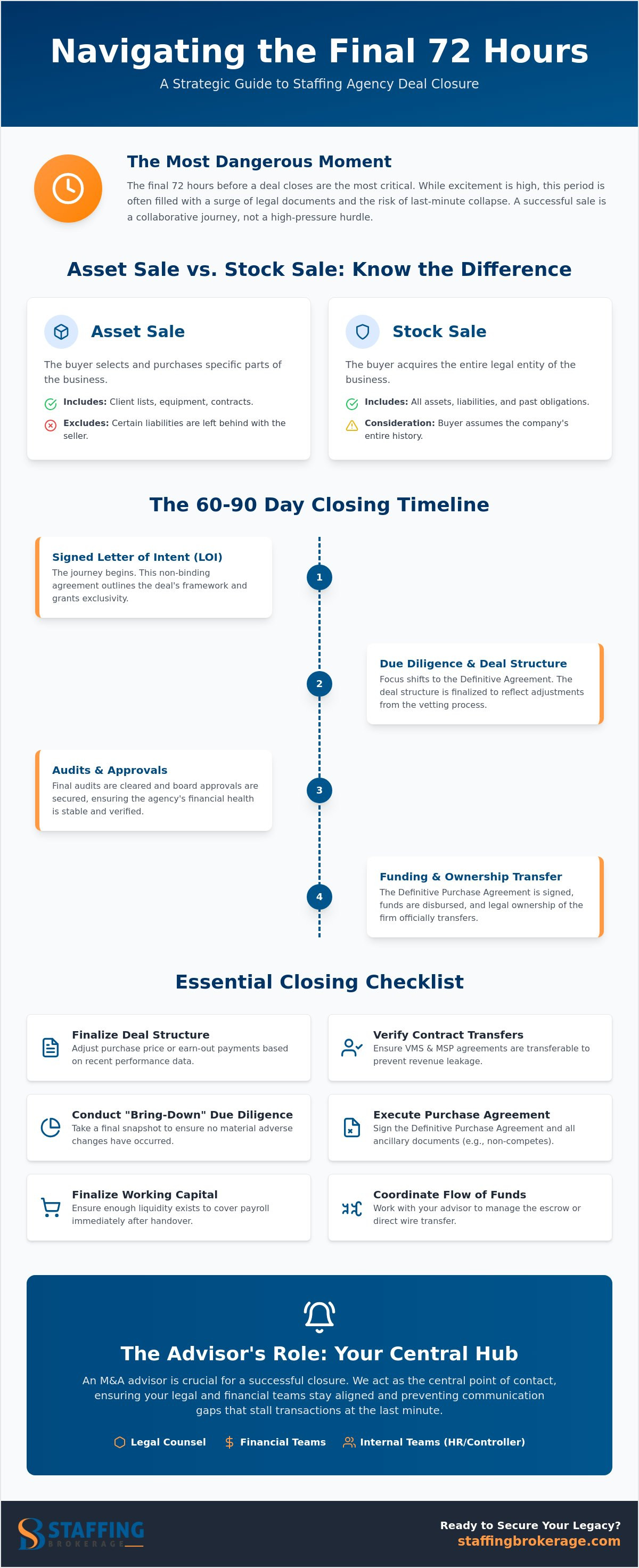
A staffing agency deal closure is more than just a formal handshake. It's the technical climax of the mergers and acquisitions process, where the vision of a sale transforms into a legal and financial reality. During this phase, ownership of the firm officially transfers from the seller to the buyer, and the purchase price is disbursed according to the agreed terms.
Understanding whether you are entering an asset sale or a stock sale is vital for a successful staffing agency deal closure. In an asset sale, the buyer selects specific parts of the business, such as client lists and equipment, while leaving certain liabilities behind. A stock sale involves the buyer acquiring the entire legal entity, including all past obligations. The final thirty days are often the most volatile period of the entire transaction. Emotions run high; both parties must maintain a "business as usual" approach to ensure the agency's value doesn't dip while legal teams finalize the details. If productivity slips during this window, it can create friction or lead to price renegotiations just before the finish line.
Achieving a clean break requires more than just technical precision; it requires a commitment to transparency from both sides. When a seller remains focused on daily operations, it signals to the buyer that the agency is a stable, well-oiled machine. This stability is the bedrock of a smooth handover. It allows the legal and financial teams to work through the complexities of the transfer without the distraction of declining performance or sudden staff turnover.
The Closing Timeline: From LOI to Funding
The journey from a signed Letter of Intent (LOI) to final funding involves several milestones. In the 2026 staffing market, this phase typically lasts 60 to 90 days. The focus shifts to the Definitive Agreement. You must finalize the staffing company deal structure to reflect any adjustments from due diligence. This includes clearing audits and board approvals to ensure the agency’s financial health remains stable.
Key Stakeholders in the Closing Room
Closing a deal requires a synchronized team. While M&A advisors and legal counsel handle the mechanics, your internal controller and HR lead are indispensable for providing ground-level data. At Staffing Brokerage, we act as the central hub for these communications. We ensure your legal and financial teams stay aligned, preventing the communication gaps that often stall transactions at the last minute.
A Step-by-Step Checklist for Closing Your Staffing M&A Deal
Closing a transaction requires a steady hand and a meticulous eye for detail. As you approach the final stages of a staffing agency deal closure, the focus shifts from high-level strategy to the granular execution of the agreement. This is where the preparation from previous months pays off. You'll need to finalize the staffing company deal structure to account for any final adjustments found during the vetting process. These adjustments often involve small shifts in the purchase price or the timing of earn-out payments based on recent performance data.
In the staffing world, your value is tied to your contracts. Verifying the transferability of Vendor Management System (VMS) and Managed Service Provider (MSP) agreements is a critical step that often gets overlooked. Some contracts require explicit consent for a change of control; missing this can lead to revenue leakage on day one. Before the final wire is sent, parties typically conduct "bring-down" due diligence. This is a final snapshot to ensure no material adverse changes have occurred since the initial audit. It’s a standard procedure that provides peace of mind for the buyer and protects the seller’s integrity.
The final step involves executing the Definitive Purchase Agreement along with all ancillary documents. These include non-compete clauses, employment agreements for key staff, and the formal bill of sale. Once the signatures are gathered, your advisor will coordinate the flow of funds through escrow or a direct wire transfer, ensuring every dollar is accounted for before the keys are handed over.
Financial and Data Reconciliation
Success lives in the numbers. You must finalize the working capital peg, ensuring there is enough liquidity to cover payroll for your contractors immediately following the handover. Simultaneously, your team should scrub the Applicant Tracking System (ATS) to ensure all candidate data is compliant and ready for a secure digital transfer. Auditing open job orders and active placements ensures the buyer has an accurate view of the immediate revenue pipeline.
Legal and Compliance Verification
Legal loose ends can unravel a deal. Double-check for "change of control" clauses in your top five client contracts to prevent service interruptions. You’ll also need to verify worker's compensation insurance tail coverage and E&O policies to protect against historical claims. Securing the necessary state and federal regulatory filings is the final hurdle to a clean ownership transition. If you're feeling overwhelmed by these moving parts, our team at Staffing Brokerage can help you manage the checklist with precision to ensure a successful staffing agency deal closure.
Managing the Closing Gap: Common Obstacles to Finalizing the Sale
The period between signing a Letter of Intent and the final staffing agency deal closure is often referred to as "the gap." It is a high-stakes window where the initial excitement of the deal meets the grueling reality of technical execution. During this time, momentum is your most valuable asset. If the process slows down, doubts can creep in, and the risk of the deal collapsing increases. Understanding the common hurdles that arise during this phase allows you to prepare for them with a steady hand and a clear strategy.
Deal fatigue is one of the most frequent obstacles. After months of intense negotiation and data sharing, both buyers and sellers can become exhausted by the endless requests for documentation. This exhaustion can lead to sloppy mistakes or a lack of responsiveness that stalls the transaction. Another common hurdle is the "Diligence Discovery" trap. This happens when a final audit or a deep dive into records reveals an unexpected liability, such as an overlooked tax filing or a pending worker's compensation claim. Managing these discoveries without killing the deal requires transparency and a focus on collaborative problem-solving rather than finger-pointing.
External factors also play a role. Market shifts or sudden regulatory changes in 2026 can cause a buyer to hesitate or attempt to renegotiate the valuation. Similarly, third-party consent delays from landlords, software vendors, or VMS providers can add weeks to your timeline. These parties don't share your sense of urgency, so proactive follow-up is essential to keep the project on track.
Handling Red Flags Late in the Game
If a buyer identifies concerns late in the process, it's helpful to reference known red flags buying a staffing agency to understand their perspective. To keep the deal moving, you can use tactical tools like escrow holdbacks. This involves setting aside a portion of the purchase price to cover specific, unresolved liabilities. If a valuation gap emerges due to a late discovery, consider offering seller financing or adjusting the earn-out structure rather than walking away from the table. These flexible solutions show a commitment to mutual success.
Maintaining Closing Momentum
To prevent the process from dragging on, set firm "Drop Dead" dates for key milestones. These deadlines encourage all parties to prioritize the transaction. Using a centralized "Closing Tracker" shared by both legal teams ensures that everyone has visibility into what is finished and what remains outstanding. A specialized advisor prevents deal-stalling by anticipating friction points and maintaining a steady rhythm of proactive communication between all professional firms involved in the staffing agency deal closure.
Documentation Essentials: From LOI to Funded Transaction
Documentation turns a conceptual handshake into a binding reality. The Disclosure Schedule is often the most time-consuming part of a staffing agency deal closure because it serves as the official record of your firm's health. This document qualifies the broad promises you make to the buyer. For example, if you state that the agency has no pending legal issues, the schedule must list the minor worker's compensation claim currently in mediation. Accuracy here is vital to prevent post-close disputes and build a foundation of trust with the new owners.
Moving the assets requires a formal Bill of Sale and Assignment of Leases. This covers the physical transfer of office equipment and the digital handover of your proprietary candidate database and ATS logins. You'll also need to finalize employment agreements for your key recruiters and managers. Securing your internal team post-close ensures the buyer that the agency’s operational "secret sauce" remains intact, which is often a prerequisite for releasing the full purchase price.
Before the final wire is sent, all parties must approve the Funds Flow Memo. This document acts as a precise map of where every dollar goes at the exact moment of closing. It accounts for debt payoffs, advisor fees, and the net proceeds arriving in your bank account. It ensures there are no surprises when the transaction is finally funded, allowing you to celebrate the completion of your journey with total peace of mind.
The Definitive Purchase Agreement (DPA)
At the heart of the transaction sits the DPA. This document contains "Representations and Warranties," which are your formal statements about the business’s financial and legal standing. Indemnification clauses then define your level of liability if those statements prove inaccurate after the sale. Because staffing involves unique risks like worker misclassification or state-specific pay equity laws, negotiating the sale of a staffing agency requires industry-specific legal expertise to protect your long-term interests.
Ancillary Closing Documents
Beyond the main agreement, several ancillary documents are required to complete the handover. Non-compete and non-solicitation agreements protect the buyer's investment by ensuring you don't immediately open a rival firm. If you plan to assist with the transition, a Transition Service Agreement (TSA) outlines your consulting role and compensation for the following months. Finally, corporate resolutions and Secretary’s Certificates provide the legal proof that your company’s leadership has officially authorized the sale. For those who require expert counsel to navigate these business law complexities, learn more about Matthew Fornaro, P.A.
If you're ready to prepare your firm for a smooth transition, contact Staffing Brokerage for professional sell-side representation.
The Role of an M&A Advisor in Securing a Successful Closure
The final days of a staffing agency deal closure are often the most emotionally charged part of the entire transaction. You have spent years building your business, and as the finish line approaches, the pressure to get every detail right can feel overwhelming. An experienced M&A advisor acts as a vital buffer between you and the buyer during these high-stress negotiations. By maintaining a objective perspective, they prevent minor disagreements from escalating into deal-breaking conflicts, ensuring that the collaborative spirit of the journey remains intact.
Coordinating a sale involves managing a complex web of communication. It's common to have five or more professional firms involved, including legal counsel, tax specialists, and internal accounting teams from both sides. Your advisor serves as the central project manager, keeping everyone aligned and ensuring that information flows smoothly without creating bottlenecks. When a last-minute financial hurdle appears, such as a discrepancy in working capital, a specialized advisor finds creative structural solutions that satisfy both parties rather than letting the momentum stall.
Beyond the technicalities, a dedicated advisor verifies that the deal closure sets the stage for your agency's long-term growth under new ownership. They aren't just looking for a signature; they're looking for a strategic fit that honors your legacy. This steady hand approach builds trust and provides the transparency needed to move through the final hours with total confidence.
Why Specialized Staffing Expertise Matters
Staffing firms have unique financial fingerprints that general business brokers often overlook. A specialized advisor understands the nuances of unbilled revenue and accrued payroll, ensuring these are accurately reflected in the final funds flow memo. This precision prevents you from leaving money on the table or facing post-close adjustments. Additionally, an industry expert knows how to maintain strict confidentiality until the very moment of closure, protecting your internal culture and client relationships from premature rumors.
- Accurate Valuation: Ensuring recruiter commissions and contractor liabilities are properly accounted for.
- Confidentiality: Managing the timing of staff announcements to ensure a stable transition.
- Industry Insight: Navigating specific 2026 regulations like the California SAFE Act or EU AI Act.
Your Partner for a Seamless Transition
At Staffing Brokerage, we believe in being more than just a service provider; we're your partner in this milestone. Our team supports owners from the initial business assessment through to the final wire transfer. We bring a calm, experienced perspective to high-stakes business transitions, focusing on ethical conduct and mutual success. We're here to handle the heavy lifting of the closing process so you can focus on leading your team through the change.
Ready to cross the finish line? Contact Staffing Brokerage for expert M&A guidance and let us help you secure the future you've worked so hard to build.
Securing Your Legacy with a Successful Handover
Reaching the final stage of a business sale is a profound milestone that requires both tactical precision and emotional resilience. You have learned that a successful staffing agency deal closure depends on meticulous documentation, from the transparency of your Disclosure Schedules to the clarity of your final Funds Flow Memo. By anticipating common hurdles like deal fatigue and third-party consent delays, you can maintain the momentum necessary to cross the threshold with confidence and clarity.
Transitioning your firm is a collaborative journey that deserves a steady, experienced hand. Staffing Brokerage brings specialized staffing industry M&A expertise and a proven track record of strategic deal closures to every partnership. We offer a national reach combined with the personalized advisory you need to protect your long-term value and ensure a seamless ownership transfer. When you are ready to take this final step, secure your staffing agency's future with Staffing Brokerage. Your hard work has built a lasting legacy; let's ensure its next chapter begins with the stability and success you deserve.
Frequently Asked Questions
What is the most common reason a staffing agency deal fails to close at the last minute?
Most deals fail at the finish line because of deal fatigue or unexpected findings during final due diligence. When negotiations drag on for months, parties can lose focus or become frustrated by repetitive requests. Discovering an undisclosed liability, such as a pending worker's compensation claim or an unfiled tax return, can also shatter trust. Maintaining transparency throughout the process is the best way to prevent these 11th-hour collapses.
How are candidate databases and ATS records legally transferred during a sale?
These assets are typically transferred through a formal Bill of Sale and an Assignment of Services agreement. You will provide the buyer with administrative credentials for your Applicant Tracking System and any proprietary databases. It's essential to ensure the transfer complies with data privacy laws by scrubbing sensitive data before the handover. This ensures the buyer receives a clean, compliant database that is ready for immediate use.
What happens to active temporary workers and their contracts on the day of closing?
In a stock sale, workers remain employed by the same legal entity, so their contracts continue without interruption. If you are executing an asset sale, the buyer must hire the workers and accept the assignment of their existing contracts. This requires careful coordination between your HR team and the buyer's team. You must ensure that payroll isn't delayed and that insurance coverage remains continuous during the transition.
How is the final purchase price adjusted for working capital in a staffing firm?
The purchase price is adjusted based on a working capital peg agreed upon during the Letter of Intent phase. Since staffing firms have high unbilled revenue and accrued payroll, the buyer compares the actual working capital at the time of the staffing agency deal closure against that peg. If your actual capital is higher, you'll receive an upward adjustment; if it's lower, the purchase price decreases accordingly.
Do I need to notify my clients before the deal is officially closed?
You generally don't notify clients until the deal is finalized to maintain confidentiality and prevent competitors from poaching accounts. However, you must check your top contracts for change of control clauses. If a major client requires prior consent for an ownership change, you'll need to coordinate that notification carefully with the buyer. This prevents you from breaching your service agreements while protecting the agency's reputation.
What is a 'holdback' and why is it common in staffing agency M&A?
A holdback is a portion of the purchase price placed in escrow for a set period, often twelve to twenty-four months. It's common in staffing agency deal closure because it protects the buyer against hidden liabilities like worker misclassification claims. If no claims arise during the holdback period, the funds are released to you with interest. This structure provides the buyer with peace of mind while securing your final payout.
How long does it take for funds to be disbursed after the final signatures?
Funds are typically disbursed via wire transfer on the same day the final signatures are collected. Once the closing agent confirms all documents are in order, they initiate the wires according to the approved Funds Flow Memo. While most owners see the funds in their account within a few hours, bank cut-off times might push the arrival to the next business day. It's a quick process once the paperwork is complete.
Can a buyer back out after signing the Definitive Purchase Agreement?
It's very difficult for a buyer to back out once the Definitive Purchase Agreement is signed. Most agreements include Material Adverse Change clauses that allow a buyer to walk away only if the business suffers a catastrophic event. Backing out without a contractually valid reason usually leads to significant legal penalties or the loss of their earnest money deposit. Once you reach this stage, both parties are legally committed to the sale.