
Staffing Company Deal Structure: A Strategic Guide to M&A Transactions in 2026
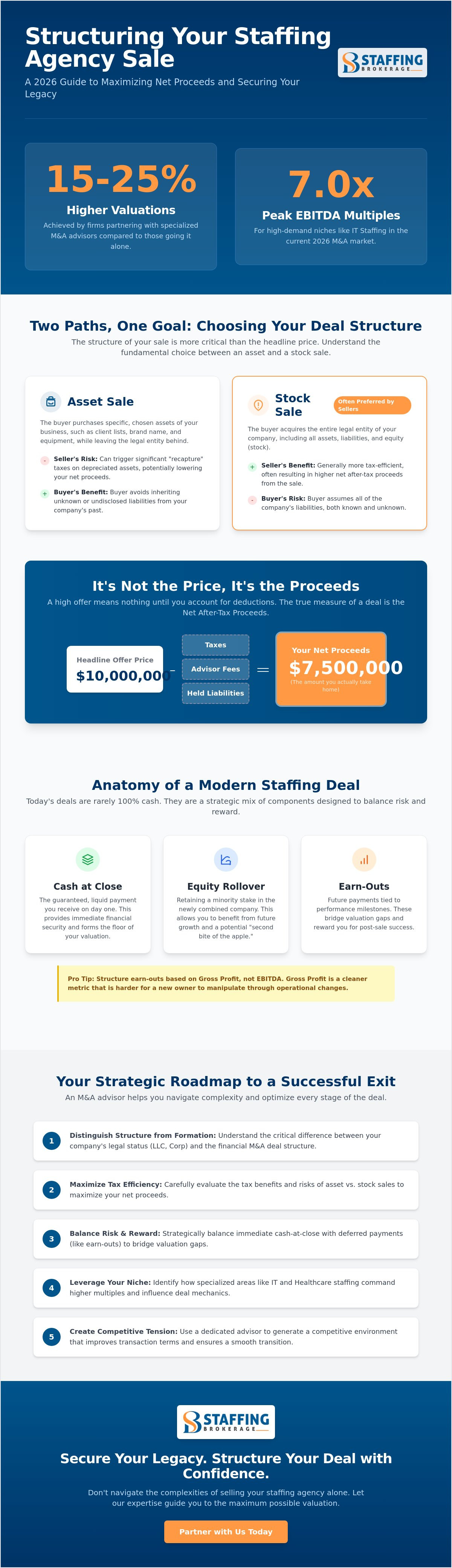
Did you know that staffing firms partnering with specialized M&A advisors often achieve valuations 15% to 25% higher than those who navigate the process alone? In a 2026 market where IT staffing multiples are reaching up to 7.0x EBITDA, the specific staffing company deal structure you choose makes the difference between a standard exit and a truly transformative windfall. We recognize the weight of this decision. It's natural to feel some anxiety about complex earn-out clauses or the long-term tax consequences of an asset versus stock sale. You've worked hard to build your agency, and you want to ensure your employees are cared for while your professional legacy remains secure.
We're here to help you turn that uncertainty into a clear, strategic advantage. You'll gain a firm grasp on the mechanics of cash-at-close versus deferred payments, giving you the confidence to protect your interests during every stage of negotiation. This guide offers a practical roadmap for a successful deal closure, exploring how current trends like AI integration and global consolidation are shaping buyer behavior this year. Let's move forward together to ensure your transaction is structured for the maximum value and stability you deserve.
Key Takeaways
- Distinguish between your firm's legal formation and the actual financial terms of the sale to ensure you're negotiating from a position of strength.
- Evaluate the tax benefits and risks of asset versus stock sales to select a staffing company deal structure that maximizes your net proceeds.
- Learn to balance immediate cash-at-close with deferred payments like seller notes to bridge valuation gaps while minimizing your long-term risk.
- Identify how specialized niches like IT or Healthcare staffing influence your deal mechanics and command higher multiples in the 2026 market.
- See how a dedicated M&A advisor uses competitive tension to improve your transaction terms and ensure a smooth transition for your employees and legacy.
Defining Staffing Company Deal Structure: M&A vs. Legal Formation
When you start thinking about selling your agency, it's easy to get caught up in the legal labels you've lived with for years. You might focus on whether you are an LLC or a C-Corp. While those entities matter for your daily operations, they are not the same as your staffing company deal structure during a sale. In the 2026 market, deal structure refers specifically to the financial and legal mechanics that dictate how a buyer pays you and what exactly they are buying. This is a critical distinction to make early in your journey.
Understanding Mergers and acquisitions (M&A) requires looking past the name on the door. You have two primary paths: an asset sale or a stock sale. In an asset sale, the buyer picks specific parts of your business, like your client contracts or your brand. In a stock sale, they buy the entire legal entity. Each path has different consequences for your taxes and your future liability. Choosing the wrong one can lead to unexpected costs that eat into your hard-earned equity. We believe in providing a steady hand to help you navigate these choices with clarity.
Why Transactional Structure Trumps Price
A high headline price looks great on a press release, but it doesn't always put the most money in your pocket. Deal structure is the blueprint for transferring ownership, risk, and value. If a buyer offers a massive price but insists on an asset sale that triggers heavy "recapture" taxes, you might actually walk away with less than you would from a lower-priced stock sale. You must focus on Net After-Tax Proceeds. This metric represents the actual cash that stays in your bank account after the government and the advisors take their share. We've seen many sellers get blinded by a big number, only to realize too late that the terms were designed to shift all the risk onto their shoulders. It's about the quality of the deal, not just the quantity.
The 2026 Staffing M&A Landscape
The market in 2026 is defined by what experts call "cautious optimism." While transaction volume is rebounding, buyers are more focused on risk mitigation than they were a few years ago. This shift has changed how deals are built. We're seeing a move away from 100% cash deals toward a mix of cash at close and deferred payments. In professional and IT staffing, where multiples are currently reaching up to 7.0x EBITDA, buyers are using more sophisticated earn-out structures. These clauses protect the buyer if your revenue dips after the sale, but they also offer you a chance to earn a premium if your agency continues to grow. For owners looking to secure the growth capital necessary to hit these performance milestones, visit Legacy Funding Advisors for fast and flexible funding solutions. It's a collaborative way to bridge the gap between what you believe your business is worth and what a buyer is willing to guarantee today.
The Core Components of an M&A Transaction Structure
Every successful staffing company deal structure relies on a delicate balance between risk and reward. It isn't just about the check you receive on day one; it's a strategic combination of immediate liquidity and future potential. The SBA guide to merging and acquiring businesses highlights that understanding these mechanics is vital for any entrepreneur looking to exit. While the headline price gets the attention, the components below determine how much you actually keep and how much risk you carry forward.
- Cash at Close: This is the immediate liquidity that sets the "floor" for the deal. It provides the financial security you need to move toward your next chapter with peace of mind.
- Equity Rollover: Some sellers choose to keep "skin in the game" by retaining a portion of ownership in the new entity. This allows you to participate in the future growth of the combined company.
- Working Capital Adjustments: This mechanism ensures the business has enough operational fuel at the moment of transfer. If your accounts receivable are higher than the agreed target, the final payout increases.
Mastering the Earn-Out Mechanism
Earn-outs have become a staple in 2026 to bridge valuation gaps, particularly for high-growth IT staffing firms aiming for those 7.0x EBITDA multiples. These are performance-based payments tied to specific milestones over a set period. We recommend setting targets based on Gross Profit rather than EBITDA. Gross Profit is harder for a buyer to influence through corporate overhead or internal accounting shifts. To protect yourself, ensure the contract includes "accelerated payout" clauses if the buyer decides to sell the company again before your earn-out period ends. This keeps your interests aligned with the new owners while rewarding your agency's continued success.
The Role of Seller Financing (Seller Notes)
A seller note, or "seller carry," functions as a loan you provide to the buyer to help fund the purchase. In the current market, these notes often feature market-competitive interest rates with repayment terms spanning several years. Buyers prefer this because it acts as an "indemnity holdback," giving them a way to offset payments if undisclosed liabilities surface after the sale. For the seller, it's a way to earn interest while potentially spreading out the tax obligation over time. If you're wondering how this might impact your final take-home, a professional business valuation and assessment can provide the clarity you need to negotiate with confidence.
Asset Sale vs. Stock Sale: Choosing the Right Path
Choosing between an asset sale and a stock sale isn't just a legal technicality; it's a pivotal decision that shapes your financial future. This choice represents a core pillar of your staffing company deal structure. It dictates how your hard-earned equity is taxed and how liabilities are managed after the keys are handed over. We believe in approaching this choice as a collaborative effort to find the most efficient path for both parties.
In an asset sale, the buyer selects specific items to purchase, such as client lists, high-performing internal teams, or proprietary software. Buyers generally prefer this because it allows for a "step-up in basis." This means they can re-value the assets at the current purchase price and begin depreciating them again. This provides a significant tax shield for their future earnings. Conversely, a stock sale involves the transfer of the entire legal entity. For the seller, this is often the cleanest exit, as it typically qualifies for favorable capital gains treatment and transfers the business in its entirety.
The Seller's Perspective: Maximizing After-Tax Cash
Most sellers lean toward stock sales to maximize the cash that actually hits their bank account. If your agency is a C-Corp, an asset sale can trigger a "double taxation" event. The government taxes the corporation on the sale of the assets, and then taxes you again when you distribute those funds to yourself. We work with our clients to evaluate these risks early in the process. If a buyer insists on an asset purchase to gain their own tax advantages, you don't have to simply accept a lower net return. You can negotiate a "tax gross-up," which is an adjustment to the purchase price that covers your additional tax liability. This ensures the deal remains fair and reflects the true value of what you've built.
The Buyer's Perspective: Mitigating Hidden Risks
From the other side of the table, buyers are often wary of "successor liability." In a stock transaction, they inherit the company's entire history, including every past mistake, from payroll errors to old legal disputes. By opting for an asset deal, they can pick and choose what they take on, effectively leaving those historical risks behind. They also benefit from the ability to re-depreciate the acquired assets, which improves their cash flow in the years following the acquisition. For those looking to grow through acquisition, our staffing company buy-side advisory offers deeper insights into how buyers use these structures to protect their investments and ensure a strategic fit.
Niche-Specific Structuring: IT, Healthcare, and Industrial
Your niche defines your risk, and your risk defines your staffing company deal structure. While the core mechanics of cash and earn-outs remain consistent across the industry, the way they are weighted changes significantly based on your specific sector. High-margin firms often command more aggressive structures because their revenue is seen as more defensible. For instance, staffing firms with gross margins above 25-30% currently receive a valuation premium because they demonstrate a level of specialization that buyers find attractive in the 2026 market.
IT and Professional Services Deals
IT and professional services transactions are leading the current M&A wave, accounting for 46% of deal volume in the first quarter of 2026. With EBITDA multiples for high-growth IT firms reaching up to 7.0x, buyers are looking for "stickiness" in the client base. If your revenue flows through Vendor Management Systems (VMS) or Managed Service Provider (MSP) contracts, buyers will closely examine the stability of those agreements. If you are selling an engineering staffing firm, the specialized nature of your talent pool can lead to higher cash-at-close percentages. This is because the high barriers to entry for competitors make your agency a more stable investment.
Healthcare and Clinical Staffing Nuances
Healthcare transactions require a focused approach to credentialing and regulatory compliance. Buyers often distinguish between "travel nurse" revenue, which can be volatile, and "per diem" revenue, which offers more local stability. Because of reimbursement shifts and policy changes, these deals often feature longer earn-out periods. This structure allows the buyer to ensure revenue levels remain stable before the full purchase price is paid. To understand how these sector-specific factors influence your agency's worth, you can explore our guide on how to value a healthcare staffing agency.
Light Industrial and Commercial Realities
Light industrial staffing firms see a different approach. Multiples here usually range from 4.0x to 4.5x EBITDA. Buyers are primarily concerned with high turnover rates and workers' compensation liabilities. Despite the lower multiples, activity is rising. The sector saw seven deals in the first quarter of 2026, which is a notable start compared to the 13 deals recorded in all of 2025. Deal structures in this segment often include larger indemnity holdbacks or specific escrow accounts. These protect the buyer from historical "tail" risks while rewarding the seller for maintaining a high-volume, efficient operation.
If you want to know how your specific niche influences your exit strategy, our team provides expert staffing company sell-side representation to ensure your deal is structured for maximum impact.
The Strategic Role of a Staffing M&A Advisor in Structuring
Navigating the final stages of a business sale requires more than just financial expertise; it demands a partner who understands the emotional and operational stakes of your journey. A specialized advisor brings a level of industry-specific nuance that a generalist business broker simply cannot match. We believe that a successful staffing company deal structure is built on a foundation of honesty and a shared commitment to long-term value. It's about moving away from a purely transactional mindset and toward a philosophy of strategic fit, ensuring that the new ownership aligns with your culture and your team's future.
One of the most significant advantages of working with a dedicated advisor is the creation of competitive tension. When multiple buyers are interested in your agency, the conversation shifts. It's no longer just about the headline price; it's about which buyer can offer the most favorable terms, the lowest risk, and the most secure earn-out protections. We act as your "steady hand" throughout these negotiations, filtering out unqualified offers and focusing on the partners who truly value what you've built. This methodical approach ensures you aren't just selling a business, but securing a legacy.
Beyond the Broker: Your Strategic Partner
Our involvement begins long before the final signatures are dry. We guide you through an initial staffing agency business valuation to set realistic expectations based on current 2026 EBITDA multiples and market trends. Once we understand your firm's true worth, we leverage our network to find qualified buyers for staffing agencies who have the capital and the vision to support your goals. Staffing Brokerage manages every detail of the deal closure process, providing hands-on guidance from the initial Letter of Intent (LOI) all the way through to the final funding of the transaction.
Preparing for Your Next Chapter
The best deal structures are rarely built overnight. We often encourage owners to begin the planning process two to three years before their intended exit. This early preparation allows you to optimize your client concentration, stabilize your margins, and address any operational gaps that might complicate a sale. This proactive stance gives you significant leverage when it's time to sit at the negotiating table. You'll move forward with the confidence that comes from knowing every detail has been accounted for. If you're ready to explore the possibilities for your agency, contact Staffing Brokerage for a confidential consultation on your agency's deal structure. We're here to help you navigate this collaborative journey with integrity and precision.
Charting Your Path to a Successful Staffing Exit
You've built your agency with dedication; now it's time to ensure the final transition reflects that hard work. We've explored how a well-crafted staffing company deal structure balances immediate liquidity with future potential while navigating the complex tax implications of asset versus stock sales. Whether you're operating in the high-growth IT sector or managing the high-volume demands of light industrial staffing, your exit strategy must be as specialized as your business. Aligning these financial mechanics with your long-term goals ensures that your legacy remains secure while your net proceeds are maximized.
Finding the right partner is the final piece of the puzzle. At Staffing Brokerage, we bring specialized industry expertise in IT, Healthcare, and Industrial staffing to every negotiation. Our national reach connects qualified buyers and sellers across the USA, backed by proven results in complex deal structuring and closure. Secure Your Legacy with Expert Staffing M&A Advisory and move forward with the confidence that your professional milestones are in expert hands. We're ready to help you turn this transition into a shared accomplishment. Your next chapter starts with a steady, strategic hand.
Frequently Asked Questions
What is the most common deal structure for a staffing agency sale in 2026?
The most common staffing company deal structure in 2026 is a hybrid model that combines a significant cash payment at closing with deferred components like seller notes and performance-based earn-outs. This approach allows buyers to manage their risk while providing sellers with immediate liquidity and the opportunity for future upside. It's a collaborative way to align interests and ensure a smooth transition for the agency's clients and internal teams.
How much cash should I expect to receive at the close of a staffing deal?
While every transaction is unique, sellers can typically expect to receive between 60% and 80% of the total purchase price as cash at close. High-margin niches like IT staffing often command higher upfront percentages because of their specialized talent pools and stable revenue. We work with you to ensure this "floor" for your deal provides the financial security you need to move confidently toward your next chapter.
Are earn-outs common in the staffing industry?
Earn-outs are very common in the staffing industry today, especially as a tool to bridge the gap between a buyer's offer and a seller's valuation. In 2026, these performance-based payments are increasingly used to reward sellers for post-sale growth. They provide a transparent mechanism for you to prove the ongoing value of your firm while protecting the buyer from sudden market shifts or client attrition.
Should I choose an asset sale or a stock sale for my staffing agency?
You should generally choose a stock sale if your primary goal is to maximize after-tax proceeds through capital gains treatment. However, buyers often push for an asset sale to gain tax benefits through a "step-up in basis." Choosing the right path requires a careful analysis of your entity type to avoid risks like double taxation while ensuring a clean transfer of liability.
What is a working capital peg and how does it affect my deal structure?
A working capital peg is a target amount of net current assets that must remain in the business at the time of closing. It ensures the buyer has enough liquidity to cover payroll and operational costs without an immediate cash infusion. If your actual working capital exceeds this peg at close, you typically receive an upward adjustment to your final purchase price, rewarding you for efficient management.
How long do staffing agency owners typically stay on after a sale?
Most staffing agency owners stay on for a transition period of 12 to 24 months after the sale is finalized. This duration depends on the complexity of your operations and the "stickiness" of your client relationships. We help you negotiate a role that balances your desire for a clean exit with the buyer's need for your industry expertise and leadership during the integration phase.
Can I negotiate the terms of a buyer's earn-out offer?
Yes, you can and should negotiate the specific benchmarks and control mechanisms of any earn-out offer. We recommend focusing on Gross Profit targets rather than EBITDA to prevent internal corporate expenses from unfairly reducing your payout. It's also vital to secure "negative covenants" that prevent the buyer from making drastic changes that could hinder your ability to meet those performance goals.
What happens to my employees in a typical staffing company deal structure?
In a typical staffing company deal structure, the buyer's goal is to retain your internal employees to maintain operational continuity and client trust. Your team is often your most valuable asset, and their specialized knowledge is critical for a successful merger. We prioritize transparency and clear communication during the deal process to ensure your staff feels supported and optimistic about their future with the new organization.