
Staffing M&A News 2026: A Strategic Roundup of Industry Trends and Acquisitions
Did you know that the first quarter of 2026 saw 35 announced transactions, marking the strongest start to a year for the staffing industry in over three years? This surge in staffing m&a news signals a significant market rebound, yet it often leaves agency owners feeling a sense of urgency mixed with uncertainty about market timing. You might worry about whether valuation multiples are currently peaking or if your specific sector is still in favor with strategic buyers.
We believe that navigating these transitions should feel like a collaborative journey rather than a high-pressure transaction. This guide provides a clear-eyed look at the 2026 landscape to help you understand exactly what recent market shifts mean for your agency's future. We'll break down current deal structures, analyze why IT and light industrial sectors are attracting record capital, and show you how to position your business for a premium exit that reflects its true worth. By the end of this roundup, you'll have the steady guidance needed to make informed decisions about your next strategic move.
Key Takeaways
- Understand why the 2026 market has shifted into a recovery and consolidation phase and how this affects your agency's competitive standing.
- Discover the 'Platform + Add-on' strategies currently used by private equity and why certain niches like IT staffing remain high-volume targets.
- Learn how to translate the latest staffing m&a news into a clear understanding of current EBITDA multiples and your firm's potential valuation.
- Explore the rise of performance-based deal structures and how they align buyer and seller expectations to ensure a successful transition.
- Develop a proactive exit strategy that focuses on long-term value preparation rather than simply reacting to market timing.
Staffing M&A News: A 2026 Mid-Year Market Overview
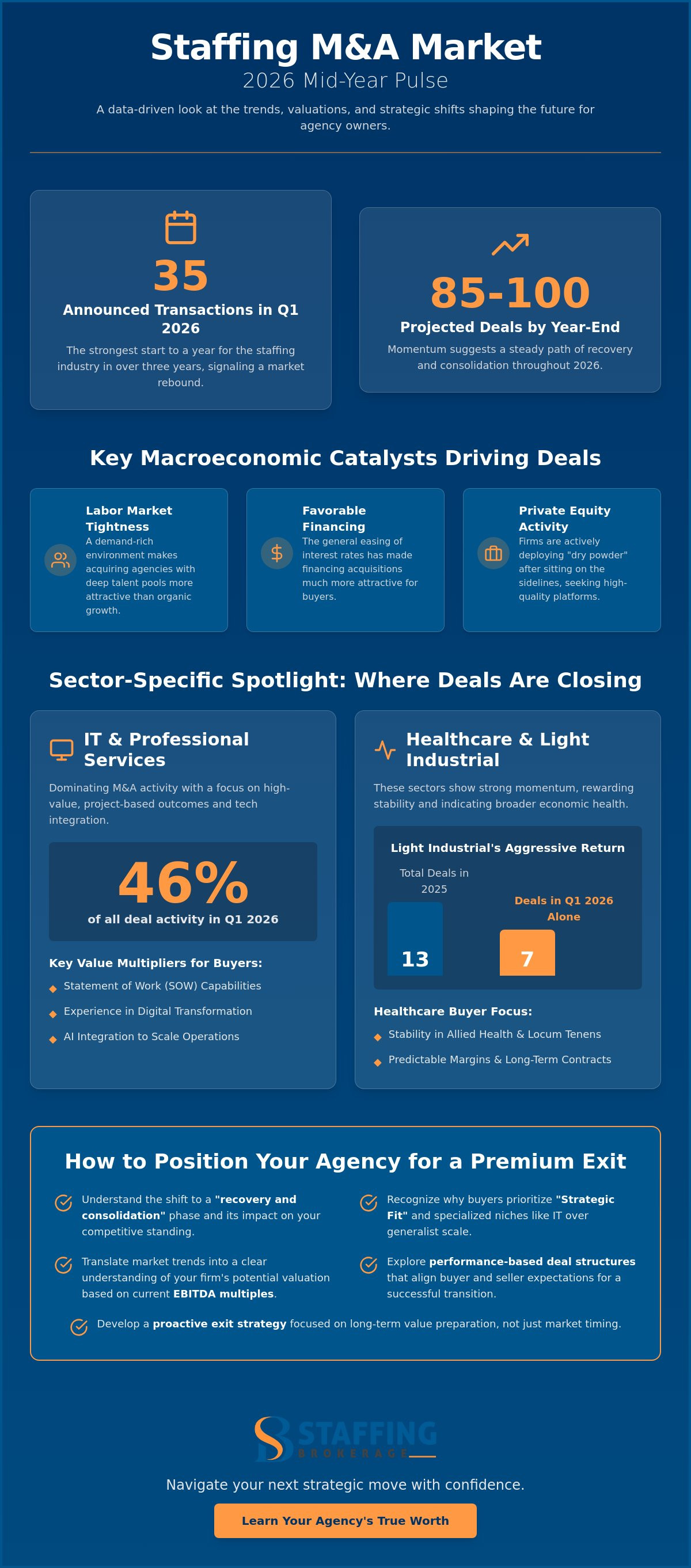
The staffing market isn't just waiting for a change; it's actively creating one. We characterize this period as a "recovery and consolidation" phase. After the quieter cycles of 2024 and 2025, the recent surge in staffing m&a news reflects a renewed confidence among both strategic and financial buyers. The first quarter alone saw 35 announced transactions. This represents the strongest start to a year since 2023. This momentum suggests that the industry is on a steady path toward 85 to 100 deals by year-end.
The Resurgence of Deal Volume in 2026
For much of the past two years, the market felt stuck in a valuation standoff. Sellers held onto peak-cycle expectations while buyers remained cautious due to fluctuating interest rates. In 2026, we've finally found common ground. Buyers are increasingly looking for a "Strategic Fit" rather than just buying for scale. This shift is essential for understanding mergers and acquisitions in the current climate. It isn't just about the numbers; it's about how your agency fills a specific gap in a buyer's portfolio. We're also seeing a notable rise in international interest. European firms are targeting North American companies to gain a foothold in a U.S. market that's projected to reach $183.3 billion this year. Within this activity, IT staffing and executive search have emerged as frontrunners, accounting for 46% of all deal activity in the first quarter.
Key Macroeconomic Catalysts
The current deal flow doesn't happen in a vacuum. Industry research indicates that we are currently in a "demand-rich environment." This demand is fueled by persistent labor market tightness. When talent is hard to find, buying an established agency with a deep candidate pool becomes more attractive than trying to grow organically. Additionally, the general easing of interest rates has made financing much more attractive for buyers. Private equity firms are also feeling the pressure to deploy "dry powder." After sitting on the sidelines during the 2024 lows, these investors are now actively seeking high-quality platforms. We've seen this play out specifically in the light industrial sector. That segment saw seven deals in Q1 2026 alone, which is a significant jump considering there were only 13 deals in that sector for the entirety of 2025. This tells us that buyers are ready to move when they see stability and growth potential.
For high-growth agencies looking to attract this influx of capital or enhance their market visibility, you can discover Pre-IPO Hype to learn how specialized investor relations and digital fundraising platforms connect companies with institutional and retail investors.
Sector-Specific Shifts: Where the Most Deals are Closing
While the overall market trajectory is upward, the activity across different niches tells a more nuanced story. Buyers in 2026 aren't just looking for volume; they're hunting for specialized expertise that can survive economic shifts. This year, we're seeing a clear divide between "generalist" firms and those that offer deep, niche-specific value. Understanding where your agency sits in this hierarchy is vital for anyone tracking staffing m&a news to time their exit correctly.
IT and Professional Services Consolidation
IT staffing and executive search continue to dominate the headlines, accounting for nearly half of all deal activity in the early months of 2026. However, the nature of these deals has changed. Strategic acquirers are prioritizing firms with Statement of Work (SOW) capabilities and proven experience in digital transformation. Buyers want to see that an agency can deliver project-based outcomes rather than just providing "bodies in seats." AI integration has also become a non-negotiable value multiplier. Firms that use automation to scale their internal operations are commanding much higher multiples. If you're looking to merge, it's worth reviewing the strategic guide to staffing agency mergers in 2026 to ensure your technology stack and culture align with what modern buyers expect.
Healthcare and Light Industrial Momentum
The healthcare sector remains a primary target for private equity roll-ups, though the focus has moved away from the "crisis" staffing of previous years. Today, buyers are looking for stability in allied health and locum tenens. These segments offer more predictable margins and long-term contract structures. This shift represents a healthy normalization that rewards agencies with strong, ethical clinical relationships over those that simply chased short-term pandemic gains.
The most surprising headline in recent staffing m&a news is the aggressive return of the light industrial and commercial sectors. This segment is often a leading indicator of economic health. In the first quarter of 2026 alone, we saw seven significant deals in this space. That's a massive jump when you consider there were only 13 deals in this sector for the entire previous year. This resurgence suggests that buyers feel confident in the manufacturing and logistics outlook. According to the 2026 staffing industry trends, firms are using acquisitions to combat margin compression by achieving greater economies of scale. If you've built a robust industrial agency, your market value may be higher now than at any point in the last three years. Exploring a professional business valuation and assessment can provide the clarity you need to decide if now is the right time to capitalize on this momentum.
The Rise of Strategic Roll-Ups and Private Equity Selectivity
Current staffing m&a news highlights a sophisticated divide in how deals are structured. You aren't just selling to a single type of buyer. Instead, you're choosing between two very different paths. Strategic buyers, usually your direct competitors, want to expand their footprint or service offerings. Financial buyers, such as private equity firms, look for scalable platforms they can grow over time. Understanding these different motivations helps you tailor your agency's value proposition to the right audience.
Strategic Buyers vs. Private Equity
Strategic buyers often pay a premium for geographic or niche expansion. They look for agencies that can plug into their existing infrastructure to create an immediate strategic fit. These buyers value the "synergy" your team brings, often allowing them to reduce overhead while increasing market share. We see this frequently when a national firm wants to dominate a specific regional market.
Private equity (PE) firms have adopted a more selective posture in 2026. They focus heavily on the "Platform + Add-on" strategy. This involves acquiring a large, stable agency as a foundation and then bolting on smaller firms to drive rapid growth. You don't need to be a massive corporation to appeal to these investors. Smaller agencies are often the perfect add-on if they have high gross margins and stable client relationships. PE firms are currently scrutinizing client concentration ratios and the depth of your management team. They want to ensure the business thrives after the founder exits. Navigating these complex buyer pools requires a steady hand, which is why many owners seek professional staffing company M&A advisory to ensure they find the right partner for their legacy.
The Adjacent Deal Landscape
The 2026 landscape also features an increase in "adjacent" deals. Staffing firms are no longer just acquiring competitors; they're buying tech-enabled service providers. Acquirers want AI recruiting tools and automated back-office software to boost their own valuations. When a staffing agency acquires a tech tool, it changes the competitive landscape for independent owners. It forces you to either invest in your own tech stack or find a buyer who has already done so. This trend is a key driver in current staffing m&a news because it shifts the focus from mere headcount to operational efficiency. Buyers are prioritizing firms that can scale revenue without a proportional increase in internal staff.
How Recent Acquisitions Influence Staffing Company Valuation
Every headline in current staffing m&a news acts as a real-time signal for your own agency's worth. These transactions aren't just isolated events; they're the market's way of telling you which operational models are currently in high demand. In 2026, we see a direct correlation between specialized delivery and premium pricing. Buyers are moving away from broad, generalist acquisitions in favor of firms that demonstrate high gross margins and defensible market positions.
Current EBITDA Multiples and Revenue Trends
Valuation multiples have stabilized in 2026, providing a more predictable environment for owners planning an exit. For middle-market firms with an EBITDA between $3 million and $4 million, we're seeing specific ranges across different segments. Light industrial staffing firms are currently trading between 4.0x and 4.5x EBITDA. Professional staffing agencies often see 5.0x to 6.0x, while high-growth IT niches with Statement of Work (SOW) capabilities are commanding premiums of 5.5x to 7.0x EBITDA. In 2026, an EBITDA multiple represents the market-clearing price buyers are willing to pay for a staffing firm's recurring cash flow, adjusted for the specific risk and growth potential of its niche.
Buyers are also applying more scrutiny to "normalized" EBITDA than in previous years. They're looking closely at add-backs to ensure that the profitability you report is sustainable under new ownership. This means that items like one-time pandemic-related expenses or discretionary owner costs are being vetted with a fine-tooth comb. To get an accurate picture of where you stand, it's essential to understand the nuances of staffing company valuation before you begin formal negotiations.
Deal Structures: Cash, Earnouts, and Equity
The "valuation standoff" of previous years is being resolved through more creative and collaborative deal structures. Earnouts have become the primary bridge to close the gap between a seller's expectations and a buyer's risk tolerance. These performance-based components allow you to capture the full value of your agency as you hit specific growth milestones post-closing. It's a way for both parties to share in the success of the transition.
We're also seeing more owners choose to retain "a second bite of the apple" through rolled equity. In this scenario, you keep a minority stake in the new, larger entity, allowing you to benefit from the eventual "second exit" when the buyer or private equity group sells the entire platform. This structure aligns your interests with the new owners and can often lead to a higher total payout than an all-cash deal. Protecting your legacy during this transition is our top priority. If you're ready to see how these structures apply to your specific situation, our business valuation and assessment provides the steady guidance you need to move forward with confidence.
Translating M&A Trends into Your Personal Exit Strategy
The staffing m&a news we've seen throughout 2026 isn't just a list of deals; it's a map you can use to navigate your own future. While the numbers are encouraging, a successful sale isn't just about market timing. It's about how well your agency aligns with what buyers are currently prioritizing. We believe every owner deserves a transition that honors their hard work and secures their legacy through a collaborative partnership.
Evaluating Your Timing Against the 2026 Cycle
To determine if now is the right time to sell, you should audit your agency against the trends we've discussed. Start by comparing your trailing twelve months (TTM) EBITDA to the sector-specific multiples currently being paid. If you're in a high-growth IT niche or a stabilized healthcare segment, you're likely in a strong position. However, you must also identify "red flags" before a buyer does during due diligence. These often include:
- Client Concentration: One account making up more than 20% of your total revenue.
- Management Depth: A lack of a secondary leadership layer, making the business too dependent on you.
- Margin Consistency: Gross margins that fluctuate significantly without a clear operational explanation.
We understand that even considering a sale can feel risky. Many owners worry about their employees or competitors finding out before the deal is done. That's why we prioritize confidentiality in selling a staffing agency above all else. A secure, quiet process ensures you maintain control over the narrative and the timing of your exit.
Preparing for a Strategic Exit
The most successful exits are often planned 12 to 24 months in advance. This window allows you to clean up your balance sheet and resolve any operational inefficiencies that might drag down your valuation. Use current staffing m&a news to identify the strategic buyers active in your specific niche. If a competitor just acquired a firm similar to yours, they might be looking for another "add-on" to fill a geographic gap in their portfolio.
2026 represents a unique window of opportunity for staffing owners. The market has recovered from previous lows, and capital is flowing back into the industry with renewed confidence. You don't have to navigate this complex landscape alone. A "steady hand" advisor can help you interpret market signals and position your firm for a premium payout. If you're curious about what your agency is worth in today's market, we're here to help. Our business valuation and assessment provides a clear, confidential starting point for your next chapter.
Building Your Path Forward in a Rebounding Market
The surge in staffing m&a news throughout 2026 proves that the industry has entered a vibrant new chapter. We've seen how specialized sectors like IT and light industrial are leading the way, while creative deal structures help owners capture the true value of their life's work. Whether you're looking to scale through an acquisition or preparing for a rewarding exit, success depends on more than just market timing. It requires a clear understanding of how your agency aligns with the strategic goals of today's most active buyers.
At Staffing Brokerage, we act as your dedicated, hands-on guide through these complex business transitions. Our specialized M&A advisors offer a national reach combined with personalized, honest strategic matching. We have proven results in guiding owners through intricate transitions while prioritizing integrity and long-term value. If you're ready to explore what the current landscape means for your future, we invite you to Request a Confidential Valuation and Market Assessment. Let's work together to ensure your next step is a collaborative journey toward mutual success. You've built an incredible business; we're here to help you protect its legacy.
Frequently Asked Questions
What is the most active sector for staffing M&A in 2026?
IT staffing and executive search are the most active sectors, accounting for 46% of all deal activity in the first quarter of 2026. These segments are highly sought after due to their specialized nature and high growth potential. We've also seen a significant resurgence in the light industrial sector, which recorded seven deals in Q1 alone compared to only 13 in the entire previous year.
How do recent staffing acquisitions affect my business valuation?
Recent acquisitions act as a real-time valuation map that helps you calibrate your agency's worth based on current market demand. Buyers are currently prioritizing tech-enabled models and firms with strong EBITDA margins. When you track staffing m&a news, you can see which specific niches are commanding premium multiples and adjust your operational focus to align with those high-value trends.
Are private equity firms still buying staffing agencies in 2026?
Yes, private equity firms are actively buying staffing agencies in 2026, though they maintain a highly selective approach. They are currently focused on a "Platform + Add-on" strategy, seeking stable firms to serve as foundations for rapid growth through additional bolt-on acquisitions. These investors are particularly interested in agencies with stable gross margins and specialization in hard-to-fill roles where they can deploy their significant capital reserves.
What is an earnout, and why is it common in 2026 staffing deals?
An earnout is a performance-based deal structure where a portion of the purchase price is paid after the closing once specific financial milestones are met. This structure is common in 2026 because it helps bridge the valuation gap between what a seller expects and what a buyer's risk tolerance allows. It ensures that you receive the full value of your agency's growth while providing the buyer with confidence in the transition's success.
How much is my staffing agency worth compared to recent deal news?
Your agency's worth depends on your specific sector and EBITDA, with professional staffing firms currently trading between 5.0x and 6.0x EBITDA. Light industrial firms are seeing multiples between 4.0x and 4.5x, while high-growth IT niches with Statement of Work capabilities can reach up to 7.0x. These figures apply to middle-market firms with an EBITDA between $3 million and $4 million, though individual performance and tech integration can drive these numbers higher.
Is 2026 a good year to sell my staffing company?
2026 is an excellent year to consider a sale because the market is experiencing its strongest rebound since 2023. With 35 transactions already announced in the first quarter and a projected total of up to 100 deals for the year, buyer appetite is high. The easing of interest rates and the deployment of private equity capital have created a unique window of opportunity for owners to achieve a premium exit.
What are the biggest red flags for buyers in the 2026 market?
High client concentration and a lack of secondary leadership are the most significant red flags for buyers in today's market. If a single client accounts for more than 20% of your revenue, buyers perceive a higher risk to your agency's stability. Additionally, buyers look for a management team that can thrive without the founder's daily involvement, ensuring the business remains a viable, scalable asset after the ownership transition is complete.
Can a small staffing agency still find a strategic buyer today?
Small staffing agencies can definitely find strategic buyers, especially if they offer a specialized "strategic fit" in a high-demand niche or geographic area. Larger firms often seek smaller agencies as "add-on" acquisitions to fill specific gaps in their service portfolios or to acquire specialized talent pools. By focusing on niche expertise and operational efficiency, smaller firms can position themselves as highly attractive targets for larger companies looking to expand their footprint quickly.