
Staffing Business Broker vs. M&A Advisor: Choosing the Right Partner for Your 2026 Exit
With 35 announced M&A transactions in North American staffing during the first quarter of 2026 alone, the market hasn't seen a start this strong in over three seasons. It's an optimistic time to consider an exit, yet the path to a successful closing is often paved with complex questions about valuation and confidentiality. You've worked hard to build your agency, and you deserve a partner who respects that legacy while navigating the specific liabilities unique to our industry. Choosing between a staffing business broker vs m&a advisor is the most critical decision you'll make before you even reach the negotiation table.
You likely feel a mix of excitement for the future and anxiety about whether a generalist can truly capture your firm's value. We've designed this guide to help you discover the critical differences between these two roles so you can maximize your agency's final sale price. We will provide a clear decision-making framework and explore the financial impact of each choice. By the end, you'll know exactly how to find a strategic ally who speaks the language of staffing and can guide your 2026 exit with a steady, experienced hand.
Key Takeaways
- Identify the fundamental differences between a volume-based listing agent and a strategic architect who understands the nuances of human capital.
- Recognize why the $1M EBITDA threshold serves as a critical hand-off point where specialized advisory becomes essential for your valuation.
- Discover how staffing-specific multipliers for IT and light industrial sectors directly influence your final deal structure and exit expectations.
- Evaluate different fee models to understand how a retainer ensures the high-level commitment and steady hand required for complex transactions.
- Use our decision-making framework to choose a staffing business broker vs m&a advisor who can provide the national reach your agency needs.
Staffing Business Broker vs. M&A Advisor: Defining the Roles
Both a business broker and an M&A advisor share a common goal: helping you transition out of your company. However, the methodologies they use to reach that goal are distinct. While the terms are sometimes used interchangeably, the choice between a staffing business broker vs m&a advisor often dictates the type of buyer you attract and the final structure of your deal. In 2026, the boundaries between these professions are shifting. Success now depends less on a formal title and more on a partner's ability to navigate the specific regulatory and financial hurdles of the staffing sector.
What is a Staffing Business Broker?
A Business broker typically operates as a volume-based professional. They often focus on "Main Street" businesses, which generally includes firms with localized operations and standardized assets. If your agency has a straightforward structure and you prioritize a relatively quick sale to a local buyer, a broker might be the right fit. Their expertise is best suited for transactions where the value is easily understood by a generalist buyer pool.
Brokers often act as "listing agents." They use public or semi-private listing sites to cast a wide net. Much like how real estate professionals use Landvoice to identify specific leads like FSBO or expired listings, a business broker relies on listing databases to find potential buyers. Their process is usually transactional and reactive. They wait for buyers to come to them rather than hunting for specific strategic fits. This approach works well for agencies where the value is clearly visible on the bottom line and doesn't require complex storytelling to justify a premium multiple. It's a path built for speed and accessibility.
What is a Staffing M&A Advisor?
An M&A advisor functions as a specialized strategist. They focus on the lower-middle and middle-market sectors, where deals involve more moving parts. Their primary objective is to maximize staffing company valuation by identifying strategic alignment between the seller and the buyer. They don't just list your business; they architect the entire transaction.
M&A advisors look for private equity groups or larger strategic competitors who see your agency as a missing piece of their own puzzle. This level of service is essential when dealing with complex structures like earn-outs, equity rollovers, or multi-state compliance issues. They act as a steady hand, guiding you through a process that can often take six to twelve months of meticulous preparation and negotiation. They prioritize the quality of the fit over the speed of the listing.
The current market favors those who understand the "hidden" value in staffing, such as your proprietary recruiter training or your specific niche in IT or healthcare. Whether you choose a broker or an advisor, you need a partner who sees your agency as a unique asset rather than just another listing. In a year defined by strong transaction activity, having a partner who speaks the specific language of human capital is your greatest advantage.
Transaction Size and Complexity: The Great Divide
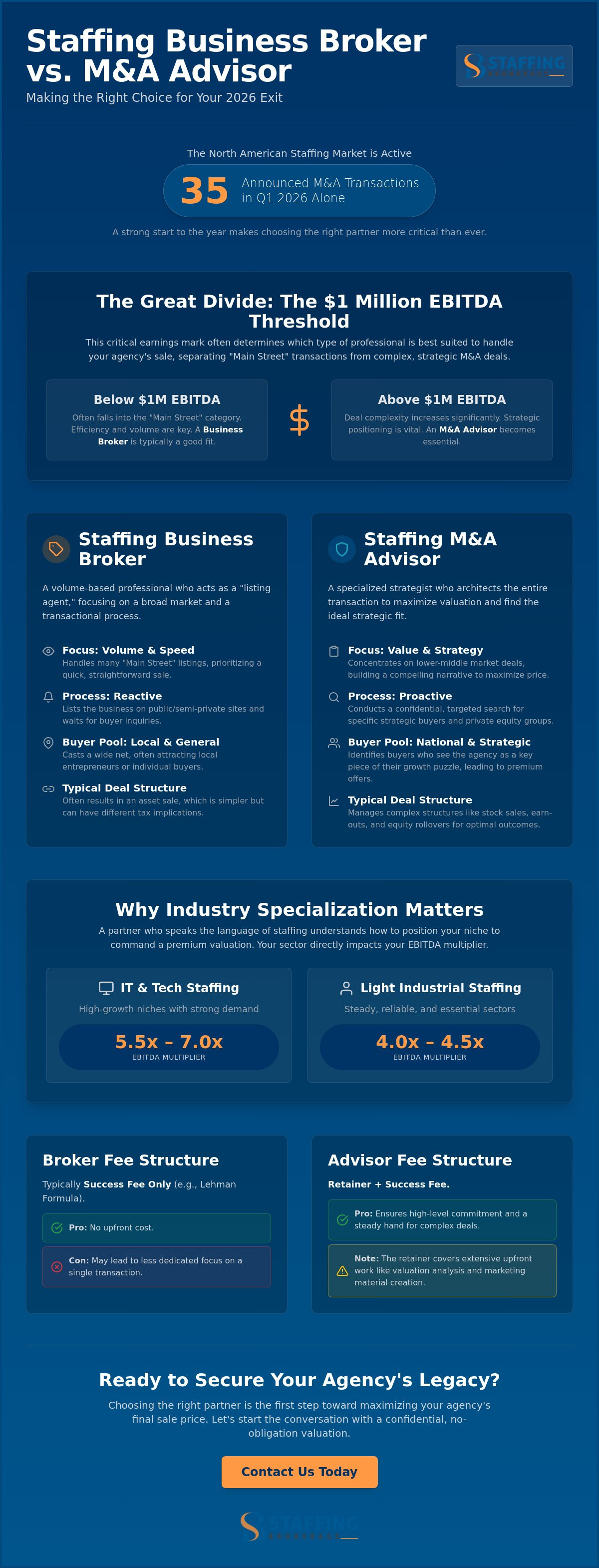
When you begin evaluating a staffing business broker vs m&a advisor, the first metric to look at is your bottom line. Traditionally, the $1 million EBITDA (Earnings Before Interest, Taxes, Depreciation, and Amortization) mark serves as the industry hand-off point. Firms generating less than this often fall into the "Main Street" category, where a broker’s volume-based approach is efficient. Once you cross that million-dollar threshold, the complexity of the deal increases exponentially. At this stage, you aren't just selling a list of clients; you're selling a sophisticated platform with specific human capital liabilities and growth potential.
The valuation itself is another area where the two roles diverge. In 2026, we've seen a clear shift toward EBITDA-based valuations over simple gross margin percentages. Your specific vertical also dictates your "Staffing Multiplier." For instance, high-growth IT niches are currently commanding 5.5x to 7.0x EBITDA, while light industrial agencies typically see 4.0x to 4.5x. An advisor understands how to position these niche strengths to institutional buyers, offering tips on how to maximize the sale price that go beyond standard accounting. They also guide you through the choice between an asset sale, which is common for smaller brokerage deals, and a stock sale, which is often preferred in larger M&A transactions for tax and continuity reasons.
Lower Mid-Market vs. Main Street Transactions
Main Street deals usually involve selling to an individual or a local competitor. These are often funded by SBA loans and focus on local stability. In contrast, lower-middle-market transactions involve private equity groups or national strategic buyers. Staffing firms often bridge these two worlds because a lean agency can generate significant revenue with a small headcount, making a professional valuation essential to determine which buyer pool you should target.
Complexity of Staffing Deal Structures
Modern transactions are rarely all-cash at close. A sophisticated staffing company deal structure in 2026 often includes earn-outs to bridge valuation gaps or equity rolls, where you retain a percentage of ownership. M&A advisors are specifically equipped to handle these nuances, along with "Net Working Capital" pegs that ensure your agency has enough liquidity to cover payroll immediately after the keys change hands. Managing these details requires a steady hand and deep industry knowledge to ensure you don't leave money on the table.
Why Industry Specialization Matters for Staffing Firms
You might wonder if any professional with a track record of selling businesses can handle your exit. While a generalist might understand a balance sheet, staffing is a unique animal that relies almost entirely on human capital rather than fixed assets. A generalist often misses the subtle nuances that drive your firm's true worth. The choice between a staffing business broker vs m&a advisor becomes much clearer when you realize that your "inventory" walks out the door every single evening. You need a partner who understands how to value that intangible energy and the systems you've built to sustain it.
The International Business Brokers Association (IBBA) provides a foundation for professional standards, but even the best generalist might struggle with staffing-specific hurdles like heavy client concentration. If 40% of your revenue comes from one client, a general broker might see a red flag and drop your valuation. A specialized M&A advisor staffing industry expert knows how to frame that relationship as a deeply embedded partnership that adds strategic value to the right buyer. They look past the surface to find the stability in your contracts and the strength of your delivery team.
Navigating Staffing-Specific Due Diligence
Due diligence in our industry is a minefield for the uninitiated. Workers' compensation claims and Experience Modification Rate (EMR) ratings can kill a deal if they aren't presented with the proper context. We focus on protecting the "engine" of your firm by ensuring your key recruiters and sales managers feel secure throughout the transition. We also navigate the legal complexities of VMS and MSP contract portability. Ensuring these large-scale contracts transfer smoothly is essential for maintaining your firm's revenue stream on day one after the sale.
Evaluating Niche Staffing Multiples
Your vertical significantly impacts your final check. Current healthcare staffing agency acquisition trends show that specialized niches continue to command a premium over general labor firms. This "Niche Premium" exists because strategic buyers are willing to pay more for specialized talent pools they can't easily build themselves. Specialized M&A advisors pinpoint hidden value by analyzing how your team's placement ratios and time-to-fill metrics outperform industry averages to drive long-term profitability. By framing your agency as a high-performance machine rather than just a local office, we help you secure the multiple you've earned.
Fee Structures and Service Levels: A Side-by-Side Comparison
Understanding the investment required to sell your firm is just as important as the final sale price. The fee models for a staffing business broker vs m&a advisor reflect the intensity of the work involved. Brokers typically operate on a "success-only" fee, which sounds appealing because you only pay upon closing. However, M&A advisors usually require a monthly retainer alongside a success fee. This retainer isn't just an upfront cost; it ensures the firm can dedicate a "steady hand" and full-time resources to your transaction, providing a level of commitment that a volume-based broker simply can't match.
M&A advisors often use the Lehman Scale or the "Double Lehman" to calculate success fees. These are sliding scales where the percentage decreases as the transaction value increases, though the Double Lehman has become a common standard for lower-middle-market staffing deals to account for increased complexity. This structure aligns our interests with yours; we succeed when you achieve a premium valuation. Beyond the fee, the service level includes creating a comprehensive Confidential Information Memorandum (CIM) and managing a secure data room. These tools are essential for protecting your sensitive recruiter data and client lists during the high-pressure due diligence phase.
The True Cost of a 'Cheap' Broker
Choosing a partner based solely on the lowest fee can be a costly mistake. Poorly positioned firms often leave significant money on the table because the broker lacks the industry-specific knowledge to spark a competitive bidding war. Without a dedicated project manager, deals often suffer from "deal fatigue," leading to broken transactions that waste months of your time. A specialized advisor pays for themselves by identifying strategic buyers willing to pay a premium for your unique culture and delivery model.
Beyond the Closing: Strategic Alignment
While a broker's job often ends when the check clears, an advisor focuses on the strategic fit for your long-term legacy. In the staffing sector, post-close transition planning is vital because your value resides in your people. We help you navigate the delicate period after the sale to ensure your team remains motivated and your clients stay loyal. This collaborative approach ensures that the "journey" of selling your business concludes with a sense of shared accomplishment and a secure future for your employees.
If you are ready to explore a partner who treats your exit as a collaborative journey rather than a mere transaction, consider our staffing company sell-side representation to ensure your legacy is protected.
Making the Choice: Who Should You Hire?
Deciding between a staffing business broker vs m&a advisor isn't just about the size of your revenue. It's about the complexity of your vision. To make the right choice, you must evaluate whether you are seeking a simple transaction or a strategic transition. The debate of staffing business broker vs m&a advisor ultimately comes down to the level of risk you are willing to manage on your own. In 2026, even smaller agencies often require a national reach because the buyer pool has expanded beyond local competitors. A partner who only looks in your backyard might miss the private equity group or national strategic buyer looking for a specific niche to round out their portfolio.
When evaluating your options, consider the dynamic between strategic and financial buyers. Strategic buyers are typically larger competitors looking for synergies, such as your recruiter training programs or specific client contracts. Financial buyers, like private equity firms, look for healthy cash flows and "platform" potential. Understanding which buyer is right for you is a key part of the benefits of using a staffing business broker or advisor who specializes in our industry.
When to Choose a Business Broker
- Financial Threshold: Your staffing agency generates under $500,000 in annual EBITDA.
- Localized Scope: Your client base is hyper-local and your operations rely on non-proprietary, standard industry practices.
- Speed and Simplicity: You prioritize a quick exit to an individual buyer, often involving SBA loan financing.
When an M&A Advisor is Essential
An M&A advisor becomes necessary when your EBITDA exceeds $1 million or you operate in a high-growth niche like IT or specialized healthcare. These firms require a sophisticated staffing agency exit strategy to protect your employees and ensure the "engine" of the business continues to run post-close. If you want access to institutional capital or national strategic buyers who value your specific recruiter productivity metrics, the advisor's "steady hand" approach is vital.
At Staffing Brokerage, we bridge the gap between the accessibility of a traditional broker and the strategic sophistication of a high-level M&A firm. We believe that every staffing owner deserves a partner who speaks the language of human capital and treats their exit as a collaborative journey. Whether you are a "Main Street" agency or a middle-market powerhouse, we provide the precision and alignment needed to maximize your value and secure your legacy.
Secure Your Legacy with the Right Partnership
Your staffing agency represents years of dedication and hard work. As you look toward a 2026 exit, the decision between a staffing business broker vs m&a advisor will define the next chapter of your professional journey. We've explored how transaction size, industry-specific due diligence, and strategic alignment create the foundation for a premium valuation. Whether you are navigating a high-growth IT niche or a stable light industrial firm, you need a partner who understands the "engine" of your business and protects your employees throughout the transition.
At Staffing Brokerage, we bring specialized staffing M&A expertise and a national reach to connect you with strategic buyers. Our proven results across IT, healthcare, and light industrial sectors ensure your firm is positioned for maximum impact. We act as your steady hand, guiding you through complex deal structures with transparency and integrity. We don't just facilitate transactions; we build collaborative journeys that lead to mutual success.
Ready for a strategic exit? Get a confidential valuation from Staffing Brokerage today. You've built a remarkable company. Now, let's work together to ensure your transition is just as successful as your growth.
Frequently Asked Questions
Is an M&A advisor more expensive than a staffing business broker?
An M&A advisor typically involves a higher total investment because they require a retainer in addition to a performance-based success fee. This reflects the intense, strategic work required to position a mid-market firm for institutional buyers. While a broker might charge a simple percentage of the sale, an advisor's goal is to increase your final valuation enough to far outweigh their fee.
Can a general business broker sell my healthcare staffing agency?
A general broker can list your agency, but selling a healthcare staffing firm requires deep knowledge of credentialing and specific liability risks. Generalists often struggle to explain Experience Modification Rates or the nuances of VMS contracts to potential buyers. Choosing a specialist ensures these critical details don't become deal-killers during the due diligence phase.
What is the typical transaction size for a staffing M&A advisor?
Staffing M&A advisors generally handle transactions for firms with at least $1 million in EBITDA or an enterprise value between $2 million and $50 million. Smaller agencies with lower earnings are usually better served by a broker. The complexity of the staffing business broker vs m&a advisor decision often hinges on this $1 million earnings threshold.
Do I need to pay a retainer to an M&A advisor?
Yes, most M&A advisors require a monthly retainer to ensure they can provide a dedicated, steady hand throughout the long sale process. This fee covers the creation of your Confidential Information Memorandum and the management of a secure data room. These upfront resources are essential for attracting high-quality strategic buyers and private equity groups.
How long does it take to sell a staffing company with an advisor vs. a broker?
Selling with a broker often takes about six months, while an M&A advisor's process typically spans six to twelve months. The longer timeline for an advisor allows for more thorough market research and the negotiation of complex deal structures like earn-outs. This methodical pace ensures every detail aligns with your long-term goals.
What are the common red flags when hiring a broker for a staffing firm?
A major red flag is a broker who lacks a specific network of staffing-industry buyers or doesn't understand your niche's EBITDA multiples. The choice of a staffing business broker vs m&a advisor becomes critical if the partner suggests public listings without a strict confidentiality plan. Look for a partner who prioritizes discretion and industry-specific metrics.
Should I sign an exclusive agreement with a staffing business broker?
You should expect to sign an exclusive agreement because it ensures your partner is fully committed to your transaction. This alignment of interests allows the professional to invest the necessary time and resources into marketing your agency properly. Most agreements last six to twelve months to account for the natural rhythm of a business sale.
What is the difference between a success fee and a commission?
A success fee is a performance-based payment made only when the deal closes, whereas a commission is a term more commonly used by volume-based brokers. M&A advisors often use a Modified Lehman formula for success fees, which scales the percentage based on the final sale price. This structure ensures your partner is motivated to maximize your agency's value.