
Negotiating the Sale of a Staffing Agency: A Strategic 2026 Guide
The highest offer on your table is often the one most likely to collapse before you ever reach the closing room. While it's tempting to chase the biggest number, true success in negotiating the sale of a staffing agency comes down to the certainty of the close and the alignment of the deal structure. You've worked hard to build a reputable firm. It's natural to feel protective of your team and anxious about complex earn-outs that could put your payout at risk.
We're here to help you turn those concerns into a clear, actionable strategy. This guide will show you how to maximize your exit value while ensuring your agency's culture remains intact under new ownership. We'll explore the latest 2026 market trends, from the 7x EBITDA multiples seen in IT staffing to the impact of restored bonus depreciation. You'll learn how to evaluate buyers, navigate transition terms, and secure a deal that reflects the true worth of everything you've built.
Key Takeaways
- Build leverage early by identifying the specific value drivers that make your firm attractive to high-quality buyers.
- Discover the strategies for negotiating the sale of a staffing agency that help you command a premium multiple based on your niche and client mix.
- Compare the benefits of strategic versus financial buyers to ensure your choice supports both your financial goals and your team's future.
- Master the art of deal structuring to maximize your cash at close while setting realistic earn-out targets that bridge valuation gaps.
- Learn how a dedicated advisor acts as a steady hand to navigate emotional hurdles while ensuring you remain the "good cop" throughout the process.
The Foundation of Leverage: Preparing for Negotiation in 2026
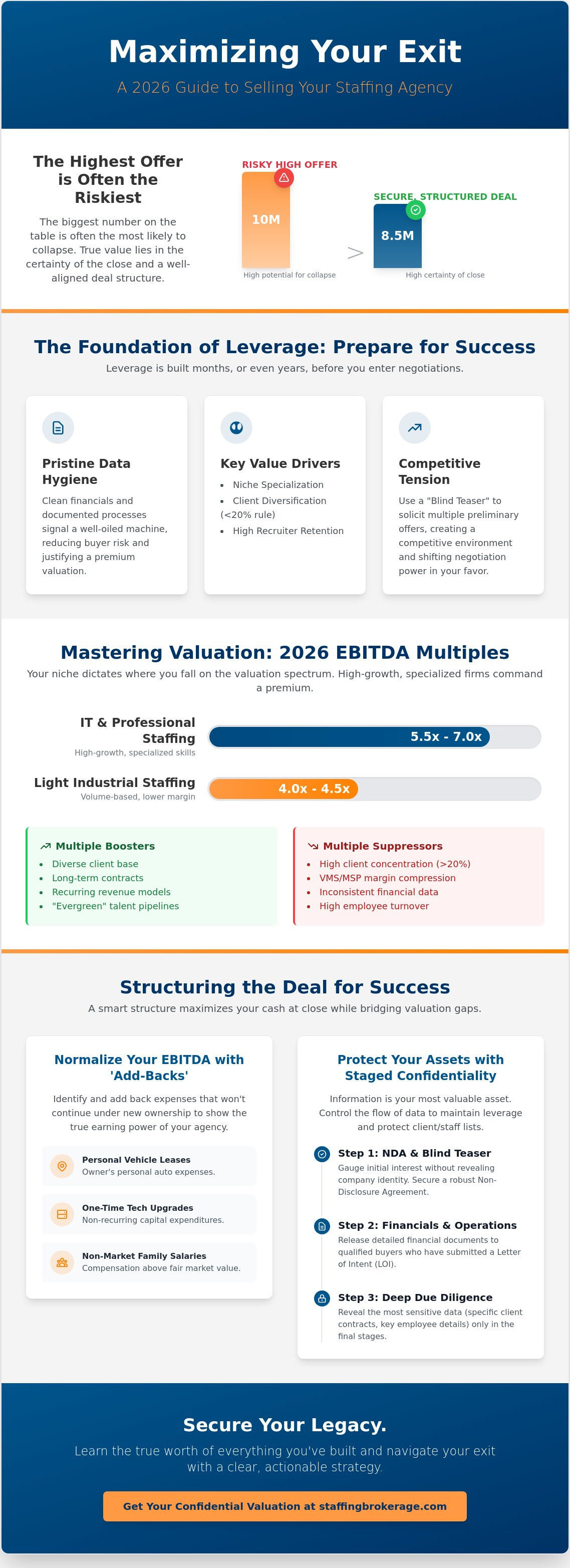
Leverage isn't something you "find" at the conference table during a final meeting. It's a resource you build months, or even years, before you decide to exit. In the staffing world, your strongest negotiating tool is your data hygiene. If your financial records are disorganized or your candidate tracking is inconsistent, buyers will perceive risk. They'll use that uncertainty to drive down your price. When your data is clean and your processes are documented, you signal that the agency is a well-oiled machine that can thrive without you. This level of preparation is the silent engine behind successful outcomes when negotiating the sale of a staffing agency.
Your "Value Drivers" are the specific qualities that make a buyer lean in. In 2026, buyers are looking for niche specialization, particularly in high-growth areas like cybersecurity, green energy, or specialized healthcare. They also want to see client diversification. If a single client accounts for more than 20% of your revenue, you're in a vulnerable position. Finally, recruiter retention is paramount. Buyers aren't just purchasing your contracts; they're purchasing the talent that fills them. Demonstrating a stable, high-performing internal team adds significant weight to your side of the scale.
To build initial competitive tension, we often use a "Blind Teaser." This is a concise, one-page document that highlights your firm's strengths, geographic reach, and financial performance without revealing your company name. It allows us to gauge interest and solicit multiple preliminary offers simultaneously. M&A negotiation leverage is the presence of multiple qualified, competing interests. By creating a scenario where several buyers are vying for the same opportunity, you shift the power dynamic in your favor. This strategy is a cornerstone of professional Mergers and Acquisitions (M&A), ensuring you aren't just taking the first offer that comes along.
Normalizing EBITDA for a Transparent Negotiation
Buyers look at EBITDA to understand your cash flow, but your tax returns don't always tell the full story. Normalizing your earnings involves identifying "add-backs." These are expenses that won't continue under new ownership, such as your personal vehicle lease, one-time technology upgrades, or non-market salaries for family members. By identifying these costs, you show the true earning power of the agency. It's vital to have your staffing company valuation documentation prepared and verified before talks begin. This transparency prevents buyers from "re-trading" or lowering their offer during due diligence.
Confidentiality as a Negotiation Tactic
Information is your most valuable asset, and you should treat it as such. We use robust Non-Disclosure Agreements (NDAs) to control the flow of data and protect your client lists. You don't have to reveal everything at once. We recommend revealing sensitive data, like specific recruiter names or proprietary sourcing methods, in stages as the buyer proves their commitment. This staged approach maintains your power and protects your staffing agency exit strategy from becoming public knowledge too early. Keeping the sale confidential ensures that your competitors don't use the news to poach your clients or staff before the deal is finalized.
Mastering Valuation Levers and EBITDA Multiples
Negotiating the sale of a staffing agency requires a deep understanding of what truly drives value in the eyes of a 2026 buyer. While the broad market often sees multiples between 4x and 7x TTM EBITDA, your specific niche dictates where you fall on that spectrum. High-growth IT niches and professional staffing firms are currently commanding multiples between 5.5x and 7.0x. In contrast, light industrial agencies typically hover in the 4.0x to 4.5x range. This "Staffing Niche Premium" exists because buyers prioritize sectors with higher barriers to entry and specialized skill sets that aren't easily replicated.
Client concentration is another critical lever that dictates your negotiation ceiling. If a single client provides more than 20% of your revenue, it creates a risk profile that can suppress your multiple. Conversely, a diverse client base with long-term contracts allows you to push for the higher end of the range. You should also consider the impact of Vendor Management Systems (VMS) and Managed Service Provider (MSP) contracts. While these offer volume and stability, they often come with margin compression. Buyers in 2026 are increasingly looking for recurring revenue models or "evergreen" talent pipelines that promise predictable cash flows, often paying a premium for that security.
The 'Add-Back' Strategy: Defending Your Numbers
When you're at the table, you must be prepared to defend your normalized EBITDA with precision. Skeptical buyers will scrutinize owner salary adjustments, so present them clearly as market-rate replacements. You should also negotiate the value of your proprietary candidate database. This isn't just a list of names; it's a vetted, high-value asset that significantly reduces the buyer's future sourcing costs. If your growth chart shows anomalies from the post-pandemic era, explain them as part of a larger, stable trajectory rather than temporary spikes. For a deeper look at these methodologies, you can review Harvard Business School on company valuation to see how different financial models apply to your firm's specific situation.
Benchmarking Against 2026 Market Trends
The current market is heavily influenced by AI-driven recruitment efficiency. Buyers want to see that your agency uses automation to reduce time-to-hire, which can improve margins by 20% to 30%. Because of these technological shifts and the strong start to the year, searches for how to sell my staffing agency are peaking among mid-market owners looking to exit while multiples remain robust. Using industry reports to justify your position helps you stay grounded in facts rather than emotions. If you're unsure where your firm stands in the current landscape, a professional valuation and assessment can provide the clarity you need to negotiate with confidence.
Strategic vs. Financial Buyers: Navigating Different Negotiation Styles
Success in negotiating the sale of a staffing agency depends on knowing exactly who is sitting across from you. Strategic buyers and financial buyers have vastly different playbooks. Strategic buyers are often industry peers looking to expand their geographic reach or enter a new niche. They focus on synergies where the combined entity is more valuable than the sum of its parts. Financial buyers, such as private equity firms, prioritize return on investment and scalability. They look at your agency as either a "platform" to build upon or an "add-on" to an existing portfolio company.
You can maximize your value by engaging both types of buyers simultaneously. This creates a competitive environment where strategic buyers feel the pressure of a financial buyer's efficiency, and financial buyers recognize the premium a competitor might pay for your market share. However, price isn't the only factor. You must evaluate cultural fit throughout the process. A buyer who doesn't align with your values can lead to high turnover during the transition, potentially impacting your final payout. The market is active; in the first quarter of 2026 alone, the industry saw 35 transactions, the strongest start in years. Understanding these buyer motivations is the key to capturing that momentum.
Negotiating with Competitors (Strategic Buyers)
When your buyer is a direct rival, confidentiality is your greatest defense. You must protect trade secrets and client lists until the deal is nearly certain. Focus the conversation on the "1+1=3" effect. Show them how your specialized talent pool in sectors like IT or healthcare complements their existing operations. These sectors accounted for 46% of transaction volume in early 2026, making them highly attractive targets. You'll also need to decide on your future role. Are you looking for a clean exit, or are you willing to stay on as a leader to guide the integration? Strategic buyers often pay a premium for a smooth transition led by the original founder.
Negotiating with Private Equity (Financial Buyers)
Private equity firms are often more clinical in their approach. They'll scrutinize your EBITDA and the scalability of your internal leadership team. If your agency is a "platform" acquisition, they'll expect you to have a robust infrastructure. A key negotiation point here is the "Second Bite of the Apple." By rolling over a portion of your equity into the new entity, you can benefit from a second payout when the firm eventually sells the consolidated group. This aligns your interests with theirs and demonstrates your confidence in the agency's future growth. It's a powerful tool for owners who believe their agency still has significant room to scale under a larger umbrella.
Structuring the Deal: Earn-outs, Working Capital, and Cash at Close
A high headline price looks great on a Letter of Intent, but it's the deal structure that determines what you actually take home. When negotiating the sale of a staffing agency, you'll encounter the distinction between "Cash at Close" and "Total Enterprise Value." The latter often includes contingent payments that you might never see if the terms aren't favorable. The deal structure often matters more than the headline price because it defines the specific path your money takes from the buyer's pocket to yours.
In 2026, we're seeing more buyers use deferred consideration to bridge valuation gaps. This makes the negotiation of these components just as critical as the multiple itself. Whether it's a seller note or an escrow holdback, each element is a lever you can use to protect your interests. If you want to ensure your deal is built on a solid foundation, our team provides expert staffing company sell-side representation to guide you through these complex financial waters.
The Art of the Earn-out
Earn-outs are a common tool to align expectations, but they can be minefields for the unwary. To protect yourself, always push to link earn-out milestones to gross profit rather than net income. Net income is easily manipulated by a buyer's corporate overhead or aggressive accounting practices. By focusing on gross profit, you track the actual performance of the staffing desks. You should also insist on "acceleration" clauses; if the buyer sells the firm again before your earn-out period ends, you should receive your full payment immediately. Most importantly, ensure you maintain enough operational control to actually hit those targets. Without the power to hire or spend on marketing, an earn-out is little more than a gamble.
Net Working Capital and Escrow Terms
The "Net Working Capital" (NWC) peg is perhaps the most overlooked part of the negotiation. Staffing agencies are working-capital intensive because you pay recruiters and contractors weekly while clients might pay you in 30, 60, or even 90 days. The "peg" is the amount of working capital you must leave in the business at closing. If the buyer sets this peg too high, it's essentially a price reduction. You also need to negotiate the "Indemnification Escrow." This is a portion of the purchase price held back to cover potential legal or tax issues. In 2026, aim to keep this holdback to 10% or less of the total price for a period of 12 to 18 months. If the buyer requires a "Seller Note," remember that interest rates are currently high; SBA 7(a) variable rates range from 9.75% to 13.25%, so your note should reflect a fair market return for the risk you're taking.
Securing Your Legacy with Professional M&A Representation
Selling a business you've built from the ground up is more than a financial transaction; it's a significant emotional milestone. When you're in the thick of negotiating the sale of a staffing agency, it's easy for personal feelings to cloud your strategic judgment. This is where a "steady hand" advisor becomes your greatest asset. We provide the objective perspective needed to stay focused on your long-term goals while navigating the inevitable stresses of the closing process. Our role is to ensure that the excitement of an initial offer doesn't lead to overlooked risks later on.
One of the most valuable roles we play is acting as a buffer between you and the buyer. We often act as the "bad cop" during difficult financial friction or pushback on terms, which allows you to remain the "good cop." This preserves your relationship with the buyer, which is vital if you're staying on for a transition period or an earn-out. Our methodical approach ensures that the collaborative journey from the Letter of Intent (LOI) to the final Purchase Agreement stays on track. We manage the due diligence phase with precision, ensuring that the momentum built during initial talks doesn't stall under a mountain of paperwork.
The Role of Your Advisory Team
A successful exit requires a synchronized effort between your M&A broker, specialist attorneys, and CPAs. We act as the central hub, coordinating these experts to ensure every legal and financial detail aligns with your objectives. Industry-specific expertise is non-negotiable in this process. A generalist broker might not fully grasp the nuances of staffing bill rates, workers' comp liabilities, or the specific impact of VMS/MSP contracts on your bottom line. We use our deep knowledge of the 2026 staffing landscape to manage competitive tension between multiple offers, ensuring you never settle for less than your agency is worth.
Closing with Confidence
The final Purchase Agreement is the ultimate roadmap for your exit. We review this document meticulously to protect you from hidden traps, such as overly broad representations and warranties or unfair indemnification clauses that could put your payout at risk. Once the ink is dry, the focus shifts to a thoughtful announcement strategy. We help you plan how to share the news with your internal team and your clients to maintain stability and trust during the handover. If you're ready to take the next step in your professional journey, you can secure your legacy with professional sell-side representation from Staffing Brokerage. We're here to ensure your transition is as rewarding as the years you spent building your firm.
Your Next Chapter Starts with a Strategic Deal
Negotiating the sale of a staffing agency is the culmination of years of hard work and dedication. By focusing on data hygiene, understanding the nuances of your niche's EBITDA multiples, and carefully evaluating the motivations of strategic versus financial buyers, you've positioned yourself for a successful exit. Remember that the structure of your deal, from the net working capital peg to the earn-out milestones, is just as important as the final price.
Managing this process requires a steady hand and specialized expertise. As a national M&A advisory firm focused exclusively on the staffing industry, Staffing Brokerage provides comprehensive support from initial valuation to the final handshake. We have a proven track record of managing complex, high-value transactions, ensuring you achieve the best possible outcome while protecting the legacy of your team. You've built something remarkable. Now, it's time to ensure its future is just as bright as its past.
Start Your Collaborative Journey to a Strategic Exit-Contact Staffing Brokerage Today
Frequently Asked Questions
How do you calculate the value of a staffing agency for negotiation?
Value is calculated by applying a market-based multiple to your normalized EBITDA based on your specific sector and size. For instance, high-growth IT staffing firms in 2026 often see multiples of 5.5x to 7.0x, while light industrial agencies typically trade between 4.0x and 4.5x. Negotiating the sale of a staffing agency requires looking beyond the multiple to factors like recruiter retention and client diversity, which can push your valuation to the higher end of the market range.
What is a typical earn-out period for a staffing firm sale in 2026?
A typical earn-out period for a staffing firm sale in 2026 lasts between one and three years. This structure is frequently used to bridge valuation gaps between buyers and sellers, especially in specialized sectors like healthcare or skilled trades. These milestones are often tied to gross profit targets to ensure both parties remain aligned on the agency's growth and stability during the transition phase.
How long does the negotiation process usually take from LOI to close?
The negotiation process usually takes between 60 and 90 days from the signing of a Letter of Intent (LOI) to the final close. This window allows for a thorough due diligence phase where the buyer verifies financial records, candidate databases, and operational processes. Maintaining momentum during this period is essential to prevent deal fatigue, which is why having a dedicated advisory team is critical for a smooth conclusion.
Should I negotiate with multiple buyers at the same time?
You should negotiate with multiple buyers simultaneously up until you sign an LOI with an exclusivity clause. This approach creates the competitive tension necessary to drive up your valuation and secure more favorable terms. Once an exclusivity agreement is in place, you must pause other talks, so it's vital to ensure the chosen buyer is the right cultural and financial fit for your legacy.
What are common deal-breakers during the due diligence phase?
Common deal-breakers during due diligence include undisclosed tax liabilities, declining revenue trends, or inconsistencies in candidate placement data. If a buyer discovers that your normalized EBITDA includes questionable add-backs that don't reflect true earning power, they may attempt to re-negotiate the price. Transparency from the start prevents these issues from derailing the transaction at the eleventh hour and protects your reputation.
How does high client concentration affect my negotiation leverage?
High client concentration significantly reduces your negotiation leverage and can lower your overall EBITDA multiple. If a single client accounts for more than 20% of your revenue, buyers perceive a higher risk of financial instability if that contract is lost. To counter this, focus on demonstrating the longevity of your client relationships and the high cost for competitors to unseat your firm from those accounts.
What is the difference between a cash-free, debt-free deal and a stock sale?
A cash-free, debt-free deal means you keep the business's cash but must pay off all debts before closing, whereas a stock sale involves the buyer purchasing the entire legal entity. Stock sales are often preferred by sellers for their favorable capital gains tax treatment in 2026. Negotiating the sale of a staffing agency often involves choosing the structure that maximizes your after-tax proceeds while minimizing future liabilities for the buyer.
Can I negotiate to stay on as a consultant after the sale is finalized?
You can certainly negotiate to stay on as a consultant, and many buyers prefer this arrangement to ensure a seamless transition of client relationships. This role allows you to mentor the new leadership team and help the agency hit the performance milestones required for your earn-out. It's an excellent way to protect your team's culture while gradually stepping back from daily operations at your own pace.