
Staffing Company Valuation: A Strategic 2026 Guide to Determining Business Worth
Would you be surprised to learn that two staffing agencies with identical gross revenue can have valuations that are millions of dollars apart? It is a frustrating reality many founders face when they first explore a staffing company valuation. You've spent years building your firm, yet the difference between a 4.0x and a 6.0x EBITDA multiple often feels like a moving target. You might worry that high client concentration is quietly devaluing your hard work, or perhaps you feel stuck trying to reconcile your growth with the profit-heavy metrics buyers actually prioritize in 2026.
We believe your business is more than just a set of spreadsheets; it is your legacy. This guide helps you master the financial and strategic metrics that determine your enterprise value in a rebounding M&A market. We'll show you how to identify critical add-backs that boost your EBITDA and provide a clear roadmap for a successful strategic exit. You will move from uncertainty to a position of strength, equipped with the knowledge to navigate your transition with total confidence.
Key Takeaways
- Learn why 2026 market multiples differ from historical averages and how to position your firm for a premium exit.
- Understand how qualitative factors like client concentration and revenue "stickiness" directly influence your staffing company valuation.
- Discover the concept of Normalized EBITDA and how identifying specific add-backs can significantly increase your agency’s reported worth.
- Prepare for a successful transition by organizing essential financial records and performing deep-dive audits of your recruiter-level gross margins.
- Explore how industry-specific advisory captures strategic value that general business brokers often overlook.
Understanding Staffing Company Valuation in the 2026 Market
The market for staffing firms has entered a period of renewed vitality. In the first quarter of 2026 alone, the North American market saw 35 announced transactions, marking the strongest start to a year in over three seasons. This momentum isn't just about volume; it's about a fundamental shift in how buyers assess worth. A modern staffing company valuation now hinges on a firm's ability to demonstrate stability in a post-volatile economy. While historical averages were once the gold standard, today's multiples reflect a premium on specialized expertise and technological integration.
There is a vital distinction between market value and strategic value. Market value is what a typical buyer might pay based on standard business valuation principles. Strategic value, however, is what your firm is worth to a specific buyer who needs your unique client list, geographic footprint, or niche talent pool. Identifying this "strategic fit" is where the true upside lies. It's why a professional assessment is so critical before you ever open your books to a potential suitor. You need to know which version of your value you're selling.
The Shift from Revenue to Profitability
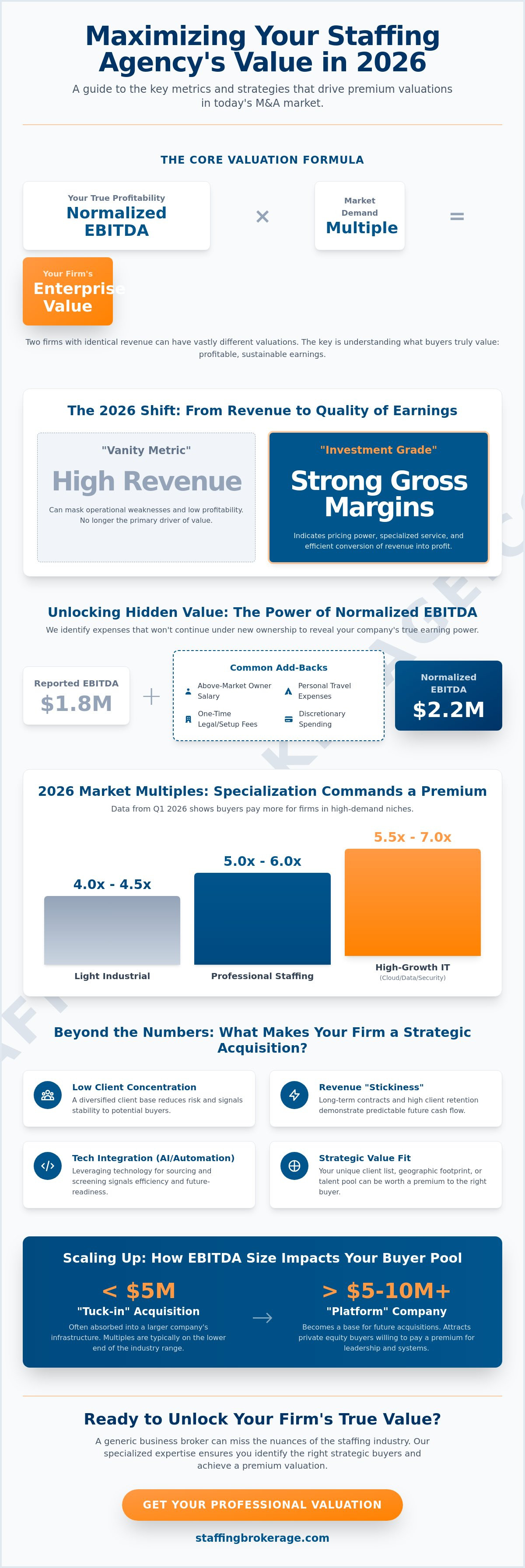
High top-line revenue often acts as a vanity metric that masks underlying operational weaknesses. Buyers today, especially private equity groups, look directly at the quality of your gross margins. An "Investment Grade" agency in 2026 isn't necessarily the largest one; it's the one with the most efficient conversion of revenue into profit. High margins suggest pricing power and a specialized service that clients can't easily replace. If your gross margins are stable and predictable, you've already cleared the first hurdle for a premium staffing company valuation.
Market Sentiment and Buyer Appetite in 2026
Buyer appetite is currently bifurcated. Generalist firms face more scrutiny, while those in high-demand niches command significant premiums. According to data from the first quarter of 2026, the specialization of your firm dictates your baseline multiple:
- High-Growth IT (Cloud/Data/Security): 5.5x to 7.0x EBITDA
- Professional Staffing: 5.0x to 6.0x EBITDA
- Light Industrial: 4.0x to 4.5x EBITDA
Buyers also prioritize firms that leverage AI to reduce time-to-hire. If your agency uses automation to improve screening and sourcing, you aren't just more efficient; you're more valuable. Technology acts as a multiplier, signaling to buyers that your firm is built for the future rather than clinging to manual, legacy processes.
The EBITDA Multiplier: Why Earnings Drive Your Agency’s Worth
While gross revenue might look impressive on a slide deck, buyers are ultimately purchasing a stream of future cash flow. This is why EBITDA, which stands for Earnings Before Interest, Taxes, Depreciation, and Amortization, is the primary anchor for any staffing company valuation. It provides a clean view of your firm's operational profitability by removing the noise of financing decisions and accounting treatments. For a buyer, your EBITDA represents the fuel available to grow the business after they take the keys. They aren't just buying your past success; they're buying your firm's capacity to generate profit tomorrow.
The size of your earnings significantly dictates the multiplier applied to that EBITDA. Generally, firms generating under $5 million in EBITDA are viewed as "tuck-in" acquisitions. In these cases, a larger company often absorbs your operations into their existing infrastructure. These deals typically command multiples on the lower end of the industry range. However, once you exceed the $5 million or $10 million EBITDA threshold, you may be categorized as a "platform" company. Platform firms often attract private equity groups willing to pay a premium because the business already has the leadership and systems to support further acquisitions.
Identifying and Calculating Add-Backs
Your tax returns rarely reflect the true economic benefit of owning your agency. To find your "Normalized EBITDA," we look for add-backs. These are expenses that won't continue under new ownership. Common examples include owner salaries that sit above market rates, personal travel, or one-time legal fees. For instance, costs associated with the initial setup for the Delaware Paid Leave Program in early 2026 or registration for the California SAFE Act are valid adjustments. Recasting financials is the process of adjusting a company’s books to show its true earning power to a buyer. By meticulously identifying these items, you can often increase your valuation by hundreds of thousands of dollars. If you're preparing for this step, learning how to sell my staffing agency through a strategic lens can help you capture every dollar of value.
Multiples by Staffing Vertical
Beyond the Numbers: Qualitative Drivers of Staffing Firm Value
A high EBITDA is a fantastic starting point, but it doesn't tell the whole story. Two agencies with identical earnings can receive vastly different offers based on the perceived risk and "stickiness" of their operations. In a professional staffing company valuation, qualitative drivers act as the swing factor that pushes your multiplier toward the higher end of the market range. Buyers aren't just looking at what you earned last year; they're looking for proof that those earnings will continue, or even grow, once you've handed over the keys. They want to see a business that functions as a well-oiled machine rather than a collection of individual efforts.
The "Founder Trap" and Transferability
One of the most common hurdles for owner-operated firms is the "Founder Trap." If you're the primary person holding every key client relationship and closing every major deal, a buyer sees significant risk. They worry that if you leave, the revenue will follow you out the door. To secure a premium valuation, you must demonstrate that your business has a management tier capable of thriving without your daily intervention. Buyers heavily discount firms where the CEO is also the primary salesperson. Transitioning from a hands-on producer to a strategic leader who empowers a recruitment and sales team is a vital step in making your firm an attractive, transferable asset.
Client Diversification and Contract Quality
Client concentration is often the primary deal killer in the staffing industry. We generally advise following the "15% Rule." This means no single client should represent more than 15% of your total gross profit. If one client accounts for 40% of your business, a buyer will view your firm as a "concentrated risk" and lower their offer accordingly. Beyond the numbers, the quality of your contracts matters. Long-term Master Service Agreements (MSAs) with exclusive or preferred vendor status are far more valuable than one-off, "spot" placements. You can maximize value selling staffing company assets by showing a diversified portfolio of stable, recurring revenue streams that aren't tied to a single point of failure.
Your technological infrastructure also plays a silent but powerful role in your staffing company valuation. A clean, well-maintained Applicant Tracking System (ATS) and CRM are gold mines for buyers. They aren't just buying your current placements; they're buying a proprietary database of talent and a history of client interactions. When your data is organized and your internal processes are automated, it signals that your firm is scalable. This technological maturity, combined with a strong internal culture and low staff turnover, provides the "strategic fit" that modern buyers are willing to pay a premium for in 2026.
The Professional Valuation Process: Preparing for a Strategic Exit
Determining your firm's worth is a methodical journey that requires both precision and discretion. A professional staffing company valuation begins with a rigorous collection of data, typically covering three years of P&L statements, balance sheets, and tax returns. We don't just look at the totals; we perform a deep-dive audit of gross margins by individual recruiter and client. This level of detail proves to a buyer that your margins are consistent and that your success isn't dependent on a single "superstar" employee or one lucky contract. It's about building a transparent, evidence-based case for your agency's stability.
Confidentiality is the cornerstone of this process. In the staffing industry, news of a potential sale can cause anxiety among internal teams and field associates. An experienced M&A advisor facilitates a "blind" valuation, ensuring your sensitive data is protected while you explore the market. We also compare your firm against a relevant set of "comps," which are recently closed deals of similar size and specialization. This benchmarking ensures your expectations align with the actual prices buyers paid in the first half of 2026, rather than outdated historical averages. If you're ready to see how your agency measures up, our team can provide a professional Business Valuation and Assessment to start your journey.
Phase 1: Financial Recasting and Normalization
Your financial statements are designed to minimize taxes, not necessarily to showcase your company's true value to a buyer. During recasting, we work together to strip away personal expenses and non-operational costs. We also create a "Pro Forma" statement that projects how the business will perform under new ownership. This phase includes a careful search for hidden liabilities. For instance, we audit your compliance with the 2026 California SAFE Act registration requirements and Delaware’s new paid leave claim processes. Addressing these operational details early prevents "deal fatigue" during the final stages of due diligence.
Phase 2: Market Positioning and Benchmarking
Once the numbers are clear, we focus on the narrative. We map your agency’s growth trajectory against national trends to highlight your competitive advantages. This information is compiled into a Confidential Information Memorandum (CIM), a document that tells the story of your staffing company valuation to qualified buyers. We'll help you set a realistic "Ask Price" based on current market data, while also defining a "Walk-Away Price." Having these benchmarks in place before negotiations begin allows you to move forward with a steady hand and total clarity on your firm's worth.
Partnering with Staffing Brokerage for an Accurate Business Assessment
General business brokers often treat a staffing firm like any other service business. They might miss the critical nuances that drive a true staffing company valuation, such as the stability of your pay-bill spread or the impact of 2026 compliance requirements on your operational risk profile. At Staffing Brokerage, we focus exclusively on this sector. We understand that your agency isn't just a collection of contracts; it's a complex ecosystem of talent, client trust, and recruiter expertise. Our specialized approach to help you sell my staffing agency assets relies on strategic matching rather than high-pressure sales tactics.
We identify the buyers who will pay a premium for your specific niche. Whether you specialize in high-growth IT or skilled trades, we know which strategic acquirers and private equity groups are currently seeking to expand their portfolios in 2026. This isn't about finding any buyer; it's about finding the right one. Our "Steady Hand" philosophy ensures you're never left wondering about the next step. We guide you through the initial assessment, the preparation of your CIM, and the final deal closure with a focus on integrity and long-term value.
Our Business Valuation and Assessment Service
Success begins with a clear-eyed look at where your firm stands today. Our assessment service provides a detailed analysis of your Normalized EBITDA, client mix, and operational scalability. We don't just give you a single number. Instead, we provide a realistic range of value based on the latest 2026 transaction data, including the rebounding M&A activity we've seen in the first quarter. Throughout this entire process, we maintain 100% confidentiality. Your data is handled with the highest level of discretion to protect your internal culture and client relationships while we build your valuation narrative.
Ready for the Next Chapter?
Moving from founder-led operations to a successful corporate exit is a major milestone. It's the culmination of your hard work and vision. Because we maintain a national network of buyers, we can ensure you achieve the best market fit possible. We look for alignment in culture and strategy, ensuring your team and clients are in good hands after the transition. If you're ready to move forward, we're here to help. Schedule a confidential consultation today to discover exactly what your staffing firm is worth in this year's market. Let's work together to turn your years of dedication into a successful and rewarding exit.
Securing Your Legacy and Future Growth
Your agency represents years of hard work and strategic decision-making. We've explored how a professional staffing company valuation balances the hard numbers of normalized EBITDA with qualitative drivers like contract quality and management depth. By recasting your financials and addressing operational risks early, you position your firm for a premium exit in a rebounding M&A market. Understanding these metrics today ensures you aren't just reacting to offers but actively steering your business toward its highest potential value.
As specialized staffing M&A experts, Staffing Brokerage provides the national reach and local industry knowledge needed to navigate this complex journey. We've built a proven track record of successful deal closures by acting as a dedicated, steady hand for entrepreneurs. Our team is committed to a partnership that values your personal milestones as much as the financial outcome. When you're ready to move forward, we're here to provide the clarity and support you deserve.
Get Your Professional Staffing Business Valuation today to discover the true worth of your firm and begin your next chapter with total confidence.
Frequently Asked Questions
What is the average EBITDA multiple for a staffing agency in 2026?
In 2026, the general range for a staffing company valuation is between 3x and 6x EBITDA. Your specific multiple depends heavily on your specialization and the size of your earnings. For instance, high-growth IT niches are currently commanding 5.5x to 7.0x, while light industrial firms typically see multiples between 4.0x and 4.5x. Firms with over $5 million in EBITDA often receive higher "platform" multiples compared to smaller agencies.
How does client concentration affect my staffing company valuation?
High client concentration is one of the most significant factors that can lower your multiplier. Most buyers prefer the "15% Rule," which suggests that no single client should account for more than 15% of your total gross profit. If one client represents a third of your business, a buyer sees a high risk that the firm's value could vanish if that one contract ends. This risk often leads to a lower offer or a deal structure with a larger earn-out portion.
What are common "add-backs" when valuing a staffing firm?
Common add-backs include owner compensation that sits above market rates, personal travel expenses, and one-time legal or consulting fees. In 2026, you might also include non-recurring costs related to legislative changes, such as the initial setup for the California SAFE Act or Delaware’s paid leave claims. These adjustments help normalize your earnings, showing a buyer the true profit potential of the business under new ownership.
Is my staffing agency valued on revenue or profit?
Staffing agencies are almost always valued based on their profit, specifically a multiple of EBITDA, rather than their top-line revenue. While revenue indicates your market presence, EBITDA proves your ability to generate cash flow. A buyer is essentially purchasing a stream of future earnings, so the efficiency of your gross margins and the control of your overhead are more important than your total billings.
How long does a professional staffing business valuation take?
A professional valuation typically takes between two and four weeks to complete. This timeframe depends on the organization of your financial records and how quickly you can provide three years of P&L statements and balance sheets. Once we have the data, the process moves quickly as we recast your financials and benchmark your agency against a relevant set of recently closed "comps" in your specific vertical.
Does the type of staffing change the valuation?
Yes, the sector you serve is a primary driver of your baseline multiple. Professional staffing firms in IT, healthcare, and specialized engineering command higher prices because their talent pools are scarce and their margins are robust. In contrast, agencies focused on general administrative or light industrial roles often face lower multipliers due to higher turnover and more competitive, price-sensitive market conditions.
What is the difference between an asset sale and a stock sale in valuation?
In an asset sale, the buyer chooses specific assets to purchase, such as your client list and brand, which allows them to depreciate those assets for tax benefits. A stock sale involves the buyer taking over the entire legal entity, including all its past liabilities and contracts. While stock sales can be cleaner for a seller, asset sales are more frequent in the staffing industry because they often provide a more favorable tax structure for the buyer.
How can I increase my staffing agency valuation before I sell?
You can boost your valuation by diversifying your client base and building a management team that doesn't rely on your daily involvement. Strengthening your "sticky" revenue through long-term Master Service Agreements (MSAs) rather than spot placements also makes your firm more attractive. Finally, ensuring your ATS and CRM data is clean and actionable proves to a buyer that your recruitment engine is scalable and ready for growth.