
Staffing Agency Value Drivers: How to Maximize Your M&A Exit Value in 2026
Did you know that the first quarter of 2026 saw 35 major staffing M&A transactions in North America, marking the strongest start to a year in over three seasons? While the market is active, professional buyers have become incredibly selective, often looking past top-line revenue to find the specific staffing agency value drivers that ensure long-term stability. It’s natural to feel a sense of uncertainty about your firm’s true worth, especially when factors like recruiter turnover or client concentration weigh on your mind. You’ve worked hard to build this business, and you deserve to know that you aren’t leaving money on the table when it’s time for your next chapter.
We're here to help you turn that uncertainty into a strategic advantage. This article provides a clear roadmap to maximize your exit value, from understanding why IT staffing firms are currently commanding multiples as high as 7.0x EBITDA to preparing for the Department of Labor’s proposed Joint Employer Rule. You will learn which operational fixes offer the highest return on investment and how to position your niche for maximum appeal. By focusing on strategic alignment and risk reduction, we can move forward with a plan to transform your agency into the premium asset professional buyers are eager to acquire.
- Learn why similar firms receive different valuations and how to leverage key staffing agency value drivers to increase your multiple.
- Discover how to optimize your revenue quality by focusing on high-margin niches like IT, where buyers look for gross margins of 30% or higher.
- Identify "value killers" like client concentration and learn how to build a business that runs smoothly without your daily oversight.
- Understand the impact of AI integration and legal hygiene on your 2026 exit value.
- Find out how professional sell-side representation ensures a collaborative journey toward a successful, high-value transaction.
What Are Staffing Agency Value Drivers and Why Do They Matter?
When you look at your staffing firm, you likely see years of hard work, late nights, and successful placements. A buyer, however, looks through a different lens. They seek staffing agency value drivers, which are the specific characteristics of your business that reduce their risk and signal high growth potential. Think of these drivers as the narrative behind your numbers. They explain why your business is a safe, profitable investment rather than just a collection of spreadsheets.
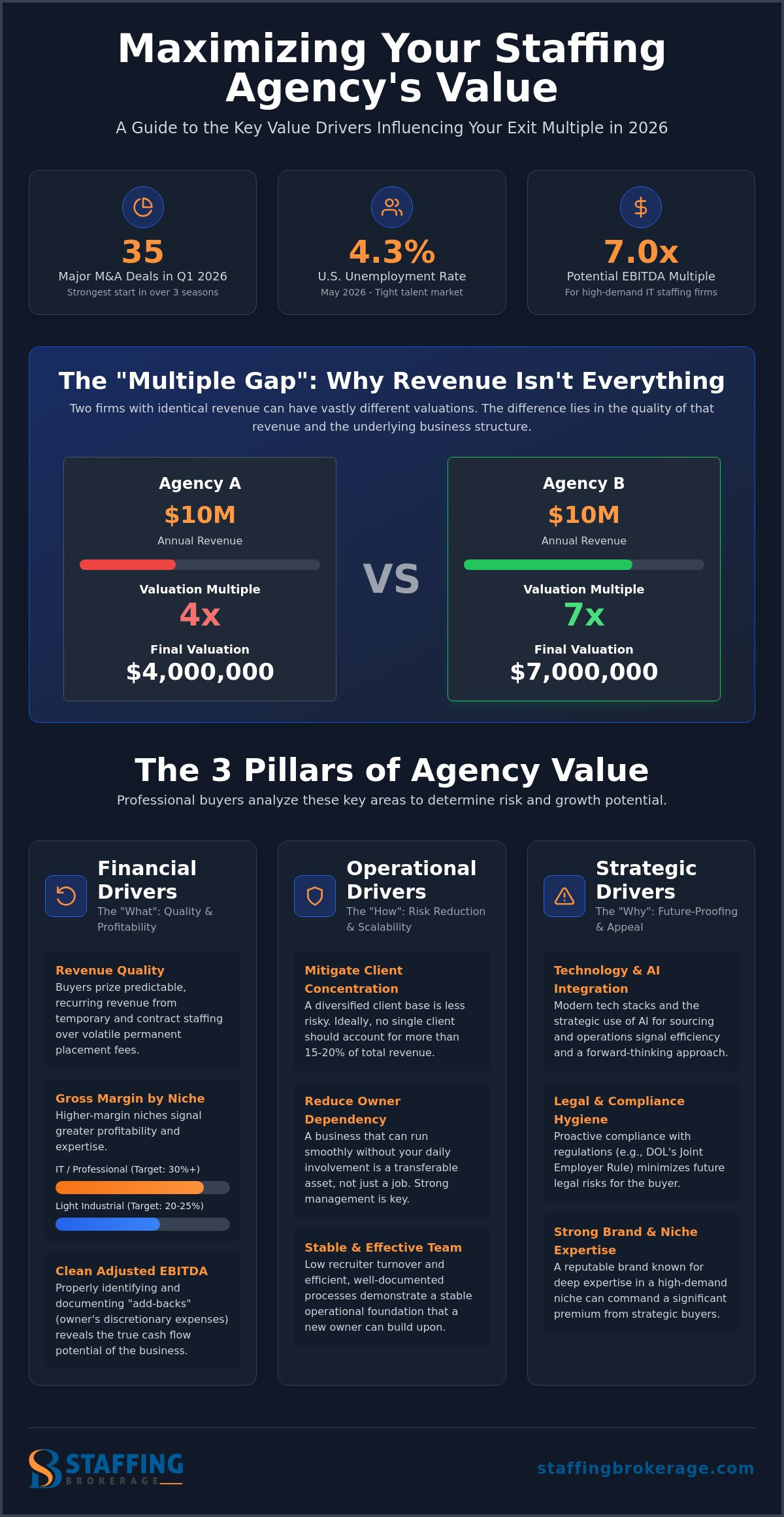
The concept of the "Multiple Gap" illustrates this perfectly. Imagine two agencies, both generating $10 million in annual revenue. One might sell for a 4x multiple, while the other commands a 7x multiple. The difference isn't found in the total revenue; it's found in the quality of that revenue. Buyers in 2026 are highly selective. With the federal funds rate sitting between 3.50% and 3.75%, the cost of capital is significant. Investors aren't just buying your past performance; they're buying the confidence that your firm will thrive under new ownership. They want a transferable asset, not a lifestyle business that relies entirely on your personal relationships to survive.
The Difference Between Price and Value
It's helpful to remember that price is what a buyer pays at the closing table, but value is the perceived future benefit they expect to receive. Your staffing agency value drivers directly influence the "multiple" applied to your earnings. In our industry, we measure these earnings through adjusted EBITDA. This figure represents your Earnings Before Interest, Taxes, Depreciation, and Amortization, adjusted to remove non-recurring expenses or one-time costs that won't continue after the sale. A clean, well-documented adjusted EBITDA allows a buyer to see the true cash-flow potential of your firm, which often leads to a higher valuation.
Strategic vs. Financial Value Drivers
Value drivers generally fall into two categories. Financial drivers focus on the "what," including your gross margins, revenue growth, and consistent cash flow. Strategic drivers focus on the "how," such as your brand reputation, deep niche expertise, and proprietary recruiting processes. A financial buyer, like a private equity firm looking for a new platform, focuses heavily on your stability and margins. Conversely, a strategic buyer might pay a significant premium if your firm offers something they lack, like a specialized IT recruiting team or a strong presence in a specific geographic market. Understanding which category your firm excels in helps us position you for the right type of partnership.
Financial Value Drivers: Revenue Quality and Margin Optimization
Financial health is the foundation of any successful exit. When we evaluate staffing agency value drivers, we start with the quality and consistency of your revenue streams. Not all dollars are created equal in the eyes of a buyer. Temporary and contract staffing revenue is prized because it represents an annuity, a predictable flow of income that continues after you hand over the keys. With the U.S. unemployment rate at 4.3% as of May 2026, the talent market remains tight. This makes your existing pool of placed contractors an incredibly valuable asset. Permanent placement revenue, while profitable, is often viewed as more volatile because it requires a constant restart each month.
Gross margins are another critical benchmark. For light industrial firms, we typically look for margins between 20% and 25%. If you operate in professional or IT niches, buyers expect to see 30% or higher. Consistency is equally vital. A buyer will always prefer a firm with three years of steady growth over a firm that doubled its revenue in a single lucky year but has no history of stability. To see how your specific numbers align with current market expectations, you can request a professional business valuation and assessment to pinpoint your exact standing.
We must also consider the add-back factor. These are owner-specific expenses, like a personal vehicle, family health insurance, or a one-time legal fee, that won't exist under new ownership. Identifying these allows us to normalize your true profitability. In many cases, this process reveals a much healthier EBITDA than your tax returns might suggest. It’s about presenting the most accurate picture of your firm’s earning power to a potential partner.
Revenue Multiples by Staffing Niche
In 2026, the niche you serve heavily dictates the multiple a buyer is willing to pay. IT and tech staffing firms, especially those with Statement of Work (SOW) capabilities, are commanding the highest multiples, often ranging from 5.5x to 7.0x of EBITDA. Healthcare staffing remains robust due to aging demographics, though regulatory shifts like the proposed Joint Employer rule require a steady hand to navigate. Industrial and light industrial firms typically see multiples between 4.0x and 4.5x. While these firms offer high volume, their lower margins and commoditization lead to more conservative valuations.
The Importance of Recurring Revenue Streams
The most valuable firms are those with sticky revenue. Buyers measure this by looking at your retention rates for both clients and temporary associates. If your firm is currently heavy on permanent placements, we can work together to build a roadmap for introducing more contract roles. This shift transforms your business from a series of transactions into a reliable income engine. This predictability reduces buyer anxiety and is one of the most effective ways to push your multiple toward the higher end of the industry range.
Operational Value Drivers: Reducing Risk and Building Scalability
Operational efficiency is where your firm proves it can scale. While financial metrics provide the foundation, operational staffing agency value drivers demonstrate that your business is a durable machine rather than a one-person show. Buyers in 2026 are particularly wary of "owner-centric" firms. They want to see that your success is built on repeatable systems and a deep bench of talent. If your growth depends entirely on your personal Rolodex, a buyer sees a high-risk transition. If your growth depends on a structured sales engine, they see a scalable opportunity.
Recruiter bench strength is another area where precision matters. High turnover is a red flag that suggests a volatile culture or poor training. Buyers will look closely at your average biller tenure and the cost of replacing a high-performing recruiter. Firms that invest in retention and professional development often command higher multiples because they offer a stable, productive workforce that doesn't require immediate rebuilding by the new owner. It’s about proving that the engine stays running long after you've exited the building.
Solving the Client Concentration Problem
Client concentration is often cited as the primary value killer in staffing M&A. If your largest client accounts for more than 15% of your total gross profit, buyers will likely apply a discount to your multiple. We call this the "Rule of 15." It is the gold standard for risk mitigation. To prepare for a sale, focus on diluting this concentration by aggressively growing your mid-tier accounts. If you have a high-concentration situation that you can't change quickly, frame it as an expansion opportunity. Show the buyer how much room is left to grow within that account or how the relationship is protected by long-term, exclusive contracts.
Building a Transferable Management Team
A truly valuable business can run for 90 days without the owner's daily involvement. This level of management depth is a significant driver of a premium exit. You need to identify your "stay players," the key recruiters and managers who are essential to the business after you leave. Protecting these assets involves more than just a good salary. It requires clear incentives and employment agreements that align their success with the new owner's goals. Planning for a successful staffing agency ownership transition ensures that your team feels secure and motivated throughout the process, which protects the value you’ve built.
Strategic Value Drivers: Technology, Compliance, and Branding
Strategic staffing agency value drivers are the differentiators that move a firm from a standard industry player to a premium acquisition target. While financial and operational metrics prove you are a healthy business, strategic drivers show you are a "future-proofed" leader. In 2026, buyers are looking for firms that have moved beyond legacy systems. They want to see a clear competitive advantage, such as a dominant brand in a specific geographic niche or a proprietary database of 10,000 plus specialized professionals who are actively engaged with your team. This candidate "gold mine" is often the hidden value that justifies a higher multiple during the valuation process.
Compliance and legal hygiene have also taken center stage this year. With the Department of Labor's proposed Joint Employer rule introduced in April 2026, buyers are performing deeper due diligence on how agencies manage liability. Clean Master Service Agreements (MSAs) and Vendor Management System (VMS) contracts are non-negotiable. If you're unsure how your current tech stack or contracts impact your marketability, our team at Staffing Brokerage provides expert staffing company sell-side representation to help you prepare for these high-level inquiries.
AI Integration as a 2026 Value Multiplier
Artificial Intelligence is no longer a luxury; it's a fundamental driver of EBITDA per recruiter. Buyers prioritize firms that have successfully automated the "top of the funnel" activities like sourcing and initial screening. Industry reports from early 2026 show that AI-driven sourcing can cut time-to-hire by 20% to 30%. This efficiency allows your team to focus on high-value relationship building rather than manual data entry. Automated candidate engagement increases the multiple by significantly reducing manual labor costs and creating a more predictable pipeline of talent.
Contractual Protections and MSA Quality
The quality of your contracts protects the buyer's future investment. Strong non-compete and non-solicit clauses ensure that the value you've built doesn't walk out the door with a departing employee. Perhaps most importantly, your contracts must include transferability clauses. These allow the agreements to remain in effect after the sale, ensuring the business doesn't lose its revenue base during the transition. We often focus on these details when negotiating the sale of a staffing agency, as clean terms can be the difference between a smooth closing and a deal that stalls in legal review. Professional branding combined with bulletproof compliance creates a narrative of stability that every buyer finds attractive.
Maximizing Your Exit Value with Professional M&A Advisory
Selling your life's work is a significant personal and professional milestone. It isn't just a transaction; it's a transition that requires a dedicated partner. While it's tempting to work with a generalist business broker, they often struggle to articulate the specific staffing agency value drivers that justify a premium multiple. A generalist might see a standard service business, but a specialist understands the nuances of VMS contracts, recruiter retention, and the impact of the 2026 regulatory landscape. At Staffing Brokerage, we act as your "steady hand" guide, ensuring your firm's unique narrative is presented with precision and authority.
Timing the market is a delicate balance. You shouldn't wait until you're exhausted to consider an exit. Instead, the best time to sell is when your internal metrics are at their peak and your growth trajectory is clear. A professional staffing company valuation serves as more than just a price tag. It establishes a realistic but aggressive floor for negotiations, providing the confidence you need to hold firm when discussing your agency's true worth with sophisticated buyers.
The Power of Strategic Matching
Our approach goes beyond finding the highest bidder; we focus on finding the right partner. The ideal buyer is one who values your specific staffing agency value drivers, such as a specialized candidate database or a repeatable sales engine, more than a generic financial investor might. We use our national reach to identify partners who offer a strong strategic fit and cultural alignment. Throughout this process, we manage a "quiet" sale. This protects your employees and clients from unnecessary anxiety, ensuring your daily operations remain stable while we secure your future.
Preparing for Due Diligence Early
The most successful deals are often decided during the due diligence phase. We conduct a thorough "Pre-Due Diligence" audit to identify and address any potential issues before a buyer's team begins their review. This proactive stance prevents eleventh-hour surprises that could potentially derail a closing. Engaging a professional staffing company M&A advisory firm streamlines this complex journey, moving you methodically toward a successful conclusion.
If you're ready to see how your hard work translates into market value, we're here to provide the clarity you need. Contact Staffing Brokerage for a confidential assessment and let's start planning your premium exit today.
Securing Your Legacy with a Strategic Exit
Maximizing your firm’s worth is about more than just hitting revenue targets. It’s about intentionally cultivating the staffing agency value drivers that professional buyers prioritize. By focusing on high-margin revenue quality, reducing client concentration, and integrating AI-driven efficiencies, you transform your business into a resilient, transferable asset. These strategic shifts not only increase your multiple but also ensure a smoother transition for your team and clients. You’ve built something remarkable; now is the time to ensure the market recognizes its full potential.
You don’t have to navigate this complex journey alone. As specialized staffing M&A experts, we provide the steady guidance needed to match your firm with our extensive national buyer network. Our proven, result-driven strategy is designed to highlight your agency’s unique strengths and secure the premium exit you’ve worked so hard to achieve. Ready to see what your staffing agency is truly worth? Request a confidential valuation assessment today.
We look forward to partnering with you on this exciting milestone. Your success is our mission, and we're ready to help you turn your hard work into a rewarding new chapter.
Frequently Asked Questions
What is a 'good' EBITDA multiple for a staffing agency in 2026?
A good multiple depends largely on your specific niche and the strength of your financial performance. In the 2026 market, IT staffing firms with Statement of Work capabilities are commanding the highest multiples, typically ranging from 5.5x to 7.0x of EBITDA. Professional staffing firms often see 5.0x to 6.0x, while light industrial firms generally range between 4.0x and 4.5x. These figures serve as a baseline, but exceptional staffing agency value drivers can push your final multiple toward the higher end of these ranges.
How does client concentration specifically impact my agency's valuation?
High client concentration is often viewed as a significant risk factor that can lead to a lower multiple. If a single client accounts for more than 15% of your total gross profit, buyers worry about the stability of the business if that relationship ends post-acquisition. To protect your valuation, it is essential to dilute this concentration by growing other accounts before hitting the market. A diversified client base signals to a buyer that your revenue is resilient and not dependent on a single point of failure.
Is it better to sell to a strategic buyer or a private equity firm?
The best choice depends on your personal goals and the legacy you wish to leave behind. Strategic buyers often pay a premium because they are looking for specific synergies, such as your geographic footprint or niche expertise, to integrate into their existing operations. Private equity firms often seek "platform" agencies with strong management teams to lead future acquisitions. We help you evaluate both paths to find the partner that offers the best strategic fit and long-term value for your team.
What are 'add-backs' and how do they increase my staffing firm's value?
Add-backs are non-recurring or personal expenses that a new owner will not incur, which we add back to your net income to calculate your true adjusted EBITDA. Common examples include owner-specific perks, one-time legal fees, or discretionary spending that won't continue after the sale. By identifying these costs, we normalize your profitability and present a clearer picture of your firm's earning power. This process often reveals a higher true cash flow, which directly increases the final valuation of your business.
How long does it typically take to prepare a staffing agency for a high-value sale?
While a transaction can close in several months, the ideal preparation phase starts 12 to 24 months before you plan to exit. This timeframe allows you to optimize your staffing agency value drivers, such as diversifying your client base and cleaning up legal contracts. Early preparation ensures you have the robust documentation and stable financial history required to withstand rigorous due diligence. It also gives you the time to implement operational improvements that can significantly increase your eventual sale price.
Does the location of my staffing agency matter for a national buyer?
Location remains a key factor for buyers looking to expand their geographic footprint or enter a specific high-growth regional market. National buyers often target agencies in areas where they lack a physical presence but see strong demand for talent. However, if your firm has deep specialization in a high-demand niche like IT or skilled trades, your candidate database and expertise often carry more weight than your physical office address. A strong national reach helps us match your specific location with the right strategic partner.
What role does AI play in staffing agency valuation today?
In 2026, AI integration is a powerful efficiency multiplier that buyers use to gauge your firm's future-readiness. Agencies that use AI to automate sourcing and screening can report time-to-hire reductions of 20% to 30%, which significantly improves EBITDA per recruiter. This technology allows your team to focus on high-value relationship management rather than manual data entry. Buyers prioritize firms with a modern tech stack because it suggests a scalable operation that can thrive in a competitive, tech-driven landscape.
Should I focus on growth or profitability in the 12 months before selling?
Profitability and margin stability are usually the most critical factors in the final year before a sale. While top-line growth is attractive, buyers apply multiples to your EBITDA, so an extra dollar of profit is often worth more than an extra dollar of raw revenue. You should focus on maintaining healthy gross margins, ideally 30% or higher for professional niches, while ensuring your growth remains steady and predictable. A balance of consistent growth and strong profitability projects the most confidence to potential partners.


