
10 Critical Questions to Ask a Staffing M&A Advisor Before You Sign
What if the greatest risk to your staffing agency's legacy isn't a market shift, but a "tail" clause hidden in an advisor's contract? With 35 staffing M&A deals already announced in the first quarter of 2026, the market is moving fast, yet many owners still feel a lingering anxiety. You've spent years building your firm's gross margins and reputation. It's natural to worry about confidential information leaking to competitors or hiring a generalist who doesn't grasp the nuances of IT staffing or light industrial multiples. Knowing the right questions to ask staffing m&a advisor candidates is the only way to ensure your hard work is truly protected.
We believe your exit should be a collaborative journey, not a source of stress. This article empowers your strategy by showing you exactly how to vet a partner who understands staffing-specific valuation drivers. We'll provide a clear framework for your interviews, covering everything from contract terms to industry expertise. By the end, you'll have the confidence to choose a mentor who will maximize your deal value and secure your professional milestones.
Key Takeaways
- Understand why specialized industry knowledge is the most critical asset for accurately valuing your firm's unique gross margins and niche positioning.
- Master the specific questions to ask staffing m&a advisor professionals to ensure they have a proven track record of closing deals in your specific sector.
- Learn how to navigate fee structures and contract terms so you can enter a partnership with complete transparency and financial confidence.
- Secure your legacy by identifying the day-to-day operational protocols that safeguard your business's confidentiality throughout the entire transaction.
- Establish a clear roadmap for interviewing potential advisors that focuses on strategic fit and long-term value rather than high-pressure sales tactics.
Why the Right Staffing M&A Advisor is Your Most Important Strategic Asset
Selling your staffing firm is a deeply personal milestone. It represents years of late nights, urgent placements, and strategic growth. Because this is more than a simple exit, you need a partner who views the process as a collaborative journey rather than a cold transaction. A specialized advisor serves as a mentor and a steady hand through the complexities of Mergers and acquisitions (M&A). Without this specific expertise, you risk deal fatigue or a final valuation that fails to capture your company's true value. Preparing the right questions to ask staffing m&a advisor professionals is the best way to protect your legacy from the start.
The Risks of Hiring a Generalist Business Broker
Generalist brokers often lack the industry-specific lens required to value a staffing company correctly. They might treat your firm like a traditional retail business, overlooking the qualitative drivers that sophisticated buyers prioritize. This lack of specialization creates several vulnerabilities during a sale.
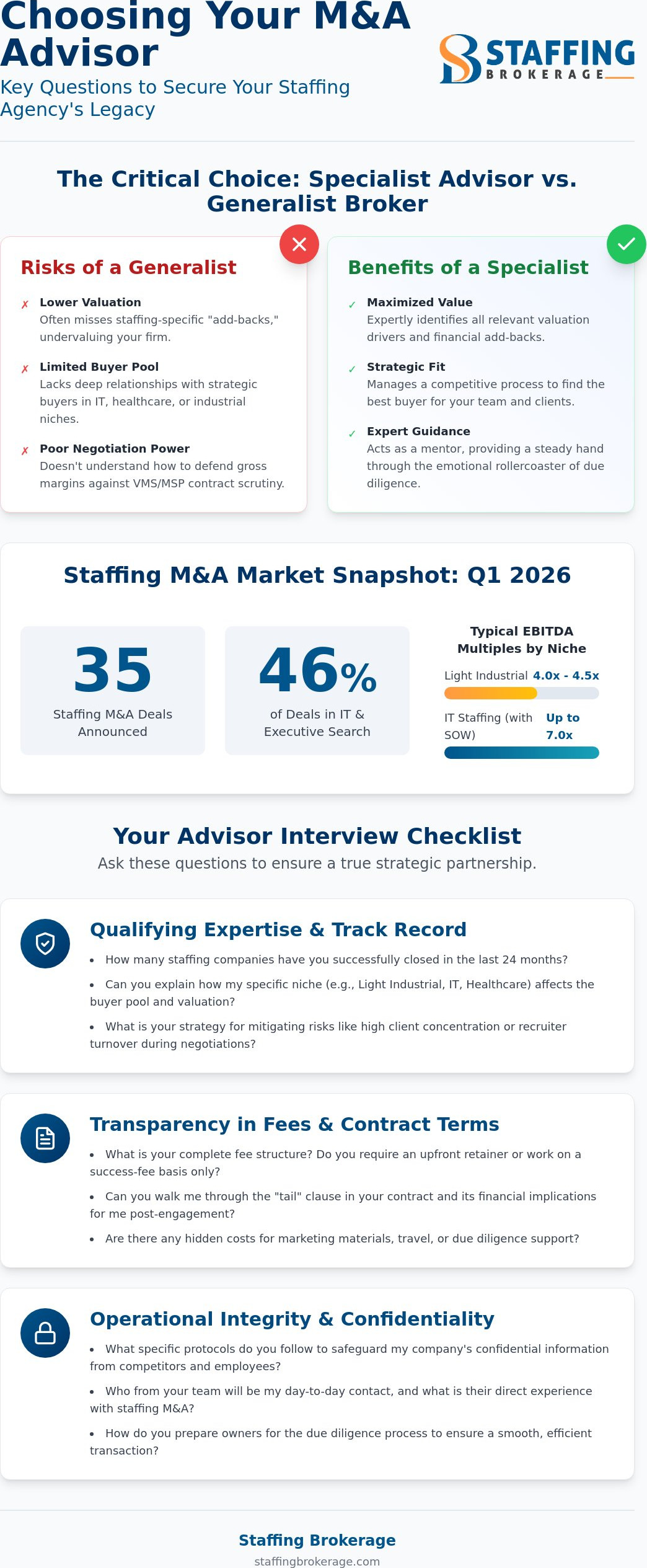
- Generalists frequently miss staffing-specific "add-backs," such as non-recurring tech migrations or specific owner expenses, which can lead to a significantly lower valuation.
- They rarely possess deep-rooted relationships with strategic buyers who are actively looking for specific niches like IT staffing or healthcare.
- A generalist may not understand how VMS or MSP contracts impact your pricing power or how to defend your gross margin stability during negotiations.
Defining the Role of a Specialized M&A Consultant
A specialized consultant moves beyond simply "listing" a business. They actively manage a competitive process designed to find the best strategic fit for your team and your clients. The advisor acts as the vital bridge between your current daily operations and your future professional or personal growth. During the due diligence phase, which often feels like an emotional rollercoaster, they provide a calm, experienced perspective to keep the deal moving forward. This hands-on guidance ensures that you stay focused on running your business while they handle the intricate financial and legal hurdles of the closing process. By using questions to ask staffing m&a advisor candidates to vet their experience, you ensure your partner has the "steady hand" necessary for a successful transition.
Qualifying Expertise: Questions to Probe Staffing Industry Track Record
Choosing an advisor is a high stakes decision that requires more than a gut feeling. You need objective proof of their ability to navigate the specific hurdles of the workforce solutions sector. According to Forbes, certain Qualities of a Qualified M&A Advisor, such as deep industry objectivity and risk management, are non negotiable. When you begin your interviews, focus on these specific questions to ask staffing m&a advisor candidates to ensure they possess the "steady hand" your business deserves.
Start by asking: "How many staffing companies have you successfully closed in the last 24 months?" The market in 2026 is moving quickly. With 35 transactions announced in the first quarter alone, you want a partner who is active in the current environment. A follow up question should address your specific sector: "Can you explain how my specific niche affects the buyer pool?" For instance, IT staffing and executive search accounted for 46% of all deal activity early this year. If you operate in the light industrial sector, you need an advisor who recognizes the recent resurgence in that space, which saw seven deals in Q1 2026 compared to only 13 in all of 2025.
Next, dive into market data. Ask: "What is your current perspective on staffing company revenue multiples?" A qualified advisor should cite current benchmarks, such as 4.0x to 4.5x EBITDA for light industrial or up to 7.0x for IT staffing with SOW capabilities. They must also be prepared for tough conversations. Ask: "How do you handle buyers who are concerned about our recruiter turnover or client concentration?" If one client accounts for more than 20% of your revenue, your advisor needs a clear strategy to mitigate that risk during negotiations.
Understanding Staffing-Specific Valuation Drivers
A specialized advisor knows that your bottom line is rarely as simple as it appears on a tax return. Inquire about how they normalize EBITDA for a staffing firm. They should look for specific add-backs like owner compensation, non-recurring technology migrations, or one-time legal fees. It's helpful to ask about their experience with sophisticated staffing company valuation models that account for "quality of earnings" (QoE) reports. These reports are essential in 2026 as buyers scrutinize add-backs to ensure profitability is sustainable under new ownership.
Verifying a Specialist Buyer Network
Don't settle for an advisor who simply "blasts" an email list. Ask for examples of recent strategic versus financial buyers they have worked with. You want someone with direct lines to private equity groups that utilize a "platform plus add-on" strategy. This approach involves acquiring a stable firm like yours as a foundation for future acquisitions. If you are looking for a partner who prioritizes strategic fit, getting a professional Business Valuation and Assessment is often the first step toward a successful match.
Transparency in Logistics: Questions About Fees and Contract Terms
Once you've verified an advisor's industry knowledge, it's time to look at the fine print of the partnership. Transparency in financial and contractual logistics is the foundation of a trust based relationship. You shouldn't feel hesitant to dive deep into the numbers; a professional advisor expects these questions to ask staffing m&a advisor candidates. Clear communication about costs prevents surprises during the final stages of a deal, ensuring you stay focused on the transition rather than the invoice.
Start by asking Question 5: "What is your fee structure, and what percentage is contingent on a successful close?" You also need to know Question 6: "Is there an upfront retainer, and what specific deliverables does it cover?" These answers reveal how the advisor balances their own business needs with your goal of a high valuation. Additionally, ask Question 7: "What is the length of your 'tail' period, and does it apply to all buyers or only those you introduced?" Finally, clarify Question 8: "Are there any hidden costs for marketing materials or third party valuations?" These questions ensure that every dollar spent is an investment in your firm's future.
Deciphering the Success Fee vs. Retainer Balance
A success based fee structure is the gold standard because it aligns your advisor's interests directly with yours. When the majority of their compensation depends on the final sale price, they're incentivized to negotiate the best possible terms for your agency. While success fees are the primary driver, a "modest" retainer is common in the national staffing M&A market. This retainer typically covers the heavy lifting of the initial phase, such as performing a deep dive valuation and creating a professional Confidential Information Memorandum (CIM). Discussing these fees early builds the trust necessary for a collaborative journey.
The "Tail" Period and Engagement Exclusivity
The "tail" period is a standard clause in most engagement letters, usually lasting between 12 and 24 months. It exists to protect the advisor from situations where a seller might pause a deal only to close it privately with a buyer the advisor introduced. However, you should negotiate this tail so it only applies to "covered" buyers who were actually part of the advisor's process. When you are Negotiating M&A Engagement Letters, focus on performance milestones rather than indefinite exclusivity. Avoid any advisor who demands long term commitment without providing a clear, step by step roadmap of their planned activities and deliverables. This approach keeps the process methodical and intentional, protecting both your time and your agency's value.
Operational Integrity: Questions on Confidentiality and Team Structure
Your staffing agency's value isn't just in its contracts; it's in the people and the processes you've perfected over years. Protecting these assets during a transition requires more than just a signed agreement. It requires operational integrity. As you finalize your shortlist, there are several high level questions to ask staffing m&a advisor candidates regarding their team structure and security measures. These inquiries ensure your "secret sauce" remains protected while you find the ideal strategic fit for your firm's future.
Ask Question 9: "Who specifically will be my point of contact and manage the day-to-day process?" In many large firms, the senior partner who pitches you might disappear once the engagement letter is signed. You should also ask Question 10: "What is your step-by-step protocol for protecting my confidentiality with employees and competitors?" A professional advisor uses a "blind profile" or teaser in the early stages of the staffing business sale process. This document highlights your firm's strengths without revealing its identity. This leads to Question 11: "How do you vet buyers before sharing any sensitive financial or client data?"
The "Bait and Switch": Ensuring Senior-Level Attention
M&A is a relationship business that demands a "steady hand" at the top. You should insist on regular strategy calls with the lead advisor rather than being handed off to a junior associate. Junior staff often lack the industry intuition needed to navigate complex negotiations or recognize subtle shifts in buyer sentiment. Senior level attention ensures that the person managing your deal understands the qualitative nuances of the staffing industry, providing the professional authority your transaction requires.
Protecting Your Staffing Agency’s "Secret Sauce"
Staffing firms are built on "tribal knowledge" and the deep relationships your recruiters hold with their talent pools. If your top performers hear rumors of a sale before you're ready, you risk losing the very people who drive your valuation. Your advisor must use staged data release and ironclad Non-Disclosure Agreements (NDAs). They should manage due diligence in a way that doesn't alert your team, maintaining stability until the deal is certain. If you want a partner who prioritizes this level of discretion, consider our Staffing Company Sell-Side Representation to guide your journey.
Partnering for Success: The Staffing Brokerage Collaborative Approach
At Staffing Brokerage, we view every engagement as a shared mission. We prioritize long-term value and strategic fit because we know your business represents your life's work. Our commitment to honest practice ensures that the results we deliver are both proven and sustainable for staffing owners. With a national reach and deep roots in the workforce solutions industry, we provide the sophisticated guidance you need to navigate these high-stakes transitions. Having a clear set of questions to ask staffing m&a advisor candidates is the first step toward finding a partner who truly aligns with your goals. We invite you to a confidential, no-obligation assessment of your business to explore how we can support your unique journey.
Moving from Founder to a Successful Exit
Transitioning from a hands-on founder to a successful exit requires more than just finding a buyer; it requires a roadmap. We guide owners through the intricacies of staffing agency succession planning by focusing on what makes your specific firm special. A "one-size-fits-all" approach often fails in this industry because every agency has its own culture and niche expertise. We develop personalized strategies that respect your history while positioning you for maximum valuation. As you consider your options, think about your legacy as much as the final check. Your firm's future depends on finding a successor who values your team and your clients as much as you do.
Your Next Steps Toward a Strategic Transaction
The complexity of a strategic transaction shouldn't feel overwhelming. By knowing the right questions to ask staffing m&a advisor professionals, you ensure a "steady hand" is at the helm of your deal. This clarity transforms a stressful process into a methodical, step-by-step progression toward your personal and professional milestones. When you are ready to take the next step, Schedule a confidential consultation with Staffing Brokerage. The right partnership makes even the most complex transitions feel manageable and rewarding. We are here to serve as your dedicated guide, ensuring your exit is as successful as the business you've built.
Secure Your Legacy with the Right Strategic Partner
Your staffing agency is the result of years of dedication and strategic growth. Transitioning away from your business is a significant milestone that deserves the highest level of care and professional integrity. By mastering the questions to ask staffing m&a advisor candidates, you ensure that your partner possesses the industry intuition and operational transparency required for a successful close. You've learned how to spot the risks of generalist brokers and the importance of ironclad confidentiality protocols that protect your "secret sauce" and your top-performing recruiters.
Choosing an advisor with specialized staffing industry expertise and a national network of strategic buyers makes the complex feel manageable. We provide a proven track record of successful transitions, offering the steady hand you need during this collaborative journey. Your hard work has built a valuable firm; now is the time to ensure its future is in expert hands. Ready for a confidential assessment? Speak with a Staffing Brokerage advisor today. We look forward to helping you achieve the rewarding exit you've earned.
Frequently Asked Questions
How much do staffing M&A advisors typically charge?
Advisors generally utilize a fee structure that combines a success based percentage of the final transaction value with a monthly or one time retainer. This balanced approach ensures your partner is motivated to maximize your valuation while covering the intensive costs of the initial assessment and marketing phases. The specific success fee often follows tiered industry scales that adjust based on the total size of the deal.
Is it better to use a local business broker or a national staffing M&A advisor?
A national staffing M&A advisor is almost always the superior choice because the buyer pool for specialized agencies is rarely limited by geography. While a local broker might understand your immediate market, a national expert understands your specific niche and has direct lines to international strategic buyers. This industry specific lens is one of the most vital questions to ask staffing m&a advisor candidates during your search.
What is a "tail" in an M&A engagement letter?
A "tail" is a contractual period, usually lasting 12 to 24 months after an engagement ends, where the advisor is still entitled to a fee if you sell to a buyer they introduced. It protects the advisor's work in identifying and vetting potential partners for your agency. You should ensure the tail only applies to specific "covered" buyers who were actively involved in the advisor's process during the engagement.
Can I sell my staffing agency without an M&A advisor?
You can sell your agency independently, but you face higher risks of valuation errors and confidentiality leaks to competitors. Without an advisor to manage the competitive process, you may struggle to defend staffing specific "add backs" or navigate the emotional rollercoaster of due diligence alone. Most owners find that a professional partner pays for themselves by securing a higher multiple and a much smoother transition.
How long does the average staffing agency sale take from start to finish?
The average staffing agency sale typically takes between six and twelve months from the initial valuation to the final close. This timeline includes several distinct phases: preparing the financial data, identifying prospective buyers, conducting management meetings, and finalizing the due diligence process. A methodical approach ensures that no details are overlooked and that the final agreement protects your long term professional legacy.
What is the difference between a strategic buyer and a financial buyer in staffing?
Strategic buyers are usually other staffing firms looking for market share, while financial buyers are typically private equity firms focused on return on investment. Strategic partners often pay higher multiples because they can realize immediate synergies and cost savings. Financial buyers might offer "rolled equity," allowing you to stay involved and benefit from future growth as they build a larger platform through acquisitions.
How do I check the track record of an M&A advisor?
You can verify a track record by requesting a list of recently closed staffing transactions and speaking directly with former clients about their experience. Look for advisors who are active in industry associations and can demonstrate deep knowledge of current market multiples. Asking specific questions to ask staffing m&a advisor about their experience with your particular niche will reveal their true level of expertise and industry involvement.
Should I pay an upfront fee to an M&A consultant?
Retainers are standard in the industry and cover the significant work performed before a deal ever reaches the market. This fee supports the creation of your Confidential Information Memorandum and the execution of a comprehensive, professional valuation. A modest upfront commitment demonstrates that both the owner and the advisor are dedicated to a high quality sales process that prioritizes long term value over a quick transaction.