
Selling a Commercial Staffing Agency: The Strategic 2026 Guide to a Maximum Value Exit
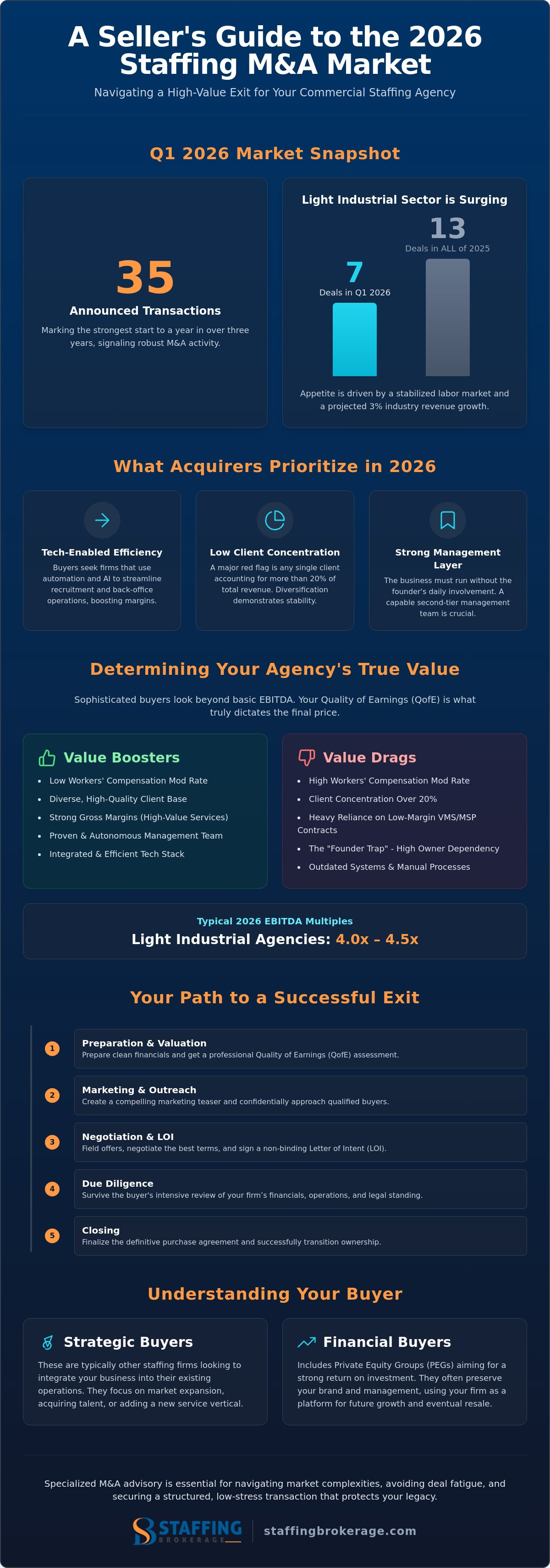
The first quarter of 2026 saw 35 announced transactions in the staffing industry, marking the strongest start to a year in over three years. While this momentum is promising, the decision to move toward an exit often brings a mix of pride and uncertainty. You've likely spent years building your firm, and it's natural to feel concerned about confidential leaks to competitors or the weight of intense due diligence. You're looking for more than just a high price; you want a smooth transition that protects your legacy and your team.
Mastering the process of selling a commercial staffing agency requires a strategic approach that balances financial goals with operational integrity. We'll show you how to navigate the current market, where buyers prioritize tech-enabled efficiency and diversified client portfolios. This guide covers everything from current EBITDA multiples to creative deal structures, providing a clear path to a clean, high-value exit. By the end, you'll have a roadmap to turn your professional milestone into a rewarding reality.
Key Takeaways
- Learn why current 2026 market trends favor light industrial firms and how to audit your client concentration to protect your valuation.
- Master the step-by-step process of selling a commercial staffing agency, from preparing clean financials to creating a compelling marketing teaser.
- Understand the differences between strategic and financial buyers to ensure your firm finds a home that respects your legacy and employees.
- Discover why specialized staffing M&A advisory is essential for avoiding deal fatigue and securing a structured, low-stress transaction.
- Move beyond basic EBITDA multiples by identifying Quality of Earnings factors that sophisticated buyers prioritize in today's economy.
The 2026 Landscape: Why Selling a Commercial Staffing Agency Requires a Modern Strategy
The 2026 market for staffing firms has reached a pivotal turning point. With 35 transactions announced in the first quarter alone, we're seeing the strongest start to a year in over three seasons. This surge reflects a broader trend in Mergers and acquisitions (M&A) where buyers are moving away from simple "body shop" models. Instead, they're hunting for strategic talent partners. If you're considering selling a commercial staffing agency this year, you're entering an environment that rewards operational precision and technological integration over sheer volume.
Demand is particularly robust in sectors like light industrial staffing. In fact, the first quarter of 2026 saw seven deals in this sector, a massive jump compared to the 13 deals recorded in the entire 2025 calendar year. This appetite is driven by a stabilized labor market and a projected 3% industry revenue growth. Buyers aren't just looking for headcount; they're looking for firms that have weathered recent shifts and emerged with clean margins and resilient client bases.
Market Drivers for Commercial Staffing in 2026
Several external factors are shaping valuations right now. Reshoring initiatives have revitalized domestic manufacturing, placing a premium on agencies with strong light industrial pipelines. Additionally, buyers are placing a significant premium on firms that have integrated automation and AI into their back-office operations. Technology integration isn't just a buzzword anymore. It's a margin booster that streamlines recruitment and payroll, making your firm more attractive during due diligence.
The financial environment also plays a role in these transitions. As of July 2, 2026, the Prime Rate sits at 6.75%. This impacts the cost of capital, with SBA 7(a) fixed-rate loans ranging from 9.75% to 14.75%. While these rates are a consideration, the high volume of deal activity suggests that quality firms still command competitive attention from both private equity and strategic buyers.
The "Founder Trap" and Marketability
One of the biggest hurdles in selling a commercial staffing agency is what we call the "Founder Trap." If the business can't run without your daily involvement, its value drops significantly. Buyers in 2026 are looking for a scalable enterprise, not a lifestyle business. They want to see a second-tier management layer that can maintain operations and client relationships after you exit. This ensures the company's stability and protects the buyer's investment.
Transitioning your firm into a marketable asset involves documenting every process and diversifying your revenue. If a single client accounts for more than 20% of your total revenue, it's a red flag for most acquirers. Successful exits this year are defined by firms that have professionalized their leadership and reduced dependency on any one individual or customer.
Determining Value: Advanced Metrics for Staffing Company Valuation
Valuation isn't just about the bottom line. While EBITDA is the starting point, sophisticated buyers in 2026 are looking deeper into your Quality of Earnings (QofE) when you are selling a commercial staffing agency. They want to know if your profit is repeatable. This means they'll scrutinize your workers' compensation experience modification rate. A low experience mod suggests a culture of safety and operational control, which directly increases your agency's worth. Conversely, high mods act as a drag on valuation; they signal hidden risks and potential future costs that a buyer will have to absorb.
Client concentration remains a critical factor when selling a commercial staffing agency. If a single client accounts for more than 20% of your total revenue, buyers see a significant risk. If that client leaves, the business is crippled. We also look closely at how your Vendor Management Systems (VMS) and Managed Service Provider (MSP) contracts are structured. While these provide steady volume, their lower margins mean they're often valued differently than direct-hire or high-margin niche business. Getting a professional business valuation and assessment can help you identify these nuances before you begin the exit process.
The EBITDA Multiple Framework for 2026
Current market data from mid-2026 shows clear ranges for different sectors. Light industrial agencies are typically trading between 4.0x and 4.5x EBITDA. Professional staffing firms command higher multiples, usually between 5.0x and 6.0x. If your firm specializes in high-growth IT with Statement of Work (SOW) capabilities, you might see multiples as high as 7.0x. Buyers are currently very strict about "add-backs." They'll verify every personal expense or one-time cost you try to add back to your earnings to ensure the numbers are transparent. Understanding the tax implications of selling a business is equally vital, as your deal structure will determine how much of that multiple stays in your pocket.
Operational KPIs That Drive Premium Prices
To reach the top end of those valuation ranges, your internal metrics must be stellar. Buyers look for specific signals of health:
- Gross Margin Stability: In the commercial sector, buyers look for consistent margins that aren't being eroded by price wars.
- Recruiter Productivity: High revenue-per-recruiter ratios suggest a lean, tech-enabled operation.
- Associate Retention: High retention rates for your temporary staff signal a reliable service model and lower recruitment costs.
These KPIs prove that your agency is a well-oiled machine. When you can demonstrate growth through data rather than just anecdotes, you build the confidence needed for a maximum-value transaction. Buyers are willing to pay a premium for stability and a proven track record of operational excellence.
Strategic vs. Financial Buyers: Finding the Right Fit for Your Legacy
Choosing the right buyer is a pivotal moment in the process of selling a commercial staffing agency. It isn't just about the highest number on a term sheet; it's about the future of your staff and the continuity of your service. In 2026, the buyer pool is primarily divided into two camps: strategic and financial. Each group has a different philosophy and set of motivations. Understanding these helps you align your exit with your long-term personal and professional goals.
Balancing a high offer against the best outcome for your team requires a steady hand. While a financial buyer might offer a complex structure with future upside, a strategic buyer might provide a more straightforward, clean exit. We often see that the "best" fit is the one where the buyer's operational DNA matches your own. Commercial staffing is a high-touch, fast-paced business. If the buyer doesn't understand the nuances of managing a large temporary workforce, the transition can become rocky for your long-term employees.
The Strategic Buyer Advantage
Strategic buyers are typically industry peers or larger staffing firms looking for synergy. They might want to acquire your agency to expand their geographic footprint or to add a specific service line, like light industrial or clerical staffing, to their portfolio. Because they can often consolidate back-office functions like payroll and HR, they can find cost savings that allow them to offer higher multiples. Integration usually moves quickly because they already understand the regulatory environment and the specific challenges of the commercial sector. For example, a national firm looking to enter a new state can use your established reputation as a springboard for rapid expansion.
Private Equity and the "Platform" Play
Financial buyers, particularly private equity (PE) groups, are aggressively targeting the staffing sector this year. According to the 2026 Staffing Industry M&A Report, many PE firms are using a "Platform + Add-on" strategy. They acquire a large, stable agency to serve as a platform and then "bolt on" smaller, specialized firms to drive growth. This model often involves "rolled equity," where you retain a minority stake in the new entity. This gives you a "second bite of the apple" when the PE firm eventually sells the entire platform. However, be prepared for a rigorous due diligence process. Financial buyers are intensely focused on clean data, scalable processes, and recurring revenue streams.
Ultimately, your decision depends on what you value most. If you want to see your brand live on and your team integrated into a larger industry leader, a strategic buyer is often the way to go. If you're looking for a partner to help scale the business while you retain some ownership, a financial buyer might be the better fit. We're here to help you weigh these options so you can move forward with confidence.
The M&A Process: A Step-by-Step Guide to Selling Your Staffing Business
Selling a commercial staffing agency is a marathon, not a sprint. It's a structured process that requires patience and precision to ensure you don't leave value on the table. The journey starts with a rigorous preparation phase. You'll need to clean up your financial statements and document every operational process. Buyers are looking for a business that can function seamlessly from day one of the new ownership. If your records are disorganized, it creates doubt, and doubt is a deal-killer.
Once your house is in order, we move to the marketing phase. This begins with a "Teaser," a document that provides enough data to pique interest without revealing your company's name. Qualified buyers who sign an NDA then receive the Confidential Information Memorandum (CIM). This is your firm's story told through data, highlighting your growth potential and market position. This phase leads to the Letter of Intent (LOI), which is the most critical document in the deal. It sets the price, the timeline, and the exclusivity period.
The next hurdle is the due diligence marathon. Buyers will perform a deep dive into your client contracts, recruiter performance, and tax filings. They'll verify every claim made in the CIM. Success here depends on the quality of your preparation. Finally, we reach the closing and transition phase. This is where the handoff occurs. A smooth transition ensures that your long-term employees and clients feel secure during the change in leadership. If you're ready to start this journey, our staffing company sell-side representation services provide the steady hand you need.
Maintaining Confidentiality During the Sale
Protecting your reputation is our top priority. We prevent "competitor shopping" by vetting every potential buyer before they see any sensitive information. Non-disclosure agreements (NDAs) are non-negotiable. They ensure that your internal staff and competitors don't find out about the sale prematurely. Usually, it's best to inform your key management team only when a deal is highly likely to close, protecting your daily operations from unnecessary stress.
Navigating Staffing Company Deal Structure
The final check you receive depends heavily on how the transaction is built. Most deals include a mix of cash at closing and earn-outs. Earn-outs are performance-based payments that can bridge the gap between your asking price and the buyer's offer. You'll also need to manage working capital adjustments, which ensure the business has enough liquidity to operate post-sale. For a deeper look at these complexities, read our guide on staffing company deal structure to understand how to maximize your take-home pay.
Maximizing Your Exit: Why Specialized M&A Advisory is Non-Negotiable
Choosing the right partner to represent your interests is the final, most critical decision in your journey. While general business brokers facilitate many types of sales, selling a commercial staffing agency requires a level of industry specific knowledge that generalists simply don't possess. A general broker might understand basic cash flow, but they often struggle with the nuances of workers' compensation experience mods, VMS contract profitability, or the impact of the SAFE Act in California. These details aren't just administrative; they're the levers that determine your final valuation and the security of your deal.
Industry expertise is your best defense against "deal fatigue." Many transactions fail during the final stages because the parties lose momentum during complex due diligence. A specialized advisor anticipates these hurdles before they arise. At Staffing Brokerage, we act as your steady hand, keeping the process moving at a methodical pace. We don't just wait for buyers to find you. We leverage a national pool of qualified strategic and financial buyers who are specifically looking for commercial staffing platforms. This creates a competitive environment that positions your firm as the logical, high value conclusion of your years of hard work.
The Value of Industry-Specific Representation
Staffing contracts and liabilities are unique. An advisor who understands the "emotional rollercoaster" of this industry knows that your employees are your greatest asset. We help you navigate the delicate balance of maintaining confidentiality while proving the strength of your recruiter team. This specialized approach ensures that your legacy is protected and your team finds a stable home. For a deeper look at how we manage these complex transitions, explore our insights on staffing company M&A advisory.
Preparing for Your Next Chapter
Succession planning is more than just a retirement strategy; it's a tool for value maximization. By the time you reach the final signature, you should feel a sense of shared accomplishment rather than exhaustion. Our role is to guide you through every step, from the initial business valuation and assessment to the final closing documents. We handle the heavy lifting of the M&A process so you can focus on running your business until the handoff is complete. Ready to see what your hard work is worth in the 2026 market? Schedule a confidential valuation with Staffing Brokerage today.
Securing Your Professional Legacy in 2026
The journey toward an exit is a significant milestone that honors everything you've built. The 2026 market offers unique opportunities for owners who prioritize operational precision and technological integration. By focusing on a diversified client base and maintaining a low experience mod, you position your firm as a premium asset in a competitive landscape. Whether you align with a strategic peer or a financial partner, the goal remains a transaction that provides financial reward while protecting your long-term employees.
Selling a commercial staffing agency is a complex process, but you don't have to walk this path alone. Our team of specialized staffing industry M&A experts provides the steady hand and access to a national network of qualified buyers needed to ensure a strategic fit. We've built a proven track record of closures that value both the numbers and the people behind them. Your hard work deserves a transition that is as methodical as it is rewarding.
Begin your journey to a successful exit with a professional staffing company valuation. We're ready to help you turn your strategic growth plan into a successful reality.
Frequently Asked Questions
How much is my commercial staffing agency worth in 2026?
Valuation depends on your specific sector and EBITDA. As of mid-2026, light industrial firms typically see multiples between 4.0x and 4.5x, while professional staffing firms can reach 5.0x to 6.0x. These figures are based on your trailing twelve months (TTM) earnings. Factors like recruiter retention and tech integration can push you toward the higher end of these ranges. A professional assessment is the best way to determine your firm's specific market price.
How long does the process of selling a staffing company typically take?
The typical timeline for selling a commercial staffing agency ranges from six to nine months. This period accounts for initial preparation, marketing to potential buyers, and the rigorous due diligence phase. While some deals close faster, a methodical pace ensures that all legal and financial details are handled correctly. This steady approach protects your legacy and ensures a smooth transition for your long-term employees and clients.
Should I tell my employees I am selling the agency?
It's generally best to maintain confidentiality until a deal is nearly certain. Informing staff too early can lead to anxiety, recruiter turnover, or accidental leaks to competitors. We typically recommend involving a few key management members under strict NDAs during the process. You should only share the news with the broader team once the Letter of Intent has transitioned into a firm purchase agreement and closing is imminent.
What is the difference between a strategic buyer and a financial buyer?
Strategic buyers are industry peers who seek synergies, such as geographic expansion or cost savings in back-office operations. Financial buyers, like private equity groups, view your agency as a platform for growth. While strategic buyers often offer higher upfront multiples due to cost savings, financial buyers may offer rolled equity. This allows you to retain a minority stake and benefit from a second sale in the future.
Can I sell my staffing agency if I have high client concentration?
Yes, you can sell with high client concentration, but it will likely impact your valuation or deal structure. Buyers view any client accounting for over 20% of revenue as a significant risk. To mitigate this, buyers may require a larger portion of the sale price to be tied to an earn-out. This structure ensures you are compensated fairly while protecting the buyer if a major account departs shortly after the sale.
What are common red flags that kill staffing M&A deals?
Deal-killers often include disorganized financial records, high recruiter turnover, or undisclosed legal liabilities. In 2026, buyers are also wary of firms that lack a second-tier management layer or have outdated technology. If the owner is the only person holding key client relationships, it creates a trap that many sophisticated buyers will avoid. Addressing these issues 12 to 24 months before selling a commercial staffing agency is essential for a clean exit.
What is an earn-out and how does it work in staffing sales?
An earn-out is a performance-based payment made after the initial closing. It bridges the gap between your asking price and what a buyer is willing to pay upfront. These payments are typically tied to meeting specific revenue or EBITDA targets over one to three years. It's a common tool in 2026 for aligning interests and ensuring the business continues to thrive during the ownership transition period.
Is 2026 a good year to sell a commercial staffing firm?
2026 is an exceptionally strong year for sellers, with 35 transactions announced in the first quarter alone. This marks the strongest start to a year the industry has seen in over three years. High demand for light industrial staffing, combined with a stabilized labor market, has created a favorable environment for well-organized firms. Current growth projections and buyer appetites suggest it's an ideal time for a maximum-value exit.