
Maximizing Value: A Guide to M&A in Staffing
With 35 transactions announced in North America during the first quarter of 2026, the market for m&a in staffing has reached its most active pace since 2023. You've likely felt the shift as our industry moves into a recovery and consolidation phase after the slower cycles of 2024. It's natural to feel some uncertainty about whether your EBITDA multiples are holding steady or if the due diligence process has become a steeper mountain to climb. We understand that your business is more than just a balance sheet; it's the result of years of dedication and hard work.
This guide will help you unlock the complexities of the current market by providing expert insights into 2026 trends, valuation drivers, and the strategic deal structures that protect your legacy. You'll gain a clear understanding of your firm's true market worth and the confidence to choose a buyer who aligns with your values. We'll explore how specialized niches and AI integration are driving premiums today, giving you a reliable roadmap for a successful and rewarding strategic exit. By the end, you'll have the clarity needed to transform this complex transition into a collaborative journey toward your next milestone.
Key Takeaways
- Navigate the 2026 market rebound with confidence by understanding current deal volumes and timing your exit for maximum impact.
- Uncover the specific valuation drivers, such as high-growth IT niches, that command premium EBITDA multiples for m&a in staffing today.
- Compare the motivations of strategic consolidators and private equity platforms to select a partner that aligns with your firm’s long-term culture.
- Gain clarity on complex deal structures by learning how to balance cash at close with deferred payments and performance-based earn-outs.
- Recognize why specialized advisory is essential for identifying hidden assets in your talent database that generalist brokers often overlook.
The Landscape of Staffing Industry Mergers and Acquisitions in 2026
Mergers and acquisitions (M&A) serve as a powerful engine for staffing owners. Whether you're looking for a graceful exit or a way to scale your firm rapidly, m&a in staffing provides the necessary structure to reach those professional milestones. In 2026, we've seen a distinct shift toward "cautious optimism." Owners are no longer just waiting for economic uncertainty to pass; they're actively positioning their firms for strategic growth. This year marks a definitive move away from the four-year lows of 2024, where only 93 deals were recorded, toward a more robust and intentional consolidation phase.
Staffing remains a resilient asset class for investors because it solves the most fundamental business challenge: finding talent. Even when broader economic shifts create friction, the demand for flexible workforces and specialized skills keeps staffing firms at the center of the conversation. Investors view these agencies as essential infrastructure. They value the recurring revenue and deep client relationships that well-run firms maintain, seeing them as stable anchors in a fluctuating market.
Current Market Trends and Growth Projections
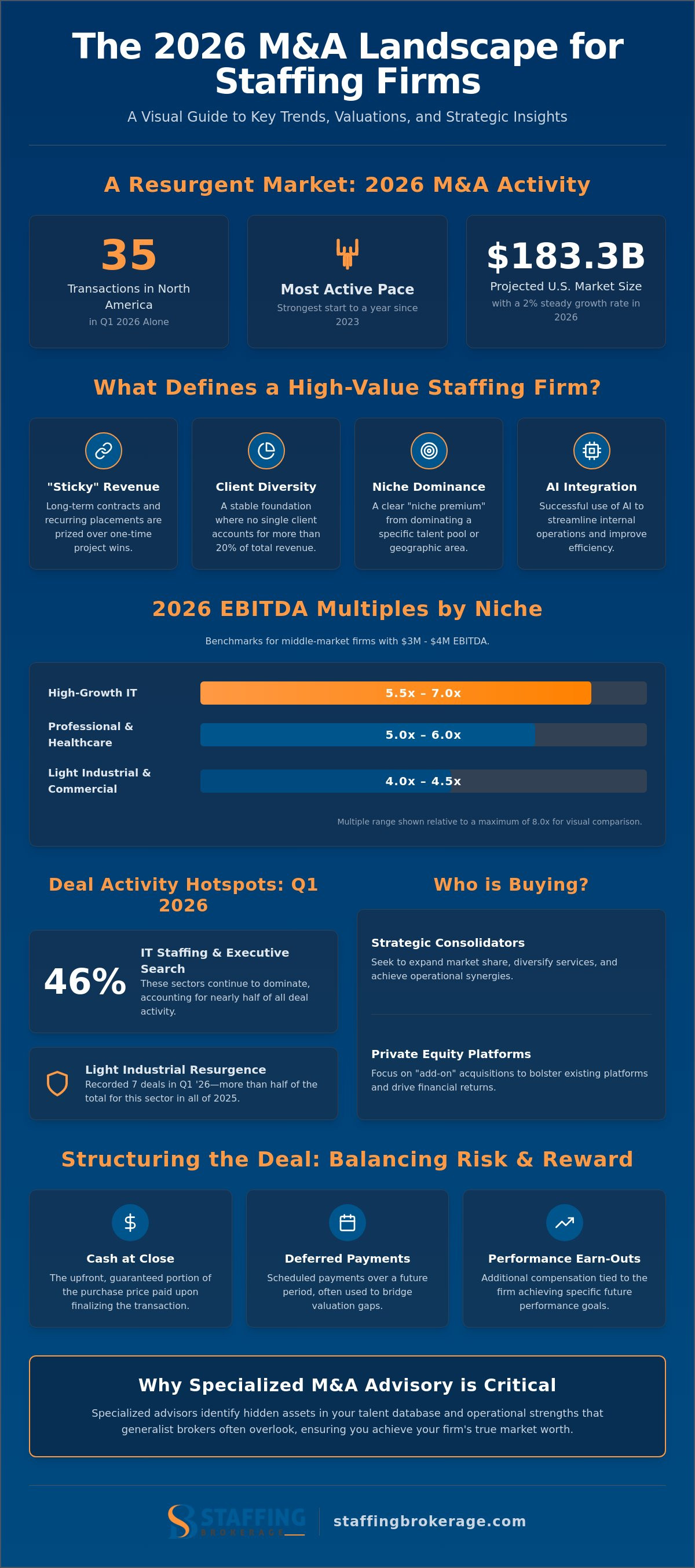
The U.S. staffing industry is projected to reach a market size of approximately $183.3 billion in 2026. While the overall growth rate is a steady 2%, the real story lies in the tight labor market. This scarcity of talent has turned acquisition demand into a primary growth strategy. Private equity investors are particularly active, focusing on "add-on" acquisitions. Rather than starting from scratch, they're buying specialized firms to bolster their existing platforms. This approach allows them to diversify their service offerings and gain immediate access to niche talent pools without the long lead times of organic growth.
The Rebound of Deal Volume in 2026
Activity levels in 2026 have already shown a significant recovery compared to the previous two years. North America saw 35 announced transactions in the first quarter alone, representing the strongest start to a year since 2023. This momentum is driven by sector-specific demand. IT staffing and executive search remain the heavy hitters, accounting for 46% of all deal activity in early 2026. However, the light industrial sector is seeing a surprising resurgence; it recorded seven deals in the first quarter, which is more than half of the total deals seen in that sector throughout all of 2025. Buyers are clearly hungry for specialized talent pools and firms that have successfully integrated AI to streamline their internal operations.
Key Valuation Drivers: What Defines a High-Value Staffing Firm?
Valuation in the staffing world often feels like a moving target. However, the primary language used to determine your firm’s worth is the EBITDA multiple. This number represents a bridge between your current earnings and the future potential a buyer sees in your business. When preparing for m&a in staffing, it's vital to recognize that not all revenue is created equal. Buyers look for "sticky" revenue, which usually comes from long-term contracts and recurring placements rather than one-time project wins. Strategic preparation for m&a in staffing involves more than just cleaning up the books; it requires a deep dive into what actually makes your firm attractive to an outsider.
Client concentration is another critical factor. If a single client accounts for more than 20% of your total revenue, buyers often perceive a higher risk. Conversely, a diverse client base with high-margin contracts creates a stable foundation that justifies a higher multiple. Firms that can demonstrate a clear "niche premium" by dominating a specific talent pool or geographic area often find themselves in a much stronger negotiating position.
Niche-Specific Multiples in the 2026 Market
The current market reflects a "flight to quality," where specialized firms command the highest premiums. For middle-market firms with EBITDA between $3M and $4M, the 2026 benchmarks are clear. High-growth IT niches are currently leading the pack with multiples ranging from 5.5x to 7.0x EBITDA. Professional and healthcare staffing firms follow closely, typically seeing benchmarks between 5.0x and 6.0x. Even in the light industrial and commercial sectors, stable firms are securing multiples of 4.0x to 4.5x. Navigating these legal and strategic nuances often requires specialized insight, such as the Becker Legal Staffing M&A Expertise, to ensure your contracts are structured to support these valuations.
Operational Excellence as a Value Driver
Beyond your sector, how you run your business matters. Modern buyers are looking for firms that have embraced digital transformation. Integrating AI and automation into your sourcing workflow can reduce your time-to-hire by 20% to 30%, which directly impacts your bottom line and scalability. This tech-enabled efficiency acts as a value multiplier because it proves your model can grow without a linear increase in headcount. Additionally, a strong middle-management layer is essential. If the business relies entirely on the owner to maintain client relationships, it becomes harder to sell. Investors want to see a team that can thrive independently. Understanding your firm’s current market worth through a professional assessment is the first step toward optimizing these operational drivers for a future exit.
Strategic vs. Financial Buyers: Navigating the Competitive Landscape
Choosing a buyer is one of the most personal decisions you'll make as an owner. It’s not just about the final number on the check; it's about what happens to your team, your brand, and your clients after the ink dries. In the current market for m&a in staffing, you'll likely encounter two main types of suitors: strategic consolidators and financial investors. Each follows a different playbook. Understanding their motivations helps you position your firm to attract the right partner while protecting the legacy you've built over the years.
Motivations of the Strategic Buyer
Strategic buyers are typically other staffing firms looking to grow through acquisition rather than organic sales. They might want to enter a new geographic region or a high-demand vertical like IT staffing. As we've seen, these sectors remain incredibly active, accounting for 46% of deal activity in early 2026. These buyers look for "synergy." By merging your operations with theirs, they can often reduce overhead by sharing back-office services like payroll, HR, and accounting. Because of these cost savings, a strategic buyer might pay a higher premium for your firm if you fill a specific gap in their existing portfolio.
The Private Equity Playbook in 2026
Financial buyers, primarily private equity firms, operate with a different goal in mind. They often look for a "platform" company, which is a well-run agency with strong systems that can serve as the foundation for future "add-on" acquisitions. In 2026, private equity firms are highly selective. They're focusing on scalable, tech-enabled platforms that use AI to drive efficiency and growth. For an owner, a private equity deal often includes a "second bite of the apple." You might sell a majority stake now but retain some equity. This allows you to profit again when the private equity firm eventually sells the entire consolidated group a few years down the road. It's an excellent option if you aren't quite ready to walk away and want to participate in a larger growth story.
Success in m&a in staffing ultimately hinges on culture fit. Staffing is a relationship business at its core. If your recruiters and account managers don't feel at home with the new ownership, they'll take their talent elsewhere. We've found that the most successful transitions happen when the buyer respects the existing culture and provides the resources needed to help the team thrive. Whether you choose a strategic partner or a financial backer, ensuring your values align is the best way to secure a smooth and rewarding transition.
The M&A Deal Structure: Balancing Risk and Reward
The structure of a deal is where the abstract value of your firm becomes a concrete reality. It's the most critical part of the negotiation because it determines not just how much you get paid, but when and under what conditions. For m&a in staffing, the structure often matters as much as the headline price. We view this phase as a collaborative effort to align your financial goals with the buyer's need for security and growth. It's about finding a balance that honors your hard work while ensuring the business remains healthy under new ownership.
Most transactions involve a combination of cash at close and deferred payments. Cash provides immediate liquidity, while earn-outs allow you to bridge valuation gaps by hitting specific performance targets post-sale. In the current 2026 market, where buyers are highly selective, earn-outs are frequently used to manage risk. You might also encounter roll-over equity, where you keep a portion of your ownership in the new combined entity. This allows you to participate in future growth, often leading to a larger payout down the road. Don't overlook working capital adjustments; these ensure the business has enough "fuel" to operate on day one, which can shift the final net proceeds in your pocket.
Mitigating Risk through Due Diligence
Due diligence is a deep dive into the health of your agency. You should expect a thorough review of your financial records, legal contracts, and daily operations. It’s a rigorous process, but it’s also an opportunity to prove the quality of your firm. Identifying and addressing red flags buying a staffing agency early on prevents surprises that could derail the deal. Buyers will look closely at your compliance with labor laws and how you classify independent contractors. Proactively cleaning up these areas builds trust and keeps the momentum moving forward. Requesting a professional Business Valuation and Assessment is the best way to understand how these structural components will impact your specific exit.
Closing the Deal with Confidence
The journey from a Letter of Intent (LOI) to final signatures usually takes 60 to 90 days. This period requires a steady hand to manage both the technical requirements and the emotional weight of the transition. Clear communication with your employees and clients is vital to prevent turnover or lost revenue during the handoff. For a more detailed look at the mechanics of this final phase, you can explore our guide on staffing agency deal closure. Approaching the finish line with a transparent and methodical plan ensures that you and the buyer conclude the transaction with a sense of shared accomplishment and a clear path for the future of the firm.
Why Specialized M&A Advisory is Critical for Staffing Success
Selling your firm is a significant milestone that requires more than just a generalist's perspective. While a standard business broker might understand basic financials, they often miss the nuanced drivers of m&a in staffing. Our industry is built on people, relationships, and specialized talent pools. A specialist advisor knows how to translate these qualitative assets into quantitative value. They understand why a firm with a deep database of specialized IT candidates or a high digital transformation score commands a higher multiple than a generalist agency, even if their top-line revenue is similar.
By working with a dedicated partner, you gain access to a national network of pre-vetted buyers who are specifically looking for staffing acquisitions. This network allows for the creation of competitive tension without compromising your confidentiality. We manage the delicate balance of sharing enough information to attract the right suitors while protecting your sensitive data from competitors. This methodical approach ensures you're not just finding a buyer, but the right partner who respects the culture you've built.
The Staffing Brokerage Advantage
We pride ourselves on our "steady hand" approach. We don't just facilitate a transaction; we guide you through a journey. Our team leverages years of industry-specific experience to maximize value selling staffing company assets. We look beyond the surface to find the hidden value in your internal processes, your middle-management strength, and your technology stack. This personalized strategy ensures that your exit isn't just a financial win, but a professional accomplishment that honors your legacy and provides a clear roadmap for your team's future.
Your Partner in Strategic Growth
A successful close is the result of honest practice and proven results. We bridge the gap between your initial curiosity and a rewarding final signature by providing a transparent and predictable process. Whether you're looking for an immediate exit or want to understand how to build value for a sale three years from now, we're here to help. Your business deserves a partner who is as invested in your success as you are. We focus on building trust through integrity and long-term value, ensuring you feel informed rather than overwhelmed at every step. Schedule your confidential valuation assessment today.
Your Path to a Successful Strategic Exit
The landscape of m&a in staffing is evolving rapidly, offering unique opportunities for owners who are prepared to act with intention. We've explored how specialized niches and operational efficiency through AI can significantly boost your valuation multiples. Whether you're aligning with a strategic consolidator or a private equity platform, the key is to ensure the deal structure reflects the true worth of your legacy while protecting your team's future. Success in this market requires a balance of precise data and a deep understanding of the people who drive your agency's growth.
You don't have to navigate this complex process alone. Our team provides specialized staffing industry expertise and a national network of qualified buyers to help you achieve proven results in high-value deal closures. We're here to act as your steady hand and dedicated guide through every phase of the journey. To begin your next chapter with confidence, Request a Confidential Staffing Business Valuation today. It’s the first step toward a collaborative partnership that prioritizes your personal and professional milestones. We look forward to helping you turn your hard work into a rewarding and lasting legacy.
Frequently Asked Questions
Is 2026 a good year to sell a staffing company?
Yes, 2026 is an excellent year to sell because the market has moved into a recovery and consolidation phase. With 35 transactions in North America during the first quarter alone, activity is at its highest level since 2023. This rebound follows a four-year low in 2024, making it a prime time for owners to capitalize on renewed buyer interest and a projected industry market size of $183.3 billion.
What are the typical EBITDA multiples for staffing agencies right now?
Current EBITDA multiples vary by sector, with specialized niches commanding the highest premiums. For middle-market firms, high-growth IT niches are seeing 5.5x to 7.0x, while professional and healthcare staffing benchmarks sit between 5.0x and 6.0x. Light industrial firms typically see 4.0x to 4.5x. These ranges reflect the flight to quality we've observed in m&a in staffing throughout this year.
What is the difference between a strategic buyer and a financial buyer in staffing?
A strategic buyer is usually another staffing firm looking for geographic expansion or new industry verticals. They pay for synergies and market share. A financial buyer, such as a private equity firm, views your agency as a platform or add-on to drive EBITDA growth. Financial buyers often focus on scalable systems and tech-enabled efficiency to prepare for a future recapitalization.
How long does the M&A process usually take for a staffing firm?
The m&a in staffing process generally takes 60 to 90 days from the signing of a Letter of Intent to the final close. This timeline includes rigorous financial, legal, and operational due diligence. Having your documentation organized and your middle-management team prepared can help maintain momentum. We guide you through each step to ensure the transition feels like a collaborative journey.
What are the most common red flags during staffing agency due diligence?
Common red flags include high client concentration, where one account represents over 20% of revenue, and independent contractor misclassifications. Buyers also look for owner-dependency, which is when the firm can't function without the founder's daily involvement. Addressing these issues before entering the market protects your valuation and builds trust with potential suitors during the due diligence phase.
How does technology integration affect my staffing agency’s valuation?
Technology integration acts as a significant value multiplier by proving your agency can scale without a linear increase in headcount. Firms using AI and automation to reduce time-to-hire by 20% to 30% are currently commanding higher multiples. Buyers are willing to pay a premium for tech-enabled platforms because these systems ensure more stable gross margins and higher operational efficiency over time.
Do I need to stay with the company after the sale is finalized?
Your role after the sale depends entirely on the deal structure and your personal goals. Many private equity deals involve roll-over equity, where you stay on to help grow the business for a second bite of the apple. Strategic buyers might only require a transition period of six to twelve months. We help you choose a partner whose expectations align with your desired post-sale lifestyle.
How can I maintain confidentiality while my staffing agency is for sale?
You can maintain confidentiality by working with a specialized advisor who uses blind profiles to market your firm. This approach ensures your agency's name and location stay hidden until a buyer is pre-vetted and signs a non-disclosure agreement. This process prevents competitors, employees, and clients from learning about the potential sale prematurely, allowing you to manage the narrative on your own terms.