
Financing a Staffing Agency Acquisition: A Strategic Guide for 2026
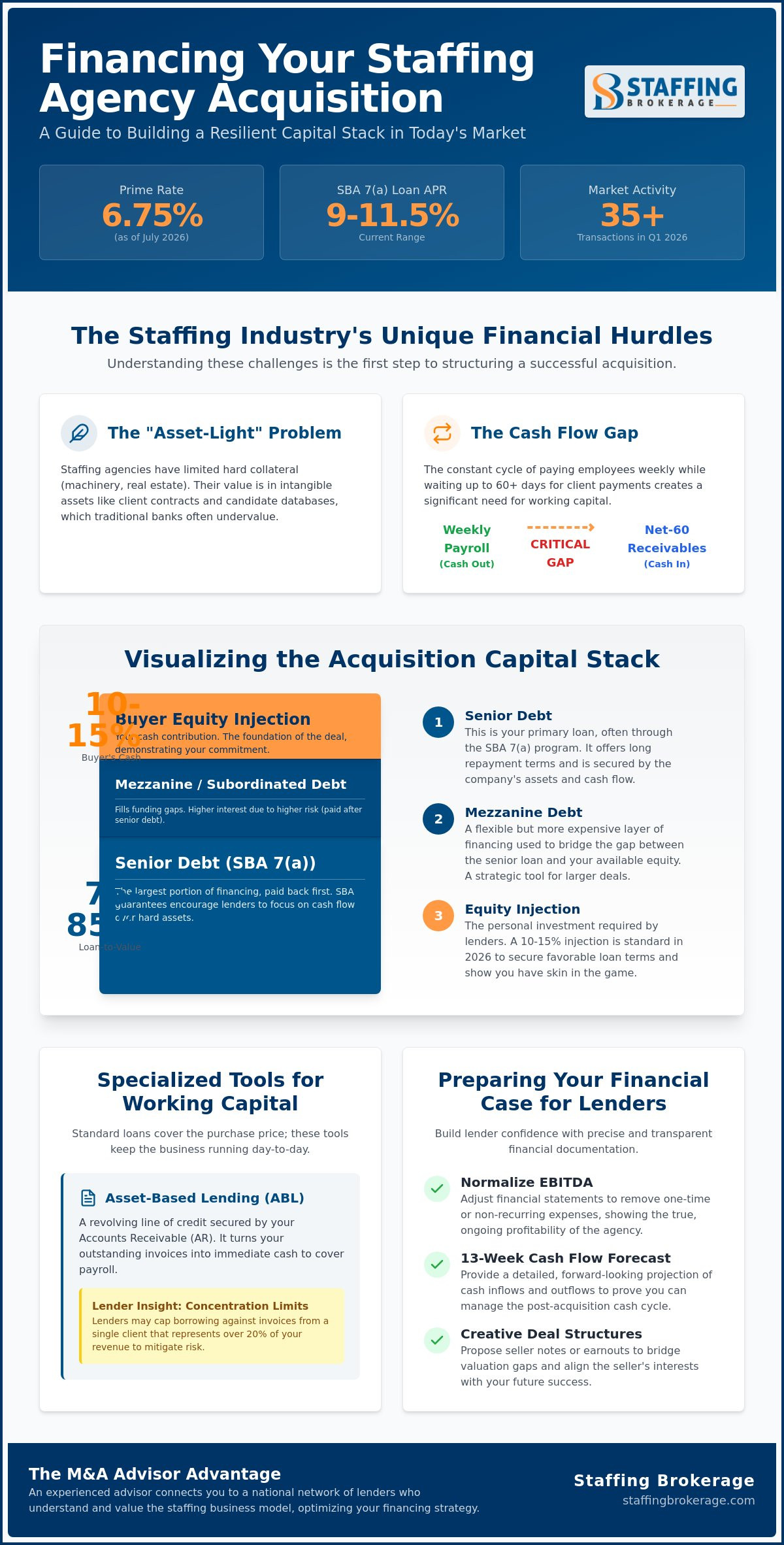
The most successful staffing acquisitions aren't built on the largest loans, but on the most resilient capital stacks. With the prime rate holding at 6.75% as of July 2026, many buyers feel the squeeze of high interest rates and the challenge of securing traditional bank loans for asset-light firms. You're likely feeling the pressure of managing the gap between weekly payroll and Net-60 receivables while trying to maintain a healthy debt service coverage ratio. Mastering the art of financing a staffing agency acquisition requires moving beyond simple debt to create a diversified funding strategy that balances risk and growth.
It's true that the current market demands more precision than ever, but the opportunities are significant, with 35 transactions already announced in the first quarter of 2026 alone. This guide will help you understand how to structure deals that align seller incentives with your future success. We'll explore the current SBA 7(a) landscape, where rates currently range from 9.0% to 11.5% APR, and show you how to build a clear roadmap that leads directly to a successful close.
Key Takeaways
- Learn how to layer diverse funding sources to confidently navigate the "asset-light" nature of the staffing industry.
- Discover specialized strategies to bridge the critical cash flow gap between weekly payroll obligations and Net-60 client receivables.
- Master creative deal structures like seller notes and earnouts to bridge valuation gaps when financing a staffing agency acquisition.
- Gain insights into normalizing EBITDA and preparing 13-week cash flow forecasts that build immediate confidence with your lenders.
- Understand how a dedicated M&A advisor opens doors to a national network of lenders who truly value the staffing business model.
Understanding the Staffing Acquisition Capital Stack
When you look at the financial structure of a deal, you're essentially looking at a "capital stack." This term describes the different layers of funding that come together to close the transaction. In the staffing industry, most buyers use a Leveraged Buyout (LBO) model, where the assets of the company being acquired are used as collateral for the loans. Successful financing a staffing agency acquisition depends on how well you balance these layers to ensure the business remains stable after the keys change hands. You'll typically see a mix of senior debt, subordinated debt, and your own equity contribution.
Staffing agencies are inherently "asset-light" businesses. They don't own heavy machinery, vast real estate, or expensive vehicle fleets. Instead, their value lies in their intangible assets: client contracts, candidate databases, and recurring revenue. For many traditional lenders, this lack of hard collateral can be a hurdle. They can't easily repossess a database if things go wrong. Because of this, your capital stack must be structured with precision to give lenders the confidence they need while protecting your cash flow. Most successful deals in 2026 require an equity injection of 10% to 15% to keep leverage ratios at a level that supports long-term growth.
Senior Debt and SBA 7(a) Loans
Senior debt sits at the top of the stack and is the first to be repaid. For many entrepreneurs, the SBA 7(a) loan program is the primary vehicle for financing a staffing agency acquisition. These loans are attractive because they offer longer repayment terms and lower down payments than traditional commercial loans. In the current market, national lenders typically expect a loan-to-value (LTV) ratio of 75% to 85%. While traditional commercial banks offer lower interest rates, they often have much stricter collateral requirements that asset-light staffing firms struggle to meet. The SBA program bridges this gap by guaranteeing a portion of the loan, which encourages lenders to focus on your agency's cash flow rather than just its physical assets.
Mezzanine and Subordinated Debt
If there's a gap between what the bank will lend and the cash you have on hand, mezzanine debt often fills the void. This layer is "subordinated," meaning these lenders are only paid after the senior debt obligations are met. Because it carries more risk, mezzanine debt comes with higher interest rates and sometimes "warrants," which give the lender the right to buy equity in the future. It's a strategic tool for larger acquisitions where you want to avoid diluting your ownership by bringing on more equity partners. It provides the necessary capital to cross the finish line while keeping you firmly in the driver's seat of your new agency.
Specialized Financing for the Staffing Cash Cycle
One of the most significant challenges in financing a staffing agency acquisition is the inherent timing gap in the business model. You'll likely face the "Weekly Payroll vs. Net-60" dilemma, where you must pay temporary employees every Friday while waiting 60 days or more for clients to settle their invoices. This creates a massive appetite for working capital that traditional term loans often can't satisfy. To manage this transition smoothly, you need a financing strategy that treats the acquired agency’s accounts receivable (AR) as a dynamic asset rather than a static balance sheet entry.
Strategic buyers often use the target company's own AR to help fund the initial purchase. By setting up a revolving credit facility simultaneously with the close, you can unlock immediate liquidity to cover both the acquisition cost and the first several weeks of payroll. While the SBA 7(a) loan program provides the long-term foundation for the purchase price, specialized working capital tools ensure the engine keeps running from day one. If you're unsure which vehicle fits your specific deal, consulting with an M&A advisor can provide the clarity needed to align your capital with your growth goals.
Asset-Based Lending (ABL) Frameworks
Asset-based lending is often the preferred choice for established agencies with high-quality AR. Lenders look closely at your aging reports to determine the "borrowing base," which is the total amount you can draw against your invoices. They pay special attention to concentration limits. If a single client in the IT or healthcare sector accounts for more than 20% of your revenue, a lender might cap the amount you can borrow against those specific invoices to mitigate risk. A well-structured ABL facility grows alongside your acquisition, providing more capital as you bill more hours.
The Role of Invoice Factoring in M&A
For turnaround acquisitions or smaller startups where credit history might be thin, invoice factoring serves as a powerful bridge. Unlike ABL, which is a loan against the AR, factoring is the actual sale of those invoices to a third party. It's often more expensive than a traditional line of credit, with rates typically ranging from 1% to 4% of the invoice value. However, it provides nearly instant cash without the strict covenants of a bank. Many buyers use factoring to stabilize the business during the first year before transitioning to a lower-cost ABL framework as the agency matures and shows consistent profitability.
Creative Deal Structuring: Seller Notes and Earnouts
In the current financial environment, bridging the gap between a buyer's offer and a seller's expectation requires more than just a larger bank loan. Creative deal structuring has become a cornerstone of financing a staffing agency acquisition in 2026. By involving the seller in the capital stack, you reduce your immediate cash requirements and ensure the former owner remains invested in the agency's smooth transition. This collaborative approach turns a simple sale into a shared journey toward future growth, rather than a mere change of hands.
One of the most effective ways to align interests is through an equity roll. In this scenario, the seller retains a minority stake, typically between 10% and 20%, in the new entity. This is particularly valuable in the staffing industry, where client relationships and recruiter loyalty are paramount. When a seller "rolls" equity, they send a powerful signal to lenders and employees alike that they believe in the company's continued success under your leadership. This structure often makes it easier to qualify for SBA 7(a) loans for acquisitions, as it demonstrates a lower risk profile to the underwriting team by maintaining leadership continuity.
Structuring Effective Seller Notes
A seller note is essentially a loan from the seller to you, the buyer. In 2026, these notes typically carry interest rates between 7% and 9%, often sitting just below the rates of senior bank debt to remain attractive for both parties. Most senior lenders require these notes to be on "standby," meaning the seller won't receive principal payments for a specific period, usually the first year. Beyond filling a funding gap, a seller note acts as a vital safety net. You can structure the note with "right of set-off" language, allowing you to deduct funds from the balance if undisclosed liabilities or significant client losses occur shortly after the close.
Designing Performance-Based Earnouts
Earnouts are perhaps the most dynamic tool for managing valuation differences. They allow you to pay a portion of the purchase price only after the agency hits specific milestones, such as Gross Profit or EBITDA targets, over 12 to 24 months. To avoid disputes, it's essential to use clear, unambiguous accounting definitions that both parties agree upon upfront. Many successful buyers now implement "Retention Earnouts" specifically for key branch managers or top-performing recruiters. This ensures the talent that drives the agency's value stays in place while you integrate the business into your portfolio, protecting the very cash flow that supports your financing a staffing agency acquisition.
Preparing Your Financial Case for Lenders
Lenders approach asset-light businesses with a healthy degree of caution. To secure the best terms for financing a staffing agency acquisition, you must present a financial case that leaves no room for ambiguity. This process begins with a 13-week cash flow forecast. While a standard annual projection shows high-level profitability, the 13-week view proves you can handle the weekly payroll spikes without tripping bank covenants. It's the primary tool lenders use to assess your operational readiness during the critical first quarter of ownership.
You also need to focus on normalizing EBITDA with surgical precision. Lenders will accept specific add-backs, but you have to be realistic to maintain credibility. Common adjustments include the owner's excess salary, personal travel expenses, or one-time legal fees from a previous dispute. However, they'll likely reject "pro-forma" savings that haven't happened yet. Your pro-forma statement should instead highlight clear, documented synergies; such as merging back-office software or consolidating redundant insurance policies; to show a stronger debt service coverage ratio (DSCR). If you need help identifying these hidden values, our staffing company buy-side advisory services can help you build a bulletproof financial model.
The Quality of Earnings (QofE) Report
A third-party Quality of Earnings report is often the difference between a "yes" and a "no" from a national lender. This report goes much deeper than a standard audit by analyzing revenue concentration and client stickiness. For example, if one client accounts for more than 20% of total revenue, the QofE will stress-test what happens to your cash flow if that contract is lost. It also verifies the accuracy of payroll taxes and workers’ compensation codes. Misclassified employees can lead to massive back-tax liabilities, and lenders want to know you've identified these risks before they sign the check.
Presenting the Business Plan to Investors
Your business plan is your opportunity to frame the acquisition as a strategic journey. Investors and lenders are hyper-focused on recruiter turnover, which is often the biggest threat to post-acquisition stability. Address this objection head-on by detailing your plan for culture integration and performance-based incentives. Show them a clear, step-by-step path to debt repayment through increased operational efficiency. By demonstrating a deep understanding of these staffing-specific metrics, you prove that you aren't just buying a company; you're scaling a proven system.
How an M&A Advisor Optimizes Your Financing Strategy
Finding the right capital is often less about the interest rate and more about the partner behind the money. While a generic business broker might simply pass along a list of local banks, a specialized M&A advisor understands the nuances of financing a staffing agency acquisition on a national level. We maintain deep relationships with lenders who specifically seek out staffing firms because they understand the value of recurring revenue and high-quality accounts receivable. Our role is to act as your strategic advocate, ensuring that every layer of your capital stack is optimized for long-term stability.
One of the greatest advantages of working with an advisor is the ability to create competitive tension. When multiple lenders are vying for your business, you gain the leverage to negotiate better terms, lower fees, and more favorable covenants. We help you identify the ideal staffing company deal structure that matches your specific risk tolerance and growth objectives. This methodical approach ensures that you aren't just taking the first offer on the table, but the one that truly aligns with your vision for the agency.
Buy-Side Advisory: From Assessment to Closure
The process from a signed Letter of Intent (LOI) to final funding typically takes 60 to 90 days. During this window, deal fatigue is a very real risk that can derail even the most promising transactions. Our staffing company buy-side advisory team manages this timeline with precision, coordinating between lenders, legal counsel, and the seller to keep the momentum moving forward. We handle the heavy lifting of information requests and lender due diligence, allowing you to focus on the operational transition and maintaining staff morale.
Accurate Valuation as a Financing Tool
A defensible staffing company valuation is the bedrock of any successful financing request. Senior debt underwriters rely on industry benchmarks to justify their loan amounts. For instance, in mid-2026, professional staffing firms typically trade at 5.0x to 6.0x EBITDA, while high-growth IT staffing firms can command 5.5x to 7.0x. By presenting a valuation rooted in these current market realities, we help you build immediate trust with financing sources. This transparency ensures that your purchase price isn't just a number you've agreed upon with the seller, but a valuation that the financial market is ready to support.
Architecting Your Path to Acquisition Success
Closing a deal in 2026 requires more than just a willing seller; it demands a resilient financial foundation. You've seen how balancing the layers of your capital stack and bridging the weekly payroll gap are essential for maintaining operational stability. By mastering creative deal structures like seller notes and preparing a bulletproof financial case with a 13-week forecast, you position yourself as a credible buyer in an increasingly competitive market. Successfully financing a staffing agency acquisition is a collaborative journey that rewards precision, patience, and strategic alignment.
At Staffing Brokerage, we bring specialized staffing industry M&A expertise and a proven track record of national deal closures to your side of the table. Our approach focuses on long-term value and integrity, ensuring your transition is as smooth as possible. We act as your steady hand, managing the complexities of lenders and due diligence so you can focus on leading your new team. Schedule a consultation with our M&A advisors to architect your acquisition financing plan. Your next chapter in the staffing industry is within reach, and we're excited to help you close it with confidence.
Frequently Asked Questions
What is the typical down payment required for a staffing agency acquisition?
Buyers seeking SBA loans for acquisitions are typically required to make a down payment of 10% to 15%. This equity injection demonstrates your commitment to the lender and helps maintain a healthy debt service coverage ratio. In some cases, a portion of this can be structured via a seller note; however, lenders usually insist on at least 10% coming from your own cash reserves to ensure you have skin in the game.
Can I use the acquired company’s receivables to finance the purchase?
Yes, you can leverage the target agency’s accounts receivable to fund a significant portion of the transaction through a revolving credit facility. By setting up an Asset-Based Lending (ABL) line or a factoring arrangement at the time of close, you unlock the liquidity held in unpaid invoices. This strategy is a cornerstone of financing a staffing agency acquisition because it provides the immediate working capital needed to cover the first several payroll cycles.
How does an earnout work in a staffing agency sale?
An earnout is a performance-based payout where a portion of the purchase price is paid only if the agency hits specific financial milestones after the sale. These targets are usually based on EBITDA or Gross Profit over a 12 to 24 month period. It's an effective tool for bridging valuation gaps, ensuring the seller stays motivated to transition client relationships and maintain recruiter stability during the first year of your ownership.
Why do banks often struggle to finance staffing companies?
Traditional banks often struggle with staffing firms because they're "asset-light" businesses with few tangible assets like real estate or equipment to serve as collateral. Lenders prefer hard assets they can repossess if a loan defaults. Since a staffing agency's primary value is its candidate database and client contracts, you must work with specialized lenders who understand how to underwrite cash flow and accounts receivable rather than physical property.
What is the difference between ABL and factoring for an acquisition?
Asset-Based Lending (ABL) is a line of credit secured by your accounts receivable, while factoring is the actual sale of your invoices to a third party for immediate cash. ABL is generally less expensive and suitable for established firms with strong credit histories. Factoring, with rates typically between 1% and 4%, offers more flexibility for startups or turnaround deals where rapid access to cash is more critical than the lowest cost of capital.
How long does it take to secure financing for a staffing M&A deal?
The process from a signed Letter of Intent (LOI) to the actual funding of the deal typically takes 60 to 90 days. This window allows for deep-dive due diligence, the preparation of a Quality of Earnings report, and the lender's underwriting process. Managing this timeline effectively requires close coordination between your M&A advisor, legal counsel, and the financing source to prevent deal fatigue from setting in before the close.
Are SBA loans still a viable option for buying a staffing agency in 2026?
SBA 7(a) loans remain a highly viable and popular option for financing a staffing agency acquisition in 2026. With the ability to borrow up to $5 million, these loans offer longer repayment terms and lower down payments than most conventional commercial products. Even with variable rates currently ranging from 9.0% to 11.5% APR, the SBA program provides the stability needed for smaller to mid-sized acquisitions in the staffing sector.
What are the most common red flags lenders look for in staffing deals?
Lenders primarily look for high client concentration, where a single customer accounts for more than 20% of total revenue. Other red flags include a Debt Service Coverage Ratio (DSCR) below 1.25x or inconsistent payroll tax filings. They also scrutinize recruiter turnover rates and "right to hire" clauses in client contracts. Identifying and addressing these issues during the due diligence phase is vital for presenting a clean financial case to potential financing partners.


