
How to Maximize Staffing Agency Sale Price: The 2026 Strategic M&A Guide
Why did the first quarter of 2026 see 35 major staffing transactions, the strongest start in over three years, while some owners still worry they'll leave money on the table? It's a valid concern. You've poured your life into your firm, and the thought of a buyer undervaluing your hard work or mishandling your legacy is stressful. You likely want to maximize staffing agency sale price but feel uncertain about how to normalize your earnings or protect your team's confidentiality during the process.
This guide is designed to be your steady hand through that complexity. You'll discover the precise operational and financial levers that drive modern industry multiples, from the 4.5x EBITDA seen in light industrial to the 7.0x peaks in IT staffing. We'll walk through how to escape the "founder trap," manage client concentration risks, and navigate the 2026 regulatory environment. By the end, you'll have a clear roadmap to secure a high-premium exit and minimize the tax and legal friction that often follows a life-changing sale.
Key Takeaways
- Understand why specialized niches like IT and healthcare command higher multiples and how current market trends influence your firm's baseline value.
- Learn the art of EBITDA normalization to ensure every owner-centric cost is added back, which can significantly multiply your final payout.
- Discover how to align your firm with the right strategic or financial buyer to maximize staffing agency sale price through competitive bidding.
- Identify and fix operational red flags, such as high client concentration or owner dependency, before they can stall your deal or lower your premium.
- Master the nuances of deal structuring to protect your hard-earned equity and bridge valuation gaps using strategic earn-outs.
The 2026 Staffing Valuation Landscape: Why Price is More Than a Multiple
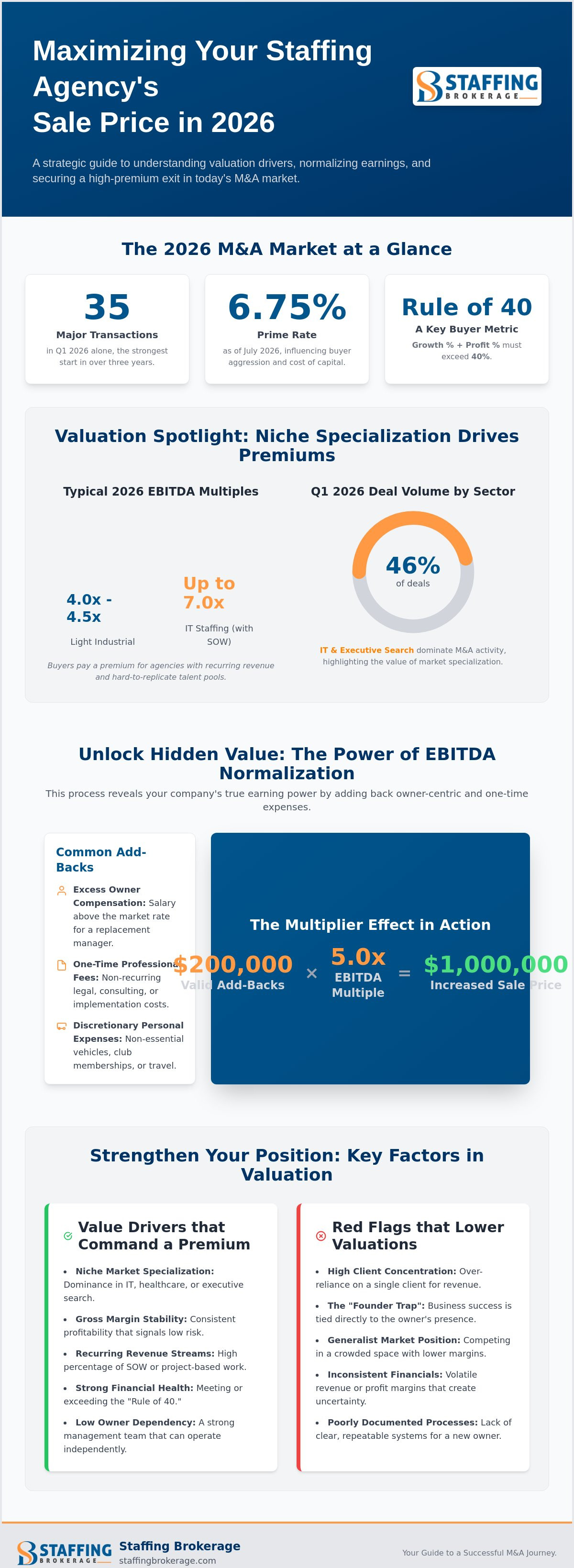
The 2026 market is proving to be a landmark year for agency owners. With 35 announced transactions in North America during the first quarter alone, we're seeing the strongest start to a year since 2023. This surge is driven by a renewed appetite for Mergers and acquisitions (M&A) as buyers seek stability and growth. However, a high price isn't guaranteed by market volume alone. To truly maximize staffing agency sale price, you must understand that "the multiple" is a reflection of your firm's risk profile and its strategic fit within a buyer's portfolio.
Why does one firm trade at 4.0x EBITDA while another commands 7.0x or higher? It often comes down to investment readiness. In mid-2026, light industrial firms typically see multiples between 4.0x and 4.5x, while IT staffing firms with Statement of Work (SOW) capabilities can reach up to 7.0x. Buyers pay a premium for agencies that demonstrate gross margin stability and a clear path toward recurring revenue. They aren't just buying your past performance; they're investing in your future scalability.
The Shift Toward Niche Specialization
Generalist firms are facing multiple compression as buyers prioritize specialized, high-demand verticals. The 2026 environment shows that IT staffing and executive search accounted for 46% of deal volume in the first quarter. This "scarcity premium" exists because clinical and technical talent pools are harder to build and maintain. If your agency holds a dominant position in a technical niche, you aren't just selling a business. You're selling a strategic advantage that a buyer cannot easily replicate in-house. This specialization is a primary lever to maximize staffing agency sale price because it reduces the buyer's long-term risk.
Market Sentiment and Timing the Exit
Timing is a critical component of your exit strategy. With the prime rate sitting at 6.75% as of July 2026, the cost of capital influences how aggressive private equity groups can be. Sophisticated buyers often look for the "Rule of 40," where your combined growth rate and profit margin exceed 40%. Balancing these two metrics ensures you remain attractive to both strategic and financial buyers who are currently active in the market. For a deeper look at the specific metrics that define your worth, see our guide on staffing company valuation.
Normalizing EBITDA: Using Add-Backs to Reveal True Profitability
Your profit and loss statement tells one story to the tax office, but it often tells a completely different one to a potential buyer. To truly maximize staffing agency sale price, you must move beyond the raw numbers on your tax returns. This is where EBITDA normalization comes into play. It's the methodical process of identifying and "adding back" expenses that a new owner won't carry. By stripping away owner-centric costs, you reveal the true earning power of the agency under new leadership.
Buyers in 2026 are increasingly focused on the Quality of Earnings (QofE). They aren't just looking at the bottom line; they're scrutinizing the stability of your gross margins and your workers' compensation experience modification rates. Transparent financials build a bridge of trust. When you present a clean, defensible set of normalized earnings, you reduce the perceived risk for the buyer, which often leads to faster offers and higher premiums. Understanding various business valuation methods is the first step in ensuring your hard work is reflected in the final offer.
Common and Aggressive Add-Back Categories
Identifying add-backs requires a detailed eye. Most buyers accept adjustments that reflect a transition to market-based operations. Common categories include:
- Owner Compensation: If you pay yourself $400,000 but a replacement manager costs $150,000, that $250,000 difference is a legitimate add-back.
- One-Time Professional Fees: Legal costs for a specific dispute or fees for a one-time technology implementation shouldn't count against your ongoing profitability.
- Discretionary Personal Expenses: This includes business-funded vehicles, club memberships, or travel that serves a personal purpose.
The Impact of EBITDA Normalization on Final Price
The math here is powerful. Consider a scenario where an owner identifies $200,000 in valid add-backs. At a 6x multiple, that single exercise results in a $1.2 million increase in the final sale price. However, you must be careful. Aggressive or poorly documented add-backs can backfire during due diligence, causing a buyer to lose confidence in your data. The best strategy is to defend your add-backs during the LOI stage with clear receipts and logical explanations. If you're unsure where to start, getting a professional business valuation and assessment can provide the clarity you need to move forward with confidence. Each dollar you successfully normalize is effectively multiplied by your deal multiple, making this one of the most efficient ways to increase your exit value.
Strategic vs. Financial Buyers: Identifying the Highest Bidder
Finding the right buyer is a critical step that often determines whether you achieve a standard exit or a record-breaking one. In the 2026 market, where we saw 35 major transactions in the first quarter alone, the "who" is just as important as the "how much." To maximize staffing agency sale price, you must distinguish between the two primary types of buyers: strategic and financial. Each approaches your business with a different set of goals and valuation methodologies. Understanding these motivations allows you to position your firm as the missing piece of their specific puzzle.
Strategic buyers are typically larger staffing firms looking to expand their geographic footprint or enter a new vertical, such as the high-growth IT or healthcare sectors. They often pay a premium because they can extract more value from your agency than it generates on its own. This is a core principle in the academic guide to company valuation methods, which explains how cash flow discounting changes when synergies are involved. Financial buyers, on the other hand, are often private equity (PE) firms. They view your agency either as a "platform" to build upon or a "bolt-on" to add to an existing portfolio company.
The Synergy Premium: Why Competitors Pay More
Competitors often offer the highest upfront price because of cost and revenue synergies. On the cost side, a strategic buyer can eliminate redundant back-office functions like HR, payroll, and accounting software, instantly increasing your margin. Revenue synergies are even more attractive. If you have a specialized niche in IT staffing, a larger generalist firm can cross-sell your services to their massive client base. Identifying which competitors are currently in "acquisition mode" is a key part of our collaborative journey. We look for firms that have recently raised capital or announced a shift toward the specialized verticals you already dominate.
Financial Buyers and the Platform Play
Private equity activity in 2026 is heavily focused on roll-up strategies in the light industrial and IT sectors. These buyers look for scalable processes and a strong middle-management tier that can function without the founder. One unique advantage of a financial buyer is the "second bite of the apple." In these deals, you might sell 70% to 80% of your business now and roll over the remaining equity. As the PE firm grows the larger platform and eventually sells it, your remaining shares could be worth significantly more than the initial sale. If you're starting to think about these options, our guide on how to sell my staffing agency provides a clear framework for planning this type of strategic exit.
Operational Value Drivers that Command a Premium
Operational cleanliness is often the difference between a standard offer and a record-breaking deal. While financial normalization is vital, buyers in 2026 are deeply focused on de-risking the transition. They want to know that the engine will keep humming after the keys change hands. To truly maximize staffing agency sale price, you must audit your internal processes through the lens of a sophisticated acquirer. This means moving beyond simple cash flow and proving that your success is a result of systems, not just individual heroics.
A major red flag for any buyer is high client concentration. If a single client represents more than 15% of your total revenue, it creates a single point of failure that can lead to significant valuation hair-cuts. Buyers often worry about what happens if that one client decides to go in a different direction post-sale. By diversifying your book of business and securing long-term Master Service Agreements (MSAs), you provide the stability that commands a premium multiple. This stability is especially critical in 2026 as firms navigate new regulatory hurdles like California's SB 1032, which requires more robust compliance and registration for staffing agencies.
Reducing Dependency on the Founder
The most common objection we hear from buyers is: "What happens if the owner leaves?" If you're the primary rainmaker and the face of every major client relationship, your business is a job rather than a scalable asset. You should aim to transition key account relationships to a dedicated management team at least 12 months before you go to market. Documenting your processes via Standard Operating Procedures (SOPs) turns your tribal knowledge into a transferable asset. A self-sustaining sales and recruitment engine is worth significantly more than a founder-led firm.
Contractual Quality and Recurring Revenue
The nature of your revenue matters as much as the amount. Buyers prioritize agencies that have shifted from spot business to Managed Service Provider (MSP) or Vendor Management System (VMS) contracts. These agreements signal predictable, long-term revenue streams. You should also ensure your internal team is locked-in through non-compete agreements and clear retention bonus structures. Reviewing our list of red flags buying a staffing agency can help you spot and fix these operational gaps before a buyer's due diligence team finds them. If you're ready to prepare your firm for a premium exit, our staffing company sell-side representation provides the strategic guidance to ensure your operational value is fully recognized.
Finally, your 2026 tech stack plays a pivotal role in valuation. Agencies using AI-driven sourcing and automated compliance tools are seen as more efficient and future-proof. These technologies don't just save time; they protect your margins and make your firm a more attractive bolt-on for larger strategic buyers who want to acquire modern, efficient infrastructures.
Deal Structuring: Protecting Your Valuation During Negotiations
Many owners focus solely on the headline number in a Letter of Intent. However, to truly maximize staffing agency sale price, you must look closely at the fine print of the deal structure. Price is just a starting point; structure is the reality of what you actually take home after taxes, escrows, and adjustments. A high offer with unfavorable terms can often result in less wealth than a lower offer with better cash-at-closing components. We view this phase as a collaborative effort to ensure the value you've built is fully protected during the final hand-off.
One of the most complex parts of a staffing transaction is the working capital peg. Since staffing is a capital-intensive business with significant accounts receivable, buyers expect a certain amount of liquidity to remain in the company at closing. If you don't set this "peg" correctly based on your historical averages, you might find yourself effectively giving away your own cash at the closing table. Understanding the nuances of staffing company deal structure ensures you protect your liquidity while meeting the buyer's operational requirements.
Cash at Closing vs. Contingent Payments
The balance between guaranteed cash and contingent payments, like earn-outs, is a primary negotiation point in 2026. Earn-outs help bridge the valuation gap between what you believe the firm is worth and what a buyer is willing to risk today. To protect your interests, we often recommend structuring these based on Gross Profit rather than total Revenue. This ensures your margins remain a priority during the transition period and prevents a buyer from "buying" revenue at the expense of profitability. You might also consider a "Seller Note," where you act as the lender for a portion of the purchase price. This provides a steady interest-bearing income stream and demonstrates your confidence in the agency's continued success.
The Role of Professional Sell-Side Representation
Successfully navigating these waters requires more than just a general business broker. A specialized staffing company M&A advisory firm understands the specific nuances of our industry, from workers' comp liabilities to VMS contract transfers. We utilize a "double-blind" marketing process to ensure your confidentiality remains intact until a qualified buyer is fully vetted. This protects your internal team and client relationships while we build a competitive environment for your firm. If you're ready to see how these levers apply to your specific situation, we're here to guide you. Preparing for a discovery call is the first step toward assessing your firm's current market value and building a strategy for a high-premium exit.
Securing Your Legacy and Your Future
Selling your agency is the culmination of years of dedication, and it marks the beginning of your next chapter. By normalizing your EBITDA through defensible add-backs and reducing operational dependencies on yourself, you transform your business into a highly attractive, scalable asset. You've seen how the right deal structure and strategic buyer alignment can significantly increase the wealth you actually keep at the closing table. These intentional steps are the most effective ways to maximize staffing agency sale price in the competitive 2026 landscape.
Navigating this complex journey requires a partner who understands the specific nuances of the staffing industry. We combine specialized staffing M&A expertise with a national network of strategic buyers to ensure your hard work receives the premium it deserves. Our proven 2026 deal closure record is a testament to our commitment to finding the perfect match for your firm's legacy and your personal goals. When you're ready to explore your options, we're here to provide a steady hand and clear direction.
Request a Confidential Business Assessment today to see how we can work together to achieve the life-changing exit you've earned. We look forward to helping you reach this incredible milestone.
Frequently Asked Questions
What is the average EBITDA multiple for a staffing agency in 2026?
In mid-2026, average EBITDA multiples are segmented by niche, with light industrial firms typically trading between 4.0x and 4.5x. Professional staffing agencies often command higher multiples of 5.0x to 6.0x. If your firm specializes in IT staffing with SOW capabilities, you might see multiples reaching up to 7.0x. These figures depend on your gross margin stability and the scalability of your internal leadership team.
How long does the process of selling a staffing business typically take?
The process usually takes between six and twelve months from the initial assessment to the final closing. You'll spend the first few months on valuation, marketing preparation, and identifying the right buyers. Once you sign a Letter of Intent, the due diligence and legal phase typically requires another 60 to 90 days. Starting your preparation at least a year in advance is the best way to ensure a smooth transition.
Should I tell my employees I am planning to sell the agency?
You should maintain strict confidentiality and only inform the broader staff once the transaction is finalized. Telling employees too early can cause unnecessary anxiety and lead to the departure of key recruiters or account managers, which can lower your firm's value. We recommend only involving a small, trusted "deal team" of senior leaders who can help gather data under a non-disclosure agreement.
How much do staffing agency business brokers charge for their services?
Most specialized M&A advisors charge a combination of a monthly retainer and a success fee paid at closing. The success fee is typically a percentage of the total transaction value, often ranging from 3% to 10% depending on the size and complexity of the deal. This structure aligns your advisor's goals with yours, as they're incentivized to help you maximize staffing agency sale price through competitive bidding.
What is the difference between an asset sale and a stock sale in staffing M&A?
In an asset sale, the buyer only purchases specific parts of the business, such as client contracts and equipment, while you retain the legal entity. A stock sale involves the buyer purchasing the entire corporation, including all its history and liabilities. Buyers often prefer asset sales for tax depreciation benefits, while sellers usually prefer stock sales because they often result in lower capital gains taxes and a cleaner exit.
Can I maximize my sale price if I have high client concentration?
You can still achieve a high premium with client concentration by securing long-term Master Service Agreements (MSAs) that prove the revenue is "sticky." Buyers are more comfortable when they see a history of consistent renewals and a dedicated account management team that handles the relationship. If you can show that the client is integrated into your systems rather than just a personal friend of the owner, you'll protect your valuation.
What are the most common deal breakers during staffing agency due diligence?
The most frequent deal breakers include undisclosed workers' compensation liabilities, declining gross margins during the due diligence period, and inaccurate financial records. Buyers also walk away if they discover high internal staff turnover or significant client dissatisfaction. Maintaining transparent communication and clean "Quality of Earnings" reports from the start helps prevent these issues from derailing your transaction at the finish line.
How do I normalize my earnings for a staffing company valuation?
You normalize earnings by adding back any expenses that won't continue under a new owner, such as owner compensation above market rates or personal travel expenses. One-time professional fees, like those for a specific legal dispute or a major software implementation, are also valid add-backs. This process allows potential buyers to see the true profitability of the agency, ensuring you receive a multiple on every dollar of actual earning power.