
Finding Buyers for Staffing Firms: A Strategic M&A Guide for 2026
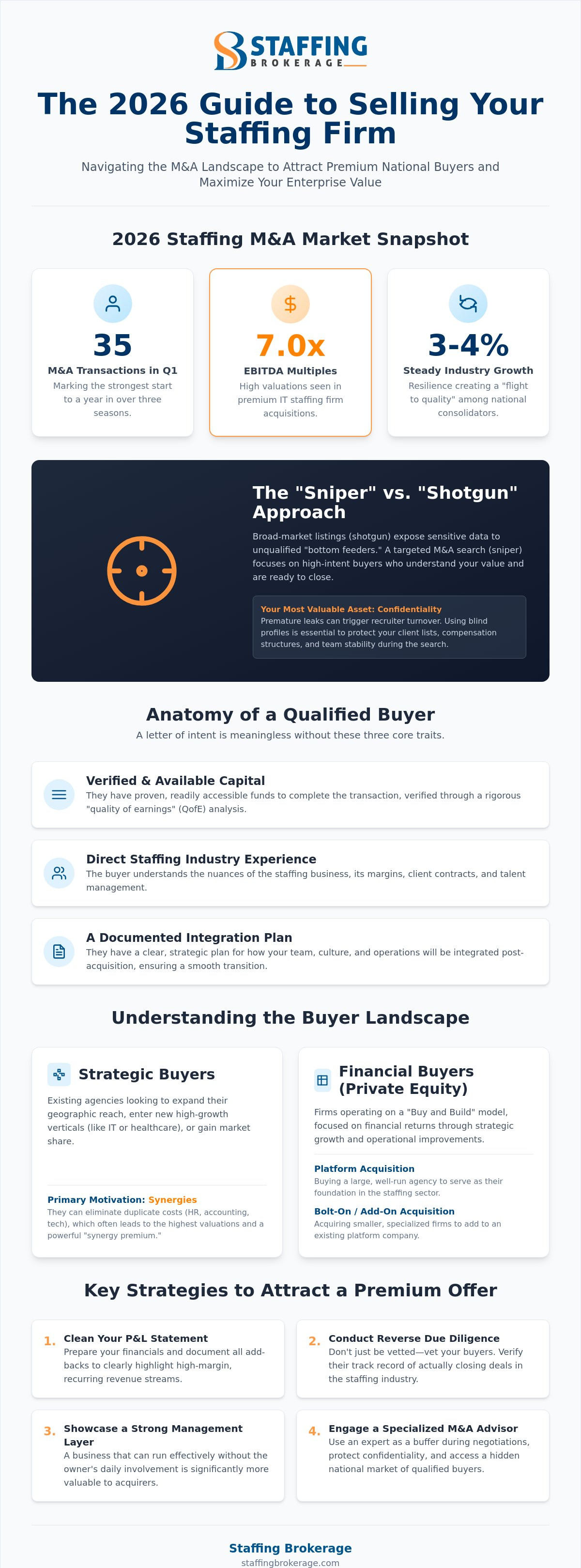
Did you know that the first quarter of 2026 saw 35 announced staffing M&A transactions, marking the strongest start to a year in over three seasons? Even with this surge in activity, the process of finding buyers for staffing firms remains a delicate balance of timing and strategy. It's common to feel a sense of unease when unsolicited low-ball offers land on your desk, or to worry that a search might accidentally breach the confidentiality you've worked so hard to maintain. You want a deal that respects your team and your legacy, not just a quick exit.
We're here to act as your steady hand through this transition. In this guide, you'll learn how to identify, vet, and attract high-intent national buyers who are willing to pay a premium for your specific expertise. We'll preview the current market trends, including the 7.0x EBITDA multiples seen in IT staffing, and provide a roadmap to secure a deal structure that maximizes your enterprise value while protecting your firm's future.
Key Takeaways
- Understand why broad-market listings put your confidentiality at risk and how to define a qualified buyer based on verified capital and clear integration plans.
- Discover the distinct goals of strategic and financial buyers, including how private equity groups use platform and bolt-on strategies to drive growth.
- Master the strategy for finding buyers for staffing firms by conducting reverse due diligence to verify a prospect's actual track record of closing deals.
- Prepare your agency for a premium exit by cleaning your P&L statement and documenting add-backs that highlight your high-margin recurring revenue.
- Access a hidden national market of qualified buyers and protect your team's legacy by using a specialized M&A advisor as a buffer during negotiations.
The Challenge of Finding Qualified Buyers for Staffing Firms
Identifying a potential suitor for your agency is easy; finding a qualified buyer is where the real work begins. In the professional context of Mergers and acquisitions (M&A), a qualified buyer isn't just someone with a checkbook. We define a truly qualified candidate as an entity with three specific traits: verified and readily available capital, direct staffing industry experience, and a documented plan for how they'll integrate your team. Without these components, a letter of intent is often little more than a distraction that wastes your time.
The process of finding buyers for staffing firms has evolved significantly. While some owners still try the "shotgun" approach by posting on broad-market listing sites, this is a dangerous game for a service-based business. These platforms expose your sensitive data to "bottom feeders" who lack the resources to close a professional deal. Instead, we advocate for a "sniper" approach. This targeted M&A search focuses on high-intent buyers who already understand your specific vertical. In 2026, the primary filter for these buyers has shifted toward a rigorous "quality of earnings" (QofE) analysis. They aren't just looking at your top-line revenue. They're dissecting the sustainability of your margins and the health of your client contracts to ensure the value is real.
Why Confidentiality is Your Most Valuable Asset
Staffing is a business built entirely on people and relationships. This makes confidentiality your most fragile and valuable asset during a sale. We often see "competitor fishing," where rival firms pose as buyers just to peek at your client list or recruiter compensation structures. If news of a potential sale leaks prematurely, it can trigger immediate turnover among your top recruiters who fear for their job security. To prevent this, we use blind profiles as the standard for initial buyer outreach. A blind profile highlights your firm's strengths and financials without revealing your name or location, ensuring your search doesn't damage the very business you're trying to sell.
The 2026 Market: Why Demand Remains High
Despite broader economic shifts, the staffing industry is maintaining a steady growth rate of 3% to 4%. This resilience has created a "flight to quality" among national consolidators. Buyers are currently prioritizing specialized niches, particularly in IT and healthcare, where margins remain robust and talent is scarce. They're also looking for firms with a strong middle-management layer. A business that can run effectively without the owner's daily involvement is worth significantly more in the current market. Finding buyers for staffing firms in 2026 means showcasing that your agency is a stable, self-sustaining engine ready for a new captain.
Understanding the Buyer Landscape: Strategic vs. Financial Acquisitions
The process of finding buyers for staffing firms requires a deep understanding of who is actually sitting across the table. In 2026, the market isn't a monolith. It's a collection of distinct personas, each with unique motivations and valuation methods. We typically categorize these into four groups: strategic competitors, private equity platform buyers, private equity add-on buyers, and family offices. While a competitor might value your client list, a family office might value your culture and long-term stability.
Strategic Buyers: Searching for Synergies
Strategic buyers are often existing agencies looking to expand their geographic reach or enter a high-growth vertical like healthcare or IT. These buyers frequently offer the highest valuations because they benefit from synergies. When two firms merge, they can often eliminate duplicate costs in HR, accounting, or technology. This "synergy premium" can be a powerful tool when negotiating the sale of a staffing agency. Many top-performing staffing firms target these buyers specifically to maximize their exit value through cost-saving efficiencies. They're not just buying your revenue; they're buying a shortcut to a new market.
Financial Buyers: Private Equity and Roll-Ups
Financial buyers, specifically private equity (PE) firms, operate on a "Buy and Build" model. In 2026, we see a clear distinction between "Platform" and "Bolt-on" acquisitions. A platform deal involves a PE firm buying a large, well-run agency to serve as their foundation in the staffing sector. Once the platform is established, they seek smaller "bolt-on" or "add-on" firms to increase their scale. These buyers are hyper-focused on EBITDA. They'll scrutinize your financials to identify "add-backs"—one-time expenses that shouldn't count against your ongoing profitability.
For many owners, a PE deal offers a "second bite of the apple." You might sell 70% to 80% of your business now and retain equity, profiting again when the PE firm eventually sells the entire consolidated group. This strategy is particularly common in sectors like IT staffing, where multiples can reach up to 7.0x EBITDA for firms with Statement of Work (SOW) capabilities. If you're curious about where your agency fits in this landscape, a professional business valuation can help clarify your market position.
Family offices have emerged as a compelling third option for mid-market firms. These are private wealth management firms that invest for the long term. Unlike PE firms that must exit within five to seven years, family offices often hold businesses for decades. They provide a steady hand and are often the best fit for owners who prioritize the long-term legacy of their brand and the security of their employees. They offer stability that aggressive consolidators sometimes lack.
How to Vet and Qualify Potential Buyers for Your Agency
Once you begin the process of finding buyers for staffing firms, you'll likely receive a range of expressions of interest. However, a high offer price is meaningless if the buyer lacks the capital or experience to cross the finish line. We encourage our clients to engage in "Reverse Due Diligence." This is your opportunity to pivot from being the party under scrutiny to the one doing the interviewing. You've spent years building your reputation; you deserve to know exactly who is proposing to take the reins.
Start by asking direct, punchy questions about their track record. A critical question to pose is: "How many staffing acquisitions have you closed in the last 24 months?" A buyer who hasn't closed a deal recently might be "tire kicking" or testing the market at your expense. You want to assess their "Certainty to Close." Deal fatigue is a real risk in M&A. If a buyer is disorganized or lacks a clear integration plan, the process can drag on for months, distracting you from running your business and potentially causing the deal to collapse at the eleventh hour.
Assessing Financial Capability
Serious buyers expect to prove they have the means to execute. We recommend requesting a "Proof of Funds" or a letter from their lending institution early in the discussions. It's vital to distinguish between buyers with committed capital, such as established private equity firms, and "search funds" that still need to raise equity for each specific deal. Relying on a buyer who hasn't secured their financing adds a layer of unnecessary risk to your exit. Understanding your own staffing company valuation will help you determine if a buyer's financial offer is grounded in reality or if they're simply over-promising to get you to the table.
Cultural and Strategic Fit Analysis
Finding buyers for staffing firms isn't just a financial exercise; it's a search for a partner. A massive offer from a buyer with a "churn and burn" culture will likely lead to a mass exodus of your internal team. This often results in failed earn-outs and a tarnished legacy. We suggest interviewing owners of other agencies the buyer has acquired. Ask them how the integration actually went and if the buyer honored their post-closing promises. Being aware of red flags when buying a staffing agency can help you spot a predatory or incompatible buyer before you've shared too much sensitive information. A buyer who respects your culture is far more likely to protect the value of the business after you've moved on.
Strategies to Attract Premium National Buyers to Your Firm
Finding buyers for staffing firms at a national level requires a shift in how you present your agency's value. Local buyers might focus on your reputation in your specific city, but national consolidators and private equity groups are looking for a scalable engine. They want to see high-margin contracts and a "Clean" P&L that clearly separates your personal expenses from the operational costs of the business. By documenting every non-recurring expense, you create a transparent financial picture that builds trust and justifies a premium multiple.
Optimizing Your EBITDA for a National Exit
A successful staffing agency exit strategy hinges on your ability to normalize your Earnings Before Interest, Taxes, Depreciation, and Amortization (EBITDA). National buyers in 2026 are particularly sensitive to client concentration. If a single client represents more than 20% of your total revenue, buyers see a risk that needs to be priced in. To attract the best offers, you must demonstrate a diversified portfolio of high-margin contracts. We work with owners to identify valid add-backs, such as one-time legal fees or the owner's personal vehicle lease, which can significantly boost your final valuation.
The Growth Narrative: Selling the Future, Not the Past
Your marketing materials, specifically the "Teaser" and the Confidential Information Memorandum (CIM), should tell a story of where the company is going. Finding buyers for staffing firms is more effective when you use national market data to prove your firm's scalability. While historical performance is the foundation, buyers are ultimately paying for future cash flows, not historical performance. To prove this potential, we recommend documenting your unfilled orders. This represents revenue that is already on the books but hasn't been realized yet due to talent shortages, serving as a clear indicator of immediate revenue potential.
Highlighting your recruitment technology stack is another way to stand out. In the 2026 market, buyers look for firms that have integrated AI into their sourcing and screening processes to drive efficiency. When you combine a modern tech stack with a deep middle-management layer, you prove to national buyers that your firm is ready to scale. If you're ready to see how your agency compares to national benchmarks, our team can provide a comprehensive business assessment to identify your most valuable growth levers.
The Value of Specialized M&A Representation in Finding the Right Fit
Selling your agency is likely the most significant financial event of your professional life. It's a process that requires more than just a list of contacts; it requires a blend of financial precision and industry-specific networking. While you focus on maintaining the momentum of your business, a specialized advisor acts as the "steady hand" managing the complexities of the market. The process of finding buyers for staffing firms is significantly more effective when you have an intermediary who understands the nuances of bill rates, spread, and recruiter retention.
One of the primary advantages of specialized representation is access to the "Hidden Market." The most qualified national buyers, including top-tier private equity groups and strategic consolidators, rarely browse public business-for-sale websites. They rely on trusted brokers to bring them high-quality, vetted opportunities. By managing a competitive bidding process, an advisor can create the leverage necessary to drive up valuation multiples. When multiple buyers are vying for your firm, you're no longer a price-taker; you're a strategic partner in a high-value transaction.
Negotiations can often become emotional, especially when discussing the legacy of your team or the final purchase price. Your advisor serves as a critical buffer, keeping the dialogue professional and focused on the objective. This role is essential when finalizing a staffing company deal structure that protects your interests. We ensure that earn-outs are achievable, equity rollovers are clearly defined, and legal indemnities don't leave you with unnecessary post-closing risks.
Beyond the Listing: The Strategic Matching Process
We don't just look for any buyer; we look for the right buyer. Our process involves using deep industry data to identify firms with specific "gaps" that your agency is uniquely qualified to fill. Perhaps a national firm has a strong sales engine but lacks the specialized IT sourcing capabilities you've perfected. This precision matching is one of the core benefits of using a staffing business broker compared to a local generalist. We provide a national reach that connects you with buyers who truly value your specific niche and culture.
Getting Started: Your Confidential Assessment
The journey toward a successful exit begins with a clear understanding of where you stand today. Our initial engagement focuses on a comprehensive business valuation and assessment. This foundation allows us to build a growth story that resonates with premium buyers while identifying any operational hurdles we should address before going to market. We view this as a collaborative journey, and we're committed to transparency at every step. If you're ready to explore what the current market holds for your agency, we invite you to reach out for a confidential, no-obligation consultation to discuss your goals and the potential value of your firm.
Securing Your Agency's Legacy in a Competitive Market
The 2026 staffing market offers incredible opportunities for owners ready to take the next step. Success in this landscape depends on your ability to look beyond initial offers and identify partners who align with your long-term vision. By prioritizing confidentiality and conducting rigorous reverse due diligence, you can filter out distractions and focus on buyers who truly value your team's niche expertise. Remember that finding buyers for staffing firms is a strategic journey that requires a clean P&L and a compelling growth narrative.
We're here to act as your reliable ally, leveraging our national buyer network and deep expertise in staffing industry M&A to ensure you receive the enterprise value you've earned. Our proven success in sell-side representation means you don't have to navigate these complex waters alone. We provide the steady hand needed to manage the search while you continue to lead your agency with confidence. If you're ready to explore your options with a partner who values integrity as much as you do, we invite you to Request Your Confidential Business Valuation and Buyer Assessment. Your next chapter is within reach, and we're excited to help you write it.
Common Questions About Selling Your Staffing Firm
How long does it typically take to find a buyer for a staffing firm?
The process generally takes between six and twelve months from the initial assessment to the final closing. This timeline allows for thorough financial preparation, a confidential marketing phase, and the rigorous due diligence required in today's market. While it's possible to move faster, a methodical approach ensures you don't rush into a deal that compromises your firm's legacy or your financial goals.
What is the difference between a strategic buyer and a financial buyer?
Strategic buyers are usually other staffing agencies looking for synergies, such as geographic expansion or new vertical expertise. They often pay higher multiples because they can eliminate redundant costs. Financial buyers, like private equity groups, focus on your firm's standalone cash flow and EBITDA. They often look for "platform" companies to lead a consolidation strategy or "bolt-on" firms to add to an existing portfolio.
Should I tell my employees I am looking for a buyer?
We strongly advise against sharing this information with your team until a deal is nearly finalized. Prematurely disclosing a potential sale can create unnecessary anxiety and lead to the turnover of your top recruiters. Maintaining strict confidentiality is essential to protecting your agency's value. We use blind profiles to ensure the process of finding buyers for staffing firms doesn't disrupt your daily operations or your culture.
What are the most attractive staffing niches for buyers in 2026?
In the current 2026 market, IT staffing, healthcare, and executive search remain the most sought-after sectors. Buyers are particularly interested in firms with Statement of Work (SOW) capabilities, which can command multiples as high as 7.0x EBITDA. While generalist firms are still selling, those with deep specialization in high-demand verticals are attracting the most competitive national bidding and favorable deal structures.
How do I know if a buyer’s offer is actually fair?
Fairness is determined by comparing the offer to current market benchmarks and your specific quality of earnings. A fair offer in 2026 should reflect the 4.0x to 7.0x EBITDA range common in the industry, adjusted for your growth rate and client diversification. You should look beyond the headline price to evaluate the cash-at-close versus earn-out components. A professional valuation is the best way to establish a realistic baseline.
Can I sell my staffing agency if I have high client concentration?
Yes, you can certainly sell, but it will influence the deal's structure. If one client accounts for more than 20% of your revenue, buyers see increased risk. They'll often mitigate this by shifting more of the purchase price into an earn-out or deferred payment. Finding buyers for staffing firms with concentration issues requires a narrative that emphasizes the strength and history of your client relationships to build buyer confidence.
What is a 'bolt-on' acquisition in the staffing industry?
A bolt-on acquisition occurs when a private equity firm buys a smaller agency to integrate into an existing platform company. These deals are designed to add immediate value through new talent, a different geographic footprint, or a specialized niche. Bolt-ons are a primary driver of the current "Buy and Build" trend, allowing larger entities to scale rapidly by absorbing well-run, smaller agencies into their established infrastructure.
Do I need to stay with the company after the sale?
Most buyers expect a transition period to ensure a smooth handover of client and candidate relationships. This typically lasts between six months and two years. If you're selling to a private equity firm as a platform company, you might stay on long-term to lead the expansion. However, if you're looking for a clean exit, we can target strategic buyers who have the management depth to take over quickly.


