
Staffing Agency Transition Planning: A Strategic Guide for 2026
What if the most important milestone for your business isn't your next big contract, but how you eventually step away from it? Many founders realize too late that staffing agency transition planning is the difference between a chaotic exit and a legacy that thrives for decades. With the staffing M&A market seeing 35 transactions in the first quarter of 2026 alone, which is the strongest start in years, the window to prepare your firm for its next chapter is officially open.
It's natural to feel anxious about client attrition or maintaining ethical standards during a sale. You've worked hard to build trust with your temporary employees and clients, and you don't want to see those relationships falter. We're here to help you master the complexities of both ownership and operational transitions to protect what you've built. This guide provides a clear roadmap for business continuity, helping you distinguish between daily management shifts and full ownership transfers. You'll learn how to maximize your agency's value and ensure a seamless handoff that keeps your culture intact.
Key Takeaways
- Understand the critical differences between daily operational shifts and full ownership changes to maintain business stability.
- Discover how ethical transition practices protect your reputation and keep your most valuable client and talent relationships intact.
- Learn why effective staffing agency transition planning should begin years before your intended exit to maximize your firm's market value.
- Identify the essential components of a transition roadmap, including process audits that ensure no operational detail is overlooked.
- See how a dedicated M&A partner acts as a steady guide to help you reach your professional milestones with confidence.
What is Staffing Agency Transition Planning?
Staffing agency transition planning is far more than a simple handbook for new hires or a collection of standard operating procedures. It's a comprehensive strategy designed to shift responsibilities or ownership while protecting the momentum you've worked years to build. While many owners view transitions as a distant "someday" event, the reality is that a successful handover requires a deliberate, multi-layered approach. It's about ensuring that if you stepped away tomorrow, your clients wouldn't notice a dip in service and your internal team wouldn't miss a beat.
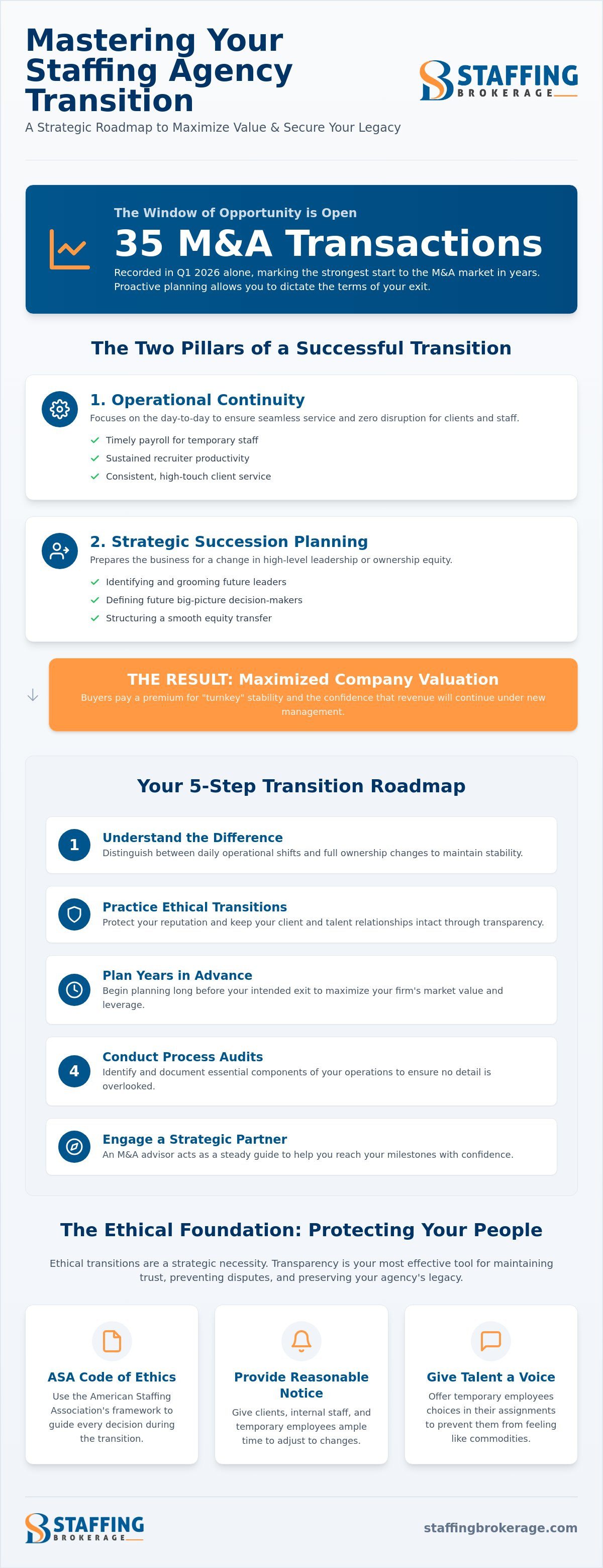
In the current 2026 market, we're seeing a significant rebound in M&A activity. With 35 transactions recorded in the first quarter alone, the pace of change is accelerating. Proactive planning allows you to dictate the terms of your exit rather than reacting to external pressures. This process safeguards your firm's most valuable asset: its reputation. In an industry built on trust, any perceived instability during a transition can lead to immediate client attrition. By documenting your processes and identifying future leaders early, you transform your agency from a founder-dependent business into a scalable enterprise.
The Two Pillars of a Successful Transition
A robust transition rests on two distinct but interconnected supports. First, operational continuity focuses on the day to day. It ensures that your temporary staff are paid on time, your recruiters stay productive, and your clients receive the same high-touch service they expect. Second, strategic succession planning prepares the business for a change in top-level leadership or equity. This involves identifying who will make the big-picture decisions once the founder exits.
When these two pillars are strong, they directly contribute to a higher staffing company valuation. Buyers are willing to pay a premium for agencies that demonstrate "turnkey" stability. They aren't just buying your revenue; they're buying the confidence that the revenue will continue under new management.
Why Timing Matters in the 2026 Market
The 2026 staffing market is projected to reach $183.3 billion, growing by 2%. This growth brings both opportunity and volatility. Early planning prevents "fire-sale" scenarios that often occur during unexpected life events or sudden market shifts. If you wait until you're ready to leave to start planning, you've already lost leverage. You want to be in a position to sell when the market is strong, not because you're forced to exit. Staffing agency transition planning is a fundamental risk-mitigation tool that ensures an agency remains resilient during leadership shifts and attractive to future buyers.
The Ethics of Operational Transition: Protecting Clients and Talent
Leading a staffing firm through a period of change requires more than just financial oversight; it requires a deep commitment to the people who power your business. You aren't just moving contracts or office furniture. You're managing the careers of your internal team and the livelihoods of your temporary workforce. If you ignore the human element of staffing agency transition planning, you risk devaluing the very company you've worked so hard to build. Ethical transitions aren't just about doing the right thing. They're a strategic necessity to prevent legal disputes and ensure you don't burn bridges with long-term clients.
Transparency is your most effective tool for maintaining trust during these shifts. When stakeholders feel left in the dark, anxiety grows, and productivity drops. By being open about the transition process, you reassure clients that their service levels will remain consistent. This proactive approach to business succession planning ensures that your legacy remains untarnished and your firm stays attractive to future partners. If you're concerned about how your current operations might impact your market standing, a professional business valuation and assessment can help identify potential risks before they become liabilities.
The ASA Code of Ethics in Practice
The American Staffing Association (ASA) provides a clear ethical framework that should guide every move you make. A key component is providing reasonable notice to all parties involved. Whether you're shifting vendors or preparing for an ownership change, you owe it to your clients and staff to give them time to adjust. Ethical protocols also dictate that temporary employees should have a voice. Offering them a choice in their assignments during a transition prevents them from feeling like commodities. When you prioritize their stability, you protect the client's bottom line by keeping production levels steady.
Mitigating Risk for Temporary Staff
Talent is the lifeblood of the staffing industry. In 2026, with the U.S. staffing market projected to reach $183.3 billion, the competition for reliable workers is intense. A "Talent First" communication plan is essential to avoid mass resignations. You must communicate changes clearly and early, focusing on what stays the same for the worker. Payroll continuity is the most critical factor here. Even a minor disruption in pay during an ownership or system shift can lead to immediate turnover. By ensuring every recruiter and temporary employee is paid accurately and on time, you maintain the stability that buyers look for in a high-performing agency. Staffing agency transition planning that puts people first isn't just ethical; it's the smartest way to protect your firm's value.
Transitioning Ownership: From Founder to Strategic Exit
Ownership transition is rarely a single event; it's a multi-year journey that requires careful orchestration. For many founders, the business is their life's work, making the prospect of stepping away both emotional and complex. However, viewing this shift as a strategic evolution rather than a simple departure is key. When you treat your exit as a long-term project, you give yourself the space to build a company that functions beautifully without your daily involvement. This shift from a founder-led model to a management-led model is exactly what sophisticated buyers look for in the 2026 market.
A documented plan is your most powerful tool for attracting premium offers. In a year where analysts forecast up to 100 total M&A deals in the staffing industry, competition for buyer attention is high. Buyers aren't just looking at your current revenue; they're evaluating the durability of your earnings. By formalizing your staffing agency transition planning, you demonstrate that your firm is a stable, turnkey investment. This preparation should ideally begin years in advance, aligning your daily operations with a clear exit strategy staffing agency owners can rely on to protect their legacy.
Succession Planning for Staffing Owners
The first step in this journey is deciding who will lead next. You might choose to groom internal successors, which often preserves company culture and provides a sense of stability for your team. This process involves identifying high-potential managers and gradually increasing their decision-making authority. Alternatively, you may look for external buyers who bring new resources to the table. Regardless of the path, implementing "key man" insurance and robust legal protections is essential. These tools ensure the business remains viable even if a critical leader departs unexpectedly, providing a safety net for both the staff and the future owner.
Transitioning to a Strategic or Financial Buyer
Your transition plan will look different depending on who is sitting across the table. Private equity firms often utilize a "platform + add-on" strategy, looking for stable agencies to serve as a foundation for further acquisitions. Strategic buyers, like larger staffing firms, might focus more on geographic expansion or niche specialization. In mid-2026, we're seeing professional staffing firms command EBITDA multiples between 5.0x and 6.0x, while IT firms with SOW capabilities can reach up to 7.0x. To hit these high marks, you must navigate the "earn-out" period effectively. This phase requires you to stay involved for a set time to hit performance targets, making a smooth handoff even more critical. A clear transition plan reduces the risk profile for a buyer by proving the agency can flourish independently of its founder.
Key Elements of a Robust Transition Roadmap
A successful roadmap is more than a simple project log; it's a blueprint that ensures your agency's heart keeps beating once you step away. To build this, you must first conduct a thorough audit of your daily responsibilities. Many founders don't realize how much of the firm's "secret sauce" lives only in their heads. Identifying these unwritten rules is the first step in effective staffing agency transition planning. You need to document every high-level decision you make and every relationship you manage to ensure no institutional knowledge is lost during the handoff.
Timing is everything. While a smaller boutique firm might manage a transition in six to twelve months, larger organizations often require two to three years to fully decouple the founder from daily operations. This lead time is essential to stabilize the business and protect your legacy. Every roadmap needs a "Key Contacts" directory. This isn't just a list of names; it's a guide to the gatekeepers at your top clients and the primary points of contact at your vendors. If you're unsure where to start your audit, our team provides expert business valuation and assessment services to pinpoint exactly where your transition plan needs the most work.
Operational Handover Essentials
The operational side of your roadmap must be granular. You need clear Standard Operating Procedures (SOPs) for your recruitment and placement cycles so that new leadership understands your quality standards. Access management is equally vital. Ensure that your successors have the correct permissions for your Applicant Tracking Systems (ATS) and Vendor Management Systems (VMS). Finally, document client-specific requirements and Service Level Agreements (SLAs). These details prevent service gaps that could lead to client frustration during the changeover.
The Communication Strategy
How you tell your story matters. You'll need a drafted "Day One" announcement for your staff and clients that emphasizes stability and growth. For firms with a national reach, managing public relations is key to maintaining your brand's standing in the broader market. Don't just announce the change and walk away. Establish a feedback loop early in the process to catch any "transition friction" before it turns into a larger problem. By listening to your team and clients during the first few months, you can make the small adjustments that ensure long-term success.
Navigating the Transition with a Strategic M&A Partner
Successfully crossing the finish line of a business sale requires more than just a willing buyer; it requires a steady hand to guide the process. An experienced M&A advisor acts as your strategic partner, ensuring that your staffing agency transition planning translates into a successful closing. While some owners attempt to manage these shifts reactively, a proactive approach keeps you in control. Specialized staffing company M&A advisory services streamline the entire journey by aligning your operational readiness with market expectations. This partnership allows you to focus on running your business while experts handle the complexities of the transaction.
Selling a firm you've built from the ground up is an emotional experience. A neutral third party provides the perspective needed to manage these emotions during tough negotiations. They act as a buffer, keeping the conversation focused on long-term value and strategic fit rather than short-term friction. If you're ready to begin this journey, the first step is always a professional business valuation and assessment. Knowing your true market worth today allows you to plan your exit with clarity and confidence.
The Role of an Advisor in Deal Structuring
The way a transaction is organized determines how smoothly the transition will actually go. Your advisor ensures that the staffing company deal structure supports your specific goals. This often involves balancing upfront cash with performance-based incentives, such as earn-outs, which keep interests aligned during the handover period. A skilled advisor also focuses on careful buyer matching. They look beyond the price tag to find an acquirer who respects your company culture and will protect your legacy for years to come.
Executing the Final Handover
The final phase of a transition is often the most intense. You must manage the due diligence process without letting daily operations slip. Your M&A partner coordinates this data exchange, allowing you to stay focused on your clients and recruiters. As the deal nears completion, the focus shifts from being an "Owner" to acting as a "Consultant" during the post-sale period. This phase is critical for a seamless transfer of knowledge and relationships. By finalizing the closure with a clear plan and professional support, you can step into your next chapter knowing your firm, your team, and your clients are in good hands.
Securing Your Agency's Future for 2026 and Beyond
Effective staffing agency transition planning is about more than just an exit; it's about honoring the legacy you've built while ensuring your team and clients continue to thrive. By focusing on operational continuity and ethical transparency, you transform your business into a resilient asset that commands a premium in the 2026 market. Whether you're grooming an internal successor or preparing for a strategic sale, a documented roadmap provides the clarity needed to navigate complex shifts with confidence.
Our team of specialized staffing industry M&A experts is here to act as your steady hand throughout this process. We offer a national reach for strategic buyer matching and a commitment to honest practice and proven results. Taking the first step now ensures you remain in control of your firm's destiny. Begin your journey with a professional business valuation from Staffing Brokerage.
You've worked hard to build a successful firm; let's work together to ensure its next chapter is just as rewarding.
Frequently Asked Questions
How long does a staffing agency transition typically take?
A typical transition takes anywhere from six months to three years. Smaller boutique firms can often complete the process within a year, while larger organizations with complex operations require more time to fully decouple the founder from daily tasks. The exact timeline depends on your operational readiness and how quickly a successor can assume your current responsibilities.
Is a transition plan the same as a succession plan?
No, these two strategies serve different purposes. Succession planning focuses specifically on who will take over leadership roles and how equity will be transferred. Transition planning is a broader operational roadmap that covers everything from vendor management and client handovers to internal process documentation. You need both to ensure your firm remains stable during a change in ownership.
What are the biggest risks of a poorly planned transition?
The primary risks include client attrition, talent loss, and a significant drop in business value. If clients perceive instability, they may move their contracts to a competitor. Similarly, your best recruiters might leave if they feel their future is uncertain. A chaotic handover can also lead to payroll errors, which immediately damages your reputation with temporary staff and regulators.
How do I tell my clients that I am transitioning the business?
Transparency is your best tool, but you must time the announcement carefully. Share the news only after you've finalized the deal or established a clear leadership shift. Introduce the new points of contact personally and emphasize that service levels will remain consistent. Focusing on the benefits of the new partnership helps reassure clients that their needs will continue to be met.
Do I need a lawyer or an M&A advisor for transition planning?
You'll benefit from having both on your team. A lawyer manages the legal contracts and protects your interests, while an M&A advisor provides the strategic guidance necessary for staffing agency transition planning. An advisor acts as a steady hand, helping you match with the right buyer and ensuring the deal structure supports a smooth handover for everyone involved.
Can a transition plan help increase my staffing agency valuation?
Yes, a robust plan significantly increases your firm's market value. Buyers pay a premium for agencies that don't depend solely on the founder to function. By proving that your processes are documented and your management team is capable of running the business independently, you reduce the buyer's risk. This turnkey stability often leads to higher EBITDA multiples during a sale.
What happens to my temporary employees during a merger or sale?
In an ethical transition, temporary employees should experience no disruption in their daily work or pay. You must prioritize payroll continuity and clear communication to keep morale high. Following American Staffing Association standards, you should provide employees with reasonable notice and, when possible, a choice in their assignments. This people first approach protects the talent pool that drives your revenue.
How far in advance should I start planning my exit transition?
You should ideally begin staffing agency transition planning two to five years before your intended exit date. This lead time allows you to groom internal successors, optimize your financial performance, and address any operational gaps. Starting early ensures you're prepared to sell when market conditions are most favorable rather than being forced to exit under pressure.


