
Sell My Recruiting Business: The 2026 Strategic Guide to a Maximum Value Exit
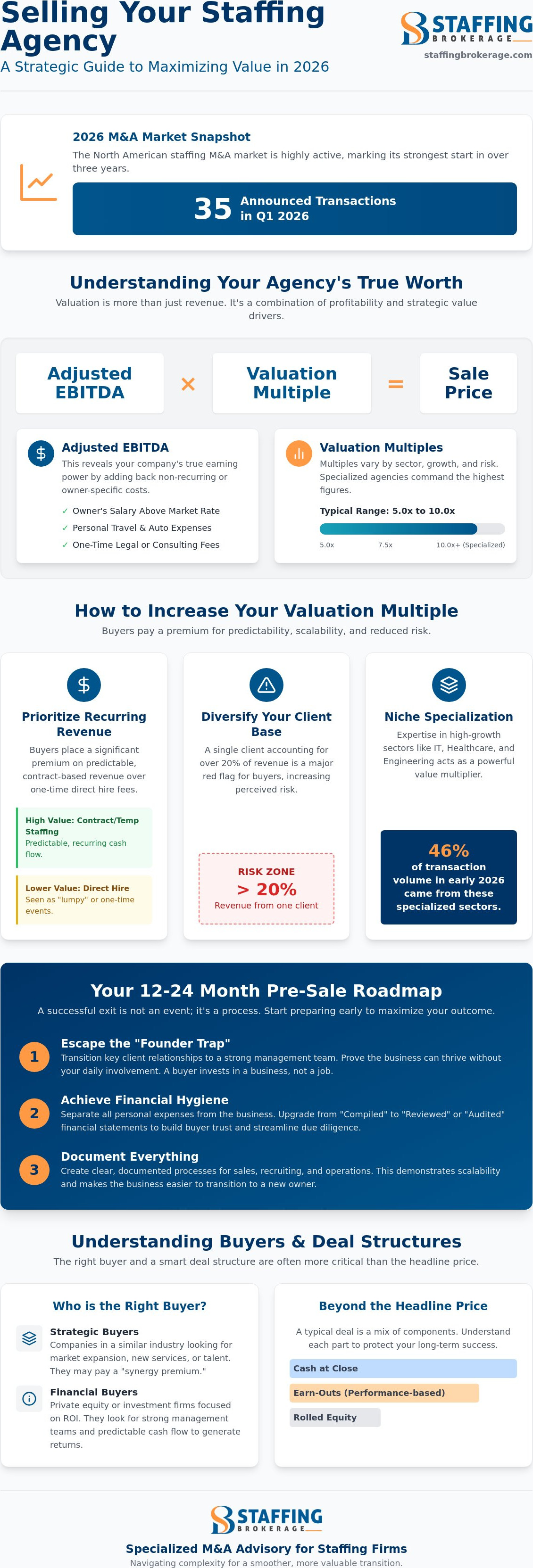
In the first quarter of 2026, North American staffing M&A reached its strongest opening in over three years with 35 announced transactions. While the market is active, the difference between a standard exit and a high-value sale often comes down to how early you shift from an owner-operator mindset to a shareholder perspective. It is natural to feel a mix of optimism and anxiety when you decide it is finally time to sell my recruiting business. You've spent years building this company, and the fear of leaving money on the table or facing a complex due diligence process is a valid concern for any dedicated founder.
We believe your exit should be a rewarding milestone rather than a stressful burden. This strategic guide provides the exact steps to value, prepare, and position your company for its highest potential value with expert M&A insights. We'll walk through current 2026 valuation multiples, which are reaching up to 10x EBITDA for specialized agencies, and show you how to maintain your daily billings while the sale moves forward. You'll gain a clear understanding of how to find a buyer who aligns with your culture while securing the financial future you've earned.
Key Takeaways
- Understand how 2026 valuation multiples, often ranging from 5x to 10x EBITDA, combine with intangible assets to determine your agency's true market worth.
- Learn how to sell my recruiting business for its highest potential value by building founder independence and scalability at least 12 to 24 months before going to market.
- Identify the differences between strategic and financial buyers to determine who'll offer the best cultural fit and potential synergy premiums.
- Discover why the deal structure, including cash at close, earn-outs, and equity, is often more critical to your long-term success than the initial headline price.
- See how specialized M&A advisory helps you navigate complex staffing nuances like VMS/MSP contracts and recruiter commission structures for a smoother transition.
What Is My Recruiting Business Worth? Understanding 2026 Valuation
Determining how to sell my recruiting business for its peak value starts with a clear-eyed look at valuation. It's more than just a simple calculation of your last twelve months of revenue. In 2026, savvy buyers view your agency as a collection of financial metrics and intangible assets, such as your brand reputation, recruiter tenure, and proprietary candidate databases. The goal is to present a business that functions as a predictable wealth-generating machine rather than a practice that relies solely on your personal effort.
The industry standard for valuation is the "Multiple of EBITDA" model. EBITDA stands for Earnings Before Interest, Taxes, Depreciation, and Amortization. This metric provides a baseline for a firm's operational profitability. This process is a fundamental part of Mergers and acquisitions (M&A), where buyers look for a balance of historical profit and future potential. In the current market, staffing firms often see multiples between 5.0x and 10.0x of their normalized earnings, though this varies based on your specific sector and growth trajectory.
Key Valuation Metrics: Beyond the Bottom Line
While EBITDA is the starting point, "Adjusted EBITDA" is the number that actually drives the sale price. We work with you to identify "Add-backs," which are expenses that a new owner likely won't incur. These include your personal salary, non-business travel, and one-time legal or consulting fees. By normalizing these costs, we reveal the true earning power of the company. You should also consider client concentration. If one client accounts for more than 20% of your revenue, buyers see a risk. Diversifying your client base before you sell my recruiting business is a proven way to protect your multiple.
Direct Hire vs. Contract Revenue Multiples
Buyers in 2026 place a significant premium on contract and temporary staffing revenue. This is because contract revenue is predictable and recurring. It provides a steady cash flow that makes a business easier to finance and manage. Direct hire fees, while often carrying higher margins, are seen as "lumpy" or one-time events. If your firm is heavy on direct hire, we focus on packaging your "sticky" client base. Highlighting long-term Master Service Agreements (MSAs) and a history of repeat placements can help bridge the valuation gap between these two models. Niche specialization in IT, Healthcare, or Engineering also acts as a value multiplier, as these sectors represented 46% of transaction volume in early 2026.
Preparing Your Agency for a Strategic Exit
Successful exits don't happen by accident; they're the result of deliberate, long-term preparation. Most experts recommend a 12 to 24 month window to prepare your firm for the market. This timeframe allows you to clean up your books and, more importantly, prove the business can thrive without your daily involvement. When you decide to sell my recruiting business, you aren't just selling a revenue stream. You're selling a scalable asset that can continue to grow under new ownership.
A common hurdle for many owners is the "Founder Trap." If you're still the primary biller or the only person holding key client relationships, a buyer sees a "job" rather than a "business." Transitioning these accounts to a strong middle-management tier is essential for a maximum value exit. Buyers in 2026 look for a leadership team that maintains stability after the owner departs. Implementing a robust staffing agency exit strategy ensures your firm is ready for the scrutiny of a sophisticated acquirer.
Financial Hygiene and Clean Books
Financial hygiene is the process of making your P&L bulletproof for due diligence. Many owner-operated firms use "Compiled" financials, but moving to "Reviewed" or "Audited" statements by a CPA significantly increases buyer trust. It shows you have nothing to hide. When preparing to sell my recruiting business, you must separate personal expenses from business operations immediately. Whether it's a personal car lease or family travel, these expenses should be clearly documented and removed from the business ledger. Understanding different business valuation methods helps you see your books through the lens of a buyer.
Operational Scalability and the Founder Trap
Scalability is proven through documentation. If your recruitment and sales cycles only exist in your head, the business has no value to an outsider. You need documented Standard Operating Procedures (SOPs) for everything from candidate sourcing to client onboarding. This transparency allows a buyer to see exactly how the "machine" works. If you're looking for a steady hand to guide you through this preparation, our team provides specialized sell-side support to ensure you don't leave money on the table.
Strong middle management acts as a bridge for the new owner. When a buyer sees a team of capable recruiters and managers who don't rely on the founder for every decision, the perceived risk drops. This lower risk profile directly correlates to a higher valuation multiple. Focus on empowering your team today so you can enjoy a clean exit tomorrow.
Finding the Right Buyer: Strategic vs. Financial
Finding the right buyer is just as critical as the valuation itself. When you decide to sell my recruiting business, you'll generally encounter two distinct groups: strategic buyers and financial buyers. Each group has different motivations. Choosing between them will shape everything from your final payout to the future of your employees and your personal legacy. We guide you through this selection process to ensure the partner you choose aligns with your long-term goals.
Understanding the motivations of these acquirers is essential for a successful negotiation. Gaining insights from staffing company buy-side advisory gives you a unique advantage. It allows you to see the "other side" of the negotiation table and anticipate the specific metrics a sophisticated buyer will prioritize during due diligence.
Strategic Buyers: Selling to Competitors
Strategic buyers are often your competitors or larger firms operating in your same vertical. They're looking for synergies that can accelerate their own growth. This might mean acquiring your geographical footprint, your niche expertise in sectors like renewable energy, or your deep relationships with specific client accounts. Because these buyers can often eliminate duplicate back-office costs, they might pay a "synergy premium" that exceeds a standard market multiple. However, selling to a competitor requires extreme caution. We prioritize strict confidentiality during this process. This ensures your recruiters and clients don't hear rumors that could disrupt your daily operations before the deal is finalized.
Financial Buyers: Private Equity and Search Funds
Financial buyers, primarily private equity (PE) firms and search funds, are increasingly active in the recruiting sector. In 2025, private equity firms accounted for 59% of all transactions in the $5M to $50M range. These buyers typically look at your firm as either a "Platform"—an initial investment they plan to grow through further acquisitions—or an "Add-on" to an existing portfolio company. PE firms often require the founder to stay on for 12 to 24 months to ensure a smooth transition. A unique advantage of this path is the "second bite of the apple." By rolling a portion of your equity into the new entity, you could receive a second significant payday when the PE firm eventually sells the entire group in the future.
Whether you prefer a clean exit or a continued partnership, identifying the right buyer profile is a foundational step. Each path offers different levels of "cash-at-close" versus long-term upside. Our role is to help you weigh these options so you can sell my recruiting business with total confidence in the outcome.
Navigating M&A Deal Structures for Staffing Firms
When you decide to sell my recruiting business, the number you see on the letter of intent is just the beginning. In the 2026 market, the staffing company deal structure often matters more than the headline price. A deal's structure can shift the effective price by 10% to 25%, making it vital to understand how your money is delivered. Most offers today consist of three main pillars: guaranteed cash at closing, equity rolls, and performance-based earn-outs. We help you balance these components to maximize your net proceeds while minimizing your long-term risk.
Tax implications also play a massive role in your final take-home amount. Most buyers prefer an asset sale because it allows them to step up the basis of the acquired assets for depreciation. For you, the seller, this can lead to higher taxes compared to a stock sale, where you might benefit from lower capital gains rates. Understanding these nuances early allows you to negotiate terms that protect your wealth. If you want to ensure your offer is structured for success, our sell-side representation team can help you evaluate every line item.
Understanding Earn-outs and Performance Hurdles
An earn-out acts as a bridge between a buyer’s valuation and a seller’s asking price. If you believe your firm is poised for explosive growth, an earn-out allows you to prove it and get paid for that future success. Common metrics for these hurdles include Gross Margin, EBITDA, or the retention of top-tier clients. An earn-out typically spans 12 to 36 months in the recruiting industry. This period ensures the buyer that the business remains stable during the transition of leadership and client relationships.
The Due Diligence Gauntlet
Once you sign a letter of intent, you enter the 60 to 90 day due diligence window. This is a rigorous period where the buyer verifies every claim you've made. They'll scrutinize your client contracts, recruiter retention rates, and even your IT infrastructure. It's a demanding process that can feel intrusive. The key to surviving is to keep your eyes on the daily operations. Don't let your billing slip during this time, as any dip in performance can give a buyer leverage to renegotiate the price. We act as your steady hand during this phase, managing the information flow so you can stay focused on your team.
Why Work with a Specialized Staffing Business Broker?
A general business broker might understand a basic profit and loss statement, but they often lack the depth to explain the nuances of VMS/MSP contracts or the complexities of recruiter commission structures to a potential buyer. These industry-specific details are where value is either captured or lost. When you decide to sell my recruiting business, you need a partner who speaks the language of staffing fluently. Specialized staffing company M&A advisory firms bring a level of precision that a generalist simply cannot match. We understand how your recurring contract revenue differs from a one-time direct hire fee and how to articulate that value to sophisticated acquirers.
Our role is to act as your "steady hand" throughout the entire journey. We handle the heavy lifting of buyer matching and data room management so you can focus on hitting your quarterly billing targets. By maintaining a professional and methodical pace, we ensure you feel informed and confident at every milestone. This collaborative approach turns a complex transaction into a shared accomplishment.
The Value of a Competitive Process
A primary advantage of working with a specialized advisor is the creation of a competitive auction. Instead of "negotiating against yourself" with a single interested party, we bring multiple qualified buyers to the table. This environment naturally drives up the final sale price and improves deal terms. Negotiating the sale of a staffing agency requires a delicate touch. An intermediary allows you to maintain a positive relationship with your future partner while we handle the difficult conversations regarding price and structure. The Letter of Intent (LOI) serves as your roadmap, and we ensure it sets a firm foundation for a successful close.
Your Next Steps: From Assessment to Closing
Your journey toward a maximum value exit begins with a confidential staffing company valuation. This assessment provides a realistic baseline for what the market will pay in 2026. From there, we leverage our national reach to identify buyers across the United States who are looking for exactly what you've built. We do this with absolute discretion to protect your team and your reputation. When you are ready to sell my recruiting business, Staffing Brokerage is committed to providing an honest, transparent, and professional experience. We focus on strategic fit and long-term value, ensuring that your clean exit is the rewarding milestone you deserve.
Securing Your Legacy in the 2026 Market
Selling your agency is the culmination of years of hard work, grit, and dedication. By focusing on founder independence, clean financial hygiene, and a strategic deal structure, you've already laid the groundwork for a successful exit. You don't have to navigate the complexities of the M&A landscape alone. When you decide it's time to sell my recruiting business, having a partner who understands the specific nuances of the staffing industry makes all the difference. This transition is a journey we take together, ensuring your company's value is fully recognized by the right buyers.
Our team provides confidential sell-side representation and access to a national buyer network to ensure you find the perfect cultural and financial fit. As specialized staffing M&A experts, we manage every detail of the process with a steady hand. This allows you to stay focused on your daily operations while we handle the complexities of the sale. Get a Confidential Valuation of Your Recruiting Business today to begin your journey toward a clean, high-value exit. You've built something remarkable; it's time to realize its full potential and secure the future you've earned.
Frequently Asked Questions
How long does it typically take to sell a recruiting business?
It typically takes between six and nine months to sell a recruiting business from the initial valuation to the final closing. This timeframe allows for a strategic preparation phase, a competitive marketing period, and the standard 60 to 90 day due diligence window. Moving at this methodical pace ensures that we find the right cultural fit while you continue to hit your billing targets.
Should I tell my employees I am planning to sell my agency?
You should wait until the deal is nearly finalized and a purchase agreement is signed before informing your broader team. Early disclosure often creates unnecessary anxiety and can lead to recruiter turnover, which directly impacts your company's value. We help you manage the process with absolute discretion, ensuring your daily operations remain stable while we handle the negotiations in the background.
What is the average EBITDA multiple for a staffing firm in 2026?
In the current 2026 market, founder-led staffing firms in the lower middle market generally command multiples between 5.0x and 10.0x of normalized EBITDA. Agencies with a heavy focus on niche sectors like healthcare, IT, or renewable energy often sit at the higher end of this range. Your specific multiple is also influenced by your mix of contract versus direct hire revenue and your overall growth trajectory.
Can I sell my recruiting business if I am the primary biller?
Yes, you can sell my recruiting business even if you are the top producer, though it requires a plan to transition your accounts. Buyers view a business as more valuable when the revenue doesn't depend solely on the owner's personal effort. We work with you to shift those key client relationships to your senior team members, which helps prove the company's scalability and secures a higher multiple.
What is the difference between an asset sale and a stock sale?
An asset sale involves the buyer purchasing specific parts of the business, such as client lists and equipment, while a stock sale transfers the entire legal entity. Buyers often prefer asset sales because they can "step up" the basis of assets for tax depreciation. Sellers usually prefer stock sales because they often qualify for more favorable capital gains tax treatment. We help you evaluate which structure aligns best with your financial exit goals.
How do I maintain confidentiality during the sale process?
We maintain confidentiality by using "blind profiles" that highlight your firm's strengths without revealing its name or specific location. No identifying information is shared until a prospective buyer has signed a strict Non-Disclosure Agreement (NDA) and passed our initial vetting process. This protective layer ensures your competitors, clients, and employees don't learn about the potential sale until you're ready to tell them.
What are the most common red flags buyers look for in due diligence?
Buyers are particularly wary of client concentration where a single account represents more than 20% of your total revenue. Other red flags include high recruiter turnover, unorganized financial records, and a lack of documented Standard Operating Procedures. Addressing these issues well before you sell my recruiting business is the best way to protect your valuation and ensure a smooth transition.
Do I need to stay with the company after the sale is finalized?
Most buyers expect the founder to remain for a transition period of 12 to 24 months to ensure stability. This period is often tied to an earn-out or equity roll, allowing you to participate in the company's future growth. If you're looking for a faster exit, we focus on empowering your middle-management team today so the buyer feels confident in the agency's ability to thrive without your daily presence.


