
How to Sell My Staffing Agency: A Strategic 2026 Guide to Maximizing Value
Did you know that the first quarter of 2026 saw 35 announced M&A transactions in the staffing industry? This 9% year-over-year growth signals the most active start to a year in nearly half a decade. If you're starting to think, "it's time to sell my staffing agency," you're looking at a market that's hungry for specialized expertise and proven results.
We understand that the thought of an exit brings up a mix of pride and pressure. You likely worry about leaving money on the table or losing key employees during the transition. It's the biggest financial decision of your professional life, and you shouldn't have to face it with uncertainty or confusion over complex valuation terminology.
This guide will give you the clarity and confidence to move forward. You'll discover the exact roadmap to value your business, prepare your team, and secure a deal that maximizes your financial reward. We'll walk through current 2026 multiples and the strategic steps required for a smooth, confidential transaction that honors the legacy you've built.
Key Takeaways
- Understand the current 2026 market dynamics and why strategic buyers are aggressively pursuing specialized staffing firms this year.
- Learn how to apply current EBITDA multiples and gross margin metrics to accurately value and sell my staffing agency for its true worth.
- Distinguish between strategic and financial buyers to find a partner that aligns with your financial goals and your company's culture.
- Follow a structured, step-by-step roadmap that simplifies the transition from the initial assessment to the final closing of the deal.
- Discover why a specialized "steady hand" advisory approach is essential for managing high-stress negotiations and protecting your legacy.
Understanding the 2026 M&A Landscape for Staffing Firms
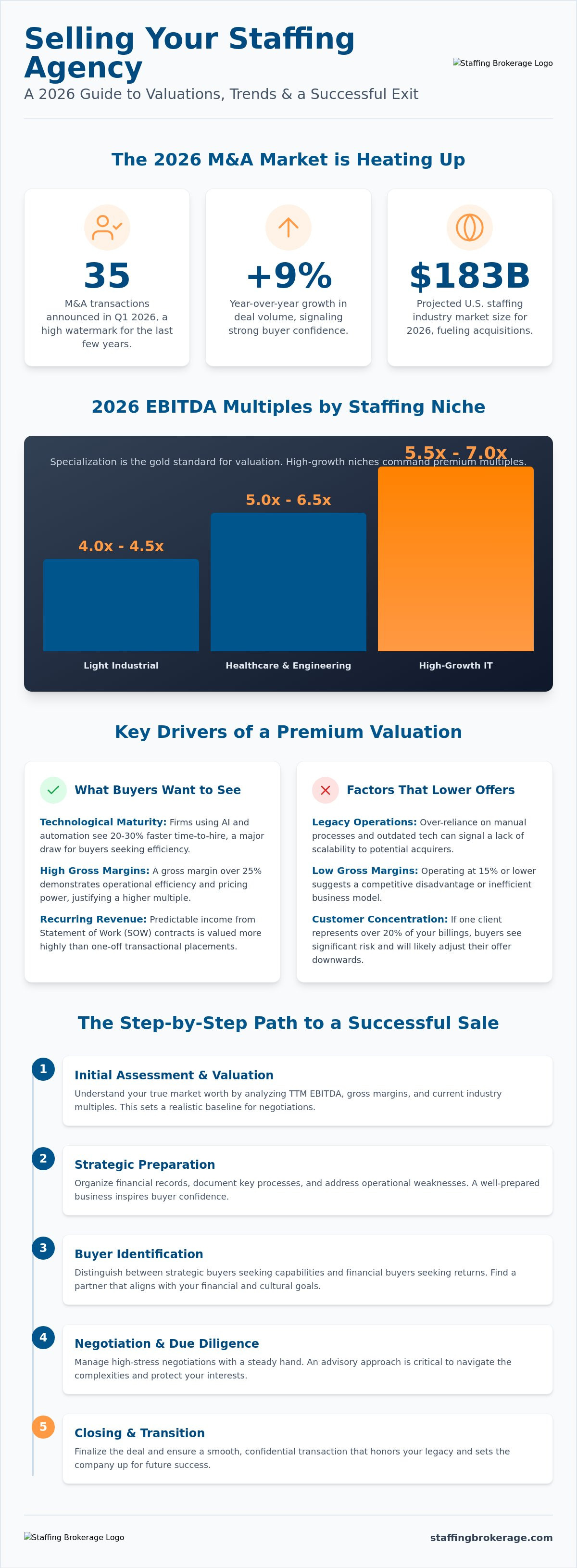
The 2026 M&A landscape for the staffing industry is currently experiencing a powerful resurgence. In the first quarter of 2026 alone, we've seen 35 announced transactions; this marks the most active start to a year in at least three years. This momentum suggests that if you're thinking, "it's time to sell my staffing agency," you're entering a market where buyers are actively seeking high-quality partners. The U.S. staffing industry is projected to reach a market size of $183.3 billion this year, and this growth is fueling a new wave of strategic acquisitions across the country.
Buyers aren't just looking for top-line revenue anymore. They're hunting for specialized capabilities and technological maturity. Technology is a major driver in today's valuations. Firms that have successfully integrated AI and automation into their sourcing and screening processes are seeing time-to-hire reductions of 20% to 30%. These efficiencies make your business much more attractive to a buyer who wants a modern, scalable platform rather than a manual, legacy operation.
Specialization remains the gold standard for valuation premiums. In the current market, high-growth IT staffing niches are commanding multiples between 5.5x and 7.0x EBITDA. Healthcare and engineering niches also continue to outperform the broader market. When you decide to sell my staffing agency, these specialized talent pipelines and deep industry relationships act as a significant lever for your final sale price.
Why 2026 is a Pivotal Year for Sellers
The national staffing landscape is undergoing a period of intense consolidation. Large, generalized firms are selling off non-core assets to focus on high-return markets, while private equity firms are re-engaging with significant capital. A prime example is the $437 million acquisition of Cross Country Healthcare in the second quarter of 2026. This influx of private equity money into the mid-market creates a competitive environment that favors prepared sellers. Beyond the market data, it's also a time to evaluate your personal goals. Whether you're looking for retirement or your next venture, the current stability offers a rare window for a clean, profitable exit.
Market Drivers: What is Pushing Multiples Higher?
The value of a firm today is heavily weighted toward the quality and predictability of its revenue. Buyers prioritize recurring revenue models and Statement of Work (SOW) capabilities over one-off, transactional placements. This stability is exactly what strategic buyers need to justify paying higher multiples. Implementing a clear staffing agency exit strategy helps you identify these value drivers early. By focusing on specialized talent pipelines and operational precision now, you ensure that your business stands out as a premium asset in a crowded marketplace.
Determining What Your Staffing Agency is Really Worth
Valuing a business isn't just about looking at last year's tax returns. When you prepare to sell my staffing agency, the most common metric you'll encounter is a multiple of EBITDA (Earnings Before Interest, Taxes, Depreciation, and Amortization). This number represents your operational profitability. In 2026, these multiples vary significantly by sector. For example, light industrial firms typically see 4.0x to 4.5x, while high-growth IT niches can command up to 7.0x. These benchmarks provide a baseline, but the specific details of your operation will move the needle.
Gross margin percentages also play a critical role in your final sale price. A firm with a 25% gross margin is often viewed as more stable and efficient than one operating at 15%, even if their top-line revenue is identical. Buyers also look closely at customer concentration. If a single client accounts for more than 20% of your billings, buyers may perceive a higher risk and adjust their offer accordingly. It's about showing that your success is repeatable and diversified. Demonstrating a broad, loyal client base is the best way to defend a premium multiple.
Common Valuation Metrics in Staffing
While revenue multiples are sometimes discussed, EBITDA is the primary language of 2026 M&A. Buyers look at your Trailing Twelve Months (TTM) to see recent performance, but they're also interested in your projected earnings for the next fiscal year. We define staffing company valuation as a mix of financial health and market positioning. Understanding this balance is the first step toward a successful exit that reflects your hard work.
Maximizing Value Through Add-Backs
This is where many owners leave money on the table. Add-backs are expenses that won't continue under new ownership. If you pay yourself a salary significantly above market rate, the "excess" can be added back to your EBITDA. The same applies to one-time legal fees, personal travel run through the business, or non-recurring technology upgrades. These adjustments are vital when you want to sell my staffing agency for the highest possible price.
Identifying these adjustments requires a meticulous eye and a steady hand. By normalizing your financials, you present a "pro-forma" EBITDA that reflects the true earning potential of the agency. A clean set of financials doesn't just increase the price; it builds buyer trust during due diligence. When you're ready to see how these numbers apply to your specific situation, a professional business valuation and assessment can provide the clarity you need to move forward with confidence.
Identifying the Right Buyer: Strategic vs. Financial Acquisitions
Identifying the ideal buyer is about more than just finding the highest bidder. It's about finding a partner who values what you've built and possesses the resources to take it to the next level. When you decide to sell my staffing agency, you'll generally encounter two distinct groups: strategic buyers and financial buyers. Each group has different motivations, and understanding these can help you position your firm for the best possible outcome.
Confidentiality is the bedrock of this entire search. You don't want your competitors or clients to know you're exploring an exit until the deal is secure. We manage this through a "blind" profile that highlights your agency's strengths, such as your 2026 EBITDA performance or niche specialization, without revealing your identity. This steady, methodical approach protects your current operations while we vet potential suitors for the right strategic fit.
Strategic Buyers: Paying for Synergy
Strategic buyers are typically other staffing firms or larger corporations looking to expand their footprint. They aren't just buying your cash flow; they're buying your market share, your client list, and your specialized recruiters. For these buyers, the value lies in "synergy." If your agency has a strong presence in a geographic area where they are weak, or if you dominate a high-margin niche like IT or engineering, they may pay a premium to acquire that expertise instantly. Finding qualified buyers for staffing agencies involves looking for these specific overlaps where your business becomes the missing piece of their larger puzzle.
Financial Buyers: Investing in Growth
Financial buyers, such as private equity firms, have re-entered the market with significant force in 2026. Unlike strategic buyers, they often look for "platforms" or "add-ons." A platform is a stand-alone company with a strong management team that the PE firm can use as a foundation for future acquisitions. An add-on is a smaller firm that bolsters an existing platform. These buyers prioritize strong internal management teams because they often want the owner to stay on for a few years post-sale. This "second bite of the apple" allows you to benefit from the future growth of the company under their financial backing. If you want to sell my staffing agency but aren't ready to walk away entirely, a financial buyer might offer the perfect collaborative journey toward a full exit.
The Step-by-Step Process of Selling a Staffing Business
Selling a business isn't a single event; it's a methodical progression that requires a steady hand to manage. When you decide to sell my staffing agency, the journey typically follows a structured path designed to build value at every turn. It begins with an initial assessment to ensure your financials and operations are ready for scrutiny. From there, we move into the active market, ensuring your legacy is protected while we hunt for the perfect strategic fit.
The process generally follows these five essential phases:
- Phase 1: Initial assessment and professional business valuation.
- Phase 2: Development of the Confidential Information Memorandum (CIM).
- Phase 3: Targeted marketing and vetting of potential buyers.
- Phase 4: Negotiation of the Letter of Intent (LOI) and due diligence.
- Phase 5: Final contract negotiation and deal closure.
Each phase is a collaborative effort. We focus on highlighting your firm's unique strengths, such as your 2026 growth in specialized niches or your high-performing internal team. This narrative approach ensures that buyers see the future potential of the business, not just its past performance.
The Critical Role of Due Diligence
Due diligence is the phase where a buyer verifies every financial and operational claim you've made. It's a rigorous period of scrutiny that requires a well-organized virtual data room. Sellers must proactively identify and resolve red flags buying a staffing agency, such as inconsistent candidate documentation or high client concentration. Addressing these issues early prevents "deal fatigue," a common trap where long delays cause buyers to lose enthusiasm or attempt to renegotiate the price at the eleventh hour. A prepared seller is a confident seller.
Structuring the Deal for Success
The final price is only one part of the equation; how you receive that money is equally vital. In the 2026 market, many deals include a combination of cash at closing, seller notes, and earn-outs. Earn-outs are particularly popular right now because they align the interests of the buyer and seller over a one-to-three-year period. You'll also need to decide between a stock sale and an asset sale, as each has different tax and liability implications. Working with staffing company deal structure experts ensures you optimize your net proceeds and protect your financial future. If you're ready to begin this journey, our staffing company sell-side representation provides the end-to-end guidance necessary for a clean, rewarding exit.
Navigating the Exit: Why Specialized M&A Advisory Matters
Generalist business brokers often struggle with the unique nuances of the staffing sector. They might understand basic balance sheets, but they often overlook the complexities of VMS/MSP contracts, worker's compensation liabilities, or the impact of payroll funding on cash flow. When you decide to sell my staffing agency, you need a partner who speaks this industry's language fluently. A specialized advisor understands that your value isn't just in your equipment or real estate; it's in the talent pipelines and client relationships you've spent years cultivating.
The transition from founder to seller is an emotional journey that requires a steady hand. Negotiations can become high-stress environments where deal fatigue often sets in. We act as your reliable ally, maintaining a calm and experienced presence that keeps the transaction on track. By leveraging industry-specific data from the 2026 market, we ensure that your agency is positioned correctly against national benchmarks, helping you move forward with total clarity and confidence.
The Staffing Brokerage Difference
Our approach is rooted in honest practice and strategic alignment. We don't just look for any buyer; we look for the right buyer who respects your legacy and provides a strong cultural fit for your team. We provide end-to-end guidance, managing everything from the initial valuation to the final wire transfer. Because we focus exclusively on the staffing industry, we maintain a deep network of pre-vetted national buyers who are actively looking for acquisitions in 2026. This specialized focus allows us to create a competitive environment that drives maximum value for your business.
Your Next Steps Toward a Strategic Exit
Success in an exit is often the result of careful, long-term preparation. Ideally, the planning process should begin 12 to 24 months before you intend to go to market. This lead time allows you to clean up financials, diversify your client base, and address any operational gaps that could impact your valuation. It's never too early to understand what your business is worth in the current climate.
If you're ready to explore your options, we invite you to request a confidential business assessment. This initial conversation is a chance to align your personal milestones with market opportunities. We'll provide a transparent look at how 2026 multiples apply to your specific niche and help you map out a collaborative journey toward a successful sale. Partner with us for your staffing agency sale and ensure your exit is as rewarding as the business you've built.
Securing Your Legacy in a Growing Market
The 2026 staffing market offers a unique window of opportunity for owners ready for their next chapter. By understanding current EBITDA multiples and the difference between strategic and financial buyers, you can position your firm for a premium exit. Success depends on more than just high revenue; it requires a clean deal structure and a meticulous approach to due diligence. This process is a significant milestone, and having a reliable ally ensures you don't leave value on the table.
When you decide to sell my staffing agency, the right partner makes all the difference in achieving your financial and personal goals. We bring specialized M&A expertise and a national reach to every transaction, connecting you with pre-vetted buyers who value your agency's unique strengths. Our proven track record of successful staffing deal closures ensures that your transition is handled with the care and precision it deserves.
Request Your Confidential Staffing Agency Valuation
Your hard work has built something remarkable. We're here to help you cross the finish line with confidence and celebrate a successful new beginning.
Frequently Asked Questions
How much is my staffing agency worth in 2026?
Your agency's value is primarily determined by a multiple of your EBITDA, with specific premiums for specialized niches. In 2026, light industrial firms typically see multiples of 4.0x to 4.5x, while professional staffing firms range from 5.0x to 6.0x. Factors like gross margin, recurring revenue models, and internal management strength will determine where your business lands within these ranges.
How long does it typically take to sell a staffing business?
A typical staffing business sale takes between six and nine months from the initial assessment to the final wire transfer. This timeline includes the preparation of marketing materials, vetting potential buyers, and a rigorous 60 to 90 day due diligence period. Starting your planning 12 to 24 months in advance ensures you aren't rushed and can address any operational red flags early.
Should I tell my employees I am selling the agency?
It's usually best to keep the sale confidential from the broader staff until a Letter of Intent is signed and due diligence is well underway. Early disclosure can lead to anxiety and unwanted turnover during a sensitive transition. You should only involve a very small circle of key leadership whose assistance is vital for gathering data for the buyer's review.
What is a typical EBITDA multiple for an IT staffing firm?
In 2026, IT staffing firms command some of the highest premiums in the industry, with multiples ranging from 5.5x to 7.0x EBITDA. If your firm specializes in high-growth niches or possesses Statement of Work (SOW) capabilities, you may even see offers at the higher end of that spectrum. Buyers value the specialized talent pipelines and technical expertise these agencies provide.
Can I sell my staffing agency if I have high client concentration?
You can certainly sell my staffing agency even with high client concentration, though it often influences how the deal is structured. Buyers may mitigate their risk by shifting more of the purchase price into an earn-out or a seller note. Demonstrating long-term contracts and deep relationships with those key clients helps reassure buyers that the revenue will remain stable after the transition.
What is the difference between an asset sale and a stock sale?
An asset sale involves the buyer purchasing specific items like your client list and equipment, which allows them to step up the tax basis of those assets. A stock sale involves the buyer taking over the entire legal entity, including all past and future liabilities. Sellers often prefer stock sales for the favorable capital gains tax treatment and the clean break from legal responsibilities.
How do I maintain confidentiality while my business is on the market?
Confidentiality is maintained by using a "blind" teaser that describes your agency's financials and market position without revealing its name. Potential buyers must sign a strict Non-Disclosure Agreement before receiving any identifying information or the Confidential Information Memorandum. This methodical approach ensures that your clients, employees, and competitors remain unaware of the sale until it's strategically appropriate to share.
Do I need an M&A advisor if I already have a buyer interested?
Even with an interested buyer, an M&A advisor is essential to ensure you aren't leaving money on the table. A single interested party rarely offers the best possible terms without the pressure of a competitive process. An advisor manages the complex negotiations and due diligence requirements, allowing you to focus on running your business while they secure the highest possible net proceeds for your exit.


