
Nurse Staffing Agency Valuation: A Strategic 2026 Guide for Owners
If you're still valuing your agency based on peak pandemic revenue, you might be surprised to find that today’s buyers have shifted their focus entirely. In 2026, the market has matured, and a professional nurse staffing agency valuation is now driven by the durability of your margins rather than just top-line growth. It's a shift that can feel unsettling if you're planning an exit, especially with the fear of leaving money on the table after years of dedication to your clinicians and clients.
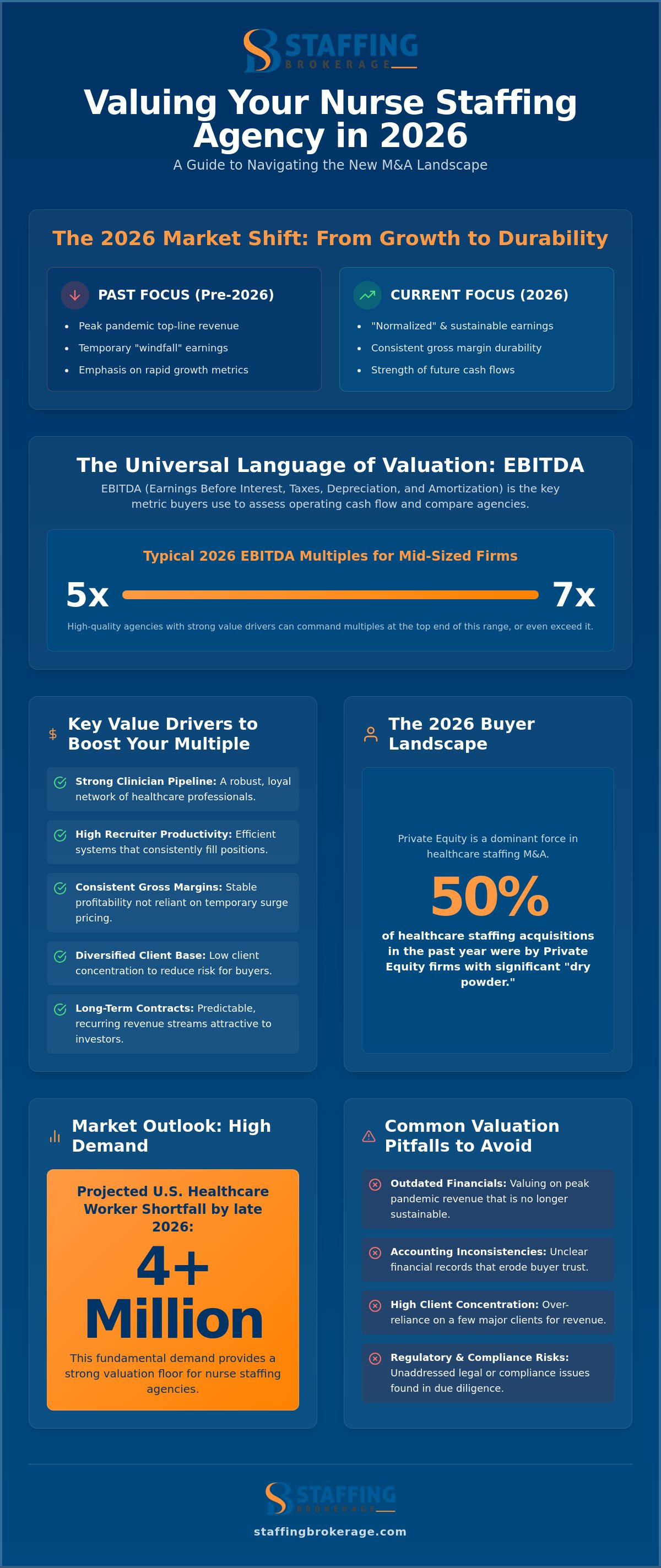
We understand the weight of these decisions and the desire for a clear, honest assessment of your life's work. You deserve to know exactly where you stand in a landscape where private equity now accounts for half of all healthcare staffing acquisitions. This guide will show you how to interpret current EBITDA multiples, which typically range from 5x to 7x for mid-sized firms, and identify the specific operational levers that maximize your company's worth. We'll walk through the metrics that matter most to buyers today, from recruiter productivity to the strength of your clinician pipeline, so you can move forward with total confidence in your strategic next steps.
Key Takeaways
- Learn how to adjust your historical data to reflect 2026 market realities and ensure your financials align with current buyer expectations.
- Understand the "universal language" of EBITDA and market approaches to gain a clear perspective on your nurse staffing agency valuation.
- Identify the specific revenue mixes and client concentration thresholds that can significantly boost your multiple or create unexpected hurdles.
- Spot and resolve common red flags, from accounting inconsistencies to regulatory risks, before they impact your final transaction value.
- Discover the roadmap for moving from an initial assessment to a successful, strategic exit with a partner who understands the staffing industry.
Understanding the 2026 Landscape for Nurse Staffing Valuations
A professional nurse staffing agency valuation is far more than a simple calculation of your annual profits. It's a sophisticated blend of financial performance metrics and an assessment of your operational risk. In 2026, the market has moved away from the frantic pace of previous years, settling into a more predictable rhythm that rewards stability and precision. Buyers aren't just looking at what you earned last month; they're evaluating the systems you've built for understanding the nurse staffing agency model and how those systems protect future cash flows.
We've entered a period of "Post-Pandemic Normalization." The windfall earnings seen in 2021 and 2022 were extraordinary, but they no longer serve as a reliable baseline for a nurse staffing agency valuation. Today's strategic buyers and private equity groups are stripping away those temporary spikes to find your "normalized" earnings. This isn't a setback. Instead, it's an opportunity to showcase the sustainable, recurring growth your agency has achieved in a more balanced economy. With the U.S. projected to face a shortfall of over 4 million healthcare workers by the end of this year, the demand for your services remains fundamentally high.
The Shift from Revenue to Margin Durability
In previous cycles, top-line revenue growth was often enough to excite investors. That's no longer the case. In 2026, buyers are scrutinizing gross margins and "margin durability" with intense focus. They want to see that your bill rates have stabilized at healthy levels and that you aren't reliant on temporary surge pricing to stay profitable. When we look at your financial history, we distinguish between "sustainable" earnings, which come from long-term contracts and loyal clinician pipelines, and "windfall" earnings that may not repeat. Agencies that can demonstrate consistent margins in a stabilized market often command higher multiples because they represent a lower risk to the buyer.
Why 2026 is a Strategic Year for an Exit
The current year presents a unique window for owners considering a transition. Private equity firms currently hold significant "dry powder," and they accounted for half of all healthcare staffing acquisitions over the past twelve months. This capital is looking for a home in stable, essential industries. Because the aging U.S. population ensures a long-term demand for nursing care, your agency has a natural valuation floor that many other industries lack. Success in this market is about timing your exit while demand for high-quality, clinical pipelines is at a premium. A steady hand and a clear strategy can help you turn years of hard work into a life-changing milestone.
Primary Valuation Methods: EBITDA Multiples and Market Approaches
When you speak with potential buyers, you'll quickly find that EBITDA is the universal language of staffing M&A. EBITDA stands for Earnings Before Interest, Taxes, Depreciation, and Amortization. It serves as a proxy for your agency's operating cash flow, allowing buyers to compare your performance against other firms regardless of how you're financed. While some industries rely on an "Asset-Based Approach," this rarely applies to the service-heavy staffing world. Your value doesn't lie in real estate or equipment; it's found in your clinician relationships, your contracts, and your ability to generate recurring profit.
The Market Approach is the second pillar of a professional nurse staffing agency valuation. This method involves looking at comparable transactions of other nursing firms to see what the market is currently paying. This is particularly relevant because demand remains high. According to the Registered Nurse Employment Projections, the profession's growth continues to outpace many other sectors, which keeps strategic buyers interested in acquiring established clinician pipelines. By combining your internal EBITDA with external market data, we can build a realistic picture of your agency's worth.
Understanding Staffing Company Revenue Multiples
While EBITDA is the primary driver, revenue multiples sometimes enter the conversation for high-growth tech-enabled firms. In 2026, these tech platforms can achieve multiples from 10x to 20x EBITDA. However, traditional agencies typically focus on EBITDA multiples for a more grounded assessment. Current data shows that small firms with under $1 million in EBITDA are marketed in the 3x to 5x range. Mid-sized firms generating between $1 million and $10 million in EBITDA are commanding 5x to 7x. If your agency has a niche specialization in high-acuity areas like ICU, Dialysis, or Behavioral Health, you can often expect a premium multiple because these skills are harder to recruit and offer higher margins.
The Power of the EBITDA Add-back
An add-back is a non-recurring or personal expense that increases your reported profit. These adjustments are essential because they "normalize" your earnings, showing a buyer what the business would earn under their ownership. Common examples include one-time legal fees, owner's excess salary, or non-recurring pandemic-related costs. Professional staffing company valuation experts are skilled at identifying these hidden pockets of value in your P&L. If you're curious about how your specific expenses might be viewed by a buyer, it's often helpful to speak with a dedicated advisor who can help you prepare your financials for a transparent and successful transaction.
Key Value Drivers: What Makes Your Agency More Valuable?
Understanding the math behind a nurse staffing agency valuation is only the first step. To truly maximize the price you receive, you must look at the operational levers that drive a buyer's interest. In 2026, market participants aren't just buying your past earnings; they're buying the security of your future revenue. This security is often found in your revenue mix. While travel nursing remains a staple, agencies with a healthy balance of per diem and permanent placement often see higher multiples because these segments offer diversified risk and steady cash flow.
Client concentration is another critical factor that can make or break a deal. If a single hospital system represents more than 20% of your total revenue, most buyers will view this as a significant risk. They see it as a single point of failure that could jeopardize the entire business if a contract is lost. Conversely, agencies with a broad base of direct contracts are highly prized. While VMS and MSP platforms are common, direct contracts allow for better margin control and stronger facility relationships, making your nurse staffing agency valuation much more attractive to strategic acquirers.
Compliance and credentialing have also become non-negotiable value drivers. A "clean" Joint Commission audit history isn't just a badge of honor; it's a financial asset. It proves to a buyer that your back-office systems are professional and scalable. In a high-stakes clinical environment, knowing that every clinician on your roster is fully vetted and compliant reduces the buyer's legal exposure and speeds up the due diligence process.
The Human Capital Advantage
While many competitors focus solely on tech, the most successful agencies in 2026 prioritize the "human" side of the business. Clinician retention is a powerful driver of value. If you have a loyal "bench" of nurses who return to your agency for multiple assignments, you've built a sustainable pipeline that reduces recruitment costs. Similarly, recruiter tenure is vital. Buyers look for an internal team that is settled and experienced. If your core staff has been with you for years, it suggests the business won't skip a beat after the sale. Your proprietary database of 10,000+ vetted nurses is a strategic asset that represents years of relationship-building and trust.
Operational Efficiency and Technology
Efficiency is the engine that powers your margins. Tech-enabled platforms that automate shift matching and credentialing increases recruiter productivity, allowing your team to manage more clinicians without increasing overhead. These scalable back-office systems are essential, especially when viewed through the lens of a strategic guide to acquisitions. Buyers want to see "clean" data. If your financial and operational records are organized and easily accessible, you demonstrate a level of professional maturity that commands a premium price and ensures a smoother transition.
Avoiding Valuation Pitfalls: Red Flags in Healthcare M&A
Building a successful company takes years of dedication. However, losing significant value during a transaction can happen in a matter of weeks if you aren't prepared. When buyers conduct a nurse staffing agency valuation, they aren't just looking for reasons to say yes. They're actively hunting for "deal killers" that suggest future instability. One of the most common pitfalls is inaccurate financials. "Shoebox accounting" or co-mingling personal and business expenses might work for a small local shop, but it creates a massive trust gap during a professional transaction. Buyers want to see audited or reviewed financials that tell a clear, consistent story about your profitability.
Legal and regulatory exposure is another area where value often leaks away. In the nursing industry, unresolved wage-and-hour claims or pending lawsuits can cause a buyer to walk away or demand a significant escrow holdback. Similarly, relying on a single geographic market can be seen as a risk. While being a "local leader" has its perks, agencies with national reach or licenses in multiple states are often more valuable because they're easier to scale. Perhaps most importantly, you must avoid the "Founder Trap." If the agency's relationships and daily operations rely entirely on you, the owner, the business is worth significantly less to a buyer who needs a self-sustaining organization.
Due Diligence Red Flags
Preparation is your best defense against a low offer. It's helpful to review common red flags when buying a staffing agency to identify what you should fix before hitting the market. Unorganized credentialing files are a major bottleneck that can slow down a deal and signal poor internal controls. Likewise, high internal staff turnover is a red flag for cultural instability. If your recruiters are constantly leaving, a buyer will worry about the durability of your clinician pipeline and your ability to maintain revenue after the transition.
The Impact of Payor Concentration
A diversified client base is a hallmark of a healthy agency. Relying on a single hospital system creates a "single point of failure" that makes buyers nervous. If that one client changes their staffing strategy or moves to a different vendor, your revenue could vanish overnight. To maximize your nurse staffing agency valuation, focus on diversifying your client base at least 18 to 24 months before a sale. Frame your market position by highlighting the variety of facilities you serve and the long-term nature of your contracts. If you're concerned about how your current client mix might impact your sale price, you can request a professional business valuation to get a clear picture of your agency's market standing.
Partnering with Staffing Brokerage for a Professional Assessment
A generic business broker might understand how to read a balance sheet, but they often lack the industry-specific insight required for an accurate nurse staffing agency valuation. They might miss the value of your proprietary clinician database or fail to account for the stability of your direct hospital contracts. We believe that your business is more than just a series of numbers; it's the result of years of dedication to patient care and professional integrity. Our role is to act as your strategic ally, ensuring that every operational nuance is highlighted to attract the right buyers.
The Staffing Brokerage approach focuses on moving you from an initial assessment to a strategic exit that honors your legacy. We don't just list your business; we connect verified sellers with a national network of qualified buyers who understand the healthcare sector. This commitment to integrity ensures a strategic fit that adds long-term value for both parties. By acting as a steady hand throughout the process, we help you navigate the complexities of M&A without the high-pressure tactics often found in larger brokerage firms.
The Valuation Journey
Our process begins with a collaborative initial assessment where we look deeply at your agency’s performance and future potential. Once we've established a baseline, we move into strategic positioning. This is where we tell the story of your business in a way that resonates with strategic acquirers and private equity groups. We guide you through every stage of the deal closure, providing support from that very first introductory call to the final signature. This methodical pacing ensures you feel informed and in control at every turn.
Your Next Strategic Step
Market conditions in 2026 are favorable for well-run firms, but waiting too long can lead to missed opportunities as buyer preferences evolve. Engaging with professional staffing company M&A advisory protects the value you've built and ensures a seamless transition for your internal staff and clinicians. It's about finding the right time to transition while demand for high-quality nursing pipelines remains high. If you're ready to explore what your life's work is worth in today’s market, contact Staffing Brokerage for a confidential valuation today.
Securing the Future Value of Your Life's Work
You've built an agency that serves as a vital link in the healthcare chain. Gaining a clear understanding of your nurse staffing agency valuation is the first step in ensuring that your years of hard work translate into a meaningful legacy. We've explored how the 2026 market rewards margin durability and how identifying the right EBITDA add-backs can reveal your firm's true financial strength. By addressing operational risks like founder dependency now, you prepare your business for a successful and seamless transition.
Navigating a business sale is a significant milestone that requires a steady hand. Our team of specialized staffing M&A experts provides collaborative strategic advisory, connecting you with a proven national buyer network to find the perfect fit. We're committed to a transparent process that prioritizes your personal and professional goals. When you're ready for a clear roadmap, Get Your Confidential Nurse Staffing Agency Valuation. Your next chapter is a journey we're honored to take with you.
Frequently Asked Questions
How much is a nurse staffing agency worth in 2026?
A nurse staffing agency's worth is primarily determined by its EBITDA and operational maturity. In 2026, small firms with under $1 million in EBITDA typically see valuations in the 3x to 5x range. Mid-sized agencies generating between $1 million and $10 million in EBITDA often command higher multiples of 5x to 7x. High-growth niche platforms can reach much higher levels, sometimes exceeding 10x.
What is the average EBITDA multiple for healthcare staffing companies?
The average enterprise value to EBITDA multiple for the healthcare staffing sector is approximately 9.9x as of mid-2026. However, your specific multiple depends on factors like revenue mix and geographic reach. While the overall sector average is high, individual nurse staffing agency valuation outcomes vary based on whether you're a local operator or a large national firm.
Can I sell my nurse staffing agency if I have high client concentration?
Yes, you can sell with high client concentration, but it often leads to a lower multiple or a larger earn-out structure. Buyers view any client representing more than 20% of revenue as a single point of failure. If you're in this position, focus on diversifying your contracts or demonstrating the long-term stability of that primary relationship before hitting the market.
How long does the valuation and sale process typically take?
The journey from initial assessment to final deal closure typically takes between six and nine months. This timeframe allows for thorough financial preparation, marketing to qualified buyers, and a detailed due diligence phase. Moving at a methodical pace ensures that all compliance and credentialing files are in order, which helps prevent delays during the final transition.
What are "add-backs" and how do they help my valuation?
Add-backs are non-recurring or personal expenses that are added back to your net income to show the true earning potential of the business. Common examples include one-time legal fees, owner's excess salary, or non-repeating pandemic expenses. These adjustments are a critical part of a nurse staffing agency valuation because they help "normalize" your profit for a potential buyer.
Do I need a specialized broker to value my nursing firm?
Partnering with a specialized broker is essential because they understand industry nuances that generic brokers might miss. A specialist knows how to value your clinician pipeline, navigate VMS/MSP complexities, and identify the right strategic buyers. This industry-specific expertise helps you avoid leaving money on the table and ensures a strategic fit for your legacy.
How does Joint Commission accreditation affect my business value?
Joint Commission accreditation acts as a powerful "seal of approval" that reduces perceived risk for a buyer. It demonstrates that your clinical and operational processes meet high national standards, which can lead to a premium on your valuation multiple. A clean audit history signals that your agency is professional, scalable, and ready for a smooth integration into a larger organization.
What is the difference between a strategic buyer and a financial buyer?
Strategic buyers are usually competitors looking for synergies, while financial buyers are often private equity groups focused on investment returns. Strategic buyers might pay a premium for your specific geographic footprint or clinician niche. Financial buyers, who accounted for half of all acquisitions last year, often look for stable platforms they can grow through further acquisitions.