
How to Sell a Light Industrial Staffing Agency: A 2026 Strategic Guide
In the 2026 M&A market, your top-line revenue isn't actually the most important number on your balance sheet. You've likely spent years navigating the pressure of rising labor costs, like California's $16.90 minimum wage, while worrying about how to sell a light industrial staffing agency for its true worth despite high workers' compensation risks. It's a heavy burden to carry, especially when you're also managing client concentration issues that keep you up at night. You want to know that your hard work will result in a clean exit that protects your legacy and your people.
We understand these challenges because we've stood beside owners just like you as a dedicated partner. This guide will show you how to maximize your firm's value and navigate a successful exit by focusing on the operational discipline that buyers now demand. With middle-market firms currently trading at multiples between 4.0x and 4.5x EBITDA, there's a significant opportunity for a rewarding exit if you're prepared. We'll preview the current 2026 valuation landscape, the impact of the One Big Beautiful Bill Act on your capital gains, and the strategic steps needed to ensure a streamlined, confidential transaction.
Key Takeaways
- Discover why the 2026 demand for blue-collar labor has created a unique window for agency owners to exit with maximum financial reward.
- Learn how to professionally value your firm and prepare to sell a light industrial staffing agency using EBITDA-based models that highlight your true earnings.
- Mitigate the impact of workers' compensation risks and client concentration to protect your valuation during the due diligence process.
- Evaluate the differences between strategic and financial buyers to find the partner that best aligns with your company culture and long-term goals.
- Navigate the complexities of a confidential sale with a steady hand, ensuring your clients and staff remain secure throughout the transition.
The 2026 Market for Light Industrial Staffing M&A
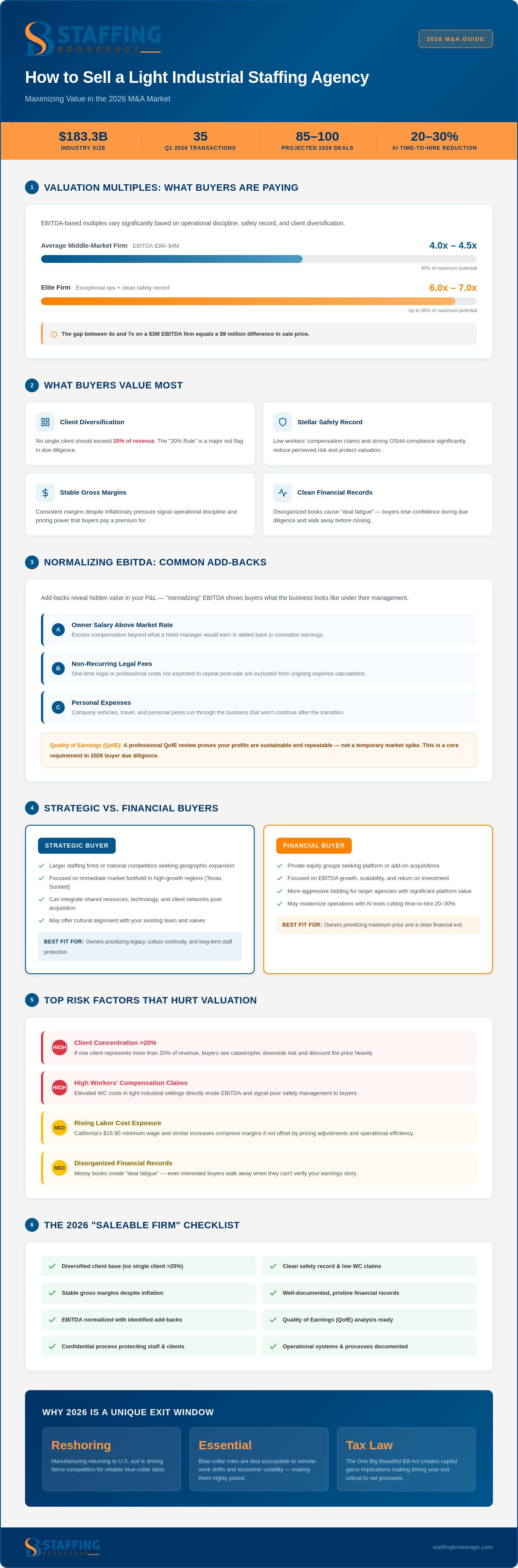
The 2026 market for light industrial staffing is defined by a fierce competition for reliable blue-collar talent. As reshoring efforts accelerate and manufacturing continues its return to U.S. soil, the firms that manage this labor pool have become highly prized assets. In the first quarter of 2026 alone, North American staffing M&A saw 35 announced transactions; light industrial and commercial firms accounted for seven of those deals. This momentum suggests a projected deal volume of 85 to 100 transactions for the full year. For an owner looking to sell light industrial staffing agency operations, the current environment offers a unique window of opportunity within a $183.3 billion industry.
Success in this market isn't just about your size; it's about your operational discipline. Buyers are looking for firms that have weathered the challenges of rising labor costs and shifting regulations with grace. A truly saleable firm in 2026 displays a diversified client base, a stellar safety record, and stable gross margins despite inflationary pressures. Ultimately, light industrial M&A is a strategic consolidation of labor capacity that allows larger entities to secure the "essential" workforce needed to sustain national infrastructure.
Why Strategic Buyers are Targeting Blue-Collar Firms
Strategic buyers are increasingly focused on "essential" labor sectors because these roles are less susceptible to remote-work shifts and economic volatility. These acquirers often use acquisitions to fuel geographic expansion, buying local specialists to gain an immediate foothold in high-growth regions like Texas or the Sunbelt. By integrating a local firm into the broader temporary staffing industry framework, they can leverage shared resources and technology. Modern AI and automation tools are now cutting time-to-hire by 20% to 30%, making industrial firms more scalable and attractive to buyers who want to modernize traditional workflows.
Current Multiples for Industrial Staffing Agencies
Valuation multiples reflect a clear split between average and elite firms in the current landscape. For middle-market firms with an EBITDA between $3 million and $4 million, we're seeing multiples typically ranging from 4.0x to 4.5x. However, firms that demonstrate exceptional operational discipline and clean safety records can see those numbers climb as high as 6.0x or 7.0x. A "size premium" often applies here; larger agencies with higher revenue typically attract more aggressive bidding from private equity groups and national competitors looking for a significant platform. Your final valuation will depend heavily on how well you've mitigated risks like client concentration and workers' compensation costs.
Determining What Your Light Industrial Agency is Worth
You might be tempted to look at revenue multiples first, but in the light industrial sector, top-line revenue can be incredibly misleading. A high-revenue firm with razor-thin margins and high workers' compensation costs is often worth less than a smaller, more efficient operation. We use an EBITDA-based valuation model because it focuses on the actual cash flow available to a buyer. A professional staffing company valuation goes beyond basic accounting; it examines your Quality of Earnings (QofE) to prove that your profits are sustainable and repeatable. Buyers in 2026 are looking for proof that your earnings aren't just a result of a temporary market spike but a product of solid operational discipline.
Normalizing EBITDA: The Power of Add-Backs
Buyers want to see what the business would look like under their management. This means "normalizing" your EBITDA by identifying add-backs that increase your bottom line. Common add-backs include your salary if it's above market rate, non-recurring legal fees, and personal expenses like company vehicles or travel that won't continue post-sale. Identifying this hidden value in your P&L statement can significantly boost your final price when you decide to sell light industrial staffing agency assets. Keeping your books pristine is vital; disorganized records lead to "deal fatigue," where buyers lose confidence during due diligence and walk away before the finish line.
The Impact of Client Concentration on Value
A major red flag for any buyer is the "20% Rule." If a single warehouse or manufacturing plant represents more than 20% of your total revenue, buyers perceive a high risk. If that one client leaves, the business is in trouble. To protect your value, you should start diversifying your client base at least 12 to 18 months before a sale. Focus on securing "sticky" contracts; these are multi-year agreements that guarantee volume and make your revenue predictable. Predictability is the fastest way to push your multiple toward the higher end of the 2026 range. If you want to see how these factors impact your specific firm, an expert Business Valuation and Assessment can provide the clarity you need to move forward with confidence.
Preparing for Sale: Mitigating Risk and Compliance
Many owners hesitate to enter the market because they believe their workers' compensation costs are a "deal killer." While it's true that light industrial firms carry higher inherent risks than clerical or IT agencies, high insurance costs don't have to prevent a successful exit. When you sell light industrial staffing agency operations, buyers aren't looking for a zero-risk environment; they're looking for a controlled one. A skilled M&A advisor helps frame your risk profile by showing that your premiums are a managed cost of doing business rather than an unpredictable liability. This preparation is a core component of a proactive staffing agency exit strategy that protects your final valuation.
Your Experience Modifier Rate (EMR) serves as a primary benchmark for buyers. An EMR below 1.0 signals to an acquirer that your safety protocols are effective, making your firm a "premium" asset. If your rate is higher, we work with you to build a narrative around recent improvements, closed claims, and enhanced training programs. This transparency builds trust and prevents buyers from using safety risks as a tool to chip away at your purchase price during negotiations.
The 5-Step Safety Audit for Sellers
Before you open your books to a buyer, you must conduct a rigorous internal review. This process ensures there are no surprises waiting in your loss runs. We recommend following these five steps:
- Step 1: Review the last three years of OSHA logs and loss runs to identify any recurring patterns in injuries.
- Step 2: Assess on-site safety protocols at your largest client facilities to ensure they meet modern standards.
- Step 3: Evaluate the effectiveness of your internal safety coordinator. A dedicated, active safety leader adds significant intangible value.
- Step 4: Work with your carrier to clean up or close old, open claims that might inflate your perceived risk.
- Step 5: Document your proactive safety culture, including regular training sessions and PPE compliance checks, to prove your commitment to worker wellness.
Employment Law and I-9 Compliance
In the 2026 regulatory environment, compliance is more scrutinized than ever. Buyers will conduct deep dives into your I-9 records to ensure every worker is authorized. Any gaps here can lead to significant indemnification demands or even a collapsed deal. You must also ensure all temporary staff are correctly classified as W-2 employees. With the Department of Labor's 2026 focus on joint employer standards, proving that you maintain clear, compliant employment boundaries protects both you and the buyer from future wage and hour claims. Taking the time to audit these files now ensures a smoother transition later.
Finding the Right Buyer: Strategic vs. Financial
Identifying the ideal buyer is as much about alignment as it is about the final check. Once you decide to sell light industrial staffing agency operations, you'll encounter two primary types of acquirers: strategic and financial. Each brings a different motivation to the table. Choosing between them depends on your personal goals and the legacy you want to leave behind. While a strategic buyer might offer immediate synergies, a financial buyer could provide a way for you to participate in future growth. We help you evaluate these options to ensure your agency lands in the right hands.
Strategic Buyers: Expansion and Synergy
Strategic buyers are typically larger competitors or national firms looking to gain a foothold in a specific geographic area or niche. In 2026, we see strong interest in regions with heavy manufacturing reshoring, like the Sunbelt. These buyers value "synergy," which is the ability to eliminate redundant costs while gaining your established client list. Because they can integrate your operations into their existing framework, they often pay a premium for high-quality assets. However, the trade-off can be significant. Acquisitions by strategic players often lead to brand consolidation and staff restructuring as the buyer implements their own systems. Understanding these motivations is key, whether you are on the selling side or exploring staffing company buy-side advisory services to grow your own footprint.
Financial Buyers: Private Equity and Roll-ups
Financial buyers, such as private equity firms, look at your agency as an investment vehicle. They generally follow one of two paths: using your firm as a "platform" to build a larger entity or as an "add-on" to an existing portfolio company. Unlike strategic buyers, financial acquirers often insist that the current management team stays in place to maintain operational stability. This is an excellent option if you aren't ready to retire immediately. It also introduces the "second bite at the apple," where you retain a small equity stake and profit again when the PE firm eventually sells the larger consolidated group. These deals focus heavily on your EBITDA and the strength of your middle management.
Whether you want to sell light industrial staffing agency assets for a total exit or a partial buyout, the buyer's profile changes everything. Staying on as a manager post-sale provides continuity for your staff and clients, which can be reassuring during a transition. However, you'll need to adapt to a new reporting structure and corporate culture. Cultural fit matters immensely, as your team will need to align with the new owner's way of doing business. If you're ready to explore who might be the best match for your firm, contact us for Staffing Company Sell-Side Representation to start the conversation.
The Staffing Brokerage Approach: Your Steady Hand to Exit
The decision to exit your business is a significant milestone. It's a transition that requires more than just a spreadsheet; it needs a partner who understands the rhythm of the warehouse floor and the intricacies of the industrial labor market. Choosing to sell light industrial staffing agency operations involves navigating specific risks that general business brokers often overlook. At Staffing Brokerage, we act as your seasoned mentor, ensuring every step of the process is handled with the precision and care your legacy deserves.
Confidentiality is our top priority. In the light industrial sector, even a whisper of a sale can cause anxiety among your clients and internal staff. We manage the entire process with a "steady hand," using blind profiles and strict non-disclosure agreements to protect your reputation until the right moment. This methodical approach ensures your business continues to thrive while we work behind the scenes to secure your future. We don't just facilitate transactions; we build partnerships based on trust and shared accomplishment.
Our Proven Process for Industrial Sellers
Our journey together begins with a comprehensive assessment. We don't just look at your current P&L; we evaluate your strategic position within the 2026 market. We identify qualified buyers who aren't just looking for revenue, but for the specific labor capacity and operational excellence you've built. From there, we guide you through the complexities of negotiating the sale of a staffing agency, managing the Letter of Intent (LOI) to ensure the terms reflect your firm's true value. We stay by your side through the final due diligence, providing the support needed to cross the finish line with confidence.
Integrity and Long-Term Value
We believe a successful transaction is one where everyone wins. Our philosophy centers on finding a strong strategic fit, ensuring your staff and clients are in good hands long after the papers are signed. We're committed to transparency and honest practice, avoiding high-pressure tactics in favor of building long-term value. This collaborative journey is about more than just a closing date; it's about honoring the work you've done while creating a path for what's next. We take pride in being a reliable ally through every twist and turn of the sale process. If you're ready to explore your options, we're here to help. Schedule a confidential valuation with Staffing Brokerage today and let's begin this next chapter together.
Secure Your Future in the 2026 Staffing Market
The path to a successful exit starts with a clear understanding of your firm's true value and a commitment to operational excellence. We've explored how normalizing your EBITDA and proactively managing your safety culture can significantly impact your final sale price. Whether you choose a strategic buyer for immediate synergy or a financial partner for a "second bite at the apple," the right preparation ensures your legacy remains intact. The 2026 market is ripe with opportunity for owners who have maintained a steady hand on their operations.
Taking the leap to sell light industrial staffing agency assets is a major life event that shouldn't be handled alone. At Staffing Brokerage, we bring specialized staffing M&A expertise and a national network of qualified buyers to every partnership. Our proven track record of successful deal closures means you can move forward with confidence, knowing an experienced ally is guiding the process. We're here to turn your years of hard work into a rewarding new chapter through a transparent and methodical transition.
Get a Professional Valuation for Your Staffing Agency
Let's begin this collaborative journey toward your successful exit today. You've built something remarkable; now it's time to ensure you receive the maximum reward for your dedication and vision.
Frequently Asked Questions
How long does it take to sell a light industrial staffing agency?
Selling a light industrial staffing agency typically takes between six and nine months from the initial valuation to the final close. This timeline allows for a methodical approach to identifying qualified buyers and completing the rigorous due diligence required in the industrial sector. A steady pace ensures that your internal operations remain stable while we work behind the scenes to secure the best possible terms for your exit.
What is the average EBITDA multiple for a light industrial firm in 2026?
For middle-market firms with an EBITDA between $3 million and $4 million, the average multiple in 2026 ranges from 4.0x to 4.5x. Exceptional agencies with clean safety records and highly diversified client bases can command higher multiples of 6.0x or even 7.0x. These figures reflect the high demand for essential blue-collar labor capacity among both strategic acquirers and private equity groups looking for stable platforms.
Can I sell my agency if I have high client concentration?
You can certainly sell your agency with high client concentration, though it often results in a more structured deal. To mitigate the buyer's risk, a portion of the purchase price might be tied to an earn-out or contingent on that major client remaining post-sale. We focus on framing your relationship with that client as a sticky partnership to help maintain your valuation despite the concentration levels.
What are the most common red flags for buyers in the industrial sector?
Buyers primarily look for red flags such as an EMR rating above 1.0, inconsistent I-9 documentation, and shrinking gross margins. Another major concern is a lack of middle management, which suggests the business is too dependent on the owner's daily involvement. Addressing these operational gaps before you sell light industrial staffing agency assets is vital for a smooth transaction and a clean exit.
Do I need to stay with the company after the sale is complete?
Your role post-sale depends entirely on the type of buyer you choose to partner with. Strategic buyers often require a shorter transition period of six to twelve months to ensure a smooth hand-off of client relationships. In contrast, financial buyers like private equity firms may want you to stay on for several years to lead the company as part of a larger growth strategy.
How do I keep the sale confidential from my internal staff and clients?
Confidentiality is maintained by using blind teasers that describe your company's financial performance and geographic reach without revealing its name. We only share identifying information with qualified buyers who have signed a strictly enforced non-disclosure agreement. This cautious approach protects your reputation and prevents any disruption to your staff or client relationships until the deal has reached a definitive stage.
What is the difference between an asset sale and a stock sale in staffing?
An asset sale involves the buyer purchasing specific items like contracts and equipment, while a stock sale means they buy the entire legal entity. In the staffing industry, sellers often prefer stock sales because they can offer more favorable long-term capital gains tax treatment. Buyers sometimes lean toward asset sales to avoid assuming undisclosed liabilities, making the negotiation of this structure a key part of the deal.
How does my EMR rating affect my business valuation?
Your Experience Modifier Rate (EMR) acts as a direct multiplier of your firm's perceived risk and profitability. An EMR below 1.0 is a significant asset that can push your valuation multiple toward the higher end of the market range. Conversely, a high rating increases insurance premiums and signals potential safety issues, which buyers will often use to justify a lower purchase price during negotiations.