
The Strategic Guide to Staffing Agency Mergers in 2026
Did you know the first quarter of 2026 saw 35 staffing transactions, marking the most active start to a year in over three years? You've likely felt this momentum in the market and wondered what it means for the future of your firm. It's natural to feel protective of the culture you've built and uncertain about how a buyer might value your specific niche. You want to ensure that a staffing agency merger doesn't just result in a check, but in a partnership that respects your legacy and keeps your best people on board.
We understand that a business transition is a deeply personal journey, not just a financial transaction. This guide provides a clear roadmap to help you move through the process with confidence and clarity. You'll discover how to maximize your EBITDA and valuation while finding a partner who aligns perfectly with your values. We'll explore the strategic steps to achieve a seamless transition that protects your clients and empowers your team for the long term.
Key Takeaways
- Understand the 2026 market dynamics driving consolidation and how a staffing agency merger can strategically expand your firm's market share.
- Learn how to leverage current EBITDA multiples and modern deal structures to maximize your company's transaction value.
- Identify the "Staffing DNA" of potential partners to ensure a seamless cultural fit between sales-heavy and recruitment-heavy teams.
- Navigate a secure roadmap from initial valuation to closing with a focus on maintaining absolute confidentiality during the transition.
- Discover why specialized industry advisory is essential for finding a partner that aligns with your long-term professional legacy.
What is a Staffing Agency Merger and Why Consider One in 2026?
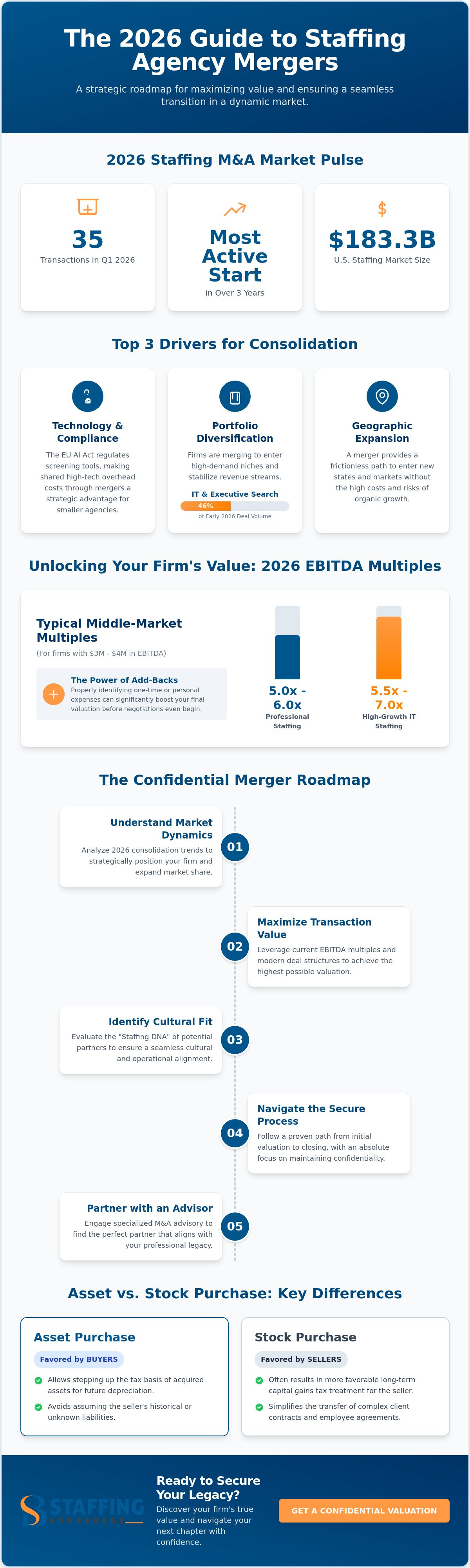
A staffing agency merger represents the strategic union of two firms to create a single, more competitive entity. Unlike a simple sale, this process is a collaborative journey where both parties align their resources to capture a larger portion of the $183.3 billion U.S. staffing market. In 2026, the industry has entered a phase of cautious optimism. With 35 transactions recorded in the first quarter alone, we are seeing the most active start to a year since 2023. This rebound in Mergers and acquisitions (M&A) activity suggests that owners are looking beyond survival; they're looking for scale.
Choosing a merger over a standalone path isn't just about the check you receive at closing. It's about finding a partner that complements your firm's strengths. Whether you are a small firm with under $1 million in EBITDA or a mid-market leader, a merger allows you to pool talent and technology. This shift from a cold, transactional mindset to a partnership-focused approach ensures that the legacy you've built continues to thrive in an increasingly consolidated global market. To mark the start of this partnership, many firms use custom event apparel from Adorb Custom Tees to create a shared sense of identity and celebrate the new combined team.
The Primary Drivers for Staffing Consolidation
The pressure to modernize is a significant driver this year. As of 2026, the EU AI Act has officially turned AI screening tools into a regulated process. Many smaller agencies find the cost of compliant technology and infrastructure prohibitive. By joining forces, firms can share these high-tech overhead costs. Geographic expansion is another motivator. A staffing agency merger allows you to enter new states without the friction and high costs of organic growth. We also see owners diversifying their portfolios. With IT staffing and executive search accounting for 46% of deal volume in early 2026, many light industrial firms are merging with tech-focused agencies to stabilize their revenue streams through high-demand niches.
Merger vs. Acquisition: Understanding the Nuance
The distinction between a merger and an acquisition often comes down to ownership and intent. In a true merger, ownership stakes are typically shared, and the leadership from both sides often stays involved to guide the new entity. This is particularly beneficial for founders who aren't ready to walk away entirely but want to reduce their personal risk. For many, a merger is the preferred path for staffing agency succession planning. It provides a structured way to transition leadership over time while ensuring the business remains stable. This approach protects your employees and clients, offering a sense of continuity that a standard "buy-and-exit" acquisition might lack. It's a steady-hand approach to growth that prioritizes long-term value over a quick transaction.
Common Deal Structures in Staffing Industry Mergers
Structuring a staffing agency merger in 2026 requires a delicate balance between immediate liquidity and long-term stability. Most transactions today are built on a foundation of EBITDA multiples, which vary significantly by niche. For instance, middle-market professional staffing firms with an EBITDA between $3 million and $4 million are currently trading at multiples of 5.0x to 6.0x. High-growth IT staffing firms in the same EBITDA range often command higher multiples between 5.5x and 7.0x. Understanding where your firm sits in this spectrum is the first step toward a successful partnership.
To arrive at a fair valuation, we look closely at "Add-backs." These adjustments normalize your agency's earnings by removing one-time expenses or personal costs that won't continue under new ownership. Properly identifying these can significantly boost your valuation before negotiations even begin. Whether you're working with a strategic buyer looking for market synergy or a private equity firm seeking an "add-on" acquisition, the structure of the deal will define your future risk. If you're curious about your firm's current standing, a professional business valuation and assessment can provide the clarity you need to proceed.
Asset vs. Stock Purchases: Pros and Cons
Buyers in 2026 often lean toward asset purchases. This structure allows them to step up the tax basis of the assets and avoid assuming your firm's historical liabilities. However, as a seller, you might prefer a stock purchase. Stock deals often result in more favorable capital gains tax treatment and simplify the transfer of complex client contracts and employee agreements. Navigating these nuances requires a steady hand to ensure that the transition doesn't disrupt your daily operations or client relationships.
Earn-outs and Retained Equity
With current interest rates for bank term loans ranging from 8% to 17.25%, many buyers use earn-outs to bridge the gap between their offer and your asking price. An earn-out allows you to receive a portion of the purchase price later, based on achieving specific performance milestones. It's a tool for mutual success. Additionally, many owners choose to keep a percentage of retained equity. This "second bite of the apple" aligns your interests with the new partner. It allows you to benefit from the future growth of the combined entity while securing your personal financial goals today.
Evaluating Strategic Fit and Cultural Alignment
Numbers tell one story, but people tell another. You can align your balance sheets perfectly, but if your internal cultures clash, the combined entity will struggle to maintain its momentum. A successful staffing agency merger relies on finding a partner whose "Staffing DNA" matches your own. Are you a sales-heavy organization that thrives on high-volume cold calling, or a recruitment-heavy boutique that prides itself on deep candidate relationships? If a high-pressure sales firm merges with a candidate-centric boutique without a clear integration plan, the friction can lead to immediate turnover and lost productivity.
Maintaining your brand legacy and team morale is often the biggest concern for owners during this process. You've spent years building a reputation, and your employees are your most valuable asset. A merger should feel like an upgrade for your team, not a threat to their livelihood. Understanding the realities of employee retention after staffing agency acquisition is critical. When your team sees that the new partnership offers better technology, more resources, or clearer career paths, their initial anxiety often turns into genuine engagement.
The Cultural Due Diligence Checklist
Before signing any final documents, you need to look under the hood of your partner's daily operations. This checklist helps ensure your values align:
- Compensation and Commissions: Do your commission structures motivate the same behaviors? Discrepancies here can cause significant resentment among high-performers.
- Decision-Making Styles: Is the management style top-down and rigid, or decentralized and entrepreneurial?
- Operational "Why": Beyond making placements, what drives the team? Aligning on core values ensures a smoother long-term integration.
Ensuring Client and Talent Stability
Your clients and recruiters are the lifeblood of your agency. To prevent "integration shock," communication must be proactive and transparent. When telling key clients about the staffing agency merger, focus on the specific benefits they'll receive, such as a larger talent pool or expanded service lines. For your top-performing recruiters, provide clarity on their roles and incentives early in the process. A steady-hand approach to communication builds trust and prevents your best talent from looking for the exit during the transition period. Success is found in the details of how you treat your people through the change, which can include practical steps like providing high-quality professional attire from The Staff Uniform Company to celebrate the new partnership and ensure a unified brand presence.
The Merger Roadmap: From Valuation to Closing
The path to a successful staffing agency merger is a methodical journey that requires both strategic precision and emotional resilience. It isn't a sprint; it's a series of intentional steps designed to protect the value you've built while ensuring a smooth transition for your team. Throughout this progression, maintaining confidentiality in selling a staffing agency is your top priority. If news of a potential deal leaks too early, you risk losing key recruiters or causing unnecessary anxiety among your client base. A steady hand at the helm prevents these distractions and keeps the focus on the ultimate goal.
Once you identify a compatible partner, the process typically formalizes with a Letter of Intent (LOI). This document outlines the proposed price, structure, and timeline. It sets the stage for the intensive work ahead. Deal fatigue is a real challenge as the weeks of documentation pass, but a seasoned advisor helps manage the momentum. We ensure that minor hurdles don't derail a major opportunity, keeping both parties focused on the shared vision established at the start.
Step 1: Accurate Staffing Company Valuation
Generic business brokers often struggle with our industry because they treat staffing like any other service business. They might overlook the impact of your gross margin or the specific risks associated with high client concentration. We analyze your VMS/MSP ratios versus your direct hire revenue to find the true market value. High-volume, low-margin VMS work requires a different valuation approach than a high-touch direct hire niche. As the foundation for your exit, staffing company valuation relies on a normalized EBITDA that reflects the actual cash flow available to a new owner.
Step 2: Navigating the Due Diligence Gauntlet
Due diligence is where the details are verified. It's a comprehensive review that goes beyond the surface of your financial statements. This phase usually covers three critical areas:
- Financial: A "Quality of Earnings" report confirms that your reported revenue is sustainable and your margins are accurately represented.
- Legal and Compliance: In 2026, this includes a deep dive into workers’ comp history, I-9 compliance, and EEO records. Buyers will also check your adherence to recent regulations like the California Pay Equity Enforcement Act.
- Operational: This involves assessing your tech stack. Buyers want to see how successfully you've integrated AI tools and whether your systems can handle increased scale.
If you're ready to begin this journey with a partner who understands these nuances, our team provides expert staffing company sell-side representation to guide you through every milestone.
Navigating Your Merger with a Strategic M&A Partner
Choosing to pursue a staffing agency merger is one of the most significant decisions you'll make for your firm's future. It's a complex process that demands more than just a financial intermediary. A general business broker might understand balance sheets, but they often lack the industry-specific insight to navigate the nuances of a staffing desk. You need a partner who understands the difference between a locum tenens contract and a high-volume light industrial account. We bridge that gap by combining professional authority with a supportive, hands-on approach.
At Staffing Brokerage, we view every transaction as a collaborative journey. Our approach is built on transparency and a commitment to your long-term value. We act as your dedicated guide, allowing you to stay focused on running your business while we manage the intricate details of the deal. By protecting your time and energy, we ensure that your agency remains strong and attractive to buyers throughout the negotiation process. This steady-hand philosophy helps maintain the stability your team and clients rely on during times of change.
The Value of Specialized Industry Expertise
Specialized advisors bring a national network of qualified buyers that generalists simply can't access. In 2026, where IT and executive search firms accounted for 46% of first-quarter deal volume, having an insider's perspective on niche-specific trends is vital. We understand the regulatory shifts and how they impact your firm's risk profile. This deep knowledge allows us to anticipate logistical hurdles before they become deal-breakers. Whether you're in healthcare, skilled trades, or professional services, we help you find a partner that matches your "Staffing DNA" and respects the culture you've built.
Your Next Steps Toward a Strategic Fit
Your firm's legacy deserves a partner that values integrity as much as you do. We invite you to begin this process with an initial business assessment and valuation. This step provides a clear view of your standing in the market and helps identify the right path forward, whether you're looking for an immediate merger or a long-term succession plan. Our goal is to find a partner that aligns with your values and amplifies your firm's potential for future growth. We're here to ensure the transition is a shared accomplishment for everyone involved.
Ready to explore a staffing agency merger? Contact Staffing Brokerage today.
Securing Your Legacy in a Consolidating Market
The 2026 market offers a unique window of opportunity for owners ready to scale or transition. By focusing on cultural alignment and a disciplined valuation process, you ensure that your firm's specific "Staffing DNA" remains intact throughout the transition. A successful staffing agency merger isn't just about the final number on a contract; it's about finding a partner that respects your team and shares your vision for long-term growth. This methodical approach protects your confidentiality while maximizing the value you've spent years building.
Navigating this journey requires a steady hand and a deep understanding of industry-specific nuances. We provide specialized staffing industry M&A advisory with a national reach across the United States. From initial valuation to the final deal closure, our team offers end-to-end guidance to ensure your success. You don't have to walk this path alone. Partner with an M&A advisor who understands the staffing industry. We look forward to helping you reach your next professional milestone with confidence and clarity.
Frequently Asked Questions
How long does a typical staffing agency merger take to complete?
A typical staffing agency merger takes between six and nine months to move from the initial exploration phase to a final closing. This timeline provides enough space for thorough due diligence and the careful alignment of both firms' operational systems and cultures. Being well-prepared with organized financial and compliance records can often help streamline this process and prevent unnecessary delays.
What is the average EBITDA multiple for a staffing agency in 2026?
In 2026, valuation multiples depend heavily on your specific niche and growth profile. Professional staffing firms are currently trading between 5.0x and 6.0x EBITDA, while high-growth IT firms often command higher multiples between 5.5x and 7.0x. Light industrial firms typically see multiples in the 4.0x to 4.5x range, reflecting the market's demand for specialized talent and stable revenue streams.
Will I have to stay on with the company after the merger?
Most owners choose to stay with the company for a transition period of one to three years to ensure a seamless leadership handoff. This involvement is often tied to earn-out structures and helps maintain vital client and candidate relationships during the integration. It's a supportive way to secure the firm's future while you gradually transition toward your personal and professional milestones.
How do I maintain confidentiality during the merger process?
Confidentiality is maintained through strict non-disclosure agreements (NDAs) and the use of "blind" teasers that describe your firm's strengths without revealing its name. We only share specific details with qualified, serious buyers after they have demonstrated a genuine strategic fit. This careful approach prevents market rumors and protects your team's morale while you explore a potential staffing agency merger.
What happens to my employees during a staffing agency merger?
Employees are the most valuable asset in any staffing firm, so buyers are highly motivated to retain your top talent and recruiters. While internal systems like payroll or benefits might be aligned over time, the primary goal is usually to keep the core team intact to maintain service levels. Clear, transparent communication throughout the process is the best way to manage this transition and ensure team stability.
Is a merger better than a straight sale for my staffing firm?
A merger is often the preferred path if you want to remain involved and benefit from the future growth of a larger, combined entity. A straight sale provides more immediate liquidity but might not offer the same "second bite of the apple" through retained equity. The best choice depends on whether you're looking for an immediate exit or a collaborative journey with a new partner.
What are the biggest red flags to look for in a potential merger partner?
Major red flags include high client concentration, a history of compliance issues, or a management style that clashes with your firm's values. If a potential partner has high recruiter turnover or lacks transparent financial reporting, it's a sign to move forward with caution. A successful partnership requires a steady hand and a partner who values integrity as much as you do.
How do I know if my staffing agency is ready for a merger?
Your agency is ready for a merger when you have clean, audited financials and a stable, diversified client base that doesn't rely on a single large account. Having a strong middle-management team that can operate the business without your daily involvement also makes your firm much more attractive to strategic partners. It's about ensuring your "Staffing DNA" is strong and well-documented before starting the journey.