
Financing a Staffing Agency Acquisition: 2026 Market Outlook & Capital Strategies
In 2026, the most successful staffing acquisitions aren't being won by those with the deepest pockets, but by those with the most creative capital structures. Securing the right strategy for financing a staffing agency acquisition today requires a shift in perspective, especially as you look to balance current interest rates against the need for immediate payroll liquidity. You likely feel the pressure of the 6.75% WSJ Prime Rate and the difficulty of putting a firm price on intangible assets like recruiter expertise. It's a delicate dance to ensure your new venture remains cash-flow positive from day one.
We've designed this guide to help you master these capital complexities and navigate the 2026 market with total confidence. You'll learn how to structure a deal that protects your bottom line while positioning your firm for long-term growth. We will explore the latest market trends, compare SBA options against flexible hybrid models, and provide a clear roadmap for choosing a financing partner who truly understands the staffing industry's unique rhythm. By the end, you'll have the tools to turn a complex transaction into a collaborative journey toward success.
Key Takeaways
- Analyze 2026 interest rate trends and their impact on market multiples to ensure you don't overpay for your target firm.
- Master the mechanics of Asset-Based Lending and learn why using accounts receivable is often the most efficient way of financing a staffing agency acquisition.
- Compare the long-term costs of debt versus equity to select the capital structure that best protects your cash flow and scaling potential.
- Prepare a professional buyer profile and accurate business valuation to build immediate trust with specialized lenders and financial partners.
- Discover how expert buy-side advisory serves as a steady hand during complex negotiations to ensure a smooth transition and clear ROI.
The 2026 Staffing M&A Landscape: Why Financing Strategy Matters Now
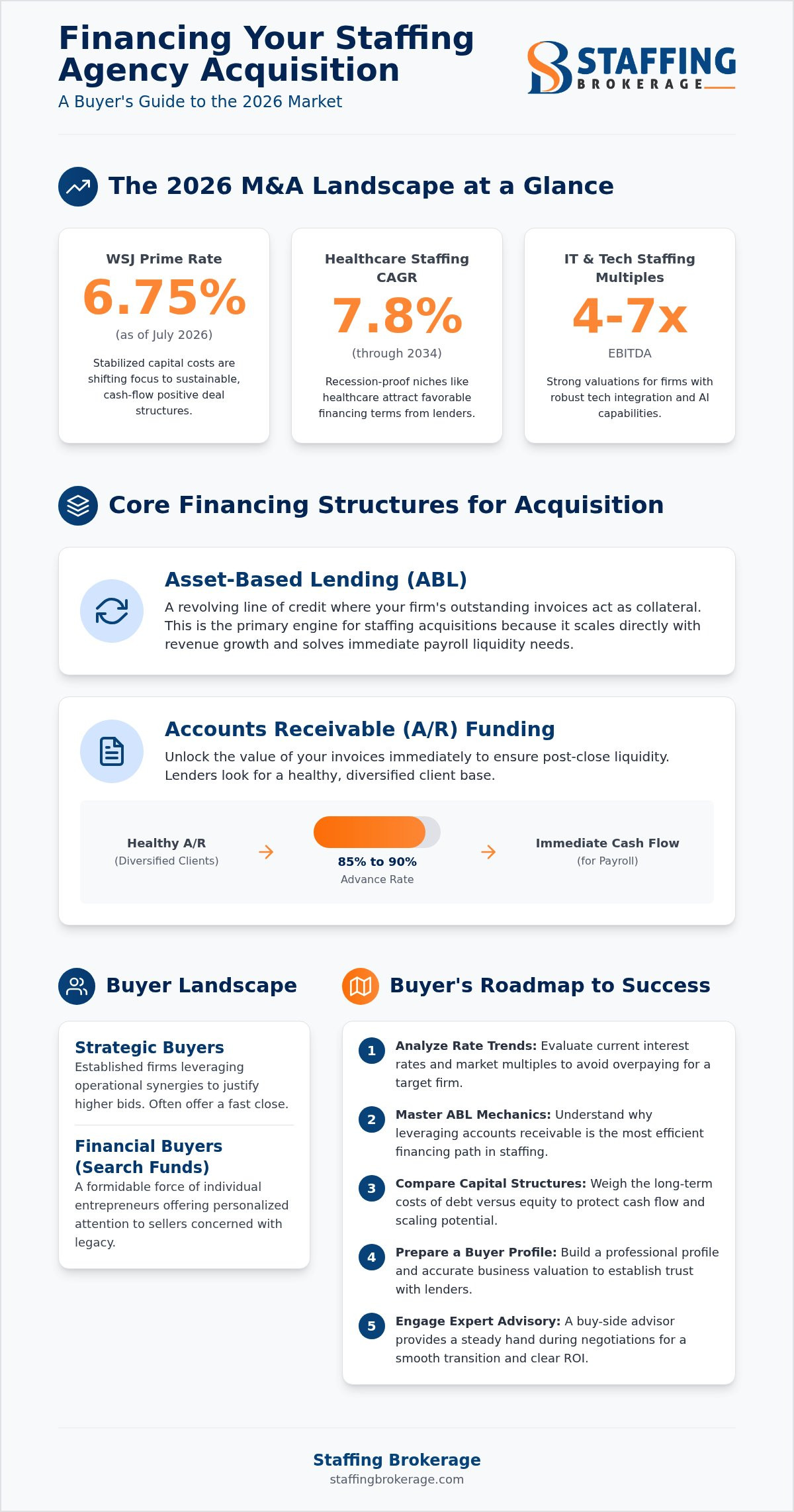
The first quarter of 2026 marked the strongest opening for staffing acquisitions in three years. This surge in activity signals a robust market, yet it also highlights why your approach to financing a staffing agency acquisition is more critical than ever. With the WSJ Prime Rate sitting at 6.75% as of July 2026, the cost of capital has stabilized but remains a primary factor in deal structuring. Buyers are no longer chasing growth at any cost. Instead, there's a clear shift toward sustainable cash-flow models that can withstand market fluctuations.
Private equity firms have returned to the middle-market staffing sector with significant "dry powder." They're particularly aggressive in high-growth areas like healthcare and technology. Healthcare staffing, for instance, is projected to grow at a CAGR of 7.8% through 2034. These buyers are looking for firms with strong tech integration and AI capabilities, which now serve as primary metrics for higher valuations. If you're competing for these high-quality targets, your financing strategy must be as agile as the firms you're looking to buy.
Economic Indicators Impacting Staffing Acquisitions
Lender confidence in 2026 is anchored in labor market stability. While the Federal Reserve continues to shape borrowing costs, banks are showing a preference for "recession-proof" niches. Healthcare staffing is a prime example. The U.S. faces a shortfall of over 4 million healthcare workers this year. This massive demand creates a safety net for lenders, often resulting in more favorable financing terms for acquisitions in this space. IT and technology staffing also command strong interest, with multiples ranging from 4.0x to 7.0x EBITDA.
Strategic vs. Financial Buyers in the 2026 Market
The landscape of Mergers and acquisitions (M&A) has evolved with the rise of "search funds." These individual entrepreneurs often compete directly with established strategic buyers. Strategic buyers usually hold a financing advantage because they can leverage existing operational synergies to justify a higher bid. However, search funds are becoming a formidable force by offering personalized attention to sellers who care about their legacy.
To win in this environment, you need to position your bid carefully. Cash-rich consolidators might offer speed, but a well-structured deal backed by a steady financing partner can often be more attractive to a seller. We focus on helping you find that balance, ensuring your financing supports long-term value rather than just a quick close. Success in 2026 means looking beyond the sticker price to the underlying capital health of the deal.
Core Financing Structures for Staffing Agency Acquisitions
Staffing is a unique industry where your greatest assets walk out the door every evening and your biggest liability is the weekly payroll clock. It's a common hurdle: you have the talent, but the gap between paying your contractors and receiving client payments can strain your cash flow. Asset-Based Lending (ABL) serves as a revolving credit line where your staffing firm's outstanding invoices act as the collateral to fund weekly payroll cycles before your clients pay their bills. This structure remains the primary engine for financing a staffing agency acquisition in 2026 because it scales directly with your revenue growth.
Leveraging Accounts Receivable (A/R) Funding
Post-close liquidity is the lifeblood of a successful transition. Factoring and ledger lines allow you to unlock the value of your invoices immediately. In a recourse financing model, your agency remains responsible if a client fails to pay, whereas non-recourse options shift that credit risk to the lender for a slightly higher fee. Most buyers in 2026 prefer a hybrid approach that provides the flexibility of a ledger line with the protection of credit insurance.
Lenders look closely at the quality of your aging report. A diversified client base is much easier to finance than a firm with 80% of its revenue tied to a single contract. This diversification directly impacts your staffing company valuation, as it reduces the risk of a sudden cash flow collapse. When your A/R is healthy and spread across multiple stable industries, lenders are more likely to offer higher advance rates, often reaching 85% to 90% of eligible receivables.
Traditional SBA 7(a) Loans for Staffing Buyers
For many first-time buyers, SBA 7(a) loans provide a vital path to ownership. As of May 2026, variable rates for loans over $250,000 typically range from 9.00% to 11.75%. While these rates are higher than traditional bank debt, the longer repayment terms and lower down payment requirements make them attractive. A significant change in June 2026 saw the SBA eliminate mandatory FICO SBSS scoring for many smaller loans, giving lenders more room to focus on the actual strength of the business rather than just the buyer's personal credit score.
Expediting your approval in a competitive market requires a clean presentation of "goodwill" and intangible assets. Since staffing firms rarely own heavy machinery or real estate, the SBA's 2026 guidelines focus heavily on the stability of the internal team and the recurring nature of the revenue. Mezzanine financing can also help bridge the gap if the SBA loan doesn't cover the full purchase price, though this "junior debt" comes with higher interest rates. Choosing the right mix of these tools often requires a steady hand. Our staffing company buy-side advisory helps you evaluate these options to find the perfect fit for your specific goals.
Comparing Debt vs. Equity: Which Fits Your Growth Model?
Deciding how to fund your expansion is about more than just interest rates; it's about your future freedom and operational flexibility. While equity might seem attractive because it doesn't require monthly repayments, it's often the most expensive capital you'll ever use for a high-margin niche firm. Giving away a percentage of your future profits can far outweigh the cost of a loan over time. Conversely, relying solely on debt requires a laser focus on your Debt Service Coverage Ratio (DSCR). Lenders watch this metric closely to ensure your agency generates enough cash to comfortably cover loan payments while still meeting the heavy demands of weekly payroll. Finding the right balance is a core part of financing in M&A deals.
The Power of Seller Financing and Earnouts
Seller notes have become a standard tool for financing a staffing agency acquisition in 2026. These notes act as a hybrid instrument that shares risk between the buyer and the seller. When a seller carries 10% to 20% of the purchase price, they remain personally invested in the firm's continued success. This alignment is crucial for maintaining recruiter morale and client relationships during the sensitive first year of ownership. It also signals to other lenders that the seller has confidence in the agency's future performance.
Earnouts add another layer of protection. By tying a portion of the final payout to specific revenue or EBITDA targets, you protect yourself against sudden client attrition. This performance-based approach is particularly effective in staffing, where human capital is the primary asset. A well-crafted staffing company deal structure balances these fixed payments with bonuses, ensuring a smooth transition that rewards the seller for a successful handoff without over-leveraging the buyer.
Private Equity and Minority Investments
If your goal is a rapid "roll-up" strategy, bringing in a financial partner might be the right move. Private equity firms provide the significant capital needed to acquire multiple firms in a short period. This strategy allows you to scale quickly, but it often comes with a trade-off in creative and operational control. For many entrepreneurs, the goal is the "second bite of the apple." This involves selling a portion of the company now while retaining a minority stake to benefit from a larger exit down the road. It's a sophisticated path that requires a steady hand to navigate, ensuring that the partnership aligns with your personal and professional milestones.
Securing Capital: A Step-by-Step Roadmap for 2026 Buyers
Moving from a strategic vision to a signed contract requires a methodical approach. In 2026, lenders aren't just looking at the target company's numbers; they're looking at you. Building a robust buyer profile is your first step. You need to demonstrate industry competence and a clear plan for post-acquisition stability. Lenders want to see a steady hand at the helm, especially when financing a staffing agency acquisition involves managing complex payroll cycles from day one. We help you present your background and financial strength in a way that builds immediate lender confidence.
Your loan application's success hinges on a precise staffing company valuation. This document serves as the foundation for your request, proving to the bank that the purchase price aligns with market realities and future earnings potential. In a market where multiples for healthcare staffing range between 5.0x and 8.0x EBITDA, having a professional valuation ensures you aren't over-leveraging your new venture. This precision protects your cash flow and provides a clear ROI roadmap for your financing partners.
Coordination is the glue that holds a deal together. You'll need to sync your M&A advisor, lender, and legal counsel to meet the tight deadlines of a 2026 close. This collaborative effort ensures that every term in the commitment letter aligns with the purchase agreement. It prevents last-minute surprises that could stall your momentum or force a renegotiation of the deal structure.
Preparing Your Financial Documentation
Lenders in 2026 require a deep dive into the target's history. You'll need three years of tax returns and a comprehensive Quality of Earnings (QofE) report to verify EBITDA and identify legitimate add-backs. These documents strip away accounting noise to show the true profitability of the firm. Aging A/R reports are the most heavily scrutinized documents because they reveal the real-time health of the collateral and the payment reliability of the agency's clients. Having these ready early can shave weeks off the approval process.
Navigating the Due Diligence Phase
Due diligence is where you verify the "human capital" that makes a staffing firm valuable. You must identify specific red flags buying a staffing agency, such as high internal recruiter turnover or a lack of enforceable non-compete agreements. These issues can kill your financing if the lender perceives a risk to client retention. We also recommend thorough audits of client contracts to ensure they're assignable and free of hidden legal liabilities. Verifying these details now ensures a successful acquisition with no surprises after the keys change hands.
If you're ready to start your journey with a partner who understands the nuances of the 2026 market, explore our staffing company buy-side advisory services today.
Navigating the Close: How Staffing Brokerage Optimizes Your Deal Structure
The final steps of an acquisition are often the most intense. You've done the research and found the right firm, but now you must secure the funds and finalize the terms. We act as your steady hand during these high-stakes national M&A negotiations. Our staffing company buy-side advisory is designed to identify capital partners who don't just see a balance sheet, but understand the intrinsic value of a staffing firm's human capital. We connect you with specialized lenders who are comfortable with the industry's unique reliance on accounts receivable and weekly payroll cycles.
Success also depends on how well your financing plan aligns with the seller's staffing agency exit strategy. If the seller is looking for a clean break or an earnout over two years, your capital structure must accommodate those specific needs. By facilitating this alignment, we help build the trust necessary to move past the final hurdles and toward a shared sense of accomplishment. Financing a staffing agency acquisition shouldn't be a source of stress; it should be the foundation of your new company's growth.
Our Collaborative Journey to Closing
The final 30 days of a deal are notorious for "deal fatigue." This is the period when small disagreements can escalate and threaten the entire transaction. We manage the communication flow between all parties, ensuring that lenders, legal counsel, and the seller stay focused on the goal. Our commitment to integrity means we prioritize a strategic fit over a quick commission. We're with you from the initial assessment through the final wire transfer, providing the precision and alignment you need to close with total confidence.
Your Next Steps Toward Ownership
Taking the leap into ownership is a significant milestone in your professional journey. We invite you to schedule a confidential consultation to discuss your specific acquisition goals for 2026. You'll gain access to our exclusive network of verified staffing companies for sale and benefit from a partner who's deeply invested in your long-term success. We help you navigate the complexities of the market so you can focus on leading your new team. Let's take that first step together and turn your vision of ownership into a reality.
Securing Your Success in the 2026 Staffing Market
Successfully navigating the path of financing a staffing agency acquisition means aligning your capital structure with the unique cash flow demands of the industry. You've seen how prioritizing A/R liquidity and balancing seller notes with traditional debt can create a resilient foundation for growth. Whether you're exploring SBA options or complex hybrid models, the key is to maintain a steady hand while focusing on long-term value rather than just a quick close.
At Staffing Brokerage, we bring specialized staffing industry expertise and a national network of qualified buyers and sellers to every transaction. Our team has proven results in crafting complex deal structures that protect your cash flow and ensure a seamless transition. We're dedicated to acting as your reliable ally, guiding you through every step of this collaborative journey with transparency and precision.
Ready to take the next step toward your professional milestones? Partner with a Strategic M&A Advisor for Your 2026 Acquisition and turn your vision of ownership into a thriving reality. We look forward to building a successful future together.
Frequently Asked Questions
How much cash down is typically required for a staffing agency acquisition in 2026?
Most lenders require a cash down payment of 10% to 20% of the total purchase price. While SBA 7(a) loans often allow for a 10% equity injection, conventional lenders might ask for more depending on the strength of your buyer profile. Seller notes can sometimes be structured to count toward a portion of this requirement, which helps preserve your personal liquidity for post-close operations.
Can I use the acquired company’s accounts receivable to fund the purchase?
Yes, leveraging the target firm's accounts receivable is a common strategy for financing a staffing agency acquisition. Through Asset-Based Lending or factoring, you can use the value of the target's outstanding invoices to provide a portion of the closing funds. This approach is highly effective because it provides the immediate working capital needed to cover the first few payroll cycles after the keys change hands.
What is the difference between an asset purchase and a stock purchase for financing?
In an asset purchase, you buy specific items like client contracts and brand assets, which allows you to "step-up" the basis for tax depreciation. A stock purchase involves buying the entire legal entity, including all its past liabilities. Lenders often prefer asset purchases because they offer cleaner collateral and fewer hidden legal risks, making it easier to secure favorable terms for your acquisition.
How do interest rate changes in 2026 affect staffing company valuations?
Valuations generally move inversely to interest rates because higher borrowing costs reduce the amount of cash flow available to service debt. When rates rise, buyers often lower their offered multiples to ensure the deal remains profitable. However, in 2026, high-demand niches like healthcare staffing have maintained strong valuations because their consistent growth outlook offsets the increased cost of capital.
Is it possible to finance a staffing agency acquisition with no personal collateral?
It's challenging but possible if you utilize specialized Asset-Based Lending that focuses strictly on the quality of the firm's invoices. These lenders prioritize the creditworthiness of the agency's clients over your personal assets. While most SBA loans require a personal guarantee, certain niche lenders in the staffing space offer non-recourse options that don't tie up your personal real estate or savings.
What role does an earnout play in the total financing package?
An earnout acts as contingent financing that bridges the gap between your offer and the seller's asking price. It allows you to pay a portion of the purchase price only if the agency hits specific revenue or EBITDA targets after the close. This structure reduces your upfront debt burden and ensures the seller remains motivated to help you retain key clients and recruiters during the transition.
How long does the financing process usually take for a mid-sized staffing firm?
You should plan for a timeline of 60 to 90 days from the signed Letter of Intent to the final closing. SBA loans typically take the full 90 days due to government documentation requirements and the elimination of certain scoring rules in 2026. Specialized ABL lenders can sometimes move closer to the 45 or 60-day mark, provided your financial documentation and A/R aging reports are clean and ready for review.
Should I use a local bank or a specialized M&A lender for my acquisition?
A specialized M&A lender is usually the better choice because they understand the unique "payroll-first" nature of the staffing industry. Local banks often struggle to value a business that lacks heavy machinery or real estate. Specialized lenders recognize the recurring value of recruiter talent and client contracts, which often leads to higher advance rates and deal structures that better support your long-term growth.


