
Employee Retention After Staffing Agency Acquisition: 5 Myths Busted
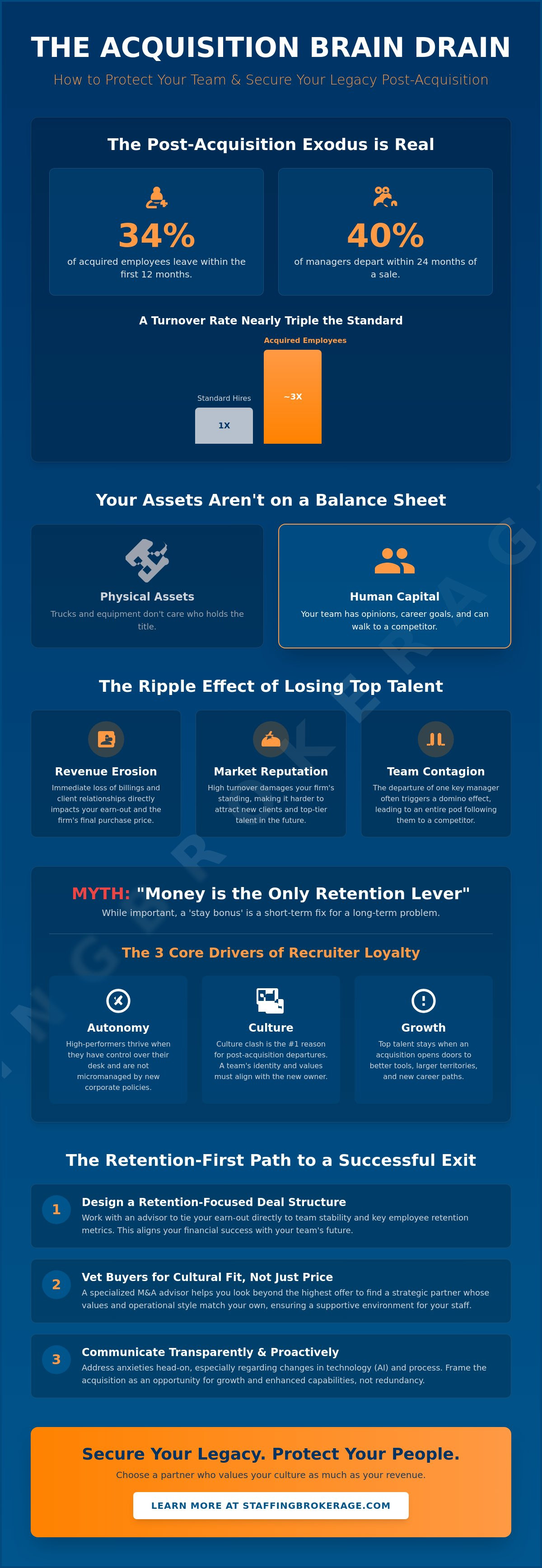
Did you know that nearly 34% of acquired employees leave their roles within the first twelve months? That is nearly triple the turnover rate of standard hires with similar experience. If you are preparing for a 2026 exit, these numbers might feel like a threat to everything you have built. You have spent years cultivating a culture of high performance, and the thought of a "brain drain" during a transition is a valid concern. Achieving successful employee retention after staffing agency acquisition isn't just about luck or a generous bonus. It is about strategic alignment and transparency from the very first conversation with a buyer.
We understand that your team is your firm's most valuable asset. You want a high-value exit that feels like a win for everyone, not a betrayal of the people who helped you grow. This guide will show you how to protect your legacy by structuring your sale with a retention-first mindset. We will debunk five common myths that often derail transitions and provide a clear path toward earn-out security. By the end, you will know exactly how to communicate with your staff and select a partner who values your culture as much as your revenue.
Key Takeaways
- Understand the hidden risks of post-merger "brain drain" and why relying on standard retention tactics often leads to high manager turnover.
- Identify the top three non-monetary drivers that keep high-performing recruiters loyal, including autonomy and cultural alignment.
- Learn how to design a deal structure that supports employee retention after staffing agency acquisition by tying earn-outs to team stability.
- Discover how a specialized M&A advisor helps you vet a buyer's history to ensure your team moves into a supportive environment.
- Secure your company's legacy by choosing a partner who values strategic fit over a simple transaction, ensuring a smooth transition for everyone.
The Post-Acquisition Retention Myth: Why 40% of Managers Leave Within 24 Months
Many sellers assume that a signed contract guarantees a stable team. However, industry data suggests that 40% of managers depart within 24 months of a sale. In our specialized field, Mergers and acquisitions (M&A) are deeply personal. Employee retention after staffing agency acquisition isn't just a HR metric; it is the preservation of your firm's lifeblood. When the announcement hits, your staff experiences an emotional "waking up" moment. They are no longer working for the person who hired them. They are working for a corporation, and that shift can trigger immediate anxiety about their future.
This "hostile" turnover is significantly higher in human capital industries than in sectors with physical assets. If you sell a fleet of trucks, the trucks don't care who owns the title. In staffing, your "inventory" has opinions, career goals, and the ability to walk across the street to a rival firm. By 2026, the landscape has become even more competitive. Headhunters now use sophisticated social listening tools to identify firms in transition. The moment a merger is rumored, your top recruiters are aggressively headhunted before the ink is even dry on your deal.
The High Cost of Recruiter Flight
Losing a high-billing recruiter doesn't just cost a placement fee; it slashes your firm's final purchase price. Buyers pay for predictable future earnings, and if your top performers exit, those earnings vanish. This often triggers a ripple effect where an entire pod follows a departing manager to a competitor. We define retention risk as a primary factor in staffing company valuation because it determines the long-term stability of the revenue you're selling. Consider these impacts:
- Revenue Erosion: Immediate loss of billings and client relationships.
- Market Reputation: Damage to the firm's standing in the local market.
- Team Contagion: A sense of insecurity that spreads to remaining staff.
Why 2026 is Different: The AI and Tech Factor
Modern buyers are constantly looking for "efficiencies." In 2026, many use AI to identify redundant back-office roles or automate candidate sourcing. This creates intense anxiety for your team. They wonder if the new tech stack will replace them or if they'll lose the autonomy they love. Specialized advisors prioritize firms with "sticky" internal cultures because they know technology can't replace the trust a veteran recruiter has with their clients. Transparent communication about these changes is the only way to maintain stability during the transition. We focus on finding a strategic fit to ensure employee retention after staffing agency acquisition remains high even as new technology is introduced. By partnering with a buyer who views your team as a growth engine rather than a cost-cutting opportunity, you protect both your people and your earn-out.
Myth: 'Money is the Only Retention Lever' for Staffing Professionals
Many sellers believe that a generous "stay bonus" is the ultimate solution for keeping a team together. While financial incentives are important, they're rarely the primary reason a high-performing recruiter stays after the ink dries. Staffing is a high-pressure, high-reward industry where professionals value their environment as much as their paycheck. If you rely solely on cash to bridge a cultural gap, you'll likely find your best people looking for the exit the moment their contractual obligations expire.
The reality is that culture clash remains the top reason for post-acquisition departures. According to MIT Sloan research on post-acquisition turnover, employees often leave because they feel a loss of agency and identity. To maintain employee retention after staffing agency acquisition, you must address the three core drivers of recruiter satisfaction: autonomy, culture, and growth. A professional staffing firm acquisition should be framed as an opportunity for your team to access better tools, larger territories, and new career paths that a boutique firm simply cannot offer.
Culture as a Valuation Driver
A specialized M&A advisor doesn't just look for the highest bidder. They look for a strategic partner whose values align with yours. A transactional buyer might focus purely on your EBITDA, but a strategic partner understands that your revenue is tied to the "desk value" of your recruiters. They know that recruiters stay for leadership and a supportive environment, not just a commission split. If you want to understand how your team's unique culture influences your firm's worth, obtaining a business valuation and assessment is a critical first step in the process.
The "Stay Bonus" Trap
Short-term financial carrots often fail because they don't address the underlying anxiety of a merger. Once the earn-out period ends, if the recruiter doesn't feel a sense of belonging, they'll leave. You need to structure long-term incentives that make them feel like stakeholders in the new parent company's success. This requires you to re-recruit your key players every day during the transition. Show them exactly how the merger benefits their personal growth. When employees see a clear path forward, employee retention after staffing agency acquisition becomes a natural outcome of a well-executed strategy rather than a forced contractual requirement.
How Deal Structure Directly Impacts Employee Stability
Many agency owners view the deal structure as a purely financial mechanism for their own benefit. This is a mistake. The way you frame the transaction at the Letter of Intent (LOI) stage dictates the level of employee retention after staffing agency acquisition. If your team perceives the deal as a "cash out" that leaves them vulnerable, they'll start looking for the exit before you've even handed over the keys. Retention isn't an HR task to be handled after the closing; it's a core component of the negotiation itself.
Engaging in Staffing Agency Sell-Side Representation is vital during this phase. A specialized advisor ensures that the contract includes protections for your people, such as preserved commission structures or guaranteed leadership roles. When employees feel that their professional world is stable and their hard work is recognized in the new agreement, they're far less likely to jump ship. We focus on building a bridge between your legacy and the buyer’s future goals.
Earn-outs and Team Performance
One of the most effective ways to align everyone's interests is by structuring earn-outs around team retention rather than just top-line revenue. This creates a win-win scenario. The buyer gets a stable, high-performing workforce, and you secure a higher final purchase price. It also provides a logical reason to keep your key billing managers deeply invested in the transition process.
This approach is supported by academic research. A doctoral study on employee retention strategies highlights that non-monetary levers, such as a supportive work environment and strong leadership, are often more effective than cash alone. By negotiating "soft" terms like title changes or continued remote work flexibility, you show your team that their needs were a priority. These details often matter more to a veteran recruiter than a one-time bonus.
Protecting the "Desk Value"
In the staffing world, the real asset is "Desk Value." This is the unique, intangible relationship between a recruiter and their candidate pool. A generalist broker often misses this nuance, focusing instead on physical assets or broad financial ratios. We understand that if a recruiter leaves, that candidate pool often goes with them. Protecting this value requires a high level of confidentiality in selling a staffing agency.
If news of a sale leaks too early, competitors will move in to poach your talent. Maintaining secrecy during due diligence ensures you control the narrative. You get to explain the "upside" of the acquisition to your team on your own terms, framing it as a growth opportunity rather than a disruption. This proactive communication is the best way to ensure long-term employee retention after staffing agency acquisition while protecting the firm's overall value.
The Role of a Specialized M&A Advisor in Protecting Your People
Choosing the right representation is the difference between a successful transition and a total collapse of your team's morale. A generalist broker often treats a staffing firm like a manufacturing plant, focusing purely on equipment and cash flow. In our industry, however, the assets walk out the door every evening. A specialized M&A Advisor for the staffing industry understands that your true value lies in your human capital. This expertise ensures that your staffing company valuation reflects the strength of your internal culture and billing history, not just a dry multiplier of your bottom line.
A steady hand is required to manage the emotional weight of a sale. Without it, rumors can lead to "panic-selling" where your best recruiters jump to competitors before the deal even closes. We act as a protective barrier, ensuring that employee retention after staffing agency acquisition remains a top priority throughout the negotiation. By focusing on alignment rather than just the final check, we help you transition from owner to mentor without losing the trust of your staff. If you are ready to explore how your team's performance influences your market price, our team offers professional staffing company sell-side representation to guide you through every step.
Vetting the Buyer’s Track Record
An experienced advisor knows that not all buyers are created equal. We look beyond the purchase price to identify "churn and burn" acquirers who only want your client list and intend to dissolve your team. Our team uses insights from our own staffing company buy-side advisory work to understand exactly how national buyers operate. We ask the hard questions that protect your legacy:
- What is your retention rate for agencies acquired in the last three years?
- How do you handle commission structure changes post-acquisition?
- What is your specific plan for integrating our current leadership team?
The Communication Strategy
The "Day 1" announcement is a high-stakes moment that can either build confidence or trigger an exodus. We help you craft a narrative that frames the merger as a growth opportunity rather than an exit. Employees need to hear how the new parent company provides them with better tools, larger territories, and more career stability. To ensure a smooth transition, we recommend a focused engagement plan for the first 90 days:
- Days 1-7: Conduct one-on-one meetings with key billing managers to address personal concerns.
- Days 8-30: Host "Town Hall" sessions with the new buyer to introduce their vision and culture.
- Days 31-90: Implement "quick win" improvements, such as upgraded tech tools or enhanced benefits, to prove the value of the merger.
By following a methodical communication flow, you reinforce the idea that this is a collaborative journey. This transparency is the most effective tool for maintaining employee retention after staffing agency acquisition and securing your post-sale earn-out.
Securing Your Legacy: The Staffing Brokerage Approach
Selling your staffing agency is a deeply personal milestone. It represents years of late nights, hard-won client contracts, and the cultivation of a high-performing team. At Staffing Brokerage, we believe your exit should be a celebration of that legacy. We don't treat your life's work as just another deal on a spreadsheet. We understand that achieving high employee retention after staffing agency acquisition requires a focus on strategic fit rather than just the highest bid. By finding a buyer who respects your firm's culture, we ensure that your team continues to thrive long after you've transitioned to your next chapter.
Our approach is built on the belief that a successful sale is a collaborative journey. We act as your dedicated, hands-on guide, balancing high-level strategy with a commitment to integrity. This isn't about high-pressure tactics. It's about building a transition where your team feels empowered, not betrayed. When you prioritize the human element, you secure your own financial future through more stable earn-outs and a preserved reputation in the industry. We've seen that when employees feel secure, the "desk value" remains intact, protecting the very foundation of the deal.
Personalized Strategy Over Volume
We intentionally limit the number of clients we represent to ensure you receive our full attention. This allows us to provide the steady hand guidance that a complex USA staffing market exit requires. Our commitment to honest practice means we won't rush you into a sale that risks your reputation. We also help you navigate your own transition from owner to mentor. This phase is critical for your legacy and for the peace of mind of the recruiters who helped you build the business. We help you define your new role, ensuring the transition is smooth for both you and your staff.
Next Steps for a High-Retention Exit
Your journey toward a secure exit begins with a confidential assessment. This initial step allows us to gauge your team's readiness and identify any potential retention risks before you go to market. It's the best way to start building a robust staffing agency exit strategy that protects your firm's most valuable asset. By identifying these factors early, we can address them in the deal structure rather than reacting to them after the sale.
In our first meeting, we'll discuss your long-term goals and perform a preliminary review of your firm's structure. We'll look at your billing managers, your internal culture, and your current market position. We focus on transparency and long-term value, ensuring you feel informed rather than overwhelmed. If you're ready to see how a strategic approach can maximize your value while ensuring employee retention after staffing agency acquisition, we're here to guide you. Contact Staffing Brokerage for a confidential assessment.
Building a Legacy Beyond the Sale
Protecting your firm's most valuable asset requires more than a simple contract; it demands a vision that extends far beyond the closing date. We've explored how strategic alignment and thoughtful deal structures serve as the foundation for long-term stability. By prioritizing culture and transparency, you can ensure that employee retention after staffing agency acquisition remains high, safeguarding both your team's morale and your final earn-out. Your exit should be a collaborative journey that rewards the people who helped you build your company while providing you with the peace of mind you deserve.
With a national reach across the United States and a proven track record of high-retention strategic fits, Staffing Brokerage provides the specialized expertise in human capital valuation you need. We're here to act as your reliable ally, guiding you through every step of this complex professional process. Partner with a specialized M&A advisor to secure your staffing agency exit and protect your team. We look forward to helping you achieve a transition that honors your hard work and secures your firm's future success.
Frequently Asked Questions
What is the average employee turnover rate after a staffing agency acquisition?
Research indicates that nearly 34% of acquired employees leave within the first year of a transition. This is significantly higher than the 12% turnover rate typically seen for regular hires with similar experience levels. Maintaining employee retention after staffing agency acquisition requires a proactive strategy that begins during the due diligence phase, rather than treating it as a post-close checklist item.
How can I prevent my top recruiters from leaving when I sell my agency?
You can prevent top talent from leaving by involving them in the future vision and negotiating "soft" deal terms like continued autonomy or title upgrades. High performers often exit because they fear a loss of agency or a negative shift in leadership. By choosing a buyer who values your existing culture, you demonstrate that their professional growth remains a priority in the new organization.
Should I tell my employees I am selling the staffing business before the deal is closed?
It is generally best to wait until the deal is finalized or very close to closing before notifying the broader team. Early disclosure often leads to unnecessary anxiety and "panic-selling" where recruiters jump to competitors before they understand the merger's benefits. Keeping the process confidential protects your firm's value while you work with an advisor to craft a positive and stable "Day 1" announcement.
What are stay-bonuses and are they effective in the staffing industry?
Stay-bonuses are financial incentives paid to employees who remain with the firm for a specific period after the sale. While they provide immediate financial security, they are often only a short-term fix if the underlying work environment changes. To be truly effective, these bonuses must be paired with long-term growth opportunities and a supportive culture that makes employees want to stay for their careers, not just the cash.
How does a buyer’s culture affect the retention of my staffing team?
A buyer's culture is the most significant factor in long-term team stability because culture clash is the top reason for post-acquisition departures. If a recruiter moves from a flexible boutique firm to a rigid corporate environment, they may feel stifled and seek a new role elsewhere. We prioritize finding a strategic fit where the buyer’s values align with your own to ensure your team feels at home.
Can a specialized M&A advisor help with the employee communication plan?
A specialized advisor is instrumental in crafting a clear and reassuring communication plan that addresses your team's specific concerns. They help you frame the acquisition as a "growth engine" rather than a simple "exit," which is vital for employee retention after staffing agency acquisition. From the initial announcement to the first 90 days of engagement, an advisor ensures the narrative remains focused on mutual success.
Will a buyer reduce my staff size immediately after the acquisition?
While some buyers look for efficiencies in back-office roles, strategic acquirers in the staffing industry typically want to grow your revenue-generating team. They are buying your firm for its talent and candidate relationships, so cutting productive recruiters would be counterproductive to their investment. We vet buyers specifically for their history of team preservation to ensure your staff's roles are secure and valued for the long term.
What happens to my team if I sell to a private equity firm vs. a strategic buyer?
Selling to a private equity firm often involves a focus on scaling and operational precision, which can lead to rapid growth and new leadership opportunities for your team. Strategic buyers usually integrate your firm into their existing brand to expand market share or service offerings. Both paths can be successful, but the impact on your staff depends on how well the buyer's long-term goals align with your firm's current internal culture.