
Confidentiality in Selling a Staffing Agency: The Owner’s Guide to a Secure Exit in 2026
In the staffing industry, your people are your product, which means a single whisper of an exit can devalue your firm overnight. Maintaining strict confidentiality in selling a staffing agency is the primary mechanism for preserving your hard-earned valuation. You've worked hard to build a culture of trust and a roster of loyal clients. It's natural to feel anxious that news of a transition might trigger internal poaching or lead clients to perceive instability during this active 2026 market.
We're here to provide the professional strategies and tools necessary to protect your reputation while you explore the market. You'll learn how to vet potential buyers discreetly without revealing your company name, use secure virtual data rooms, and follow a roadmap that keeps operations running smoothly until closing. This guide offers a clear path to a secure exit, ensuring your team and your bottom line remain protected throughout the journey.
Key Takeaways
- Understand why safeguarding your firm’s secrets is essential to preventing recruiter turnover and maintaining your agency's market value.
- Learn how professional sell-side representation ensures confidentiality in selling a staffing agency by vetting buyers before your brand is ever identified.
- Discover the two-step protection process involving blind profiles and multi-stage NDAs to keep your sensitive data secure.
- Master the "Circle of Trust" strategy to manage internal communications and avoid the common pitfalls of announcing a sale too early.
- Gain a clear roadmap for balancing business-as-usual operations with a discreet, high-stakes transition in the 2026 market.
Why Confidentiality is the Lifeblood of Your Staffing Agency Sale
Selling a staffing agency isn't like selling a manufacturing plant or a commercial vessel—where brokers like BTR Marine Services LLC manage the sale of tangible maritime assets—because in staffing, the value is tied to people rather than machinery. In our industry, we face what many call the "Staffing Paradox." Your most valuable assets are your people and your client relationships, both of which are incredibly mobile. If news of a potential sale leaks prematurely, those assets can vanish before you ever reach the closing table. This is why maintaining strict confidentiality in selling a staffing agency is more than a legal formality; it's a strategic necessity to protect your life's work.
A leak often triggers immediate "recruiter flight." Your top billers are the engine of your agency. When they hear whispers of an exit, they don't just worry about their jobs; they start taking calls from local competitors who are eager to poach proven talent. This internal instability directly impacts your bottom line. If your billings drop during the due diligence phase, it creates a valuation drag. Professional buyers in the 2026 market are looking for specialized talent pools and steady growth. Any sign of internal churn can lead them to demand a lower valuation multiple or walk away from the deal entirely.
The Cost of a 'Fire Sale' Perception
Competitors are rarely graceful when they hear a rival is on the market. They often frame your strategic exit as a "fire sale" to sow doubt among your staff and clients. This psychological pressure can lead to a self-fulfilling prophecy where perceived instability causes actual revenue loss. Keeping the process discreet allows you to maintain a "business as usual" atmosphere. It ensures your team stays focused on their recruitment targets rather than updating their resumes out of fear.
Protecting the Intangible Assets: Your Talent and Relationships
Your Master Service Agreements (MSAs) and long-term client relationships are built on a foundation of trust. If a high-value client perceives the sale as a sign of impending service disruption, they may start exploring alternative providers. While non-solicitation agreements offer some protection, they aren't a foolproof shield against a leak-driven exodus. A robust Non-Disclosure Agreement (NDA) is the first step in a larger confidentiality shield. This shield protects your reputation and ensures that your legacy remains intact while you transition to your next chapter. By working with a partner who understands these high stakes, you can navigate the sale process with the steady hand your business deserves.
The Role of an M&A Consultant in Safeguarding Your Secrets
Attempting to manage a sale on your own often leads to accidental disclosures. An M&A consultant serves as your anonymous intermediary, ensuring that your company's identity remains hidden until a buyer is fully vetted. This professional buffer is essential because it allows you to explore the market without alerting competitors or employees. By acting as a shield, a consultant manages the initial "teaser" phase, where they present a high-level overview of your agency's strengths without naming names. They prioritize the Importance of Confidentiality from the very first outreach, gauging interest based on financial performance and market niche alone.
A consultant doesn't just pass along every inquiry. They verify that potential buyers are both financially capable and ethically qualified before an NDA is ever signed. This vetting process is a critical part of maintaining confidentiality in selling a staffing agency. It ensures that only serious, qualified parties gain access to deeper layers of information. If you're looking for a partner to guide you through this process, exploring Staffing Company Sell-Side Representation can provide the protective layer you need to keep your plans private while finding the perfect match.
Acting as the 'Firewall' Between You and the Market
Owners who try to "self-sell" frequently reveal their identity through specific details in their descriptions or by speaking directly with "tire kickers." These are individuals who may just be looking for market intelligence rather than making a real acquisition. A consultant filters these distractions out. Once a qualified buyer is identified and bound by an NDA, the consultant manages the flow of sensitive data through a secure Virtual Data Room (VDR). This controlled environment allows you to track who sees what and when, preventing unauthorized downloads or sharing.
Strategic Matching: Finding the Right Fit Quietly
Industry-specific expertise is vital when recognizing "red flag" buyers who might have a history of aggressive poaching or unethical behavior. A seasoned consultant uses their network to target strategic buyers who value discretion as much as you do. They manage a "phased disclosure" process. This means your most sensitive records, like specific client names or employee salaries, aren't revealed until the final stages of the deal. By pacing the information flow, you protect your intangible assets until the transaction is virtually certain.
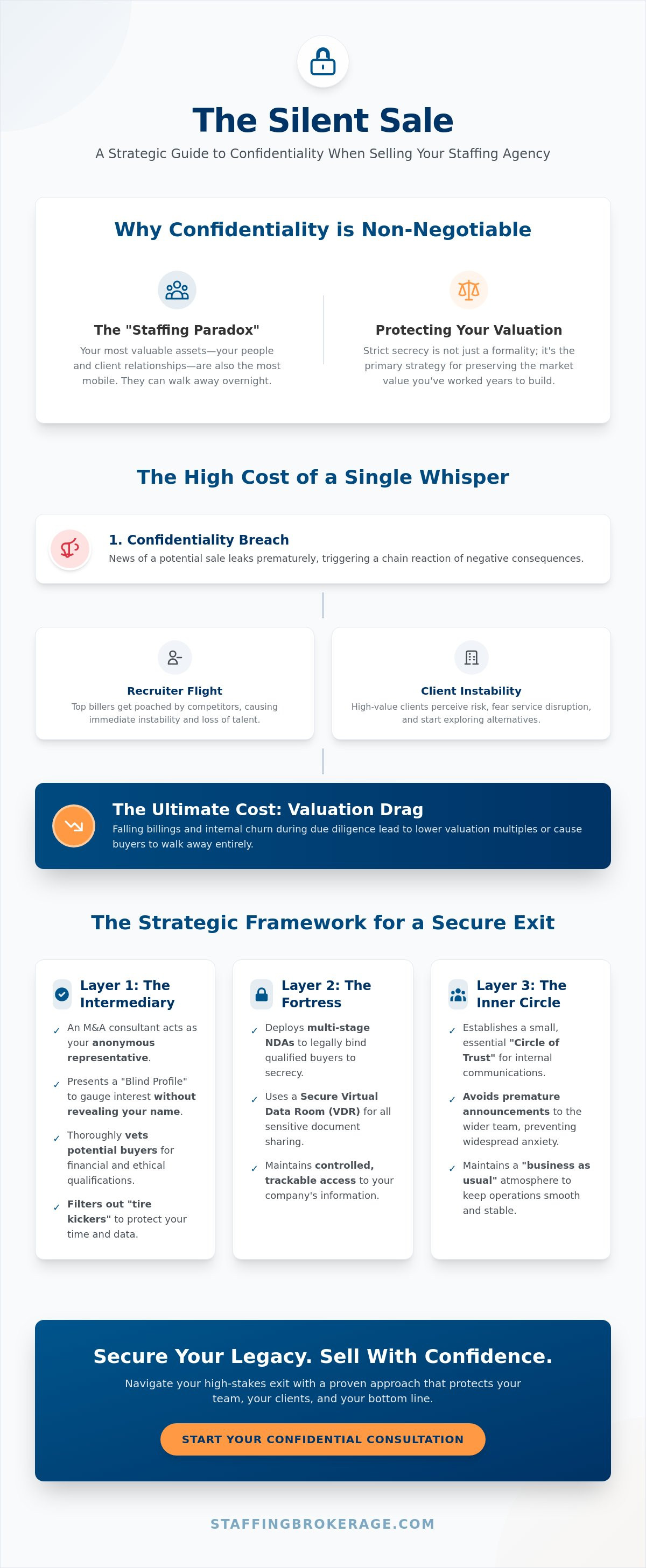
A Strategic Framework for Maintaining Absolute Confidentiality
Protecting your firm requires a methodical approach that releases information only as trust is earned. This isn't a single event but a multi-stage process designed to verify the buyer's intentions at every turn. By following a structured roadmap, you ensure that confidentiality in selling a staffing agency remains intact from the first inquiry to the final signature. With 35 transactions already recorded in the first quarter of 2026, the market is active, making a disciplined framework even more vital to prevent your agency from becoming "market gossip."
The journey begins with a "Blind Profile." This is a one-page teaser that highlights your agency's strengths, such as a 5.5x EBITDA multiple in a high-growth IT niche, without revealing your name or specific location. Once a buyer expresses interest, they must sign a multi-stage NDA. Only then do you release the Confidential Information Memorandum (CIM). This document provides a deeper look at your operations while still protecting your most sensitive data. Selling Your Company is a significant milestone, and managing this information flow correctly is the best way to avoid future regrets.
The final layer of protection is phased data access. Even after a buyer is deeply involved in due diligence, you should hold back specific employee names and client lists until the final stages. This prevents a "data dump" that could be used against you if the deal falls through. By using a secure virtual data room, you can grant access in increments, ensuring the buyer sees only what they need to see to move to the next level of the transaction.
For established entrepreneurs in the industrial and manufacturing sectors, similar strategic frameworks for growth and transition are provided by Co-Advisor, ensuring that business value is maximized through every phase of the company lifecycle.
The Power of the Blind Profile and CIM
A successful blind profile focuses on the numbers and the "why" of your business. It should include your revenue, EBITDA (typically between $3 million and $4 million for middle-market firms), and your specific industry vertical. You can describe your location by region rather than city. This allows you to gauge interest based on the merits of the business itself. Once the NDA is in place, the CIM provides the narrative that justifies your valuation, moving the conversation from "what is this?" to "how does this fit our portfolio?"
Vetting Buyers: Ensuring Financial and Ethical Qualification
Discretion is only possible if you are talking to the right people. We require Proof of Funds (POF) early in the conversation to ensure the buyer has the liquidity to close. It's equally important to conduct "reverse due diligence" on the buyer. Look at their history with previous staffing acquisitions. Do they have a reputation for retaining staff, or do they have a history of aggressive restructuring? Understanding their ethical track record helps you feel confident that your secrets are safe with them during and after the sale process.
Managing the Internal Secret: When and How to Tell Your Team
Keeping a secret from your loyal team is often the most emotionally taxing part of the exit process. However, maintaining confidentiality in selling a staffing agency is the kindest thing you can do for their long-term job security. If word gets out too soon, the resulting anxiety can destabilize the very company you're trying to protect. In the staffing world, your value is tied to your recruiters. When they feel uncertain, they start looking for the exit, which can cause your valuation to plummet before you ever reach a closing table.
Limiting knowledge to a "Circle of Trust" is the most effective way to prevent rumors. This small group usually includes only yourself and perhaps one key executive, such as a CFO or a trusted operations manager, who is essential for gathering due diligence data. Everyone else should remain focused on their daily recruitment targets. Experience shows that telling staff too early is the number one reason staffing deals fail. It creates a "pre-closing" period of high risk where your best billers might be tempted by competitors' offers.
Reframing the message is vital when you eventually share the news. You must present a "Growth Narrative" that focuses on the future. Instead of framing this as your departure, explain how the new ownership brings the resources, technology, or national reach needed to take the team’s careers to the next level. Addressing the "What about me?" fear directly helps recruiters and branch managers see that their desks and their commissions are safe under the new leadership.
Timing the Reveal: The Post-LOI Phase
The consensus best practice in 2026 is to inform employees about a sale 30 to 60 days before the scheduled closing. This typically happens after the Letter of Intent (LOI) is signed and the most intensive parts of due diligence are complete. You can follow our detailed guide on how to sell a staffing business to see how this timing aligns with the broader M&A timeline. Waiting until the deal is nearly certain prevents unnecessary stress and protects the business from the damage of a deal that falls through at the last minute.
Ensuring a Smooth Ownership Transition
A successful sale depends on the team staying in place after the ownership change. Introduce the buyer as a strategic partner who values the culture you've built. To provide immediate peace of mind, many owners offer retention bonuses or performance incentives for key billers that trigger after a successful transition period. These incentives align the team’s success with the new owner’s goals and preserve the agency’s long-term value. If you're ready to plan your discreet exit, our Staffing Company Sell-Side Representation can help you manage these sensitive internal communications with a steady hand.
Securing Your Legacy with Staffing Brokerage’s Proven Approach
You've built more than a company; you've built a legacy. Protecting that legacy requires a partner who understands that confidentiality in selling a staffing agency is the foundation of every successful deal. At Staffing Brokerage, we specialize in national, confidential transactions that prioritize your firm’s reputation and your team’s stability. With analysts forecasting between 85 and 100 deals for the full year of 2026, the market is moving quickly. You need a steady hand to navigate this activity without creating local noise or alerting your closest competitors.
Personalized Strategy for Staffing Industry Leaders
Proven Results in Confidential National Transactions
Your Secure Path to a Strategic Exit
Achieving total confidentiality in selling a staffing agency is possible when you have the right framework and partners in place. By managing the flow of information through phased disclosure and maintaining a tight circle of trust, you protect your firm's valuation and your team’s peace of mind. Your agency is the result of years of dedication; it deserves an exit process that honors that hard work and protects the relationships you've built.
At Staffing Brokerage, we bring specialized staffing industry M&A expertise to every transaction. Our national reach and qualified buyer network ensure you aren't limited to local competitors who might compromise your privacy. With a proven track record of discreet deal closures, we provide the steady hand needed to navigate the complexities of the 2026 market. We're here to act as your reliable ally, ensuring your legacy remains intact while you transition to your next chapter.
Start your confidential exit journey with a professional consultation
You've built something remarkable. We're ready to help you secure its future with the precision, alignment, and integrity you deserve.
Frequently Asked Questions
What is an NDA and why is it critical when selling a staffing agency?
A Non-Disclosure Agreement (NDA) is a legally binding contract that prevents potential buyers from sharing sensitive information about your business with third parties. It is critical because it ensures that proprietary data, such as recruiter billings and client lists, remains private during the initial evaluation. Without this legal protection, your agency's internal metrics could be used against you by competitors or leaked to the market, causing significant damage to your firm's valuation.
Can I sell my staffing firm without my employees finding out?
Yes, you can maintain strict confidentiality in selling a staffing agency until the deal is nearly finalized. Best practices suggest waiting until after a Letter of Intent is signed and due diligence is almost complete, usually 30 to 60 days before the scheduled closing. This controlled approach prevents unnecessary anxiety among your team and ensures that your best recruiters stay focused on their desks rather than searching for new roles out of fear.
When is the right time to tell my clients that I am selling the business?
Most owners notify clients immediately after the deal has closed or during the very final stages of the transition process. Telling clients too early can create a perception of instability, leading them to explore alternative staffing providers. By waiting until the transition plan is fully formed, you can introduce the new owner as a strategic partner who will enhance the service levels and resources they already enjoy.
How do M&A consultants vet potential buyers for confidentiality?
Consultants use a rigorous screening process that includes verifying Proof of Funds and reviewing the buyer's history with previous staffing acquisitions. They look for specific red flag behaviors, such as a history of aggressive poaching or unethical data usage in past deals. This vetting happens before your company's name is ever revealed, ensuring that only qualified, professional parties move forward to the next stage of the process.
What happens if a potential buyer breaks the non-disclosure agreement?
Violating an NDA can lead to significant legal consequences, including court injunctions to stop further disclosure and claims for financial damages. While litigation is a last resort, the presence of a strong agreement serves as a powerful deterrent for serious buyers. Most professional acquirers value their reputation in the M&A market and won't risk their standing by violating a confidentiality agreement during the due diligence phase.
How do I keep my competitors from finding out my agency is for sale?
Using an M&A consultant allows you to market your firm anonymously through blind teasers that omit your company name and specific city. This prevents local competitors from identifying your firm during the early stages of outreach. By acting as a firewall, your consultant filters all inquiries and only shares identifying information with vetted parties who have already signed a comprehensive confidentiality agreement and demonstrated genuine interest.
Is it possible to maintain confidentiality during the due diligence process?
Yes, you can maintain total privacy by using a secure Virtual Data Room (VDR) to manage the flow of sensitive information. A VDR allows you to track who views specific documents and prevents unauthorized downloads or printing. You can also use phased disclosure, where the most sensitive data, like specific client contracts or employee files, is only released in the final days before the deal officially closes.
What is a 'blind teaser' in the context of a staffing business sale?
A blind teaser is a one-page document that summarizes your agency's financial performance and market niche without revealing its identity. It typically includes high-level data such as revenue, EBITDA, and the specific staffing segments you serve. This tool is essential for maintaining confidentiality in selling a staffing agency because it generates interest from qualified buyers while keeping your firm's name completely hidden from the general market until you're ready.