
How to Sell a Temporary Staffing Agency: The 2026 M&A Success Guide
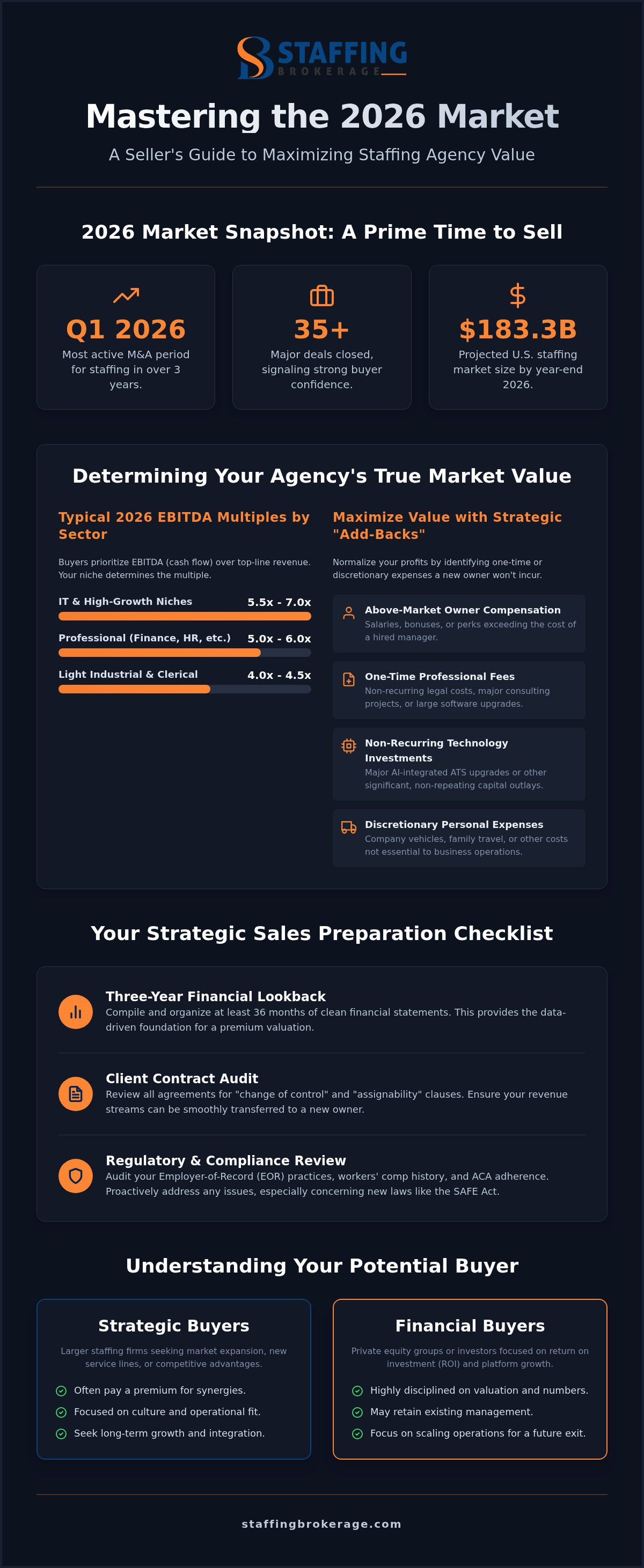
Did you know that the first quarter of 2026 marked the most active period for staffing M&A in over three years? With 35 major deals already closed and the U.S. market projected to reach $183.3 billion by year-end, the window for a high-value exit is wide open. You've worked hard to build your firm, but understanding how to sell a temporary staffing agency in this specific climate requires more than just a look at your top-line revenue.
It's natural to feel a mix of pride and anxiety when considering a sale. You're likely concerned about maintaining confidentiality, managing complex payroll liabilities, or finding a buyer who truly values your company culture. We understand those stakes. This guide provides a clear, step-by-step roadmap to help you master the 2026 market. We'll explore current EBITDA multiples for light industrial and professional sectors, the role of AI in driving your valuation, and how to navigate new regulations like the SAFE Act to ensure a smooth, profitable transition.
Key Takeaways
- Identify critical financial "add-backs" and understand the shift toward EBITDA-based valuations to ensure you capture the full value of your firm's hard work.
- Learn how to sell a temporary staffing agency by preparing a three-year financial lookback and auditing client contracts for essential assignability clauses.
- Distinguish between strategic and financial buyers to create the right competitive tension and find a partner who aligns with your company's long-term legacy.
- Navigate the complexities of due diligence by organizing your payroll funding and aging reports while negotiating a deal structure that balances immediate cash with future earn-outs.
- Discover why partnering with a specialized staffing M&A advisor protects your confidentiality and provides the steady hand needed to avoid deal fatigue.
Determining the Market Value of Your Temporary Staffing Agency
Valuation is the heartbeat of any exit strategy. If you're wondering how to sell a temporary staffing agency for its true worth, you have to look far beyond your gross billings. In 2026, the U.S. staffing market is projected to reach $183.3 billion. This growth creates a fertile environment for sellers, but buyers aren't just purchasing your past performance. They're buying the predictability and stability of your future cash flow. Understanding how a what is a temporary staffing agency is priced in the current market is the first step toward a successful transition.
EBITDA vs. Revenue: Which Metric Matters Most?
Most owners naturally focus on revenue, but sophisticated buyers in 2026 prioritize EBITDA. This stands for Earnings Before Interest, Taxes, Depreciation, and Amortization. It serves as a proxy for the actual cash your business generates. While high-growth or distressed firms might occasionally be valued on revenue multiples, the majority of profitable agencies sell based on a multiple of their adjusted EBITDA.
Your sector dictates these multiples. Current 2026 data shows IT and high-growth niches fetching between 5.5x and 7.0x EBITDA. Professional staffing firms typically see 5.0x to 6.0x, while light industrial agencies sit in the 4.0x to 4.5x range. Gross margin percentages also heavily influence these numbers. A firm with a 25% margin is often more attractive than a higher-revenue firm with only 12% margins because the profit quality is superior.
Identifying Strategic Add-Backs to Maximize Value
To capture the highest possible offer, you must "normalize" your financial statements. This is where a detailed staffing company valuation becomes essential. Add-backs are expenses that won't continue under a new owner. Identifying them correctly can add hundreds of thousands of dollars to your final sale price. Common add-backs include:
- Owner compensation or bonuses that exceed the market rate for a hired manager.
- One-time legal fees or professional services that aren't part of daily operations.
- Non-recurring technology investments, such as a major AI-integrated ATS upgrade.
- Discretionary personal expenses like company vehicles or travel that won't remain after the sale.
The Role of Quality of Earnings (QofE)
Expect buyers to perform a "Quality of Earnings" (QofE) analysis. This deep dive ensures your reported profits are sustainable. They'll look for client concentration risks. If one client represents 40% of your revenue, it creates a risk profile that might compress your multiple. However, if your earnings are diversified across several stable, high-margin contracts in niche sectors like healthcare or specialized IT, you can defend a premium price. You've spent years building this company. We're here to help you prove its value through a clear, transparent financial narrative.
Preparing Your Staffing Agency for a Strategic Sale
Preparation is the bridge between owning a business and realizing its full market potential. When you're learning how to sell a temporary staffing agency, the most critical lesson is that value is built long before the first offer arrives. Ideally, you should begin developing your staffing agency exit strategy at least 12 to 24 months before hitting the market. This lead time allows you to conduct a rigorous three-year financial lookback. This preparation provides the data-driven foundation for how to value your staffing agency effectively when negotiations begin.
Compliance is a major focus for buyers in 2026. With new regulations like California's SAFE Act (SB 1032) creating clearer frameworks for temporary staffing, acquirers will scrutinize your employer-of-record (EOR) practices. They'll audit your workers' compensation history and Affordable Care Act (ACA) mandate adherence. If your files aren't digitized or your payroll funding isn't transparent, it creates deal friction. These hurdles often lead to price chips or deal fatigue. Proactively auditing these areas ensures you present a "clean" business that commands a premium.
Operational Cleanup and Contract Management
Buyers look for stability in your revenue streams. We recommend a thorough audit of your client agreements, specifically focusing on "change of control" and assignability clauses. If a major VMS or MSP contract requires client consent for a sale, it introduces a significant risk. Standardizing these agreements now prevents headaches during due diligence. You should also evaluate concentration risks. If a single client accounts for more than 20% of your billings, start diversifying your portfolio today to protect your valuation multiple.
Building a Self-Sustaining Management Structure
A common pitfall for founders is being too hands-on. If the business stops running when you take a vacation, its value drops. Acquirers pay more for agencies with a strong internal leadership team that operates independently of the owner. This involves documenting standard operating procedures (SOPs) and implementing stay-bonuses or incentive plans for key recruiters. Keeping your top talent during the transition is vital for post-close success. By showing that the agency thrives without your daily involvement, you provide the steady hand buyers crave. For those ready to begin this process, seeking professional sell-side representation can help identify these operational gaps early.
Identifying the Right Buyer: Strategic vs. Financial
Choosing the right buyer is perhaps the most personal decision you'll make when learning how to sell a temporary staffing agency. The "highest" offer isn't always the "best" offer if it doesn't align with your goals for your employees and your legacy. In the current 2026 market, we're seeing a diverse pool of acquirers, each with distinct motivations and deal structures. Understanding these differences helps you position your firm to attract the partner who truly understands your value.
The Motivations of Strategic Buyers
Strategic buyers are typically your direct competitors or larger firms in adjacent sectors. They're looking for market share, geographic expansion, or a quick entry into a new vertical like healthcare or IT staffing. These buyers often pay a premium. They can justify a higher multiple because they anticipate "synergies." By merging back-office functions like payroll and HR, they can immediately increase the profitability of your existing revenue.
Selling to a rival has pros and cons. While they offer deep industry expertise and often provide a more straightforward cash-at-close structure, there may be cultural friction. You've spent years competing against them. Now, you're trusting them with your team. We help you navigate these sensitive conversations to ensure the "fit" is as solid as the financial offer.
The Rise of Private Equity in Temporary Staffing
Financial buyers, primarily private equity (PE) firms, have become increasingly active in 2026. Q1 of this year saw 35 transactions, marking the strongest opening quarter in three years. PE firms typically look for a "platform" company. This is a well-run agency with a strong leadership team and scalable technology that they can use to acquire smaller "bolt-on" agencies later.
These buyers value your back-office systems and tech stack. Since 84% of hiring processes now utilize AI, PE firms prioritize targets with significant technology integration. A common feature of financial deals is the "second bite of the apple." You might sell 70% to 80% of your company now and retain a minority stake. As the PE firm grows the business and sells it again in five years, your remaining shares could be worth significantly more than your initial exit. This structure is ideal for owners who want to de-risk their personal finances but aren't quite ready to walk away from the industry entirely.
Whether you prefer the immediate integration of a strategic partner or the growth-focused capital of a PE firm, we act as your steady hand. Our role is to create a competitive environment where multiple buyers vie for your agency, ensuring you receive the maximum value for your years of hard work.
Navigating Due Diligence and Deal Structure Nuances
Once you've identified a buyer, the process moves into the high-stakes phase of due diligence. Understanding how to sell a temporary staffing agency involves more than just handing over standard financial statements. You must be ready for a deep dive into your operational plumbing. Buyers will scrutinize your payroll funding mechanisms and your accounts receivable aging reports. They want to see that your "float" is managed efficiently and that your clients pay on time. To protect your trade secrets during this phase, we always recommend using a secure virtual data room (VDR) to manage the disclosure of sensitive client lists and candidate data.
Temporary Staffing Specific Due Diligence
Buyers in 2026 are particularly focused on risk mitigation. They'll audit your workers' compensation claims and safety records, especially if you operate in the light industrial sector. They also analyze client concentration and the "stickiness" of your temporary placements. If your contracts are high-volume but low-margin, or if they rely on a single VMS platform that could be terminated, it affects your risk profile. We help you present these metrics in a way that highlights your operational stability and the long-term loyalty of your client base.
Structuring the Deal for Maximum Retention
The final walk-away cash often depends on the staffing company deal structure you negotiate. Most transactions include a mix of cash at close, earn-outs, and seller notes. Earn-outs are common tools used to bridge valuation gaps, tying a portion of the purchase price to future EBITDA targets. While they can increase your total payout, they also require careful legal protections to ensure you aren't penalized for post-close decisions made by the new owner.
Another critical component is the Net Working Capital (NWC) peg. This is the amount of current assets, minus current liabilities, that must remain in the business at closing. In temporary staffing, this is heavily tied to your accounts receivable. If your receivables are lower than the agreed-upon peg on closing day, the purchase price is adjusted downward. Mastering the negotiation of the sale ensures you don't leave money on the table due to these technical accounting nuances.
If you're concerned about how your specific liabilities or payroll funding will affect your deal, our team at Staffing Brokerage can provide a preliminary assessment to prepare you for the scrutiny of due diligence.
Partnering with a Specialized Staffing M&A Advisor
Selling your business is the culmination of years of dedication, sacrifice, and strategic growth. It's more than a simple financial transaction; it's a significant life transition. When you begin exploring how to sell a temporary staffing agency, you might consider working with a local business broker. However, generalist brokers often lack the industry-specific knowledge required to navigate the complexities of temporary staffing. They might struggle to explain your workers' compensation risk profile or the nuances of your VMS revenue streams to a buyer. A specialized staffing company M&A advisory understands these levers, ensuring your firm's value is defended and articulated correctly.
The right advisor acts as a steady hand throughout the process. They help prevent "deal fatigue," a common phenomenon where the sheer volume of due diligence requests and negotiations wears down an owner. By managing the heavy lifting of document organization and buyer communication, your advisor allows you to stay focused on running your agency. This is vital, as any dip in performance during the sale process can lead to price renegotiations or "re-trading" by the buyer.
Creating a Competitive Bidding Environment
One of the greatest advantages of a specialized advisor is their ability to create a structured, competitive process. Rather than negotiating with a single interested party, an advisor identifies and vets multiple qualified buyers simultaneously. This approach shifts the power dynamic in your favor. When several strategic and financial buyers are at the table, it creates a sense of urgency and a "fear of missing out" (FOMO). This competition often results in better deal terms, higher multiples, and a choice of partners that fit your company culture. We move you from a single-offer scenario to a multi-offer auction, maximizing the reward for your hard work.
Confidentiality and the Sales Process
Maintaining secrecy is paramount. If word leaks that your agency is for sale, you risk losing key recruiters to competitors or causing unnecessary anxiety among your temporary workforce. We use "Teasers" or blind profiles that describe your agency's financial highlights and geographic reach without revealing its name. Information is only shared with vetted buyers who have signed strict non-disclosure agreements (NDAs).
Managing the flow of information ensures that you control the narrative. You decide when and how to tell your internal team and your clients about the transition. By the time the news is public, the deal is secured, and a clear plan for a seamless transition is in place. Partnering with an expert ensures that your legacy is protected and your future is secure. If you're ready to take the next step, our team at Staffing Brokerage is here to guide you through every stage of the journey.
Your Path to a Successful 2026 Exit
The 2026 M&A landscape offers a unique opportunity for agency owners to realize the full value of their years of hard work. By focusing on adjusted EBITDA multiples, cleaning up your operational compliance, and identifying the right strategic or financial partner, you position your firm for a premium exit. You've navigated the complexities of payroll funding and client management for years. Now it's time to focus on the final chapter of your ownership journey with the same level of care and precision.
Mastering how to sell a temporary staffing agency requires a blend of financial precision and industry-specific insight. At Staffing Brokerage, we provide the steady hand you need during this emotional and complex process. Our specialized industry expertise and national buyer network ensure you benefit from a competitive bidding environment. We also prioritize confidential process management to protect your firm's identity and culture throughout the entire transaction.
Secure your legacy with professional staffing company sell-side representation today. You don't have to navigate this transition alone. We're here to act as your reliable ally, turning your hard-earned success into a rewarding and seamless exit that honors everything you've built.
Frequently Asked Questions
How long does it typically take to sell a temporary staffing agency?
Most transactions take between six and nine months from the initial valuation to the final closing. This timeline includes preparing your financial data, marketing to potential buyers, and navigating the due diligence phase. Starting your preparation 12 to 24 months in advance ensures you aren't rushed. A methodical approach helps maintain business performance while managing the complexities of the sale.
What is the average EBITDA multiple for a temporary staffing firm in 2026?
In 2026, multiples vary significantly based on your specific sector and margin quality. Light industrial firms typically trade between 4.0x and 4.5x EBITDA. Professional and IT staffing agencies often command higher multiples, ranging from 5.0x to 7.0x. These figures depend on your client diversity and the level of technology integration within your recruitment processes. Higher-margin niche firms consistently attract the strongest offers.
Do I have to tell my employees I am selling the business?
You don't need to inform your entire staff until the deal is nearly finalized and a definitive agreement is signed. Maintaining confidentiality prevents recruiter turnover and protects your client relationships during negotiations. Most owners wait until shortly before closing to announce the transition. We use blind teasers and secure data rooms to ensure your intent to sell remains private while we identify the right buyer.
What happens to my temporary staff and recruiters after the sale?
Most buyers want to keep your internal recruiters and temporary workforce to ensure operational continuity and revenue stability. Since the value of a staffing firm lies in its people and client contracts, mass turnover is counterproductive for the acquirer. Strategic buyers often integrate your team into their existing structure. Financial buyers typically keep your team in place as a standalone platform to support future growth.
What is a 'working capital peg' in a staffing agency sale?
The working capital peg is a target dollar amount of net assets that must remain in the business at the time of closing. In temporary staffing, this is primarily comprised of your accounts receivable minus your accounts payable and accrued payroll. If your actual working capital is below this peg on the closing date, the purchase price is adjusted downward. It's a critical technical detail that affects your walk-away cash.
Can I sell my staffing agency if I have high client concentration?
You can sell with high client concentration, but it often leads to a lower valuation multiple or a larger earn-out component. Buyers view heavy reliance on one or two clients as a risk to future cash flow. To mitigate this, we focus on the "stickiness" of those relationships and the length of your contracts. Diversifying your client base before going to market is the best way to protect your final price.
Should I use a business broker or an M&A advisor for my staffing firm?
A specialized M&A advisor is preferred over a generalist business broker for staffing transactions. Staffing firms have unique liabilities, such as workers' compensation and complex payroll funding, that generalist brokers often misunderstand. An advisor who knows how to sell a temporary staffing agency can articulate your specific value drivers to sophisticated buyers. This industry-specific focus ensures you don't leave money on the table due to technical errors.
How do earn-outs work in the staffing industry?
Earn-outs are supplemental payments made to the seller after the closing, contingent on the business hitting specific financial targets like EBITDA or gross profit. They're common tools in 2026 to bridge the gap between a buyer's offer and a seller's asking price. These structures allow you to benefit from the continued growth of the agency. They also de-risk the transaction for the acquirer during the initial transition period.


