
The Retiring Staffing Agency Owner’s Resource Guide to a Strategic Exit
What if the very leadership that built your agency is the same thing preventing you from walking away with its full value? It's a common worry for every retiring staffing agency owner. You've spent decades cultivating relationships and building a high-performing team; yet, the thought of the business losing momentum without your daily presence is a heavy burden. You want to ensure your staff and clients are in good hands while also securing the maximum financial return for your next chapter.
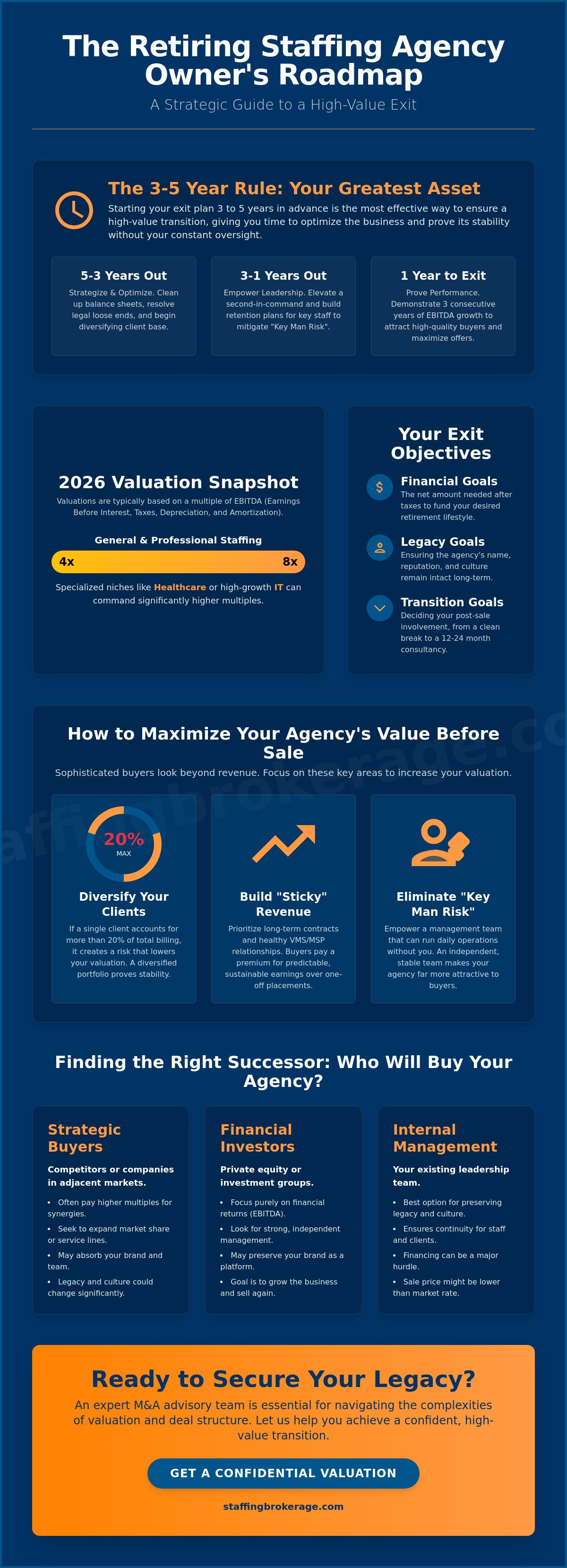
We understand that a business built on people requires a more nuanced approach than a standard transaction. This guide provides the strategic roadmap you need to move from uncertainty to a confident, high-value transition. We'll examine current 2026 valuation multiples, which range from 4x to 8x EBITDA for general staffing, and clarify the differences between selling to an internal successor versus a strategic competitor. You'll gain a clear understanding of how to prepare your agency for a sale that protects your legacy and funds your future. By treating your exit as a collaborative journey rather than a simple hand-off, you can ensure your agency continues to thrive under new ownership.
Key Takeaways
- Learn why starting your exit planning three to five years in advance is the most effective way to ensure a high-value transition.
- Discover how a retiring staffing agency owner can maximize their business worth by focusing on client diversification and operational independence.
- Compare the benefits of selling to strategic buyers, financial investors, or internal management teams to find your best fit.
- Gain a clear strategy for communicating the sale to your team and clients while transitioning your personal role from leader to consultant.
- Identify why specialized industry representation is essential for navigating the complex nuances of staffing company valuations and deal structures.
The Retiring Staffing Agency Owner’s Roadmap to a Successful Exit
An exit strategy is the formal, documented plan a founder develops to transfer ownership of their firm to a new party. For a retiring staffing agency owner, this strategy is the difference between a chaotic departure and a profitable, graceful transition. It's about ensuring your legacy continues while you secure the financial freedom you've earned. Most owners find it helpful to categorize their objectives into three areas:
- Financial Goals: The specific net amount needed after taxes to fund your retirement lifestyle.
- Legacy Goals: Ensuring the agency name, reputation, and culture remain intact for the long term.
- Transition Goals: Deciding how much time you're willing to spend as a consultant or advisor after the sale.
Early preparation is your greatest asset. Ideally, a retiring staffing agency owner begins this process three to five years before their planned departure date. This "3-5 year rule" is a standard for a reason. It gives you enough room to clean up your balance sheets, resolve any legal loose ends, and prove that your agency can grow without your constant oversight. If you rush the process, you risk appearing desperate to buyers, which lead to lower offers. A well-executed staffing agency ownership transition also acts as a safeguard for your company culture. It prevents the internal panic that often follows a sudden change in leadership.
Setting Your Retirement Timeline
Start by looking at your numbers. Financial readiness involves more than just a high sale price; it requires an understanding of your post-exit tax liabilities and lifestyle costs. Decide if you want a clean break or if you're open to an earn-out where you stay on for 12 to 24 months to ensure a smooth hand-off. The ideal exit window for a staffing firm occurs when the agency shows three consecutive years of EBITDA growth during a period of high market demand for your specific niche. Your personal health and family goals should always be the primary drivers of this timeline.
Evaluating Your Current Management Depth
Buyers look for stability. They fear "Key Man Risk," which is the danger of the business collapsing because the owner is the only person who knows how to run it. Robust Succession planning is essential here. You need to identify a second-in-command and empower them to lead daily operations long before you actually leave. Don't forget your recruiters. Since they hold the relationships with your talent pool, you should create retention plans to keep them motivated during the ownership change. A stable, independent team makes your agency far more attractive to high-quality buyers and ensures a higher valuation.
Maximising Your Agency’s Value Before the Handover
While revenue is often the first number discussed in casual conversation, sophisticated buyers look far deeper when assessing a firm's worth. For a retiring staffing agency owner, the goal is to shift the focus from top-line sales to the quality and sustainability of earnings. Understanding the nuances of staffing company valuation is essential because it helps you identify which parts of your business are actually driving the purchase price. In 2026, general and professional staffing firms typically trade between 4x and 8x EBITDA, but specialized niches like healthcare or high-growth IT can command significantly higher multiples if the foundations are solid.
High-value buyers look for "sticky" revenue. This means they prioritize agencies with long-term contracts and healthy VMS/MSP relationships over those relying on one-off placements. Client concentration is another critical factor; if a single client accounts for more than 20% of your total billing, it represents a risk that can lower your valuation. Diversifying your portfolio before you exit ensures that the business remains stable even if one major account shifts its strategy. If you're curious about how your current client mix affects your market price, a professional business valuation and assessment can provide the clarity you need to make adjustments now.
Financial Housekeeping for a Clean Exit
Clean books are the cornerstone of a successful sale. You must separate personal expenses, such as vehicle leases or non-business travel, from your operational accounts to reveal the true profitability of the agency. This process involves identifying "add-backs," which are one-time or personal costs that won't continue under new ownership. These adjustments directly increase your EBITDA (Earnings Before Interest, Taxes, Depreciation, and Amortisation), which is the primary metric buyers use to calculate your offer. It's also vital to ensure all employment law compliances and tax filings are current to avoid red flags during the final stages of a deal.
Operational Efficiency as a Value Driver
A business that runs itself is always worth more than one that requires the owner's constant intervention. Start documenting your standard operating procedures (SOPs) for everything from recruiter onboarding to client acquisition. Upgrading your Applicant Tracking System (ATS) can also pay dividends by providing buyers with clear, historical data on candidate pipelines and placement cycles. Accurate, well-organized data reduces perceived risk and streamlines the due diligence process for potential buyers. By standardizing your workflows, you prove to a successor that the agency's success is a result of a proven system, not just your personal magic.
Identifying the Right Successor: Strategic vs. Financial Buyers
Choosing the right successor is perhaps the most significant decision a retiring staffing agency owner will make. It isn't just about the check size; it's about who will lead your team and serve your clients once you're gone. You generally have three paths: selling to a strategic competitor, partnering with a financial investor, or facilitating an internal Management Buy-Out (MBO). An MBO can be deeply rewarding as it preserves the legacy with the loyal team who helped build the firm, though it often requires the owner to finance a portion of the transaction themselves.
Understanding the nuances of a staffing company strategic buyer vs. financial buyer is the first step in narrowing your search. In 2026, the market has seen a notable rebound in activity, with 35 announced transactions in Q1 alone. Private equity firms are increasingly attracted to the staffing sector's scalable models and resilient revenue streams, often looking for stable agencies to serve as "platforms" for further acquisitions. However, regardless of the buyer type, maintaining strict confidentiality is vital. If news of a potential sale leaks too early, it can spook your best recruiters or give competitors a window to poach your top accounts.
The Strategic Buyer Approach
Strategic buyers are usually larger staffing firms or competitors looking to expand their geographic reach or enter a new niche, such as healthcare or IT staffing. These buyers often pay a "synergy premium" because they can eliminate redundant back-office costs or cross-sell services to your existing client base. While the financial offer might be higher, you must carefully evaluate the cultural fit. Merging a boutique, high-touch agency into a massive national corporation can be a jarring experience for your long-term employees, so look for alignment in values and leadership styles.
The Financial Buyer Perspective
Financial buyers, including private equity groups and search funds, view your agency as a high-potential investment. They are often less concerned with immediate integration and more focused on EBITDA growth and professionalizing the business for a future exit. These deals frequently include earn-outs, where a portion of the purchase price is paid over time based on the agency's performance. This structure often requires the retiring staffing agency owner to stay on as a consultant for a year or two. Before moving forward, always demand a "proof of funds" or a clear track record of previous acquisitions to ensure the buyer has the capital and experience to close the deal.
Navigating the Ownership Transition and Personal Retirement Planning
The signature on the final sales agreement isn't the end of your journey. It is the start of a significant role reversal. For a retiring staffing agency owner, moving from "The Boss" to "The Consultant" is often the most challenging part of the entire process. You've spent years making every final call and setting the strategic direction. Now, you must step back and let the new leadership take the helm while you provide the historical context they need to succeed. This transition requires a steady hand and a clear head to ensure the agency's momentum doesn't stall.
Communication is your most delicate tool during this phase. Telling your team and your clients about the sale at the wrong moment can trigger unnecessary panic. If you speak too early, your top recruiters might start looking for more "stable" roles elsewhere. If you wait too long, they may feel a sense of betrayal. The ideal timing usually falls right after the Letter of Intent (LOI) is signed or during the final stages of due diligence. Managing the emotional impact of leaving is equally vital. It's normal to feel a sense of loss when walking away from a business you founded, but focusing on the long-term stability you've secured for your employees can provide much-needed peace of mind.
The Handover Phase
Transition periods vary significantly based on the deal structure. Some owners opt for a quick 90-day hand-off, while others stay on for two years as part of an earn-out agreement. During this time, your primary goal is "knowledge transfer." You need to pass on the unwritten rules of your most valuable client relationships and the specific nuances of your recruitment pipeline. Protecting your legacy means choosing a buyer whose values align with your own, ensuring the company culture remains intact long after you've departed. If you are ready to begin this transition with a partner who understands these complexities, explore our staffing agency sell-side representation services.
Personal Financial Planning Post-Exit
Your financial life will change dramatically once the sale proceeds hit your account. In 2026, federal long-term capital gains tax rates remain at 0%, 15%, or 20%, depending on your total taxable income. High-income earners should also account for the 3.8% Net Investment Income Tax (NIIT). It's essential to work with tax professionals to minimize this impact and diversify your wealth away from the business and into stable retirement vehicles. Planning for "Life After Staffing" is just as important as the sale itself. Whether you envision a future in philanthropy, taking on board roles, finally having the time for extended travel, or you want to explore Hunting Land Brokerage for a recreational retreat, having a clear personal roadmap ensures your retirement is as rewarding as your career.
Building Your M&A Advisory Team for a Smooth Retirement
Selling a business you have spent decades building is not a solo mission. While you are an expert at matching talent with opportunity, the mechanics of a multi-million dollar business sale require a different set of specialized skills. For a retiring staffing agency owner, the quality of the advisory team often determines the final success of the exit. A general business broker might understand basic retail or manufacturing flips, but they often fail to grasp the nuances of the staffing industry, such as recruiter productivity metrics, VMS contract risks, or the impact of local employment law on valuation.
Your team should function as a coordinated unit, with an M&A advisor acting as the primary strategist. This professional works alongside your legal counsel and CPA to ensure every aspect of the deal is optimized. Specialized staffing agency sell-side representation is particularly valuable during the due diligence phase. This is the period when buyers scrutinize every placement, contract, and financial statement. A professional advisor manages this heavy lifting, organizing your data room and shielding you from the daily stress of buyer inquiries so you can keep your agency running at peak performance until the very last day.
Selecting the Right M&A Advisor
Industry expertise is non-negotiable. You need an ally who possesses a national network of both strategic and financial buyers who are specifically looking for staffing firms. Evaluate their track record not just by the number of deals closed, but by their experience in helping a retiring staffing agency owner navigate the emotional and technical hurdles of a final exit. During the high-pressure closing weeks, your advisor's "steady hand" will be your most valuable asset. They keep the momentum moving forward, resolve last-minute disputes, and ensure the buyer remains committed to the terms established in the initial offer.
The Final Steps to Retirement
The journey concludes with the transition from the Letter of Intent (LOI) to the definitive purchase agreement. This final document codifies everything from the purchase price to the specifics of your post-sale consulting role. On closing day, you will work through a final checklist that includes transferring digital assets, notifying key stakeholders, and confirming the wire transfer of funds. It is the culmination of years of hard work and months of strategic planning. Ready to plan your next chapter? Contact Staffing Brokerage for a confidential assessment and let us help you secure the legacy you've built.
Taking the First Step Toward Your Next Chapter
A successful exit is the ultimate reward for your years of dedication and hard work. By focusing on long-term value drivers like client diversification and management depth, you ensure your agency remains attractive to both strategic and financial buyers. We've seen how early preparation and a clear transition roadmap can transform a complex transaction into a collaborative journey that protects your staff and your legacy. It's about more than just a sale; it's about the future of the people who helped you build your dream.
Every retiring staffing agency owner deserves an exit that reflects the true worth of their business. Achieving this requires more than just a listing; it requires specialised staffing industry expertise and a national network of strategic and financial buyers who understand your niche. Our confidential and ethical advisory process is designed to handle the complexities of the M&A landscape so you can focus on your personal retirement goals. You've earned the right to a transition that is as stable and rewarding as your career has been.
Start your retirement journey with a professional business valuation today. You've built something remarkable, and we're here to help you cross the finish line with confidence.
Frequently Asked Questions
When is the best time for a staffing agency owner to retire?
The best time to retire is when your agency shows three consecutive years of EBITDA growth and market demand for your niche is strong. You should ideally begin planning three to five years before your target date. This lead time allows you to optimize your financials and prove the business can thrive without your daily involvement. Exiting during a period of high M&A activity, like the rebound seen in early 2026, can significantly increase your final offer.
How much is my staffing agency worth for retirement purposes?
Valuation is typically calculated as a multiple of your EBITDA, which for a retiring staffing agency owner in 2026 generally ranges from 4x to 8x. Specialized sectors like healthcare or IT often command higher multiples, sometimes reaching 10x or more for high-growth firms. Your agency's worth also depends on "add-backs," which are personal or one-time expenses that are added back to your earnings to show the business's true profitability.
Can I sell my staffing agency if I am the primary rainmaker?
You can certainly sell, but being the primary rainmaker creates "Key Man Risk" that can lower your valuation. Buyers want to see that client relationships and revenue won't disappear when you leave. To maximize your price, start transitioning those key accounts to a successor or management team at least two years before you exit. This shift proves the agency's stability and gives the buyer confidence that the business is a sustainable investment.
What is an earn-out and how does it affect my retirement income?
An earn-out is a deal structure where a portion of the purchase price is paid after the closing, contingent on the agency hitting specific financial targets. For a retiring staffing agency owner, this often means staying on as a consultant for 12 to 24 months. While it can increase your total retirement income by bridging the gap between your asking price and the buyer's offer, it does require you to remain involved in the business post-sale.
Do I need to tell my employees I am planning to retire?
You don't need to inform your entire staff during the early stages of planning. Maintaining confidentiality is essential to prevent internal panic or competitors poaching your recruiters. Most owners wait until a Letter of Intent is signed or the due diligence process is nearly complete. This timing allows you to present the sale as a positive, strategic move that ensures the long-term stability and growth of the team.
How long does the process of selling a staffing agency usually take?
The actual transaction process usually takes between six and twelve months from the time you go to market to the day you close. This timeline includes finding the right buyer, negotiating terms, and completing the rigorous due diligence phase. However, the most successful exits involve a multi-year preparation period. This prep work ensures your books are clean and your management team is ready, which helps the final legal and financial stages move much more smoothly.
What are the biggest mistakes retiring owners make during a sale?
The biggest mistakes include having high client concentration and failing to document standard operating procedures. If one client accounts for over 20% of your revenue, buyers see it as a major risk. Many owners also wait until they are burnt out to start the process, which leaves them with little leverage. Not having a clear second-in-command is another frequent error that makes the business look too dependent on the founder.
Should I sell to a competitor or an outside investor?
Selling to a competitor often results in a higher purchase price due to "synergy premiums," as they can cut redundant costs. However, it may lead to your brand being absorbed and your culture changing. An outside investor, like a private equity firm, might keep your team and brand intact but may require a more complex earn-out structure. Your choice should align with whether you prioritize the highest check or the preservation of your agency's unique identity.


