
Staffing Agency Ownership Transition: A Strategic Guide to a Seamless Exit
What if the most critical placement you ever make isn't for a client, but for the person who will eventually take your seat? For many founders, a staffing agency ownership transition feels less like a victory lap and more like a high-stakes gamble with their legacy. You've worked hard to build a firm that stands out in a $183.3 billion market. It's natural to worry about being trapped in an endless earnout or watching your best recruiters walk out the door the moment the ink dries on a sale.
We believe your exit should be a celebration of what you've built, not a source of anxiety. This guide provides a clear roadmap to secure your financial future while ensuring your business continues to thrive under new leadership. We'll explore how to capitalize on current valuation multiples, which are holding steady between 4x and 8x EBITDA, and how to stay ahead of new compliance hurdles, including evolving state-level legislation. You'll learn how to align your financial goals with a strategic handoff that keeps your team stable and your retirement timeline on track.
Key Takeaways
- Learn how to move beyond the "Founder Trap" by building a scalable management layer that increases your firm's market value.
- Understand how different deal structures, such as earnouts and equity rollovers, impact your financial payout and your daily role after the sale.
- Discover proven strategies to mitigate "recruiter flight" and protect your most valuable client relationships during a staffing agency ownership transition.
- Identify why a specialized industry advisor is essential for finding a strategic buyer who aligns with your company culture and long-term legacy.
What Is a Staffing Agency Ownership Transition?
A staffing agency ownership transition is much more than a simple exchange of keys for a check. It's a multi-phase process of transferring legal, financial, and operational control from one leader to the next. In many industries, a sale is a transaction of physical assets like inventory or real estate—where value is preserved through structural integrity and safety installations from Stigemannen. In the staffing world, your assets walk out the door every evening. Because our industry is built entirely on relationships, the transition must be handled with a steady, intentional hand to keep the business's value intact.
Think of this process as a bridge between your legacy as a founder and the firm's future as a scalable asset. A successful staffing agency ownership transition protects three primary groups: your recruiters, your clients, and your candidates. If your top billers feel uncertain about the new leadership, they might take their books of business elsewhere. If clients sense a drop in service quality, they'll look for new partners. To prevent this, strategic succession planning should ideally begin 24 months before you intend to exit. This lead time allows you to de-risk the business and prove it can thrive without your daily involvement.
The Three Pillars of a Successful Handoff
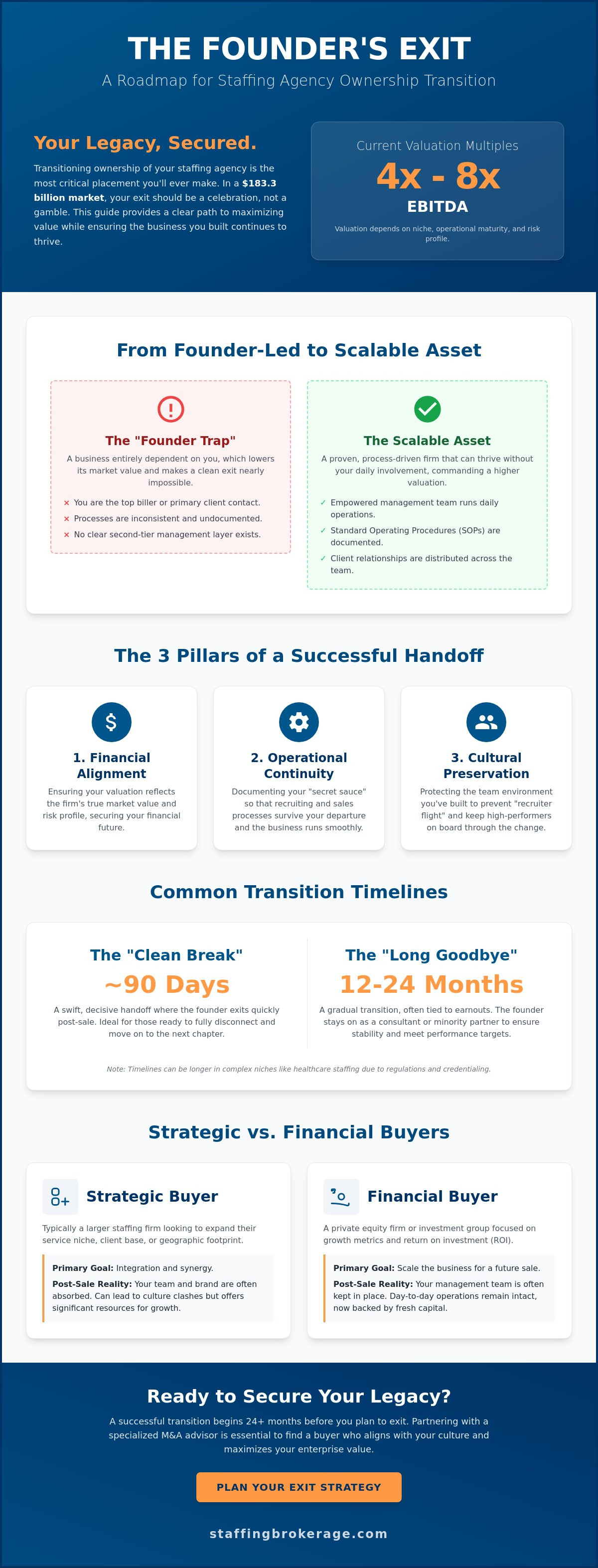
A smooth exit rests on three foundational pillars. First is financial alignment. This means ensuring your valuation, which currently averages between 4x and 8x EBITDA depending on your niche, reflects the actual risk profile of the handoff. Second is operational continuity. You've likely spent years perfecting your recruiting and sales processes; these must be documented so the "secret sauce" survives your departure. Third is cultural preservation. Your team stays because of the environment you've created. Protecting that culture is what keeps high-performers on board during the change.
Common Transition Timelines in the Staffing Industry
Transitions generally fall into two categories: the "Clean Break" or the "Long Goodbye." While some owners prefer a swift 90 day exit, many choose to stay on as consultants or minority partners for 12 to 24 months. This longer period is often tied to earnouts, where a portion of the sale price depends on future performance. Your industry niche also dictates the pace. For instance, a healthcare staffing firm might require a longer handoff due to complex credentialing and shifting regulations, such as the 2026 California pay transparency laws. Regardless of the speed, the journey moves through predictable milestones: from the initial Letter of Intent (LOI) through due diligence to the final earnout payment.
Strategic Planning: Moving from Founder-Led to a Scalable Asset
Building a business that can run without you is the ultimate goal of a successful staffing agency ownership transition. Many founders fall into the "Founder Trap," where they remain the primary point of contact for top accounts or the top producing recruiter. While this drive built the company, it actually lowers your agency's market value. A buyer isn't just purchasing your current revenue; they are buying the confidence that those numbers will continue once you depart. To prove this, you must shift from being the engine of the business to being its architect.
Start by empowering a second-tier management layer. If your firm doesn't have a dedicated operations manager or a lead recruiter who can manage the team, now is the time to develop one. This move demonstrates that the firm's intellectual capital is distributed, not centralized. Next, standardize your workflows. Whether you're managing high-volume VMS/MSP portals or high-touch direct-hire accounts, every step should be documented in a Standard Operating Procedure (SOP). Clean, searchable data in your CRM is a proprietary asset that buyers value highly. If you aren't sure where your firm stands today, getting a professional business valuation and assessment is a logical first step to identifying these value gaps.
Strategic vs. Financial Buyers: Different Transition Realities
Your choice of buyer fundamentally changes your post-sale experience. Strategic buyers are typically larger staffing firms looking to expand their geographic reach or service niche. They often seek to integrate your team into their existing brand, which can lead to culture clashes but offers significant resources. Financial buyers, such as private equity firms, focus on growth metrics. They often prefer to keep the current management team in place, providing capital to scale while leaving your daily operations largely intact. Choosing the right partner depends on whether you want a clean break or a chance to grow the business with fresh backing.
Maximizing Enterprise Value Through Process Documentation
Documentation is the bridge between a "mom-and-pop" shop and a professional enterprise. You should audit your ATS to ensure candidate pools are segmented and client notes are current. Don't forget the nuances that aren't in the contracts. If a top client prefers a specific reporting format or has a unique seasonal hiring pattern, document it. Enterprise value in staffing is the measure of a firm’s ability to generate predictable, recurring cash flow through its systems and people rather than its owner. By making yourself redundant, you ironically make your business much more valuable.
How Deal Structures Dictate Your Post-Sale Role
The structure of your deal is the blueprint for your daily life after the sale. While the total enterprise value is often the headline number, the way that value is paid out determines your level of involvement. In a relationship-heavy industry, buyers rarely pay 100% cash at closing. They want to ensure the "glue" that holds your recruiters and clients together remains in place. This makes the deal structure a central part of your staffing agency ownership transition, as it defines whether you are a departing founder, a consultant, or a minority partner in a larger enterprise.
The earnout is the most common mechanism used to bridge valuation gaps. If you are aiming for the higher end of the current 4x to 8x EBITDA multiples, expect a portion of your payout to be tied to future performance. While this can maximize your final price, it also means you'll be working toward specific targets under new ownership. Another option is the equity rollover, where you retain a minority stake, typically 10% to 20%, in the buying company. This allows you to participate in the "second bite of the apple" when the larger entity eventually sells. For those seeking the fastest exit, a stock sale is often preferred over an asset sale, though it requires more rigorous due diligence on your historical liabilities.
One hidden factor that often delays a transition is the working capital adjustment. Staffing agencies are capital-intensive due to the gap between weekly payroll and monthly client payments. Negotiating the "peg," or the amount of working capital that must stay in the business at closing, is vital. If this isn't handled with a steady hand, it can lead to last-minute disputes that sour the partnership before it even begins.
Navigating the Earnout Period Without Burnout
To survive an earnout, you must set realistic Key Performance Indicators (KPIs). We recommend focusing on Gross Margin rather than just top-line revenue. Revenue can be bought at the expense of profit, but Gross Margin reflects the true health of your placements. You should also clearly define your autonomy. Before signing, agree on who has the final say on hiring new recruiters or firing underperformers during the transition period. Maintaining a sense of control helps prevent the frustration of being a "boss with a boss."
Consulting Agreements: The Middle Path
If you don't want a multi-year earnout, a 6 to 12 month consulting agreement offers a graceful exit. This structure focuses on knowledge transfer rather than hitting growth targets. You'll spend your time transitioning key client relationships to the new team and mentoring your successor. The key to success here is setting firm boundaries. Decide early on how many hours a week you are available and which specific tasks fall under your remit. This clarity ensures you can begin your next venture or retirement while still protecting the legacy of the firm you built.
The Operational Handoff: Protecting Your Team and Clients
In the staffing industry, your enterprise value is tied directly to the people who execute your vision every day. A staffing agency ownership transition is most vulnerable during the "handoff" phase, where the risk of recruiter flight is at its peak. Your top billers are often the primary point of contact for your most lucrative clients. If they feel their career path or commission structure is at risk, they may explore other options. Protecting these high-performers requires a blend of transparency and strategic incentives to ensure the business remains stable after you depart.
Beyond your internal team, maintaining candidate stability is essential for a seamless exit. Temporary workers and contractors need to feel confident that their payroll and benefits will remain uninterrupted. This is also where information security becomes a critical operational hurdle. You must manage the transfer of sensitive candidate data while complying with evolving regulations. For example, the 2026 California Pay Data Reporting (SB 464) mandates that demographic information be stored separately from personnel records. Ensuring the new owner has systems in place to meet these standards protects both the candidates and the firm's legal standing. If you are preparing for this stage, our staffing company sell-side representation can help you audit these operational risks before they become deal-breakers.
Internal Communication: The 'When' and 'How'
Timing is everything. Start with a "Circle of Trust," informing only your senior leadership team early in the process. Once the deal is firm, frame the transition to the rest of the staff as a growth opportunity. Explain how the new ownership brings fresh capital or expanded resources that will benefit their careers. To solidify this commitment, many founders use stay bonuses or long-term incentive plans (LTIPs) that vest 12 to 24 months after the close. This aligns the team's financial interests with the success of the new leadership and reduces the anxiety that often follows a sale.
Client Retention During Ownership Change
Clients hate surprises. Use a "Joint Call" strategy where the founder and the new owner meet with top accounts together. This shows a united front and reassures clients that their service levels and pricing won't change. Relationship transfer in staffing M&A is the intentional process of shifting client trust from an individual founder to the firm's institutional systems and new leadership. By demonstrating that the "secret sauce" of your service remains the same, you de-risk the transition and protect the recurring revenue that the buyer is paying for.
Partnering with an M&A Advisor for a Seamless Exit
Generalist business brokers often struggle with the specific mechanics of the recruiting world. While they might understand retail or manufacturing, they frequently miss the nuances of staffing industry multiples and the intangible value of a diversified client base. A successful staffing agency ownership transition requires an advisor who understands that your firm's value isn't just in its office space, but in the recruiters, the proprietary candidate data, and the recurring contracts. We focus on finding a "Strategic Fit" where the buyer values your company culture as much as your cash flow.
Confidentiality is your most valuable asset during this process. In a national market, even a whisper of a sale can trigger anxiety among your staff or cause competitors to target your top accounts. Staffing Brokerage manages this "Steady Hand" process with absolute discretion. We guide you from the initial business valuation and assessment through the complex due diligence phase, all the way to the final earnout payment. We act as your dedicated guide, ensuring that every step is methodical and intentional so you never feel overwhelmed by the process.
The Value of Specialized Staffing Industry Expertise
One of the biggest advantages of working with a specialist is the ability to identify EBITDA add-backs unique to staffing owners. This might include owner-specific perks, one-time technology upgrades, or non-recurring legal fees that, when properly adjusted, can significantly increase your firm's valuation. Beyond the numbers, we provide access to a national network of qualified strategic and financial buyers who are actively looking for firms in niches like IT, healthcare, and skilled trades. We also recognize that selling your business is an emotional journey. We stand by you as a reliable ally, helping you navigate the personal milestones that come with handing over the reins of the firm you built.
Next Steps: Starting Your Succession Plan Today
You don't have to wait until you're ready to walk out the door to begin this process. The most successful exits are the result of a clear, 12-month roadmap for operational cleanup and strategic alignment. Start by requesting a confidential business valuation and assessment to benchmark your current progress and identify areas for improvement. This data gives you the clarity needed to make informed decisions about your timeline and your financial future. When you're ready to move forward, partner with Staffing Brokerage to plan your collaborative journey to a successful exit.
Securing Your Legacy and Future Growth
You've spent years building a firm that provides vital talent to the market. Now it's time to ensure that value is captured and preserved for the long term. A successful staffing agency ownership transition is about more than just a financial payout; it's about creating a sustainable future for your recruiters, candidates, and clients alike. By focusing on operational scalability and choosing a deal structure that aligns with your personal retirement or venture goals, you can transition with total confidence and peace of mind. If you are looking to secure your assets after a successful exit, you can learn more about estate planning and legacy protection from Massingill Attorneys & Counselors at Law.
Staffing Brokerage brings specialized staffing industry expertise to every partnership. We connect you with a national network of qualified buyers and offer proven results in complex ownership transitions. Our team acts as a dedicated guide, managing the intricate details of the process so you can focus on your firm's continued success. Your hard work deserves a clean financial exit and a thriving legacy. Ready to take the next step? Schedule a Confidential Exit Strategy Consultation to begin your collaborative journey today. Your next chapter is waiting, and we're here to help you reach it with a steady hand.
Frequently Asked Questions
How long does a typical staffing agency ownership transition take?
The process usually takes 6 to 12 months from the initial listing to the close of the sale, but full operational handoffs can last up to 24 months. Preparation should begin well in advance to de-risk the firm. This timeframe ensures that due diligence is thorough and that all regulatory requirements, such as the 2026 California SAFE Act registration, are fully addressed before the new leadership takes over.
Will my employees leave if I sell my staffing agency?
Staffing professionals generally stay when the transition is handled with transparency and proper incentives. While "recruiter flight" is a common fear, most employees remain when they see a clear growth path under new ownership. Using stay bonuses or long-term incentive plans (LTIPs) that vest over 12 to 24 months can effectively align their interests with the new firm's success and maintain cultural stability.
What is an earnout in a staffing company sale?
An earnout is a contractual provision where a portion of the purchase price is paid after the closing based on the business hitting specific performance targets. This is a standard tool in a staffing agency ownership transition to bridge valuation gaps. It ensures the seller remains motivated to help the new owner maintain gross margins and key client relationships during the initial handoff period.
Do I have to stay with the company after the transition?
Your post-sale role depends entirely on the deal structure you negotiate. Some owners prefer a "clean break" after a 90 day training period, while others sign consulting agreements for 6 to 12 months. If your deal includes an earnout or an equity rollover, you'll likely remain involved in a strategic capacity to ensure the firm meets its growth objectives and financial targets.
How can I maximize my staffing agency's value before a transition?
Focus on diversifying your client base so no single account represents more than 15% of your revenue. You should also aim for consistent gross margins above 25% to 30% and ensure your internal systems are documented and scalable. Buyers pay a premium for firms that don't rely on the founder for daily operations, as this significantly reduces the perceived risk of the acquisition.
What is the difference between a strategic buyer and a financial buyer?
Strategic buyers are usually other staffing firms looking to expand their market share or service offerings. They often integrate your team into their existing brand and infrastructure. Financial buyers, like private equity groups, focus on the firm's cash flow and growth potential. They typically prefer to keep your current management team in place while providing the capital needed to scale operations.
How do I tell my clients that I am transitioning the business?
Use a "joint call" strategy to introduce the new owner alongside yourself. This personal touch reassures clients that their service levels and contract terms will remain consistent. By framing the change as an infusion of new resources and capabilities, you maintain the relationship transfer that is vital for protecting the recurring revenue and enterprise value of your staffing firm.
Why should I use an M&A advisor instead of a local business broker?
Specialized M&A advisors understand the specific valuation drivers of the staffing industry, such as the difference between permanent placement and contract revenue. A local broker might use generic multiples that undervalue your firm's niche expertise. Advisors also provide access to a national network of qualified buyers, ensuring you find a partner who is a strategic fit for your unique culture and legacy.