
Staffing Agency Letter of Intent (LOI): The 2026 M&A Strategic Guide
What if the headline price on your offer is actually a distraction from terms that could cost you millions? It's a question that keeps many founders awake at night as they approach the exit. You've spent years building a reputation and a talented team, so it's natural to feel a mix of excitement and anxiety when a serious offer arrives. You want to ensure the deal structure reflects your hard work without risking a breach of confidentiality that could spook your best recruiters or clients.
We understand that this document is more than just a legal formality; it's the blueprint for your legacy. In this guide, you'll learn how to handle the staffing agency letter of intent to protect your valuation and ensure a seamless transition. With the prime rate at 6.75% and M&A activity hitting a three-year high in early 2026, the stakes for a clean deal have never been higher. We'll break down the specific terms that matter, from structuring earn-outs that reward your agency's growth to identifying which clauses are binding so you can move into due diligence with total confidence.
Key Takeaways
- Understand why the staffing agency letter of intent serves as the critical blueprint for your entire M&A journey, setting the tone for valuation and trust.
- Learn to identify and negotiate staffing-specific clauses that protect your internal culture and the value of your recruiter desks.
- Distinguish between strategic and financial buyers to determine which offer provides the best long-term fit for your agency's legacy.
- Discover how to maximize your leverage before signing the document to secure the most favorable deal structure and earn-out terms.
- Gain a clear roadmap for transitioning from the signed LOI into the rigorous due diligence phase with professional advisory support.
What is a Staffing Agency Letter of Intent (LOI) in M&A?
A staffing agency letter of intent is the foundational document that bridges the gap between a casual conversation and a formal acquisition. In the M&A world, this isn't the letter a job seeker sends to express interest in a role. Instead, it's a strategic roadmap that outlines the preliminary agreement between the buyer and the owner of a staffing firm. It serves as the "handshake" that formalizes the buyer's intent and provides the seller with a clear vision of the proposed deal structure.
With 35 transactions announced in Q1 2026 alone, the national staffing market is moving at a record pace. Buyers are currently prioritizing specialized firms in IT and healthcare, making speed to LOI a critical competitive advantage for sellers who want to capture high multiples. A well-crafted LOI acts as the bedrock for a successful staffing agency deal closure, ensuring both parties are aligned before entering the intensive due diligence phase. It transforms a vague interest into a concrete, professional commitment.
The Purpose of the LOI in Staffing Transactions
The LOI does more than just state a number; it defines the "how" of the transition. It establishes the enterprise value and the specific mix of cash, equity, and earn-outs that will make up the final payment. Beyond the financials, it grants the buyer an exclusivity period. This prevents the seller from entertaining other offers while the buyer invests resources into due diligence. Most importantly for staffing owners, it creates a high-level roadmap for how recruiters and client contracts will be handled during the change of hands.
Binding vs. Non-Binding Clauses
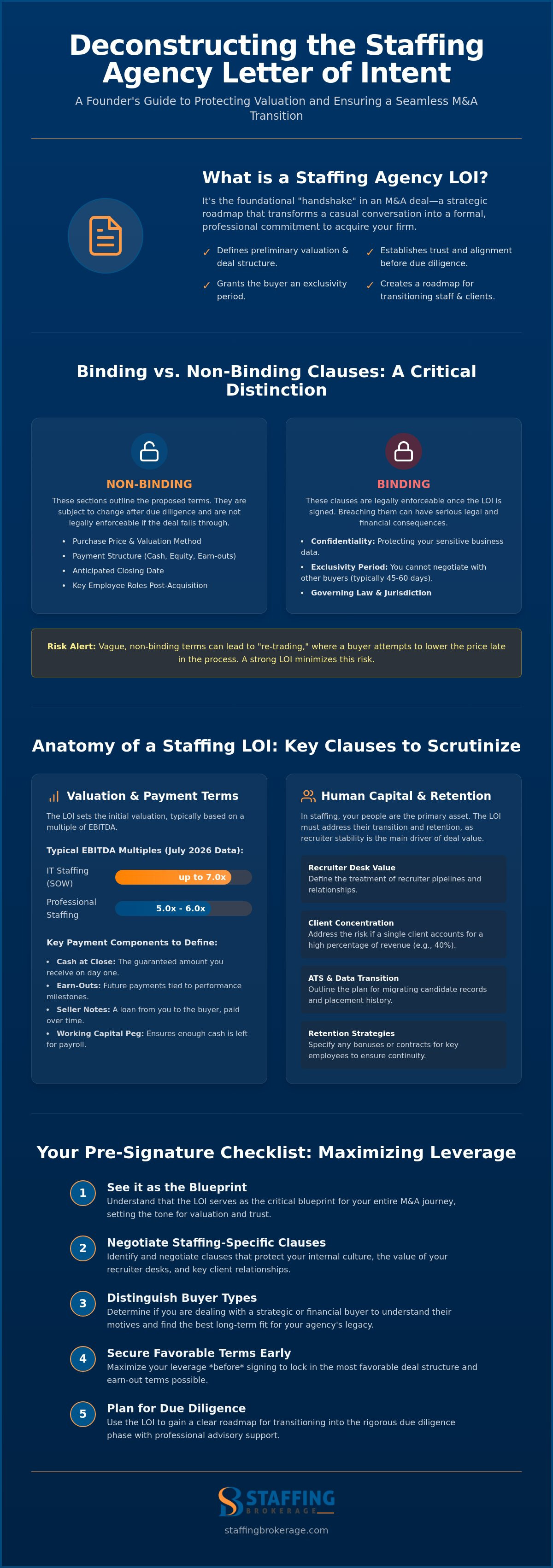
Most sections within a staffing agency letter of intent are non-binding. This means either party can walk away if the details don't align during deeper investigation. However, confidentiality and exclusivity clauses are strictly binding. If the LOI is too vague or poorly structured, you risk "re-trading." This happens when a buyer tries to lower the price late in the process because the initial terms weren't firm enough. An exclusivity period in a national staffing context is a set timeframe, typically between 45 and 60 days, during which the seller agrees not to negotiate with any other potential buyers.
By defining these terms early, you protect your agency's valuation and maintain a steady hand throughout the negotiation. It's about building a partnership based on transparency and mutual success from the very first page.
Essential Industry-Specific Clauses for Staffing LOIs
Unlike a manufacturing plant where value sits in heavy machinery, a staffing firm's value is purely organic. This is why a generic template won't suffice for your exit. When negotiating a business acquisition letter of intent for a staffing agency, you must define the treatment of the "Recruiter Desk." These represent the specific pipelines and deep-seated relationships your internal team manages every day. If one client accounts for 40% of your revenue, the LOI should explicitly state how that concentration affects the deal's risk profile. Buyers also look closely at your Applicant Tracking System (ATS) data. They want to see a clean transition plan for candidate records and placement history, especially if you're using AI-driven sourcing tools that increase your firm's efficiency and market value.
Valuation and Payment Terms
The staffing company valuation metrics included in your LOI typically focus on EBITDA multiples. In July 2026, we see IT staffing firms with SOW capabilities fetching up to 7.0x, while professional staffing firms land between 5.0x and 6.0x. Your LOI should clearly break down "Cash at Close" versus earn-outs and seller notes. A critical but often overlooked clause is the "Working Capital Peg." Because staffing is a high-volume payroll business, the buyer needs to ensure there's enough liquidity to cover the first few weeks of temporary employee paychecks. If you aren't sure where your current numbers sit, getting a professional business valuation and assessment can provide the clarity you need before you sign.
Human Capital and Retention Strategies
Recruiter stability is the primary driver of staffing deal value. If your top billers leave the day after the announcement, the buyer loses the very assets they paid for. To mitigate this risk, sophisticated LOIs often include "Stay Bonuses" or retention pools. These are financial incentives paid to key recruiters who remain with the firm through the integration period. We also focus on defining fair non-compete and non-solicitation parameters. These protect the buyer's investment while ensuring the exiting owner has a clear path forward. Our team works to balance these interests, ensuring the transition feels like a partnership rather than a disruption. By addressing these human elements in the staffing agency letter of intent, you build a foundation of trust that carries through to the final signature.
Strategic vs. Financial Buyers: How Your LOI Will Differ
The identity of the person across the table changes everything about your deal. While a high offer is always welcome, the motivations behind that number dictate the specific terms of your staffing agency letter of intent. In today's market, we primarily see two types of acquirers: strategic buyers looking for synergy and financial buyers, such as private equity firms, looking for a financial return. Choosing between them is a pivotal part of your staffing agency exit strategy. Strategic buyers are often other staffing firms that want to expand into your niche or geography. Because they can eliminate redundant back-office costs, they often offer higher multiples. Conversely, financial buyers often view your agency as a "platform" to build upon, a trend that dominated the first quarter of 2026.
The Strategic Buyer LOI
A strategic buyer's offer usually includes "Synergy Clauses." These outline how your specific vertical, such as IT or healthcare, fits into their existing portfolio. Because they already have a functioning infrastructure, they'll focus heavily on integration timelines. They want to know exactly when your brand will transition and how your recruiters will merge into their corporate culture. In these deals, the owner's post-sale role is often shorter, focused on a smooth handoff rather than long-term management. They value your client list and recruiter talent as immediate "bolt-on" assets to their existing machine, which can lead to a faster transition for you personally.
The Financial Buyer (Private Equity) LOI
Private equity firms operate with a different lens. They aren't looking to absorb your brand; they want to use it as a foundation for growth. This means their staffing agency letter of intent will focus heavily on management retention. They typically require owners to stay for two to three years to maintain stability during their "Platform + Add-on" phase. A unique feature here is the "Second Bite of the Apple," where you roll a portion of your equity into the new entity. If the company grows and sells again, that minority stake could be highly lucrative. However, expect stricter EBITDA-based earn-outs and more rigorous financial reporting. Buyers in 2026 are increasingly scrutinizing the stability of gross margins and the defensibility of normalized earnings through a Quality of Earnings review.
Understanding these distinctions helps you align with a partner who shares your vision for the future. Whether you want a clean break or a chance to grow with a larger partner, the right LOI structure makes that goal possible. We're here to help you weigh these options and find the perfect strategic fit for your agency's legacy.
Negotiating Your Staffing LOI: Protecting Value and Managing Risk
The Golden Rule of M&A negotiation is simple: your leverage is highest the moment before you sign. Once your signature is on the staffing agency letter of intent, you enter an exclusivity period that takes you off the market. This is why it's vital to address the most sensitive terms upfront. Beyond the purchase price, you must protect your internal culture. Any leak regarding a potential sale can create anxiety among your recruiters, leading to a talent exodus before the deal even closes. We recommend including strict confidentiality language that dictates exactly how and when the news will be shared with your team.
Earn-out negotiations are another critical area where value is protected or lost. In the 2026 market, buyers often use earn-outs to manage the risk of fluctuating gross margins. You'll want to ensure these metrics are based on achievable targets that you can influence, such as Net Fee Income or specific EBITDA milestones. During these discussions, watch for red flags buying a staffing agency, such as a buyer who refuses to define the "basket" and "cap" for indemnification claims. These legal protections limit your liability after the sale and are essential for a clean exit.
Setting the Due Diligence Timeline
A 60 to 90 day exclusivity window is standard for national staffing deals, giving the buyer enough time to verify your financials and client contracts. However, you shouldn't give this time away for free. We suggest defining clear milestones within the LOI, such as the completion of the Quality of Earnings report by day 30. This keeps the buyer moving toward a close and prevents the deal from dragging on indefinitely. Maintaining a steady hand during the high-stress LOI phase ensures that temporary emotions don't derail your long-term financial goals.
Closing the Gap on Valuation
If there's a gap between your asking price and the buyer's offer, a sophisticated staffing company deal structure can bridge it. This might involve adjusting the mix of cash at close versus seller notes or rolled equity. Negotiating these details requires a deep understanding of industry standards and a commitment to mutual success. A specialized broker acts as a buffer in these sensitive conversations, allowing you to maintain a positive relationship with your future partner while we handle the heavy lifting of the financial terms. If you're looking for a partner to advocate for your best interests, our staffing company M&A advisory services provide the strategic guidance needed to secure a premium valuation.
From LOI to Close: How Staffing Brokerage Leads the Way
Signing your staffing agency letter of intent is a significant milestone, but it's really the starting gun for the most intensive phase of the deal. The transition from a preliminary agreement to a final closing requires a steady hand and a commitment to the details. This is where professional staffing company M&A advisory becomes your greatest asset. We manage the exhaustive due diligence checklist, ensuring that your client contracts, payroll records, and recruiter agreements are organized and ready for scrutiny. Our role is to protect the integrity of the deal, making sure the final purchase agreement reflects the spirit of the LOI you signed.
We take pride in connecting national buyers with verified staffing agency sellers who are ready for the next chapter. By managing the flow of information, we prevent the "deal fatigue" that often sets in during the 60 to 90 day exclusivity window. Our team stays deeply involved, facilitating conversations between legal and tax professionals to ensure a smooth path to the finish line. We've seen how a collaborative approach leads to better post-close outcomes for both the buyer and the seller.
Preparing Your Agency for the LOI Stage
Success in the M&A market starts long before the first offer arrives. We work with you to clean up financial statements and recruiter contracts, removing any obstacles that could slow down a transaction. Conducting a "Pre-Sale Assessment" allows us to identify potential value-killers early, giving us time to address them before they impact your valuation. Once your agency is ready, we craft a compelling "Teaser" that highlights your firm's unique strengths. This strategy ensures you receive high-quality LOIs from buyers who truly understand the value of your niche and your team.
Your Partner in National Staffing M&A
Our Baltimore-based expertise serves as a hub for clients across the entire United States. We bring a national reach to every engagement, connecting you with qualified buyers from coast to coast. Our commitment to honest, results-driven practice means we prioritize your long-term success over a quick transaction. We act as your mentor and ally, providing the strategic guidance needed to navigate complex business transitions with confidence. If you're ready to take the first step toward a successful sale, Contact Staffing Brokerage to start your strategic exit or acquisition journey today.
Secure Your Legacy with Strategic Clarity
The journey toward a successful exit begins with the clarity and protection found in your staffing agency letter of intent. By prioritizing recruiter retention and a transparent deal structure today, you ensure that your agency's value remains intact through every stage of due diligence. Whether you choose a strategic partner or a financial buyer, the right terms will act as your roadmap to a smooth and rewarding transition. It's about more than just a final number; it's about ensuring your team and your clients are positioned for continued growth.
At Staffing Brokerage, we provide specialized staffing industry M&A advisory and a national reach across the USA to help you navigate these pivotal moments. Our history of proven success in high-value staffing transactions means you don't have to guess about your deal's future. We're here to be your steady hand, ensuring that your hard work translates into the best possible outcome for you and your team. We believe that every business transition should feel like a collaborative victory rather than a stressful transaction.
Your next chapter is a significant milestone, and we're honored to guide you toward a shared sense of accomplishment and long-term value.
Frequently Asked Questions
Is a staffing agency letter of intent legally binding?
Most sections of a staffing agency letter of intent are non-binding; however, clauses regarding confidentiality and exclusivity are strictly enforceable. This structure allows both parties to explore the deal without a legal obligation to close while protecting the buyer’s time and the seller’s sensitive data. If you decide to walk away during due diligence, you can do so without penalty, provided you haven't breached the specific binding terms.
How long does the LOI process typically take in a staffing merger?
Reaching a signed agreement typically takes one to two weeks after the initial offer is presented. This period involves back-and-forth negotiations regarding the purchase price, deal structure, and the working capital peg. We focus on moving this stage along efficiently to maintain momentum while ensuring every detail aligns with your long-term goals and protects your agency's legacy.
Can I negotiate the price after the LOI is signed?
You can technically negotiate the price after signing, but it's generally discouraged unless due diligence uncovers significant undisclosed issues. This practice, known as re-trading, can quickly damage trust between parties. It's much better to secure your valuation upfront when your leverage is highest, using the LOI as a firm foundation for the final purchase agreement.
What is a typical earn-out period for a staffing agency sale in 2026?
In 2026, the typical earn-out period for a staffing agency ranges from one to three years. These performance-based payments are often tied to specific EBITDA or gross margin targets. This structure helps bridge valuation gaps and ensures the seller remains motivated to support a smooth transition of client relationships and recruiter talent during the integration phase.
Why do most staffing LOIs include an exclusivity period?
Most LOIs include an exclusivity period to protect the buyer’s investment of time and resources during the due diligence phase. In 2026, a 60-day window is the standard for private M&A deals in the staffing sector. This "no-shop" clause prevents the seller from negotiating with other parties, giving the buyer the confidence to perform a deep dive into your agency’s financials.
Should I tell my recruiters about the LOI as soon as it is signed?
You should generally wait until the deal is nearly certain before informing your recruiters. Confidentiality is paramount during the LOI stage because early leaks can lead to internal anxiety and talent turnover. We advise our clients to keep the circle of knowledge limited to key leadership until the due diligence process is substantially complete and the closing is in sight.
What is the difference between an LOI and a Memorandum of Understanding (MOU)?
An LOI and a Memorandum of Understanding (MOU) serve similar purposes, but a staffing agency letter of intent is the standard document used in professional business acquisitions. While both outline preliminary agreements, an LOI typically includes the specific financial deal structure and binding exclusivity terms required for M&A. In our industry, the LOI is the more formal precursor to the definitive purchase agreement.
How does client concentration affect the terms of an LOI?
High client concentration often leads to stricter terms, such as a lower upfront payment or a larger earn-out portion. If a single client represents more than 15% of your revenue, buyers see increased risk. We help you structure the deal to mitigate this concern, often by highlighting the longevity and stability of those key accounts to maintain your overall valuation and secure a fair deal.


