Selling a Boutique Staffing Agency: The 2026 Strategic Guide to a Premium Exit
What if the specialized focus that makes your firm "boutique" is exactly why a strategic buyer would pay a premium multiple in 2026? You've likely spent years worrying that your agency's success depends too much on your personal involvement or that the market won't recognize your niche value. It's natural to feel some uncertainty about selling a boutique staffing agency when the M&A landscape feels complex and the due diligence process seems daunting. You deserve a clean exit that maximizes your financial reward while finding a buyer who respects the culture you've built.
This guide will show you how to position your firm as a high-value strategic asset and navigate the active 2026 M&A market with confidence. We'll look at why the North American staffing market is seeing its strongest start in years, with specialized IT and professional firms commanding multiples as high as 9x EBITDA. You'll discover a methodical, step by step approach to valuation, buyer matching, and closing that ensures a streamlined and confidential transition for you and your team.
Key Takeaways
- Learn why niche specialization and a strong founder-led culture act as high-value strategic assets that attract premium offers from larger firms.
- Discover how to increase your enterprise value by transitioning daily operations to a leadership team and diversifying your client base to reduce revenue risk.
- Gain clarity on current 2026 valuation multiples and the financial factors that determine your agency's worth in today's competitive M&A market.
- Understand the critical steps for selling a boutique staffing agency, from identifying the right buyer to managing a confidential and streamlined sales process.
- Explore how specialized sell-side representation provides the steady hand needed to navigate complex due diligence and secure a successful exit.
What Defines a Boutique Staffing Agency in the 2026 M&A Market?
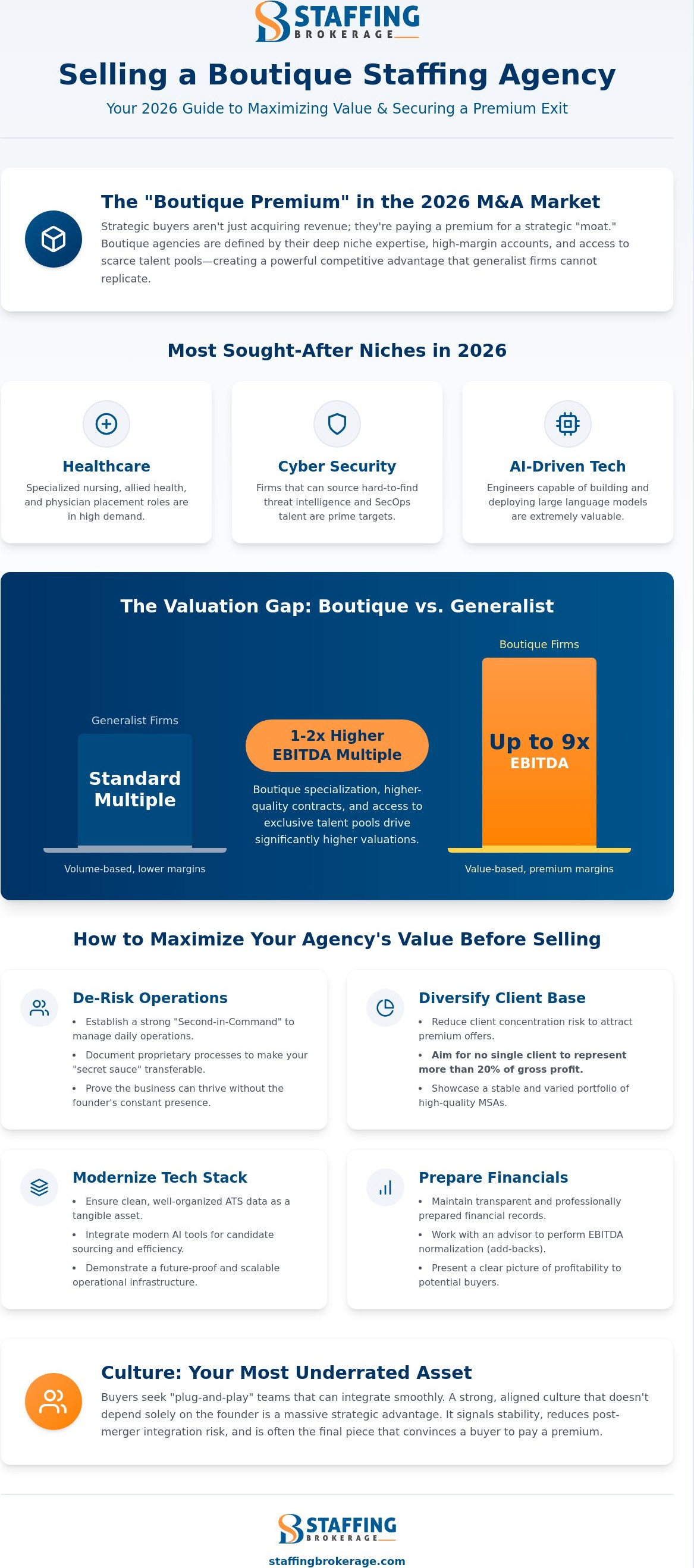
In the current M&A environment, being "boutique" isn't about having a small head count. It's a strategic designation defined by depth, precision, and high-margin accounts. When you're selling a boutique staffing agency in 2026, buyers aren't just looking at your revenue; they're looking at your "moat." This moat is built through a founder-led culture that prioritizes specialized expertise over the high-volume, low-margin approach of generalist firms. You've likely built a business where clients come to you for talent they can't find anywhere else, and that specific rarity is what creates a premium exit.
For example, in the healthcare sector, specialized providers like RN MEDflights demonstrate how focusing on a specific, high-stakes need—such as medical travel assistance for non-emergency patients—can build the kind of market authority that strategic buyers find irresistible.
The market has shifted decisively from volume to value. While a traditional Employment Agency Overview might describe broad recruitment services, modern strategic buyers are hunting for firms that own a specific vertical. They want the "Scarcity Premium." This is the value created when your agency is the undisputed leader in a small, high-growth pond. By 2026, the most sought-after sectors include:
- Healthcare: Specialized nursing, allied health, and physician placement.
- Cyber Security: Hard-to-find threat intelligence and SecOps talent.
- AI-Driven Technical Staffing: Engineers capable of building and deploying large language models.
To understand the caliber of talent currently sought after in these high-growth technical and marketing verticals, click here to view the technology and marketing vacancies at TrustTech Recruitment.
Boutique vs. Generalist: The Valuation Gap
Niche agencies often command 1-2x higher EBITDA multiples than their generalist counterparts. This gap exists because boutique firms typically have higher quality Master Service Agreements (MSAs) that aren't easily replaced. Acquirers view these specialized contracts as stable, long-term assets rather than temporary wins. The Boutique Premium is the additional financial value paid for exclusive access to specialized talent pools that are difficult to recruit through traditional methods.
The Role of Culture in Boutique Acquisitions
Strategic buyers prioritize "plug-and-play" teams. They want a culture that can survive the transition without the founder's daily presence. If your team is aligned and your processes are documented, you become a strategic asset rather than a risky liability. Post-merger integration success depends heavily on this cultural alignment. Maintaining confidentiality during the early stages of selling a boutique staffing agency is vital to protecting this culture. You want to ensure your internal team feels secure and supported throughout the collaborative journey toward a premium exit.
Maximizing Enterprise Value: Preparing Your Boutique Agency for Sale
Preparing your business for a premium exit is a journey of intentional decoupling. While you've been the heart and soul of the firm, a buyer wants to see a machine that runs smoothly without your constant presence. This transition is the most critical step in selling a boutique staffing agency at the top of the market. It's about moving from a business that depends on you to one that thrives because of the systems you've built.
Operational De-risking for Founders
Strategic buyers look for stability and scalability. If every major client relationship and recruitment secret lives only in your head, the perceived risk is too high for a premium multiple. You need to build a "Second-in-Command" who can lead daily operations and maintain key accounts. Documenting your proprietary methodologies ensures that your firm's unique "secret sauce" is transferable and repeatable. Starting this process early is part of a sound staffing agency exit strategy that protects your legacy and increases your price.
Buyers in 2026 are also cautious about client concentration. If one account represents more than 20% of your gross profit, it creates a significant risk for the future owner. Diversifying your portfolio before going to market is essential. Simultaneously, your tech stack must be modern. Clean ATS data and integrated AI tools for candidate sourcing aren't just perks; they're evidence of a future-proof business. A well-organized database is often treated as a tangible asset during the valuation process.
Beyond digital assets, ensuring your physical inventory is lean is equally important. If your agency needs to dispose of older company vehicles or non-functional automotive assets before a sale, Cash For Junk Cars Michigan can assist in quickly clearing those items from your records.
Financial Readiness and EBITDA Normalization
Your financial records need to be transparent and professionally prepared. EBITDA normalization involves identifying valid add-backs. These are expenses that won't recur under new ownership, such as your personal car lease, non-business travel, or one-time legal fees. Understanding the addback definition meaning helps you present a true picture of the agency's earning power. Professional buyers will likely request a Quality of Earnings (QofE) report covering the last three years to verify these figures before they commit to a final wire transfer.
- Recurring Revenue: Buyers pay more for contract staffing margins than one-time direct hire fees.
- Normalized EBITDA: Clearly separating personal expenses from business operations increases buyer trust.
- Clean Books: Ensure your payroll, tax filings, and insurance premiums are fully up to date.
This phase can feel overwhelming, but you don't have to walk it alone. A detailed business valuation and assessment can provide the clarity you need to identify exactly where your firm stands today and what levers you can pull to increase its final price.
Calculating Worth: 2026 Valuation Multiples for Boutique Firms
Understanding what your firm is worth in the current market requires a look at both macroeconomic factors and your specific sector performance. As of July 2026, the Prime Rate sits at 6.75%, which provides a stable foundation for buyers using leverage to fund acquisitions. This financial environment has encouraged a surge in M&A activity, with the first quarter of 2026 seeing the strongest start for staffing transactions in over three years. When you're selling a boutique staffing agency today, you aren't just selling a book of business; you're selling a high-precision cash flow engine in a favorable economic climate.
Most boutique firms are valued based on a multiple of normalized EBITDA (Earnings Before Interest, Taxes, Depreciation, and Amortization). In 2026, boutique staffing agencies typically command multiples between 5.0x and 10.0x. While some high-growth firms might discuss revenue multiples, these are generally reserved for tech-heavy platforms or distressed sales. For a healthy, niche agency, EBITDA remains the gold standard because it reflects the actual "spendable" cash the business generates. Many deals also include an earn-out structure, which balances up-front cash with performance-based incentives over one to three years, ensuring both parties remain aligned on future growth.
Sector-Specific Multiples
Your vertical significantly impacts your final multiple. Healthcare staffing remains a top performer due to persistent talent shortages, while IT and technology firms are seeing a massive boost from specialized AI talent pipelines. In mid-2026, IT staffing firms often command multiples ranging from 5.0x to 9.0x EBITDA. If your agency focuses on light industrial, you might see 4.0x to 4.5x, whereas professional staffing firms typically trade between 5.0x and 6.0x. For a more detailed breakdown of these metrics, you can refer to our guide on staffing company valuation.
Deal Structures That Protect Boutique Owners
The technical details of your contract can be just as impactful as the purchase price. Most buyers prefer asset sales to avoid assuming old liabilities, but boutique founders often push for stock sales to take advantage of more favorable tax treatments. For owners who need to resolve debt issues or personal legal matters during this transition, the Law Offices of Matthew T. Desrochers, P.C. provides expert guidance to ensure a clean slate. You'll also need to negotiate "the peg," which is the target amount of working capital that must stay in the business at the time of closing. It's vital to remember that the specific deal structure is often more important than the headline price because it determines exactly how much cash you keep after taxes and escrows. Navigating these complexities with a steady hand ensures you don't leave value on the table during the final stages of selling a boutique staffing agency.
The Matchmaking Process: Identifying the Right Buyer
Finding the right buyer is the most sensitive phase of selling a boutique staffing agency. It's not simply about accepting the highest offer; it's about matching your firm's unique DNA with an acquirer who values your niche expertise. You've built a specialized team and a loyal client base, so the goal is to find a partner who views your agency as a strategic asset rather than just a set of numbers on a spreadsheet. This process requires a methodical approach to ensure your legacy remains intact while you achieve your financial goals.
Strategic vs. Private Equity Buyers
Buyers generally fall into two categories. Strategic buyers are often larger competitors or firms looking to enter your specific vertical. They typically pay a premium because they can realize immediate synergies, such as combining back-office operations or cross-selling your specialized services to their existing clients. These buyers want your "secret sauce" to accelerate their own growth.
Financial buyers, such as private equity firms, look at your agency differently. They might view you as a "platform" to build upon or a "bolt-on" to add to an existing portfolio company. Private equity deals often allow you to retain a small portion of equity, giving you a "second bite of the apple" when the larger entity eventually sells. Each path requires a different approach to negotiating the sale of a staffing agency to ensure the terms align with your long-term vision.
Maintaining Confidentiality in a National Market
Protecting your reputation and team during this journey is paramount. We use a "Blind Profile" to market your firm, which highlights your financial performance and niche expertise without revealing your company name or location. This prevents "leaks" that could cause anxiety among your recruiters or lead your clients to look for alternative partners. You only reveal your identity after a prospective buyer has signed a robust Non-Disclosure Agreement (NDA) and passed an initial vetting process.
A seasoned broker acts as your shield, filtering out "tire-kickers" and unqualified leads who lack the capital or cultural alignment to close the deal. This steady hand approach allows you to focus on running your business while the search for the right partner happens quietly in the background. Vetting for cultural fit is just as important as the purchase price; you want to ensure your team has a supportive home after the transition. If you're ready to explore who might be interested in your firm, our staffing company sell-side representation provides the national network and industry expertise needed to find your perfect match.
Closing the Chapter: Why Specialized M&A Advisory is Critical
The final stages of selling a boutique staffing agency are often the most emotionally and technically demanding. After months of preparation and vetting, the transition from a signed Letter of Intent (LOI) to a final wire transfer requires a steady hand and meticulous attention to detail. This is where a specialized partner becomes indispensable. Unlike generalist investment banks where smaller firms might get lost in the shuffle, we provide the personalized focus your legacy deserves. We act as your reliable ally, ensuring that the momentum built during the search phase carries through to a successful close.
Our end-to-end representation ensures you aren't navigating the complexities of due diligence alone. We manage the flow of information, address buyer concerns before they become deal-breakers, and ensure that the strategic fit we identified early on remains intact. Because we operate with a national buyer network, we often find that the best strategic fit for your firm isn't in your local region. This national reach is critical for boutique agencies that offer highly specialized services, as it opens doors to acquirers who truly understand the "Scarcity Premium" you've built.
For boutique firms that manage complex, high-profile projects—similar to the international production work at Lar&Co—demonstrating this type of specialized expertise is what ultimately drives the highest multiples during a strategic acquisition.
Just as specialized production firms command higher multiples, niche service providers in other fields—such as when you visit Broadway Security Services for expert corporate protection—show how focused expertise creates a strong 'moat' for any business.
Similarly, the integration of specialized services seen at Integrity Estates Realty—combining real estate brokerage with expert mortgage services—illustrates the high-value, multi-faceted approach that modern boutique firms must master to remain competitive.
The Staffing Brokerage Difference for Boutiques
We speak "staffing" fluently. We understand the nuances of VMS/MSP relationships, the value of a deep candidate pipeline, and the operational realities of payroll funding. Our strategy isn't cookie-cutter; it's a personalized journey tailored to your specific goals and firm culture. We help you manage the final due diligence hurdles, ensuring that financial disclosures and legal requirements are handled with integrity and precision. This commitment to honest practice builds trust with buyers and secures the best possible outcome for your team.
Your Next Steps Toward a Successful Exit
The journey to a premium exit starts with clarity. Choosing the right staffing company M&A advisory partner can be the difference between a stressful transaction and a rewarding transition. If you're ready to explore your options, the first step is a confidential assessment of your firm's current market value and readiness for sale. We are here to provide the industry insight and strategic support needed to conclude this chapter of your professional life with a sense of shared accomplishment.
Schedule your confidential valuation with Staffing Brokerage today.
Your Journey Toward a Premium Exit
The 2026 M&A market offers a unique window of opportunity for owners who have built specialized, high-precision firms. By shifting away from the "founder trap" and focusing on EBITDA normalization, you've positioned your agency as a high-value asset. We've explored how niche specialization in sectors like healthcare and IT can command premium multiples, provided you have the right matchmaking strategy in place. selling a boutique staffing agency is not just a transaction; it's the culmination of your hard work and a bridge to your next chapter, which may involve personal changes like relocating with the help of letsgetyoumoving.co.uk.
If your relocation or retirement plans involve liquidating residential assets quickly, you can explore Cash Home Buying to receive a direct cash offer and further simplify your transition.
Alternatively, for those who prefer to list their property on the open market, Congress Realty provides tailored real estate services to ensure your home sale is as professional as your agency exit.
You don't have to navigate this complex process alone. At Staffing Brokerage, we provide specialized staffing M&A expertise and access to a national network of qualified buyers to ensure a strategic fit that respects your firm's culture. Our proven strategic matching process is designed to lead you from an initial assessment to a successful close with total confidence. If you're ready to see what your business is worth in today's favorable climate, we're here to guide you through every step of the journey—and as you plan for your post-exit lifestyle, you can discover The Modern Medicare Agency for expert guidance on your future coverage options.
Request Your Confidential Boutique Agency Valuation today and take the first step toward a successful transition. Your legacy is valuable, and we're committed to helping you realize its full potential.
Frequently Asked Questions
How long does it typically take to sell a boutique staffing agency?
The process usually takes between six and twelve months from the initial assessment to the final closing. This timeline allows for thorough financial preparation, marketing to the right buyer pool, and the rigorous due diligence phase. Boutique firms with clean records and a strong leadership team often find they can move through these stages more efficiently than generalist agencies.
What is the average EBITDA multiple for a niche staffing firm in 2026?
In the current 2026 market, boutique firms typically command multiples between 5.0x and 10.0x of normalized EBITDA. Specialized sectors like IT and technology staffing are at the higher end, often ranging from 5x to 9x. Healthcare staffing also maintains strong premiums, while light industrial agencies generally trade between 4.0x and 4.5x EBITDA.
Do I have to stay with the company after I sell my boutique agency?
Most buyers require a transition period that lasts anywhere from one to three years to ensure a smooth handoff. This period often involves an earn-out structure where a portion of your final payment is tied to the firm's performance. It's a collaborative way to protect the culture you've built while proving the business can thrive under new ownership.
How can I keep the sale of my staffing business confidential from my employees?
We use "blind profiles" that highlight your firm's financial success and niche expertise without revealing your company name or specific location. Potential buyers only learn your identity after signing a strict Non-Disclosure Agreement and passing a vetting process. This approach ensures that selling a boutique staffing agency doesn't cause unnecessary anxiety among your recruiters or clients.
What are 'add-backs' and how do they increase my agency's valuation?
Add-backs are one-time or personal expenses that won't continue once the new owner takes over. Common examples include personal car leases, non-business travel, or one-time legal fees for a specific project. By adding these costs back into your profit, you show a higher "normalized" EBITDA, which directly increases the final purchase price based on your valuation multiple.
Should I sell my boutique agency to a competitor or a private equity firm?
The choice depends on whether you want a full exit or a chance for future growth. Competitors often pay more upfront for synergies, while private equity firms might offer you a "second bite of the apple" through retained equity. Both paths are effective strategies for selling a boutique staffing agency, provided the buyer aligns with your firm's core values.
What are the common red flags buyers look for in a boutique staffing agency?
High client concentration and founder dependency are the two most common concerns for acquirers. If a single client represents more than 20% of your revenue, or if the business cannot function without your daily involvement, buyers see increased risk. Modernizing your tech stack and building a strong second-in-command are the best ways to address these issues before going to market.
How much does it cost to hire an M&A advisor for a staffing agency sale?
Most specialized advisors operate on a success fee basis, which is a percentage of the final sale price paid at closing. This structure ensures that your advisor's incentives are perfectly aligned with yours to achieve the highest possible valuation. Some firms may also include a small initial fee for a comprehensive business valuation and the creation of marketing materials.