
Selling an Engineering Staffing Firm: A Strategic 2026 Guide to Maximizing Value
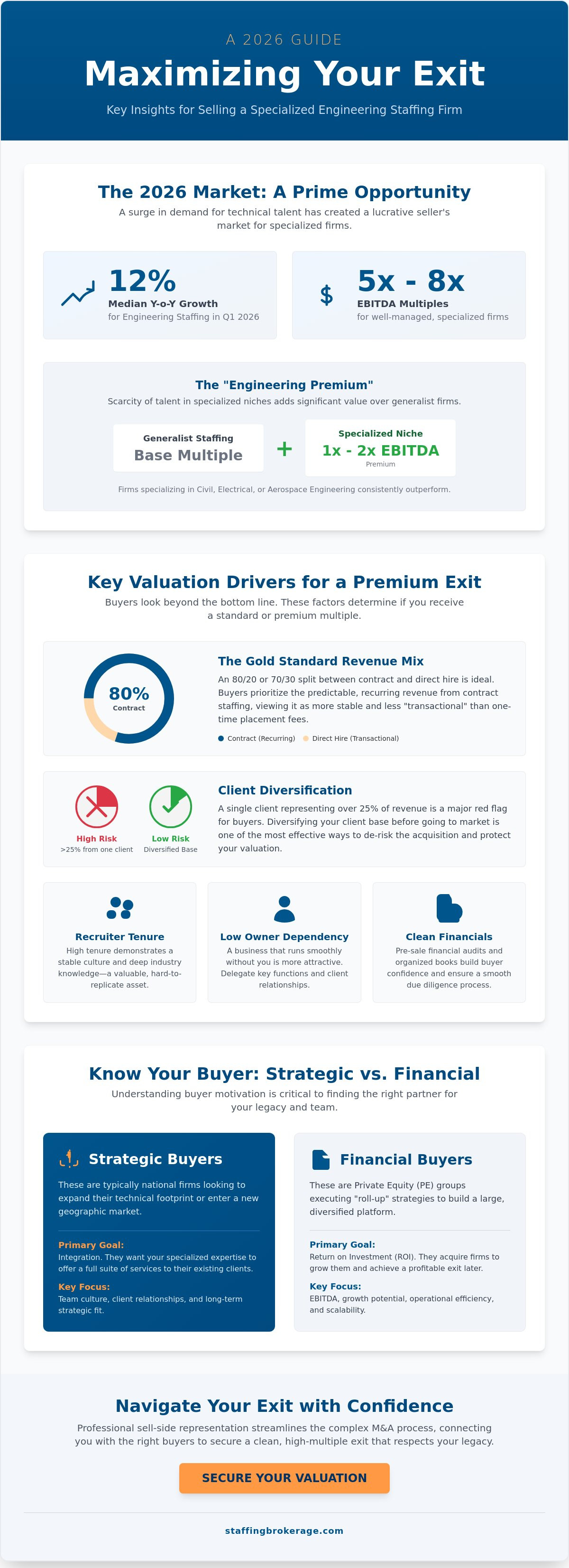
Did you know that engineering staffing firms saw a median year-over-year growth of 12% in the first quarter of 2026? This surge in demand has created a unique window for owners, as well-managed firms are currently commanding multiples between 5x and 8x EBITDA. You've likely spent years building your specialized candidate database and internal team, so it's understandable if the prospect of selling an engineering staffing firm feels both exciting and overwhelming. You might worry about customer concentration devaluing your hard work or wonder how the agency will function without you as the lead rainmaker.
We understand these concerns because we've walked this path with many founders. This guide will show you exactly how to position your agency for a high-multiple exit by aligning with what 2026 buyers actually want. You'll discover how to navigate the due diligence process with confidence and find a strategic partner who respects your legacy. We'll walk through current market drivers, valuation secrets, and the specific steps required to maximize your firm's value before you head to the closing table.
Key Takeaways
- Understand why 2026 is a prime seller's market and how to capitalize on the high EBITDA multiples currently offered for specialized technical niches.
- Learn how to optimize your revenue mix, aiming for the "gold standard" contract-to-direct-hire ratio that maximizes buyer interest and recurring value.
- Discover the specific preparation steps for selling an engineering staffing firm, including reducing owner dependency and conducting thorough pre-sale financial audits.
- Identify the critical differences between strategic and financial buyers to ensure you find a partner who aligns with your team's culture and your long-term legacy.
- Explore how professional sell-side representation streamlines the complex due diligence process to secure a clean, high-multiple exit with confidence.
The 2026 Market for Selling an Engineering Staffing Firm
The M&A market for technical talent is currently experiencing a significant surge. While the broader industry faced headwinds recently, the engineering staffing segment grew by 1% in 2025. By the first quarter of 2026, that growth accelerated to a median of 12% year-over-year. This momentum makes selling an engineering staffing firm a highly lucrative prospect for owners looking to transition. Buyers aren't just looking for revenue. They're hunting for specialized expertise that is difficult to build from scratch.
Firms specializing in Civil, Electrical, or Aerospace engineering are consistently outperforming generalist agencies. These technical niches provide a level of stability and high margin that general labor or clerical sectors simply can't match. We've seen a clear shift where buyers prioritize agencies that act as a strategic partner rather than a simple vendor. This means having deep integrations into a client's project lifecycle or managing complex "hard-to-fill" talent pipelines that require specialized certifications. There is also a significant overlap with IT staffing, as the convergence of hardware and software increases the demand for embedded systems engineers. This synergy often drives valuation multiples even higher for firms that can bridge the gap between traditional engineering and modern tech.
Why Engineering Staffing is a "Premium" Vertical
The scarcity of qualified engineers is a massive intangible asset. In 2026, finding a senior electrical engineer or a licensed civil engineer is a major hurdle for most corporations. Your specialized candidate database isn't just a list; it's a proprietary barrier to entry that competitors can't easily replicate. This scarcity creates what we call the "Engineering Premium," which typically results in a 1x to 2x EBITDA multiple bump over a generalist temporary staffing firm.
Current Buyer Profiles in the USA
Today's buyers fall into two primary camps. National strategic buyers are aggressively expanding their technical footprints to offer a full suite of services to Fortune 500 clients. Meanwhile, Private Equity groups are executing "roll-up" strategies, acquiring smaller niche firms to build a massive, diversified platform. Understanding these profiles is essential when conducting a staffing company valuation, as different buyers will value your specific client mix and geographic reach in different ways. Both groups are currently well-capitalized and looking for well-run firms with clean financials and low owner dependency.
Key Valuation Drivers Specific to Engineering Staffing
When you're preparing for the process of selling an engineering staffing firm, understanding exactly what drives the final price is vital. Buyers in 2026 aren't just looking at your bottom line. They're looking at the quality, sustainability, and risk profile of your profit. While revenue growth is excellent, the composition of that revenue often dictates whether you receive a standard multiple or a premium one.
The gold standard for engineering firms is a 70/30 or 80/20 split between contract and direct hire revenue. Contract staffing provides the recurring revenue that buyers crave. It offers a predictable stream of income that makes your firm far more attractive than one reliant on one-time placement fees. If your firm is too heavily weighted toward direct hire, buyers may view your income as "transactional" rather than "structural," which can lower your valuation multiple.
Customer concentration is another critical factor. If a single anchor client, such as a major aerospace firm or a national utility provider, represents more than 25% of your total revenue, it creates a perceived risk. Buyers worry that if that one relationship ends, the business's value will plummet. Diversifying your client base before you go to market is one of the best ways to protect your valuation. Additionally, we look at your VMS and MSP penetration. While high-volume Vendor Management Systems can drive top-line growth, they often come with lower margins. A healthy mix of high-margin direct clients and steady VMS volume is usually the best way to maximize your EBITDA multiple.
Your internal team also plays a massive role in the final price. Technical recruiters who speak the language of civil, mechanical, or electrical engineering are incredibly difficult to replace. High recruiter tenure suggests a stable culture and deep industry knowledge, which adds significant confidence for a buyer during Navigating the Sale.
The "Sticky" Revenue Model: Contract Staffing
Contract revenue is considered "sticky" because engineering projects often span two to five years. This gives buyers incredible visibility into future earnings. When you're cleaning up your books, look for "Add-backs" to normalize your EBITDA. These might include one-time engineering software licenses, specialized recruitment tools, or owner-related expenses that a new parent company won't incur. If you're curious about how your current mix impacts your worth, a professional business valuation and assessment can provide the clarity you need to move forward.
Database Quality and AI Readiness
In 2026, your data is your currency. A proprietary Applicant Tracking System (ATS) filled with "clean" data is a requirement for modern due diligence. Buyers want to see AI-enabled candidate matching that proves your operational efficiency and helps you find "hard-to-fill" talent faster than the competition. If your database is disorganized or outdated, it suggests your firm is harder to scale. Clean, segmented, and AI-ready data proves that your agency is built for the future of technical staffing.
Preparing Your Engineering Firm for a Strategic Exit
Preparation is the bridge between running a successful business and achieving a successful exit. When you begin the journey of selling an engineering staffing firm, you're essentially preparing your house for a high-stakes inspection. You want every system to work perfectly and every potential risk to be mitigated before a buyer ever looks at your books. Buyers in 2026 aren't just paying for your past profits; they're paying for a future they can predict with confidence.
To secure a high-multiple exit, we recommend following these five essential steps:
- Conduct a pre-sale financial audit. Identify and fix "leaks" in your gross margin. This includes auditing worker classifications against the latest 2026 "economic reality" tests to ensure your firm is compliant and free of hidden liabilities.
- Build a management layer. Transition day-to-day operations to a capable team. If the business can't function for a month without your direct input, it's not yet ready for a premium sale.
- Diversify your client base. Actively work to reduce reliance on any single "Anchor Client." Aim for a healthy mix where no single contract represents more than 25% of your total revenue.
- Formalize VMS and MSP agreements. Ensure all high-volume contracts are documented and, most importantly, transferable to a new owner.
- Partner with an expert. Engaging an M&A advisor staffing industry specialist ensures you have a guide who understands the technical nuances of engineering placements.
Reducing Owner Dependency
The #1 reason engineering firms fail to sell is that the owner remains the primary rainmaker. If you hold all the client relationships and technical knowledge, a buyer sees a "key person" risk. You can solve this by transitioning key accounts to a dedicated Account Management team. Document your internal processes so the business runs like a machine. When your team uses AI-enabled workflows for candidate matching without your intervention, it proves the business is a self-sustaining asset. Reviewing an SBA guide to selling a business early in the process can help you understand the structural changes required for a clean handover.
Maximizing Exit Value Through Timing
Timing is everything in the 2026 market. With engineering sectors like civil and electrical engineering benefiting from large-scale infrastructure funding, you want to sell while the wind is at your back. Selling during a growth phase is always more profitable than waiting for a plateau. Buyers pay a premium for momentum. You can use a staffing agency exit strategy to identify the right market triggers for your specific niche, ensuring you exit at the peak of the cycle.
Strategic Buyers vs. Financial Buyers: Choosing the Right Fit
Once your firm is prepared for the market, the next critical step is identifying the right type of buyer. This choice will significantly impact your post-sale role, the future of your employees, and the ultimate legacy of your agency. In the 2026 market, buyers generally fall into two distinct categories: strategic and financial. Each brings a different philosophy to the negotiation table, and your choice depends on whether you want a complete exit or a chance to grow with a larger partner.
Strategic buyers are usually competitors or larger staffing firms looking to expand their technical footprint. They value your specific engineering niche because it fills a gap in their service offerings or geographic reach. Because these buyers can combine back-office functions and reduce redundant overhead, they often pay a higher multiple. However, the integration risks are higher. Financial buyers, primarily Private Equity (PE) firms, are incredibly active right now. Deal volume in the staffing M&A market is up 20% to 30% in 2026 compared to 2024. These buyers look for "platforms" to build upon or "add-on" acquisitions to strengthen their existing portfolio companies. They often prefer that the current management stays involved to ensure stability and continued growth.
Understanding the structure of these offers is just as important as the headline price. You'll likely encounter terms like rolled equity, where you retain a small ownership stake in the new entity, or net working capital adjustments. The "peg" for working capital ensures the business has enough liquidity to operate on day one. Negotiating this correctly is a vital part of selling an engineering staffing firm, as it prevents unexpected price drops at the closing table.
The Pros and Cons of Strategic Acquisitions
A strategic sale can be highly beneficial due to synergy benefits. By merging your specialized engineering recruitment with a larger firm's infrastructure, the combined EBITDA often increases immediately. The primary challenge lies in cultural fit. Your recruiters are your most valuable asset, and they may resist moving from a boutique environment to a larger corporate structure. You can explore the current landscape of active buyers in our employment agencies sale roundup to see which firms are currently in an aggressive acquisition phase.
Understanding the Earn-out in Engineering Sales
In many engineering deals, you'll see a performance-based component called an earn-out. This typically lasts one to three years and acts as a bridge for valuation gaps between the buyer and seller. It allows you to prove the value of recent growth or upcoming contracts. To protect your interests, it's essential to negotiate "floor" protections that guarantee a portion of the payout regardless of minor market fluctuations. If you're ready to compare different offer structures, our team provides dedicated staffing company sell-side representation to help you choose the best fit for your future.
Navigating the Sale with Staffing Brokerage
Choosing the right partner for selling an engineering staffing firm is the most important decision you'll make after deciding to exit. At Staffing Brokerage, we provide end-to-end sell-side representation designed to take the weight off your shoulders. We don't just list businesses. We guide you through a collaborative journey that begins with a deep dive into your technical niche and ends with a sense of shared accomplishment at the closing table. Our team acts as both a strategic advisor and a hands-on guide, ensuring every detail of your transition is handled with precision.
Our process focuses on identifying "Qualified Buyers" who truly understand the technical staffing landscape. In the engineering world, a buyer needs to appreciate the value of your specialized candidate database and the long-term stability of your contracts. We use a "Steady Hand" approach, prioritizing ethical conduct and thoughtful strategy over aggressive, high-pressure tactics. By maintaining strict confidentiality, we protect your recruiter and client base throughout the entire process. You don't want your top talent hearing about a sale through the grapevine, so we manage the flow of information with extreme care to maintain your firm's stability.
Our National Reach for Engineering Firms
While some brokers focus only on local markets, our reach extends across the entire United States. We connect sellers with a broad network of strategic and financial buyers looking for specific technical footprints. Our priority is always "Strategic Fit" rather than just transaction volume. We want to ensure that the buyer who takes over your agency is the right steward for your legacy. This national perspective is strengthened by our partnership with the SI Staffing network, which gives us unparalleled access to active buyers who are ready to move quickly on high-quality engineering assets.
Getting Started with a Confidential Assessment
Your journey begins with a private consultation where we listen to your personal and professional goals. We don't believe in one-size-fits-all solutions. Our team performs a comprehensive business valuation and assessment to determine your exact market positioning. We'll look at your EBITDA, your contract mix, and your management structure to build a narrative that resonates with premium buyers. This methodical pacing ensures you feel informed and confident at every step. If you're ready to explore your options, you can schedule a confidential valuation of your engineering staffing firm today.
Securing Your Legacy in the 2026 Market
The current landscape offers a rare opportunity for agency owners. With high EBITDA multiples and a surge in private equity interest, the rewards for your years of hard work are within reach. Success depends on more than just high revenue; it requires a clean operational structure, a diversified client base, and a "sticky" contract revenue model. By focusing on these valuation drivers now, you ensure that your firm stands out as a premium asset when you decide the time is right.
The process of selling an engineering staffing firm is a significant milestone that deserves a dedicated partner. At Staffing Brokerage, we bring specialized M&A expertise in technical staffing and a national reach across the United States to every engagement. Our proven track record of strategic deal closures means you don't have to navigate this complex journey alone. We're here to provide the steady hand and professional guidance needed to maximize your firm's value and find the perfect strategic fit for your team.
Your next chapter starts with a clear understanding of what you've built. Get a Professional Valuation for Your Engineering Staffing Firm to begin your journey toward a successful exit. We look forward to helping you achieve the clean, high-value transition you've earned.
Frequently Asked Questions
How much is my engineering staffing firm worth?
The value of your firm is primarily determined by a multiple of your Adjusted EBITDA, but qualitative factors like your revenue mix and client diversity play a massive role. Buyers in 2026 look for high-margin contract revenue and a specialized candidate database that is difficult to replicate. A professional assessment will look beyond the balance sheet to evaluate your internal team's strength and your agency's reputation in technical niches.
How long does the process of selling a staffing firm take?
A typical sale takes anywhere from six to twelve months from the initial valuation to the final closing. This timeline includes several months of preparation to clean up financials, followed by a marketing phase, due diligence, and legal negotiations. Starting your preparation early is the best way to ensure a smooth transition and avoid delays during the sensitive due diligence period.
What is a typical EBITDA multiple for an engineering staffing agency in 2026?
In the current 2026 market, well-managed engineering firms are selling for 5x to 8x EBITDA. Firms that rely heavily on the owner for sales or delivery typically see lower multiples, often in the range of 3x to 4.5x EBITDA. Niche specializations in high-demand sectors like aerospace or electrical engineering often command the higher end of these valuation ranges.
Can I sell my staffing agency if I have high customer concentration?
Yes, you can still sell, but high concentration usually shifts the deal structure toward a larger earn-out or a lower upfront cash payment. Buyers view a single client representing over 25% of revenue as a significant risk. We often help owners mitigate this by highlighting the longevity of the contract and the depth of the integration with that specific client's engineering projects.
Do I need to stay on after the sale of my engineering firm?
Most buyers expect the founder to remain involved for a transition period of one to three years, especially if there is an earn-out component. Strategic buyers may want you to help integrate the teams, while private equity firms might ask you to stay as a consultant or minority partner. If your goal is a clean break, building a strong management layer before the sale is essential.
What are the most common red flags buyers look for in engineering firms?
Buyers are currently hyper-focused on worker classification and compliance with the 2026 "economic reality" tests for independent contractors. Other red flags include declining gross margins, high internal staff turnover, and poorly documented recruitment processes. Identifying these issues during a pre-sale audit allows you to fix them before they devalue your firm during the negotiation phase.
Should I use a business broker or an M&A advisor to sell my firm?
When you are selling an engineering staffing firm, an M&A advisor with specialized staffing expertise is usually the better choice over a generalist business broker. Engineering firms are complex assets that require a deep understanding of technical VMS environments and contract staffing margins. An advisor who knows the industry can better articulate your firm's value to strategic buyers and private equity groups.
How is net working capital handled in a staffing agency sale?
Net working capital is typically handled using a "peg," which is the average amount of capital needed to run the business over the last twelve months. Most staffing deals are "cash-free and debt-free," meaning you keep the cash on hand but pay off all debts. The buyer expects a certain level of accounts receivable and prepaid expenses to be left in the business to ensure operations continue without a hitch on day one.


