
The Rise of Private Equity Staffing Acquisitions: 2026 Market Trends and Insights
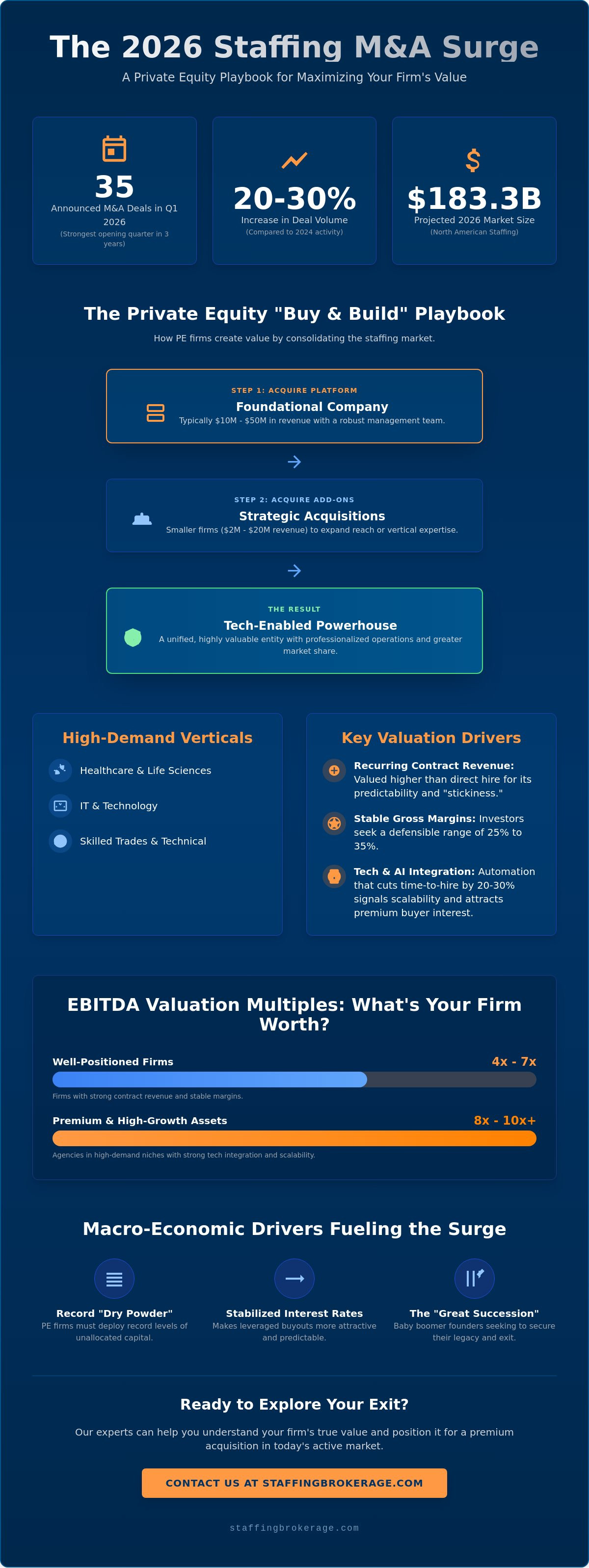
Did you know that North American staffing M&A saw 35 announced transactions in just the first quarter of 2026? This represents the strongest opening quarter in three years, with deal volume up 20% to 30% compared to 2024. If you feel like the ground is shifting beneath your feet, you aren't alone. Many owners worry about missing the peak of the market or feel confused by how a private equity staffing acquisition differs from a traditional sale to a competitor.
We understand the weight of these decisions and the desire to ensure your life's work is valued correctly. You've built something significant, and the current 2026 market, projected to reach $183.3 billion, is rewarding that effort with multiples ranging from 4x to over 10x EBITDA for premium assets. This article will help you discover why private equity firms are aggressively acquiring staffing agencies right now and how you can position your firm for a high-value exit. We'll break down the current valuation benchmarks for platform and add-on candidates, identify the niche verticals in highest demand, and provide a clear roadmap to attract high-quality investors who value your legacy as much as your ledger.
Key Takeaways
- Understand the 2026 market dynamics and why record levels of capital are fueling a surge in private equity staffing acquisition activity across North America.
- Learn the private equity "Buy and Build" playbook and why recurring contract revenue is currently earning higher valuation multiples than direct hire services.
- Identify the specific high-growth verticals, including healthcare and IT, that are attracting the most aggressive investment from institutional buyers this year.
- Determine whether your agency is positioned as a foundational "Platform" company or a strategic "Add-on" candidate based on your EBITDA and scalability.
- Discover how to prepare your financials for a successful exit by utilizing Quality of Earnings reports and identifying one-time expenses that boost your valuation.
The State of Private Equity Staffing Acquisitions in 2026
The landscape of the staffing industry has undergone a remarkable transformation over the last two years. While 2024 saw a four-year low in M&A activity with only 93 deals, 2026 has roared back with 35 transactions in the first quarter alone. This resurgence is largely fueled by the private equity sector, which now views the staffing industry as a primary vehicle for consolidation. A private equity staffing acquisition is no longer just a transaction; it's a strategic move to build tech-enabled platforms that can weather any economic climate.
Investors are sitting on record levels of capital waiting to be deployed. We're seeing a distinct shift from the cautious approach of 2024 toward aggressive platform building in 2026. Buyers are moving away from broad, generalist agencies to focus on firms with deep expertise and durable client relationships. This focus on specialization allows firms to maintain stable gross margins in the 25% to 35% range, which is exactly what sophisticated investors are looking for in today's market.
Why 2026 Is the Year of the Staffing Exit
Several factors have converged to make this year an ideal window for owners to consider a sale. Interest rates have stabilized after the volatility of previous years, making the leveraged buyouts favored by PE firms much more attractive. We're also seeing the peak of the "Great Succession," where baby boomer founders are reaching retirement age and seeking a partner to protect their legacy. In the context of 2026 M&A activity, "dry powder" refers to the record amounts of committed but unallocated capital that investment firms must deploy into high-performing service businesses. This pressure to invest has accelerated the pace of the private equity staffing acquisition trend across North America.
Macro-Economic Drivers for Human Capital Investment
The staffing model has proven its resilience in a post-inflationary economy. Specialized labor shortages in fields like skilled trades and technical recruiting have created "moats" around successful firms, making them highly defensible assets. Additionally, the integration of AI has changed the game. Firms using automation to cut time-to-hire by 20% to 30% are seeing significantly higher buyer interest. These tech-enabled agencies offer the scalability that PE firms crave. By turning human capital into a high-precision, data-driven investment, these firms are positioning themselves for premium valuations in a crowded market.
The Private Equity Playbook: Why Staffing Firms Are Prime Targets
Private equity firms operate with a clear, strategic objective. They seek out industries where they can apply a "Buy and Build" strategy to generate significant value. By initiating a private equity staffing acquisition of a large "platform" firm, they create a solid foundation for future growth. These platform companies typically boast revenues between $10 million and $50 million, supported by robust management teams. Once the platform is secure, the PE firm aggressively pursues smaller "add-on" acquisitions. These smaller firms, often with $2 million to $20 million in revenue, expand the platform's geographical reach or vertical expertise. This approach professionalizes back-office operations and creates a more valuable, unified entity through consolidated strength.
The core of this playbook is the pursuit of scalability. PE firms look for agencies where they can implement sophisticated tech stacks and centralized recruiting centers. By streamlining these functions, they increase profit margins and allow the local teams to focus entirely on client relationships and talent delivery. This transition from a founder-led boutique to a corporate-backed powerhouse is a collaborative journey that often yields impressive results for all stakeholders involved.
Recurring Revenue and the EBITDA Multiplier
Investors love predictability. This is why contract staffing is currently valued significantly higher than direct hire services in 2026. While direct hire revenue can fluctuate with hiring freezes, contract staffing provides a steady stream of income that remains resilient during economic shifts. Well-positioned firms are seeing multiples between 4x and 7x EBITDA this year. Premium assets in high-growth niches can even reach 8x to 10x or more. This "stickiness" with clients reduces perceived risk, making your agency a much more attractive target for institutional capital. If you're curious about where your agency sits on this scale, a professional business valuation and assessment can provide the clarity you need to move forward with confidence.
The "Roll-up" Phenomenon in Fragmented Markets
The U.S. staffing market remains highly fragmented, which is a goldmine for consolidation. PE firms use a technique called multiple arbitrage to create value. They buy smaller agencies at lower multiples, perhaps 4x or 5x, and combine them into a massive organization. Because larger companies are perceived as less risky and more scalable, they trade at much higher multiples. By professionalizing management and cutting redundant costs through synergies, investors turn a collection of small businesses into a high-performance market leader. It's a methodical process that rewards agencies with clean financials and a clear niche focus.
High-Growth Verticals: Where PE Capital is Flowing
Investors aren't just looking for volume. They're seeking specialized expertise that creates high barriers to entry. A private equity staffing acquisition in a high-growth vertical often commands the highest end of the valuation spectrum. In 2026, we're seeing capital flow toward sectors with durable demand and high gross margins. Successfully navigating a private equity staffing acquisition in these competitive verticals requires a clear understanding of your firm's specific value proposition.
Light industrial and logistics continue to benefit from the "Amazon effect." The logistics sector is no longer just about moving boxes; it's about sophisticated supply chain management. This shift requires a different caliber of temporary labor, which requires more specialized staffing partners. This sector recorded seven transactions in the first quarter of 2026 alone. While these firms often trade at 4.0x to 4.5x EBITDA, their sheer volume and operational stability make them attractive add-on targets for larger platforms. Similarly, niche professional services like legal and finance staffing are seeing increased interest. These firms provide the high-touch talent that corporate clients can't easily find through automated platforms.
Healthcare: Nursing and Allied Health Dominance
Healthcare staffing remains a top priority for institutional investors. The aging population ensures a steady, long-term demand for nursing and allied health professionals. PE firms are particularly interested in locums and skilled care niches because they offer recession-resistant revenue. Managing regulatory risks is a major part of the PE strategy here. They professionalize compliance and credentialing to protect the investment and ensure long-term stability. If you're operating in this sector, understanding how to value a healthcare staffing agency will help you navigate a potential exit with confidence.
The Tech Talent Resurgence
After a period of adjustment, 2026 has brought a tech talent resurgence. AI-specialized staffing firms are seeing premium valuations as companies race to integrate new technologies. Investors are shifting focus from general IT roles to high-growth niches like cybersecurity and cloud architecture. These specialized IT niches are currently trading at 5.5x to 7.0x EBITDA. PE firms are also showing a strong preference for "managed services" and Statement of Work (SOW) streams. These models provide recurring revenue that's more predictable than traditional spot placements. This shift reflects a broader market trend toward capability and specialization over pure revenue volume.
Platform vs. Add-on: How PE Firms Categorize Your Agency
Private equity firms view the market through two primary lenses when evaluating potential investments. This categorization dictates everything from the due diligence process to the final purchase price. During a private equity staffing acquisition, your firm's classification as either a platform or an add-on significantly impacts your exit strategy. Understanding where you fit helps you set realistic expectations and choose the right partner for your journey.
A platform company serves as the foundational investment for a PE firm. These agencies typically generate $5 million or more in EBITDA and possess a scalable infrastructure. Investors look for a "steady hand" at the helm, meaning a robust management team that can operate independently of the founder. In contrast, an add-on (or bolt-on) acquisition involves a smaller firm, often with $2 million to $20 million in revenue. These agencies are integrated into an existing platform to expand its geographic footprint or vertical expertise. While platforms command higher multiples due to their size and stability, add-ons offer unique strategic value that can still lead to a very lucrative exit.
Criteria for a Platform Acquisition
To qualify as a platform, your agency must demonstrate significant management depth. Investors want to see that the business functions smoothly without the founder's daily involvement in every placement. Infrastructure is equally vital. A platform needs a modern tech stack, including a robust Applicant Tracking System (ATS) and a sophisticated CRM. Clean, transparent financial reporting is non-negotiable. PE firms are looking for a brand with strong regional recognition and a proven ability to scale operations across multiple locations or service lines.
The Strategic Value of the Bolt-on
Smaller agencies shouldn't feel overlooked in the current market. In fact, many bolt-on acquisitions move much faster than platform deals. You become the "missing piece" for a larger platform looking to enter a specific niche, such as cybersecurity or locum tenens. To maximize your value as an add-on, focus on client diversification. A diverse client base reduces risk and makes your firm much more attractive to a buyer. If you're ready to explore how your agency fits into the current consolidation wave, our team provides expert staffing company sell-side representation to help you secure the best possible terms.
The valuation gap between these two categories remains a key trend in 2026. Platforms often trade at 8x to 10x EBITDA because they represent a lower-risk investment with immediate scale. Add-ons typically trade in the 4x to 7x range. However, if your agency provides a rare capability or a highly desirable client list, you can often bridge that gap through competitive bidding. The owner's role also differs. Platform founders often stay on to lead the larger entity, while add-on owners may choose a shorter transition period before moving on to their next chapter.
Navigating the PE Exit: Maximizing Value and Strategic Fit
Preparing for a private equity staffing acquisition is a transformative process that requires a shift in mindset. You're moving from a founder-led culture to a data-driven governance model. This evolution is a collaborative journey that ensures your agency's long-term success under new ownership. Navigating this cultural shift effectively often requires specialized guidance; many organizations turn to speakers.com to find keynote speakers who can inspire teams during periods of significant organizational change. While strategic buyers often focus on immediate operational fit, private equity firms look for scalable systems and financial precision. They want to see that your success is repeatable and documented through clear metrics rather than just personal relationships.
One of the most critical steps in this process is the move toward "Quality of Earnings" (QofE) reports. Unlike standard tax returns, a QofE report provides a deep dive into the sustainability of your cash flow. This is where you identify "add-backs"—one-time expenses that aren't part of the core business operations. These might include non-recurring legal fees, personal travel, or unique founder bonuses. Properly identifying these expenses can significantly boost your EBITDA and, by extension, your final purchase price. A specialized advisor helps you present these figures transparently to build trust with sophisticated investors.
Preparing Your Agency for PE Due Diligence
The rigor of financial audits in a private equity staffing acquisition is often much higher than what owners expect. PE firms will scrutinize your worker classifications, especially the distinction between 1099 and W2 workers. Compliance "housekeeping" in this area is non-negotiable. If you haven't audited your contracts and payroll recently, now is the time to start. Understanding how to prepare your staffing agency for sale can save you months of stress during the due diligence phase. Clean financials and documented compliance protocols make your firm a "low-risk" asset that commands a higher multiple.
Choosing the Right PE Partner
Not all capital is created equal. You must assess a PE firm's "hold period" to understand their future exit strategy. Some firms want to flip the asset in three years, while others take a five-to-seven-year approach. It's also vital to evaluate their industry expertise. Do they understand the nuances of the 2026 staffing market? A partner who speaks your language will be a much better ally during the growth phase. Many owners also look for a "Second Bite at the Apple" through equity rollover. This allows you to retain a portion of ownership and profit again when the PE firm eventually sells the entire platform to a larger buyer.
Next Steps with Staffing Brokerage
Our national network connects you with verified PE buyers who are actively seeking quality staffing assets in 2026. We guide you through every step, from the initial assessment to the final handshake. A confidential valuation is the best way to start your exploration without alerting your competitors or staff. When you're ready to see what your life's work is worth in this aggressive market, we're here to help. Get a confidential valuation of your staffing agency and let’s discuss how we can position your firm for a high-value exit.
Seizing Your Opportunity in the 2026 Staffing Market
The 2026 market offers a unique window for owners to capitalize on their hard work and dedication. With industry multiples holding strong between 4x and 10x EBITDA, your agency's value is likely at a historic peak right now. Success in a private equity staffing acquisition depends on more than just top-line revenue. It requires clean financials, a scalable management team, and a clear understanding of whether your firm is a platform or an add-on candidate. You've spent years building your business. You deserve a transition that honors that legacy while maximizing your financial return.
We bring specialized M&A advisory for the staffing industry and a national reach to find the right partner for your specific needs. Our team has a proven track record of high-value deal closures. We provide a personalized strategy for every client we represent. Partner with Staffing Brokerage to find the right PE buyer for your agency and secure the high-value exit you've earned. The future of your firm is bright. We're here to guide you through every step of this collaborative journey with confidence and transparency.
Frequently Asked Questions
What is the average EBITDA multiple for a staffing agency acquisition in 2026?
In 2026, average EBITDA multiples for staffing firms generally fall between 4x and 7x, though premium assets in high-growth sectors often exceed 10x. Specifically, light industrial firms currently trade around 4.0x to 4.5x. Specialized IT and professional staffing niches command higher ranges from 5.5x to 7.0x. These values depend heavily on your firm's gross margins and the stability of your recurring revenue streams.
Will I have to stay with the company after a private equity acquisition?
Most private equity buyers expect founders to remain with the company for a transition period ranging from six months to two years. If your agency is a platform acquisition, the buyer usually wants you to lead the growth strategy for several years. However, if you're an add-on, the transition might be shorter as they integrate your team into an existing management structure.
What is the difference between a strategic buyer and a private equity buyer?
A strategic buyer is usually a competitor looking to gain market share, while a private equity buyer focuses on financial growth and scalability. PE firms provide capital for expansion and typically look to sell the business again in three to seven years. This makes a private equity staffing acquisition a collaborative journey toward a "second bite at the apple" through equity rollover.
How long does the due diligence process take for a PE staffing deal?
The due diligence process for a PE staffing deal typically takes between 60 and 90 days from the signing of a Letter of Intent. This period involves an intensive review of your financials, client contracts, and compliance records. Having your documentation organized in advance helps move the process along toward a smooth closing. We guide you through this methodical process to ensure clarity at every step.
Can I sell my staffing agency if I have high client concentration?
You can certainly sell an agency with high client concentration, but it may affect your deal structure. Buyers might introduce a larger earn-out component or specific retention bonuses to mitigate the risk of losing a major account. Diversifying your client base before going to market is the most effective way to secure a higher upfront payment and a more favorable valuation multiple.
What are "add-backs" and how do they affect my agency valuation?
Add-backs are non-recurring or personal expenses that are added back to your net income to show the true earning potential of the business. Common examples include one-time legal fees, founder salaries above market rate, or personal vehicle leases. For owners looking to explore personal credit or car finance options independently, you can visit I Need Cash. These adjustments increase your EBITDA. Since multiples are applied to this number, identifying every valid add-back directly boosts your final purchase price.
Is my staffing agency too small for private equity interest?
No agency is necessarily too small for interest, as many PE platforms seek "bolt-on" acquisitions with as little as $2 million in revenue. While platform acquisitions typically require at least $10 million in revenue, smaller firms are highly valued if they offer a specific geographic reach or a specialized vertical niche. Your firm could be the perfect missing piece for a larger investor's regional strategy.
How do PE firms handle the existing staff and culture post-acquisition?
PE firms generally aim to retain key talent because the people are the primary asset in a private equity staffing acquisition. They often introduce data-driven governance and professionalized back-office systems to support your existing team. This shift usually provides your staff with better technology and more opportunities for professional growth. It's a transition designed to build on the success you've already created.