
The Comprehensive Due Diligence Checklist for Buying a Staffing Agency in 2026
What if the most dangerous liabilities in your new acquisition aren't found on the balance sheet, but hidden within the fine print of a worker’s comp policy or a shifting regulatory deadline? When you're performing due diligence buying staffing agency assets in 2026, you're doing more than checking numbers; you're auditing the resilience of professional relationships and compliance standards. It's completely normal to feel a bit of uncertainty about recruiter retention post-sale or the stability of high-concentration client contracts. You want to ensure that the growth you're paying for is sustainable and that no hidden debts are waiting in the payroll archives.
We're here to help you move forward with total confidence. This article provides a professional, step-by-step framework to audit financial, operational, and compliance risks, including new 2026 mandates like California’s SB 642 and updated pay transparency rules. You'll gain a clear risk-mitigation strategy that validates your purchase price and sets the stage for a smooth ownership transition. We'll walk through the essential checkpoints for worker’s comp, VMS contracts, and talent retention so you can build on a foundation of integrity and long-term value.
Key Takeaways
- Learn why a generic business audit falls short and how to focus your efforts on the unique human capital and contractual stability of a staffing firm.
- Understand how a Quality of Earnings (QofE) report helps you validate revenue splits and ensure you are paying a fair price based on sustainable income.
- Discover the essential steps for due diligence buying staffing agency targets, specifically auditing Workers' Comp MOD rates and state-specific labor law compliance.
- Identify critical red flags like declining gross margins or payroll discrepancies that could signal hidden liabilities before you commit to the purchase.
- See how professional buy-side advisory can streamline the acquisition process and protect your long-term investment through expert information management.
Why Staffing Industry Due Diligence Requires a Specialized Lens
Staffing is a unique industry where the primary assets are people and promises. When you're performing due diligence buying staffing agency operations, you can't rely on a generic business checklist. Standard audits often focus on tangible inventory or proprietary technology, but staffing value is rooted in human capital and contractual stability. If you've ever wondered what is due diligence? in a professional context, think of it as a comprehensive verification of the "health" of these relationships. It's about confirming that the revenue you see on paper today will still be there after the keys change hands.
Assets in this sector are inherently perishable. Unlike a manufacturing plant where the machinery stays bolted to the floor after a sale, a staffing firm's value can walk out the door every evening. A lead recruiter with a deep book of business can leave, or a major client contract might be tied to the personality of the current owner. Because of this, your audit must go beyond the balance sheet to understand the "Strategic Fit." This process evaluates how well the agency’s culture, client base, and niche expertise align with your existing goals or future growth plans. It's a collaborative journey to ensure the firm’s foundations are as solid as they appear.
The Three Pillars of a Staffing Acquisition Audit
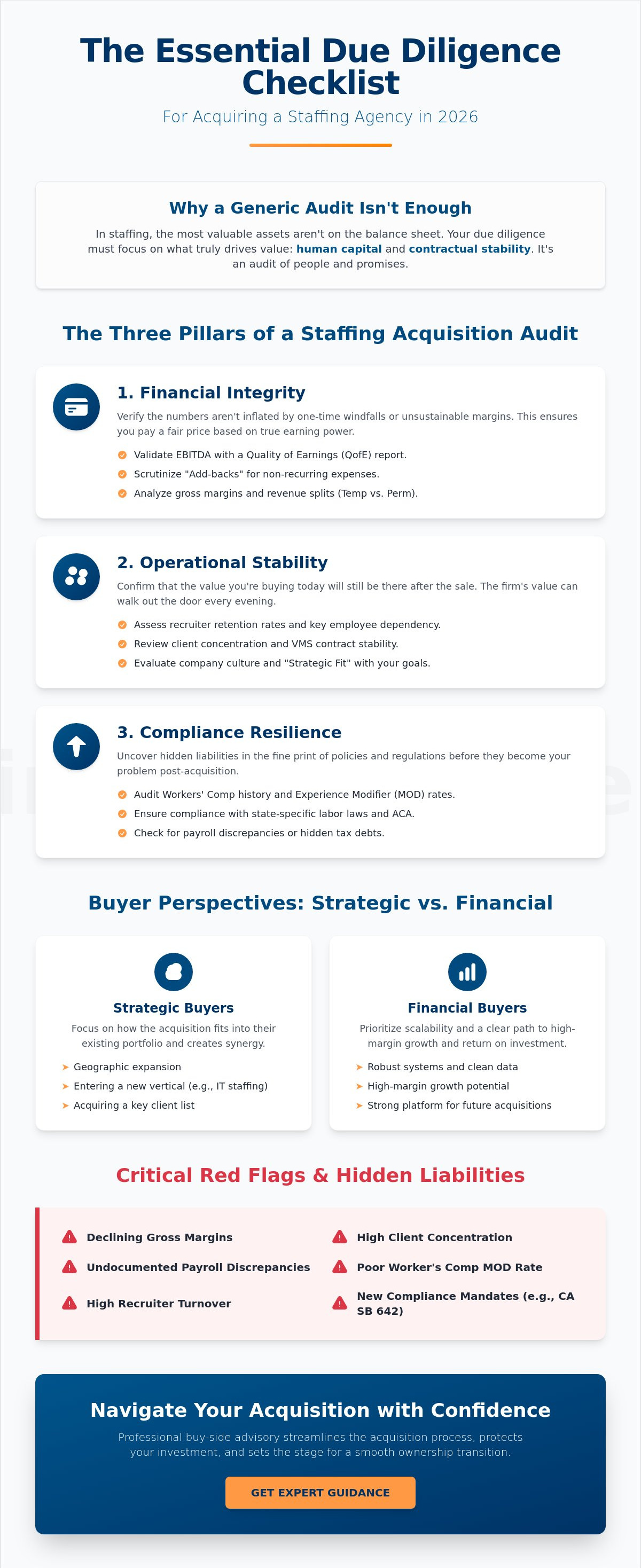
A successful audit rests on three foundational areas that require specialized attention. First, Financial Integrity involves more than just checking bank statements. You're verifying the quality of earnings and EBITDA to ensure the numbers aren't inflated by one-time windfalls or unsustainable margins. Second, Operational Stability focuses on the internal team. You're looking for a seasoned recruiting staff that feels supported and plans to stay post-acquisition. Finally, Compliance Resilience identifies hidden liabilities. This includes auditing workers’ compensation history, Experience Modifier (MOD) rates, and ensuring the agency meets all state-specific labor laws and ACA requirements. This triple-check approach builds a steady hand for the transition ahead.
Strategic vs. Financial Buyer Perspectives
Your priorities during the due diligence buying staffing agency process will shift based on your buyer profile. Strategic buyers often look for geographic expansion or a new vertical, such as moving from light industrial into specialized IT staffing. They focus on how the acquisition fills a gap in their current portfolio and look for synergy in client lists. Financial buyers, such as private equity firms, prioritize scalability and platform potential. They want to see a firm with robust systems, clean data, and a clear path toward high-margin growth. Regardless of your profile, the goal remains the same: ensuring the price you pay matches the actual value of the agency’s future cash flows and relationship stability.
Financial Due Diligence: Beyond the EBITDA Multiples
Financial health is the heartbeat of any transaction. While we previously focused on the human element, your due diligence buying staffing agency efforts must now pivot to the hard data. A standard profit and loss statement doesn't tell the whole story. You need a Quality of Earnings (QofE) report to strip away accounting noise and reveal the true cash flow. This is one of the key considerations when buying a business because it validates that the revenue is repeatable and not just a result of aggressive accounting.
You'll want to look closely at the split between temporary and permanent placement revenue. In 2026, permanent placements offer high margins but can be volatile during economic shifts. Temporary staffing provides the steady, recurring income that lenders love. We also need to analyze "Add-backs." These are personal or non-recurring expenses the current owner paid through the business. Properly identifying these is critical for an accurate staffing company valuation. If you miss a hidden expense or overstate an add-back, you risk overpaying for the firm’s actual earning power.
Working capital is another vital checkpoint. Staffing is a cash-heavy industry. You often pay your temporary workers weekly, while clients might take 30, 60, or even 90 days to pay their invoices. You must verify the current payroll funding structure to ensure you have the liquidity to support the transition without a hitch.
Analyzing Revenue Concentration and VMS Dependency
Risk management starts with the 20% rule. If a single client accounts for more than 20% of total revenue, the business is vulnerable. You should also audit any Vendor Management System (VMS) or Managed Service Provider (MSP) contracts. These agreements often have strict terms and thin margins. Check the "stickiness" of these relationships. Have they been renewed recently? A history of long-term renewals suggests a reliable partnership that will survive the sale.
EBITDA Trends and 2026 Market Multiples
The 2026 market is seeing a fascinating shift. While the overall U.S. staffing market is projected to reach $183.3 billion, private equity staffing acquisitions are driving multiples higher in specialized niches. IT staffing, with markups between 40% and 65%, often commands a higher multiple than light industrial. We help you adjust EBITDA for owner compensation and one-time tech upgrades. This ensures your offer reflects the current market reality while protecting your ROI. If you're unsure about your target's worth, our valuation services provide the clarity you need to move forward with confidence.
Operational and Compliance Audit: Protecting Your Investment
Operational due diligence is where you look beneath the hood to see how the engine actually runs. While financial records show the results, the operational audit reveals the risks that could stall your future growth. A central part of due diligence buying staffing agency targets involves a rigorous look at Worker’s Compensation. You must analyze the claims history and the Experience Modifier (MOD) rate. Since statutory employer costs like FICA and workers' comp typically range from 12% to 15% of total markup, a high MOD rate can quietly erode your profit margins before you even take over. We help you identify these trends early so you can negotiate from a position of strength.
Compliance in 2026 has become increasingly complex. Beyond the standard Affordable Care Act (ACA) requirements, you must verify that the agency is prepared for recent legislative shifts. For instance, California’s SB 642, which took effect on January 1, 2026, tightened pay scale definitions. You'll also want to review I-9 and E-Verify documentation for the entire temporary workforce. Inaccurate records here aren't just administrative errors; they're potential legal landmines that could trigger federal audits or significant fines post-sale. A steady, methodical review of these files ensures your new foundation is legally sound.
Your audit should also evaluate the technology stack. With 84% of hiring processes now utilizing some form of AI, the efficiency of the Applicant Tracking System (ATS) and CRM is a major differentiator. You're looking for seamless integration between recruitment and payroll. If the systems are fragmented or rely on manual data entry, you're inheriting an operational bottleneck that will limit your ability to scale.
The Internal Team: Recruiter Retention and Culture
The internal staff is the agency's most valuable engine. You need to analyze recruiter turnover rates and commission structures to ensure they're competitive and sustainable. We look closely for "Key Man" risk. If the founder or a single top producer handles 40% of the placements, their departure could devastate the business. Reviewing existing non-compete and non-solicitation agreements is essential to protect the "perishable assets" we discussed earlier. You want a team that's motivated to stay and grow with you.
Insurance and Liability Review
Don't overlook the safety net. Verify that the agency maintains robust General Liability, Professional Liability, and Cyber Insurance. In a world of autonomous AI agents, cyber coverage is no longer optional. We also recommend auditing past and pending litigation or EEOC claims to uncover any patterns of workplace issues. Finally, ensure all client contracts include appropriate indemnification clauses. This step protects you from being held responsible for a client's mistakes, keeping your investment secure as you move toward a successful transition.
Identifying Red Flags and Hidden Risks in Staffing Acquisitions
Even the most promising deals can harbor subtle traps that only become visible under close scrutiny. When you're conducting due diligence buying staffing agency operations, you have to look past the top-line growth. A common warning sign is declining gross margins despite increasing revenue. With the U.S. staffing market projected to reach $183.3 billion in 2026, many firms are growing, but not all growth is healthy. If an agency is expanding by taking on low-margin commodity contracts, they might be "buying" revenue at the expense of long-term profitability. This shift often signals a desperate attempt to look attractive for a sale rather than a sustainable business strategy.
Messy payroll records or the presence of "ghost employees" represent a significant legal and financial risk. In an industry where payroll is the largest expense, any inaccuracy here can lead to massive tax liabilities or insurance audits. You should also examine client contracts for unfavorable payment terms. If a major client is on Net 90 terms while you're paying temporary workers weekly, your cash flow will be under constant strain. Contracts with "at-will" termination clauses that lack notice periods are another red flag. They offer no protection for the "perishable assets" we discussed earlier, leaving you vulnerable to sudden revenue drops immediately after the transition.
Recruiter turnover is perhaps the most critical human capital risk. If the internal team is revolving door, the agency's institutional knowledge is constantly leaking. A culture gap between your management style and the target's existing environment can accelerate this turnover. We often see deals fail not because of the numbers, but because the internal staff felt alienated by the new ownership's approach. If you're concerned about the stability of a potential target, our buy-side advisory services can help you uncover these cultural and operational friction points before you sign.
The "Quality of Revenue" Red Flag
Distinguishing between high-margin niche placements and low-margin commodity staffing is vital. For example, IT staffing markups typically range from 40% to 65%, while light industrial might sit between 25% and 40%. If the revenue mix is shifting toward the lower end, the business's value is likely decreasing. Watch out for "window dressing," where a firm shows a sudden spike in placements just months before going to market. We also recommend auditing the aging of accounts receivable (A/R). If a large portion of invoices is over 60 days old, it suggests poor collection processes or clients who are struggling financially.
Mitigating Risk Through Deal Structure
You can protect your investment by using a smart deal structure. Earn-outs are a fantastic tool to bridge valuation gaps. They ensure the seller only receives the full purchase price if the agency hits specific performance targets post-sale. Seller financing is another positive sign. If a seller is willing to hold a note, it shows they have confidence in the business's future success. Finally, we always recommend using escrow accounts to hold back a portion of the purchase price. This provides a ready fund to cover any undisclosed liabilities or compliance breaches that might surface during your first year of ownership.
Partnering for Success: How Buy-Side Advisory Streamlines the Deal
The process of due diligence buying staffing agency assets is complex, but you don't have to walk this path alone. While the checklists provided in previous sections give you a roadmap, a seasoned advisor acts as your navigator. Partnering with a specialized staffing agency business broker ensures that you aren't just looking at data, but interpreting it through the lens of industry experience. They understand why a sudden shift in a VMS contract matters or how a specific state's labor law might impact your future margins. Since due diligence costs for deals under $10 million can range from $25,000 to $75,000, having an expert guide helps ensure that every dollar spent on auditing brings you closer to a secure investment.
One of the most valuable roles an advisor plays is managing the virtual data room. This digital repository can quickly become a bottleneck if information isn't organized and vetted. We help manage the flow of documents, ensuring that financial records, employee contracts, and compliance filings are accessible and clear. This methodical approach keeps the momentum of the deal moving forward and prevents the "analysis paralysis" that often stalls promising acquisitions. It's about creating a transparent environment where trust can grow between the buyer and the seller.
As you move toward a successful staffing agency deal closure, the focus shifts from auditing the past to preparing for the future. Final steps include drafting the definitive purchase agreement and setting the stage for "Day 1" post-acquisition. This transition is a collaborative journey. You want to ensure that on the first day of your ownership, the internal team feels secure and the clients see a seamless continuation of service. A steady hand during these final weeks makes all the difference in long-term value creation.
Why a "Steady Hand" Matters in Staffing M&A
A dedicated guide moves the conversation from a mere transaction to a supportive partnership. At Staffing Brokerage, we provide end-to-end support for national buyers, ensuring that every due diligence buying staffing agency effort aligns with your strategic goals. We don't just help you find a business; we help you find the right business. By focusing on strategic fit and relationship stability, we help you build a foundation for growth that lasts well beyond the closing date. Our team acts as a reliable ally, deeply invested in your personal and professional milestones.
Ready to Explore Your Next Acquisition?
Acquiring a staffing firm in 2026 requires a meticulous audit of both numbers and people. Validating the purchase price through a professional valuation and assessment is the best way to mitigate risk and ensure a smooth ownership transition. If you're ready to take the next step in your professional journey, we're here to help. Contact us today for a confidential consultation, and let's discuss how we can support your acquisition goals with integrity and precision. Together, we can turn a complex business transition into a successful milestone for your future.
Building a Foundation for Long-Term Growth
Acquiring a firm is a significant milestone that requires more than just a surface-level review of the books. By focusing on the "perishable" nature of human capital and the specific compliance hurdles of 2026, you're setting yourself up for a successful transition. You now have the tools to audit financial integrity through Quality of Earnings reports and protect your investment by identifying red flags in client contracts or recruiter turnover. Effective due diligence buying staffing agency targets is about aligning your vision with a target that is resilient and ready to scale.
We're here to be your steady hand throughout this process. With our specialized staffing industry M&A expertise and national reach across the United States, we have a track record of proven results in complex deal closures. You can partner with Staffing Brokerage for expert buy-side advisory to ensure every detail of your next acquisition is handled with precision and care. Your next great professional chapter is within reach, and we look forward to navigating it by your side.
Frequently Asked Questions
How long does due diligence typically take when buying a staffing agency?
The process usually takes between 60 and 90 days from the signing of the letter of intent to the final closing. This timeline allows for a methodical review of financial records, payroll data, and compliance filings. While smaller deals might move faster, a thorough audit requires this intentional pace to ensure no hidden liabilities are overlooked during the transition.
What is the most common red flag found during staffing due diligence?
High revenue concentration is the most frequent warning sign we encounter. If a single client accounts for more than 20% of total revenue, the business is highly vulnerable to that client's budget shifts. We also watch for discrepancies in workers' compensation class codes, which can lead to significant premium increases or audits after you take ownership of the firm.
Do I need a separate Quality of Earnings (QofE) report for a staffing firm?
Yes, a specialized QofE is essential when performing due diligence buying staffing agency assets. It provides a level of detail that standard tax returns simply can't match, such as verifying the sustainability of temporary vs. permanent placement revenue. This report ensures the EBITDA used for your valuation is grounded in transparent, recurring cash flow rather than one-time accounting gains.
How do I audit client contracts without alerting the clients to the sale?
You review these documents within a confidential virtual data room managed by a professional advisor. This allows you to assess termination clauses, payment terms, and indemnification requirements without any direct client contact. It's a standard practice that protects the agency's operational stability and relationship value while you conduct your necessary research and validation.
What happens if we find a compliance error during the audit?
Finding an error is often an opportunity to strengthen the deal structure rather than a reason to walk away. We typically address these issues through purchase price adjustments or by setting up an escrow account to cover potential future liabilities. This approach builds trust between both parties and ensures that you aren't inheriting avoidable risks as you begin your new ownership journey.
How does VMS dependency affect the valuation of a staffing business?
High dependency on Vendor Management Systems generally results in a lower valuation multiple. While VMS contracts provide steady volume, they often come with thinner margins and less direct influence over the client relationship. When due diligence buying staffing agency targets, we carefully analyze this revenue mix to ensure your offer reflects the actual margin profile and long-term stability of the business.
Should I interview the internal recruiters during the due diligence phase?
We generally recommend saving these interviews for the final stages of the deal, often just before or after the announcement. Early interviews can trigger anxiety and lead to the very recruiter turnover you're trying to avoid. Instead, focus on auditing their placement data, tenure, and commission structures to understand the team's strength through objective performance metrics first.
What is the difference between an asset purchase and a stock purchase in staffing?
In an asset purchase, you buy specific items like client lists and equipment, which often provides a tax benefit through a "step-up" in basis. A stock purchase involves buying the entire legal entity, including all its historical liabilities. Most buyers prefer asset purchases because they offer a cleaner break from the seller's past workers' comp or tax issues.