Evaluating Staffing Agency Acquisition Targets: A Strategic 2026 Guide
In 2026, a staffing acquisition is the purchase of a relationship engine, not just a ledger of past placements. You likely recognize that the true value of a firm lies in its cultural alignment and recruiter retention; however, the fear of overpaying for a firm that might lose its best talent remains a heavy burden for many buyers. Successfully evaluating staffing agency acquisition targets requires moving beyond surface-level financials to understand how a firm operates in a market defined by rapid AI integration and evolving compliance frameworks and dynamic regulatory shifts.
You deserve a clear, steady path toward growth that prioritizes long-term stability over quick wins. This guide provides a repeatable framework to help you master the due diligence process, from auditing hidden contract liabilities to understanding current 2026 market multiples across IT, healthcare, and industrial sectors. We'll explore how to value a firm's tech stack and human capital so you can move forward with the confidence of a seasoned strategist and a reliable ally.
Key Takeaways
- Identify why 2026 is a pivotal year for acquisitions as flexible labor becomes a primary driver of economic resilience and growth.
- Learn the specific risk profiles and growth opportunities when evaluating staffing agency acquisition targets in the healthcare, IT, and industrial sectors.
- Master the financial formulas behind business valuation, focusing on why adjusted EBITDA is the essential foundation for any successful negotiation.
- Follow a clear, step-by-step roadmap from the initial non-disclosure agreement to the final deal closure to ensure a smooth transition.
- Discover how specialized buy-side advisory helps you uncover off-market opportunities and avoid the hidden liabilities often missed by general brokers.
Why Buy a Staffing Business in 2026? The Strategic Investment Case
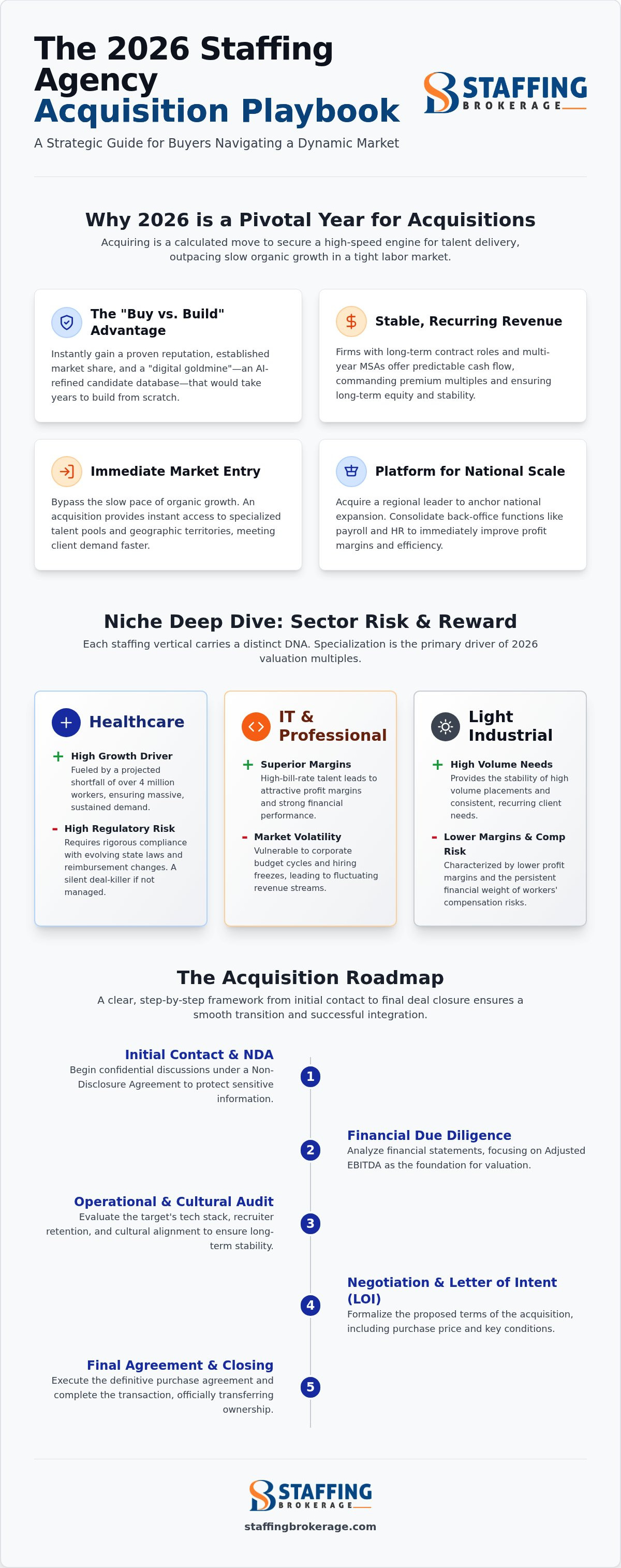
Acquiring a staffing firm in 2026 is about more than just expanding a ledger. It's a calculated move to secure a high-speed engine for talent delivery. As the labor market remains tight, organic growth often moves too slowly to meet the demands of Fortune 500 clients or rapidly scaling startups. By Mergers and acquisitions (M&A), you gain immediate access to specialized talent pools and established market share that would otherwise take years to cultivate. The 2026 economic environment continues to prioritize flexible labor as a primary driver of resilience, making these agencies vital partners for businesses facing unpredictable shifts in demand.
The "Buy vs. Build" debate has shifted heavily toward acquisition. Building a brand from scratch requires significant capital for marketing, recruiter training, and business development. Conversely, an established firm brings a proven reputation and a "digital goldmine" in the form of its database. While some competitors overlook this, a target's proprietary data is now more valuable than ever. Modern AI-driven sourcing tools have spent years refining these databases, making them far more efficient than a fresh startup's empty pipeline. When you're evaluating staffing agency acquisition targets, you're essentially pricing the speed at which you can enter a new niche or geographic territory.
The Value of Recurring Revenue in Staffing
Stability is the hallmark of a high-value target. While permanent placement fees offer high-margin "wins," they are essentially one-off transactions that fluctuate with corporate hiring freezes. Contract staffing provides the recurring revenue that builds long-term equity. In 2026, firms with a heavy concentration of long-term contract roles command premium multiples because their cash flow is predictable. To identify "sticky" revenue, look for targets with multi-year Master Service Agreements (MSAs) and high contractor retention rates. These are the firms that will survive an ownership transition and provide a steady return on your investment.
Scalability and National Market Presence
An acquisition serves as a powerful platform for national expansion across the United States. Instead of opening one branch at a time, you can acquire a regional leader to anchor your presence in a new time zone. Utilizing professional staffing company buy-side advisory ensures you identify targets that align with your existing culture and operational goals. This strategy also opens the door for significant synergy opportunities. By consolidating back-office functions like payroll, HR, and compliance into a centralized system, you can immediately improve profit margins and create a more scalable, efficient organization.
Evaluating the Niche: Healthcare, IT, and Light Industrial Targets
Selecting the right sector is the most critical step when you're evaluating staffing agency acquisition targets. Each niche carries a distinct DNA of risk and reward. In 2026, healthcare staffing remains a powerhouse due to a projected shortfall of over 4 million workers, yet it requires a steady hand to manage high regulatory barriers and sensitivity to reimbursement changes. IT and professional staffing firms offer attractive high-bill-rate talent and superior margins; however, they often face volatility during corporate budget cycles. Meanwhile, light industrial firms provide the comfort of high volume and recurring needs, but you'll need to account for lower margins and the persistent weight of workers' compensation risks.
Success in today's market often comes down to depth rather than breadth. Niche specialization is defined as the concentration of recruitment efforts and expertise within a specific, high-demand industry vertical, and it stands as the primary driver of 2026 valuation multiples. Buyers are increasingly willing to pay a premium for agencies that don't just "fill seats" but own a specific corner of the market. Understanding these nuances helps you determine how to value a company accurately based on its specific industry headwinds rather than just a generic multiple.
Assessing Vertical-Specific Risks
Regulatory hurdles are the silent deal-killers in healthcare and education staffing. You must audit compliance records to ensure the target meets evolving state requirements, such as California's SB 1032 registration laws. In the office-professional space, the permanence of hybrid work has reshaped valuations. Firms that haven't adapted their sourcing to a borderless talent pool may see their local market dominance erode. Before moving forward, it's wise to partner with a trusted buy-side advisor who can help you spot these sector-specific vulnerabilities early in the process.
Strategic Alignment with Your Current Portfolio
You need to decide if your goal is a "tuck-in" acquisition to bolster an existing vertical or a "platform" acquisition to enter a new space. A key value driver in 2026 is the target's proprietary recruitment tech stack. Look for firms that have successfully integrated AI-powered sourcing platforms to improve recruiter efficiency. Finally, watch for red flags like client concentration. If a target relies on a single Managed Service Provider (MSP) or Vendor Management System (VMS) for more than 30% of its revenue, you're inheriting a significant risk that could destabilize the firm if that single contract is lost.
Financial Valuation: Determining the Fair Purchase Price
Establishing a fair purchase price is a methodical process that balances hard data with industry-specific nuance. When you are evaluating staffing agency acquisition targets, the foundation of your offer rests on Earnings Before Interest, Taxes, Depreciation, and Amortization (EBITDA). However, the price is rarely based on raw EBITDA. We use "Adjusted EBITDA" to account for one-time expenses, owner-related costs, or non-recurring legal fees. This adjustment process, often called "add-backs," reveals the true operational profitability of the firm under your future leadership. To understand how these numbers translate into an offer, it's helpful to review the current formulas for staffing company valuation used in today's market.
Client concentration remains a top priority during the valuation phase. If a single client represents more than 20% of total revenue, it typically triggers a price discount. This protects you against the risk of that client departing shortly after the transition. You must also quantify the "human capital" value of the internal team. Replacing a top-performing recruiter is expensive and disruptive. A target with a tenured, loyal team is worth a premium because they represent the firm’s relationship engine. Effectively evaluating staffing agency acquisition targets means looking past the spreadsheet to see if the people driving the revenue are likely to stay post-close.
Key Financial Metrics to Audit
In the 2026 landscape, healthy gross margins generally range from 15% to 25% for temporary staffing and 30% to 40% for permanent placements. You should also audit Days Sales Outstanding (DSO) to understand the target's cash flow health. If the DSO exceeds 45 days, it may indicate collection issues or unfavorable client terms that will require more working capital from you. A Quality of Earnings (QofE) report is essential here. It validates the seller's claims and ensures the revenue is sustainable and accurately reported.
Deal Structures: Cash, Notes, and Earn-outs
Deal structures in staffing often include a mix of cash at closing, seller notes, and earn-outs. Earn-outs are vital because they mitigate the risk of post-sale client attrition by tying part of the price to future performance. Most buyers prefer an asset purchase over a stock purchase to benefit from a tax basis step-up and to avoid inheriting hidden liabilities. To ensure a smooth journey, structure incentives that keep the seller and key recruiters engaged. This collaborative approach builds trust and ensures the long-term strategic value of your investment.
The Acquisition Roadmap: From NDA to Deal Closure
Moving from initial interest to a successful closing requires a methodical and intentional approach. When you're evaluating staffing agency acquisition targets, the process begins with a Non-Disclosure Agreement (NDA). This step is vital to protect the seller's sensitive data while granting you access to the Confidential Information Memorandum (CIM). The CIM acts as your first deep dive into the target’s operational health. If the alignment feels right, you'll submit an Indication of Interest (IOI), followed by a binding Letter of Intent (LOI) that outlines the purchase price and deal structure discussed in previous sections.
Once the LOI is signed, you enter the 60-90 day due diligence phase. This is where your team verifies every financial, legal, and operational claim made by the seller. It's a period of intense scrutiny, but it’s also where trust is solidified. You'll work toward finalizing the Purchase Agreement, which culminates in the official transfer of ownership. Managing the post-closing integration is the final, ongoing step to ensure the strategic value you identified during the search actually materializes in your daily operations.
Due Diligence Checklist for Staffing Buyers
Staffing acquisitions have unique vulnerabilities that general business audits often miss. You must look for specific red flags when buying a staffing agency, particularly regarding worker misclassification. Auditing whether contractors are correctly identified as W-2 employees or 1099 contractors is essential to avoid inheriting massive tax liabilities. Additionally, check client contracts for "assignability" clauses. You need to ensure these relationships can legally transfer to you without requiring a full contract renegotiation. Finally, verify the candidate database to distinguish between active, reachable talent and stale files that haven't been touched in years.
Human Capital and Cultural Integration
The success of your acquisition depends on the people who generate the revenue. If the top-performing recruiters leave shortly after the founder departs, the firm's value evaporates. You must evaluate the internal culture and determine if the current environment is one where high billers want to stay. Review existing non-compete and non-solicitation agreements for key internal staff to protect your investment. A clear "Day 1" communication strategy is your best tool for building early trust. Reassure both the internal team and the temporary workforce that the transition is a collaborative journey toward shared growth. If you need a partner to help manage these complex steps, our team at Staffing Brokerage offers expert buy-side advisory to guide you from search to successful integration.
The Advantage of Specialized Buy-Side Representation
General business brokers are often skilled at moving assets, but they frequently miss the intricate liabilities unique to the staffing industry. When you are evaluating staffing agency acquisition targets, you need an advisor who understands the difference between a high-bill-rate IT firm and a high-volume industrial shop. Specialized representation ensures that nuances like worker classification, specific state regulatory hurdles, and client contract assignability aren't overlooked. At Staffing Brokerage, we identify off-market opportunities through a vast national network, giving you access to high-quality firms that never even reach the public market.
Deals of this magnitude can be exhausting, and deal fatigue is a real threat to a successful closing. We utilize a "steady hand" approach to manage the friction of complex negotiations and keep the process moving at a predictable rhythm. Our commitment to honest practice means we prioritize long-term strategic value over a quick commission. We act as a thoughtful strategist, ensuring that every target we present aligns with your personal and professional milestones.
Acting as Your Strategic Partner
We do more than just find targets; we help you navigate the complexities of deal structures and financing options. In the current July 2026 market, we stay informed on the latest lending environments to support your goals. For instance, we can guide you through the implications of SBA 7(a) variable interest rates, which are currently capped at 9.75% for loans over $250,000, or explore the stability of SBA 504 25-year debentures priced at 6.17%. Our team also vets targets based on recruiter bench strength and client stickiness to ensure the "relationship engine" you're buying is built to last. Our primary goal is to facilitate a perfect strategic fit that ensures long-term alignment rather than simply closing a transaction.
Taking the Next Step in Your Growth Strategy
Growth through acquisition is a significant milestone that requires your full attention. By partnering with us, you can focus on running your existing business while we manage the heavy lifting of the search and due diligence process. We invite you to schedule a confidential assessment of your acquisition goals so we can begin identifying the right opportunities for your portfolio. Let us act as your reliable ally and lead the way toward a successful transition that adds lasting value to your organization. Speak with a Staffing M&A Expert at Staffing Brokerage today to begin your journey.
Your Partner in Strategic Staffing Growth
Building a national presence through acquisition is one of the most rewarding milestones an entrepreneur can achieve. Success in 2026 depends on more than just high bill rates or impressive margins. It requires a deep understanding of niche-specific risks and a commitment to preserving the human capital that drives every placement. By following a methodical roadmap and focusing on strategic fit, you ensure your next deal delivers long-term value rather than unforeseen liabilities.
Evaluating staffing agency acquisition targets is a complex journey, but it's one you don't have to walk alone. Our team of specialized staffing M&A experts provides a steady hand and a proven national track record to guide you through every negotiation and audit. We're dedicated to finding the perfect alignment for your portfolio so you can grow with absolute confidence. When you're ready to turn your expansion goals into reality, we're here to act as your reliable ally and strategic advisor.
Explore Strategic Staffing Acquisition Opportunities with Staffing Brokerage
Frequently Asked Questions
How much does it cost to buy a staffing agency in 2026?
The purchase price varies significantly based on the agency's size, niche, and geographic reach. For founder-led firms in the lower middle market, prices are typically calculated as a multiple of EBITDA, often ranging from 5.0x to 10.0x. While a small local agency might sell for a few million dollars, specialized national platforms command much higher valuations. It's essential to look at the "Adjusted EBITDA" to understand the true cost of the cash flow you're acquiring.
What is the average EBITDA multiple for a staffing business right now?
Current July 2026 data shows that multiples depend heavily on the specific sector. Light industrial firms typically see 4.0x to 4.5x EBITDA, while professional staffing firms command between 5.0x and 6.0x. High-growth IT firms with Statement of Work (SOW) capabilities can reach multiples as high as 7.0x. Healthcare firms with $1 million to $10 million in EBITDA are currently being marketed in the 5x to 7x range.
Can I use an SBA loan to acquire a staffing company?
Yes, SBA loans remain a popular financing option for acquisitions in 2026. As of July 2026, the maximum variable interest rate for an SBA 7(a) loan over $250,000 is 9.75%. If you prefer a fixed rate, SBA 504 loans offer 25-year debentures priced at approximately 6.17%. These programs provide the necessary leverage to acquire a firm while preserving your working capital for post-closing growth and payroll requirements.
What are the biggest red flags when buying a staffing agency?
The most critical red flags include high client concentration, where one customer represents over 20% of revenue, and hidden worker misclassification liabilities. You should also watch for declining gross margins or sudden spikes in recruiter turnover. Successfully evaluating staffing agency acquisition targets requires a deep dive into these operational risks to ensure you aren't inheriting tax issues or a crumbling relationship engine that could destabilize the firm.
How long does the staffing acquisition process usually take?
A typical acquisition takes between six to nine months from the initial search to the final closing. This timeline includes several distinct stages, such as identifying targets, negotiating the Letter of Intent (LOI), and completing a 60-90 day due diligence period. This methodical pace ensures enough time for thorough financial audits and cultural assessments, which are vital for confirming a strategic fit between your current operations and the target.
What is the difference between a strategic buyer and a financial buyer?
A strategic buyer is usually an existing staffing firm looking to expand its footprint, niche, or capabilities to achieve operational synergies. They often pay higher multiples because the target adds unique value to their existing business. A financial buyer, such as a private equity group, focuses primarily on the target's standalone cash flow and potential for a future exit. Both play vital roles in the 2026 M&A landscape.
Should I focus on IT staffing or healthcare staffing for my first acquisition?
Your choice should align with your long-term goals and industry expertise. Healthcare staffing is currently driven by a projected shortfall of 4 million workers and shows a CAGR of 7.8% through 2034, offering immense stability. IT staffing provides higher bill rates and margins but can be more sensitive to corporate budget cycles. Healthcare often provides more recession-proof growth, making it a comforting choice for a first-time acquisition platform.
How do I ensure the recruiters don't leave after I buy the agency?
Retention starts by assessing the internal culture during the due diligence phase. You should implement stay bonuses or earn-out structures that incentivize key recruiters to remain through the transition period. Clear communication is your most powerful tool; you must present the acquisition as a collaborative journey that offers new growth opportunities. Building trust early ensures the "relationship engine" of the firm stays intact after the founder departs.