
How to Value a Healthcare Staffing Agency: A Strategic 2026 Guide
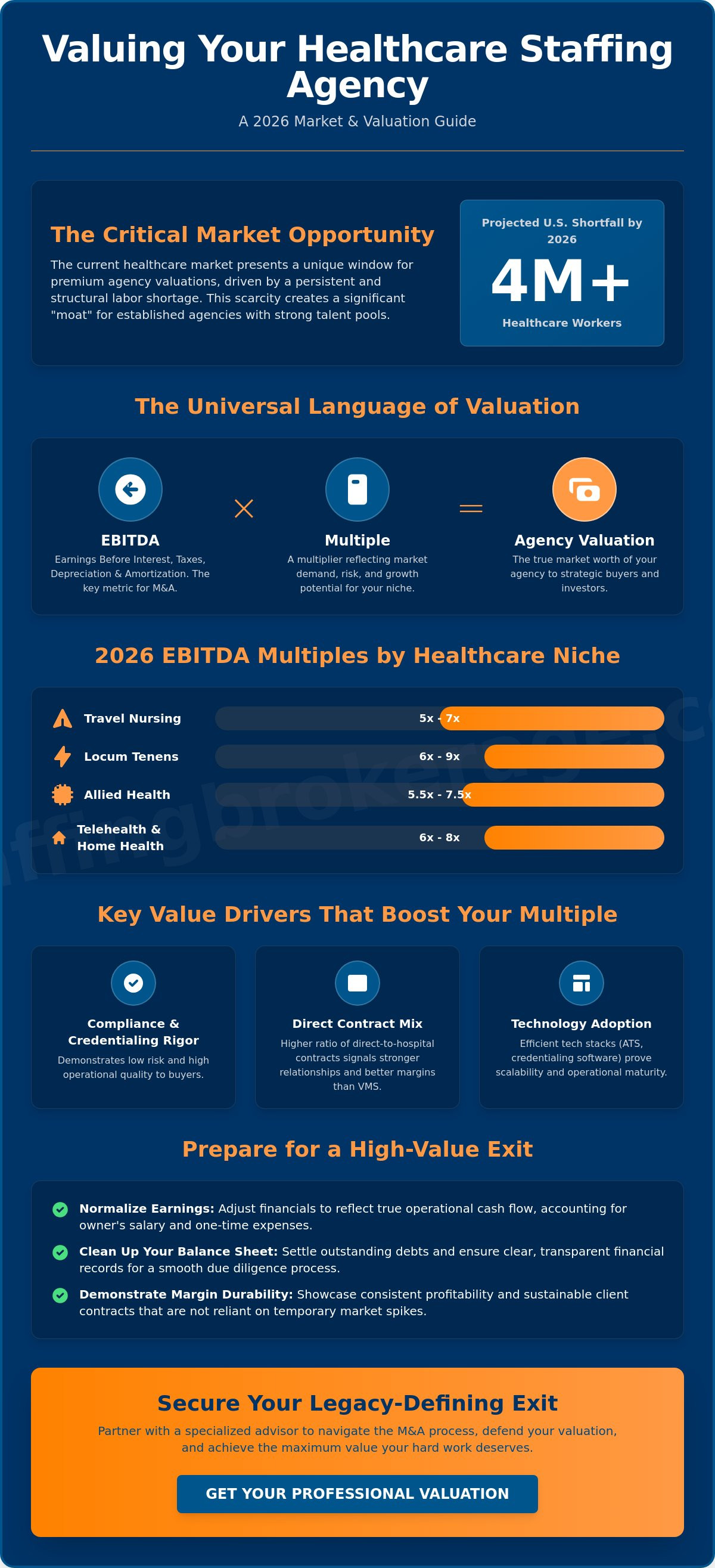
With a projected shortfall of over 4 million healthcare workers hitting the U.S. in 2026, your agency is more than just a business. It's a vital solution in a high-stakes market. You've likely spent late nights wondering how to value a healthcare staffing agency when burnout and labor shortages dominate the headlines. It's a common concern, especially when you're trying to figure out if your VMS contracts are boosting your worth or creating hidden risks for a buyer.
We believe your hard work deserves a transparent and rewarding exit. This guide helps you master the specific EBITDA multiples and healthcare-specific value drivers that determine your agency’s true market worth. Whether you're managing a niche firm with a 3x multiple or a regional powerhouse aiming for 7x, we'll show you how to normalize earnings and build a roadmap for a successful transition. We'll explore why margin durability, technology adoption, and compliance rigor are your biggest assets in today's market.
Key Takeaways
- Learn how the persistent 2026 healthcare labor shortage creates a unique window for premium agency valuations.
- Gain a clear understanding of how to value a healthcare staffing agency using EBITDA multiples that reflect your specific market tier.
- Identify the "hidden" value drivers, such as credentialing rigor and direct contract mix, that significantly boost your final sale price.
- Discover the essential steps to normalize your earnings and clean up your balance sheet for a seamless M&A transition.
- See why partnering with a specialized advisor helps you defend your valuation and secure a legacy-defining exit.
Understanding the Healthcare Staffing Market Dynamics in 2026
The healthcare staffing market has reached a point of mature, sustainable growth in 2026. The frantic, temporary spikes seen during the pandemic have settled into a more predictable rhythm. While other sectors like IT or light industrial staffing often fluctuate with the economy, healthcare remains remarkably resilient. People always require medical care, regardless of market cycles. This inherent stability is a primary reason why strategic buyers continue to prioritize healthcare agencies for their portfolio diversification.
A critical factor driving today's market is the persistent labor shortage. With the U.S. facing a shortfall of over 4 million healthcare workers this year, your agency serves as a vital bridge in the healthcare infrastructure. This supply-and-demand gap keeps valuations high because the difficulty of recruiting and retaining talent creates a significant barrier to entry for competitors. When you look at how to value a healthcare staffing agency, you must account for this "scarcity premium" that your talent pool represents.
Understanding these broader trends is the first step in applying standard business valuation methods to your specific firm. Buyers aren't just looking at your past year of revenue; they're evaluating how your agency is positioned to thrive in a high-demand, low-supply environment over the next decade.
The Role of Specialized Niches
Specialization is currently your strongest defense against margin compression. While general nursing remains a staple, specialized niches like locum tenens and allied health are commanding significantly higher multiples. These areas require deeper credentialing expertise and specialized recruiter knowledge. It's also worth noting that nursing burnout hasn't diminished the agency model. Instead, many clinicians now prefer the flexibility of contract work over permanent hospital roles. This shift ensures a steady supply of experienced candidates for agencies that prioritize clinician relationships. Additionally, telehealth and home-health staffing have emerged as high-value sub-sectors as care continues to move outside traditional hospital walls.
Market Sentiment and Buyer Appetite
In 2026, we're seeing a clear "flight to quality" among both private equity firms and strategic corporate buyers. They're moving away from high-risk acquisitions and focusing on mid-sized agencies with clean financials and diversified client bases. While interest rates have stabilized, they still play a role in how deals are structured. You'll likely see a greater emphasis on earn-outs and performance-based milestones. These structures help bridge the gap between a seller's vision and a buyer's risk assessment. A well-prepared agency that demonstrates operational rigor is perfectly positioned to navigate these discussions and secure a premium exit.
Core Valuation Methods: Multiples and EBITDA Explained
When determining how to value a healthcare staffing agency, EBITDA (Earnings Before Interest, Taxes, Depreciation, and Amortization) is the most critical metric. It serves as the universal language for buyers. This formula allows them to compare companies across different tax structures and debt levels without those variables clouding the view of operational health. While smaller agencies might focus on Seller’s Discretionary Earnings (SDE), sophisticated buyers in the M&A space prioritize EBITDA because it reflects the true cash flow available to a new owner after a transition.
Revenue multiples often serve as a quick sanity check, but they don't account for your operational efficiency. Two agencies with $20 million in revenue can have vastly different values if one has a 20% margin and the other only 10%. Positive Healthcare industry growth projections support strong multiples across the board, but your bottom line is what ultimately closes the deal. Buyers are paying for future cash flow, and EBITDA is the most reliable predictor of that performance.
SDE includes the owner's salary and personal perks, which is common for "lifestyle" businesses. In contrast, EBITDA assumes a professional management team is in place. If you're still working 60 hours a week as the primary recruiter, we'll need to adjust your earnings to account for the cost of hiring your replacement. This distinction is vital for a successful exit. A professional business valuation and assessment can provide the clarity you need to see where your agency stands today.
Current 2026 Multiples by Healthcare Niche
- Travel Nursing: These multiples have stabilized in the 5x to 7x range for agencies with $1 million to $10 million in EBITDA. The market has moved past the volatile pandemic peaks, favoring agencies with sustainable hospital contracts and durable margins.
- Locum Tenens: High-margin physician staffing remains a "darling" for investors. Due to the specialized nature and persistent provider shortages, these firms often command premiums in the 8x to 10x range.
- Per Diem and Allied Health: Localized agencies typically see multiples between 3x and 5x. However, specialized allied niches like physical therapy or radiology can push toward the 7x mark if they show strong regional dominance.
The Normalization Process
EBITDA normalization is the process of stripping away non-operational costs to reveal true profitability. This step is where we find the "hidden" value in your agency. We look for valid add-backs, such as one-time legal fees, excess owner salaries, or non-recurring technology pivots that won't continue after a sale. It's also vital to adjust for "COVID-cliff" revenue. Buyers want to see your sustainable baseline earnings rather than temporary spikes from crisis rates. By cleaning up the financials now, you ensure that you don't leave money on the table during the final negotiation.
Healthcare-Specific Value Drivers: Beyond the Financials
While the numbers on your balance sheet provide a foundation, the operational details determine whether a buyer actually believes those numbers are sustainable. When you look at how to value a healthcare staffing agency, you have to look past the EBITDA. You must evaluate the structural integrity of your revenue. A buyer isn't just purchasing your past success; they're buying the certainty that your profits will continue after you hand over the keys. This is where qualitative value drivers become your most powerful negotiation tools.
Client concentration is often the first "risk hair" a buyer looks for. If 50% or more of your revenue is tied to a single hospital system, your valuation will likely face a "concentration discount." Buyers view this as a binary risk, if that one contract is lost, the business model collapses. Diversifying your client base across multiple systems or geographic regions is a proven way to defend your multiple. Similarly, the stability of your internal team matters. If your top three recruiters have been with you for five years, your agency is far more valuable than a firm with a revolving door of staff. Your internal culture is the engine that keeps your clinicians placed and your clients happy.
The VMS and MSP Impact
In the 2026 market, the type of contracts you hold significantly influences your strategic value. Revenue derived from low-margin Vendor Management System (VMS) portals is often discounted because the agency lacks a direct relationship with the facility. You're simply a name in a portal. However, if you've secured "Tier 1" status within a Managed Service Provider (MSP) or hold direct hospital contracts, your value increases. These "sticky" relationships with clinical managers and HR directors are hard for competitors to replicate. Buyers prioritize agencies that have a seat at the table rather than those just fighting for scraps in a digital queue.
Compliance as a Competitive Advantage
Credentialing and compliance are the "hidden" assets that can either seal a deal or kill it during due diligence. In an era of heightened scrutiny, having impeccable clinical files isn't just good practice, it's a requirement for a high-value exit. The Joint Commission (TJC) accreditation serves as a gold standard that signals operational rigor to a potential buyer. A clean Joint Commission audit can add 0.5x to 1.0x to a final valuation multiple. When your files are audit-ready and your processes are scalable, you reduce the perceived risk for the buyer, allowing them to move forward with confidence and a higher offer.
Preparing Your Healthcare Agency for a High-Value Exit
Knowing how to value a healthcare staffing agency is only the first step. The real work begins when you start intentionally building that value to secure a legacy-defining exit. Preparation is about more than just numbers. It's about making your agency "buyer-ready" by removing friction and proving sustainability. A clean balance sheet is your best friend during due diligence. You should start by removing personal expenses and aggressively managing aged accounts receivable (AR). In healthcare, where payment cycles can be slow, showing a tight AR process demonstrates operational excellence.
Diversifying your client base is equally vital. If you've identified a concentration risk, now is the time to secure long-term contracts with new facilities to balance the scales. Investing in scalable technology also pays dividends. Buyers look for agencies that use modern Applicant Tracking Systems (ATS) and automated credentialing tools. These systems prove that your agency can handle growth without breaking. If you're ready to start this journey, our team provides expert staffing company sell-side representation to ensure every detail is polished before you meet a buyer.
The 12-Month Preparation Runway
Success doesn't happen overnight. We recommend focusing on maximizing value selling staffing company at least a year before you plan to list. This window allows you to commission a "Quality of Earnings" (QofE) report. This third-party audit validates your EBITDA and pre-empts buyer concerns. It's also the time to empower a "second-in-command." A buyer needs to see that your agency thrives because of its systems and leadership team, not just because of your personal connections.
Financial Transparency and Reporting
Professional buyers expect professional reporting. Moving from cash-basis to accrual accounting is essential for a cleaner staffing company valuation. Accrual accounting matches revenue with the period in which the work was performed, giving a much clearer picture of your monthly performance. You should also start tracking Gross Margin per clinician as a primary KPI. Finally, begin building a "Data Room" now. Having your credentialing logs and contract summaries organized and ready for review shows a level of preparedness that builds immense buyer confidence.
Navigating the Valuation Journey with Staffing Brokerage
Choosing the right partner to represent your life's work is a decision that impacts your financial future and your legacy. While a generalist business broker might understand basic accounting, they often fail to capture the specific nuances that drive value in the medical field. They might overlook the strategic worth of your Joint Commission accreditation or misunderstand the durability of your locum tenens margins. We focus exclusively on this sector, using industry-specific data to defend your multiple and ensure you receive every dollar you've earned. When you're determining how to value a healthcare staffing agency, you need a specialist's eye to capture the full picture.
Our "steady hand" approach means we're with you from the initial assessment to the final signature at the closing table. We don't just list businesses; we build a narrative of value. By leveraging our national network of strategic and financial healthcare buyers, we create a competitive environment that favors your goals. This collaborative journey is built on transparency and integrity, ensuring you feel confident and informed throughout the entire M&A process. We're here to act as your dedicated guide, making sure the transition is as smooth as possible.
Our Strategic Assessment Process
Our process begins with a deep-dive assessment of your agency’s clinical and financial health. We look beyond the surface to identify "hidden gems," such as proprietary recruiter training programs or high-performing niche specialties, that buyers will pay a premium for. This thoroughness allows us to develop a personalized strategy to sell my staffing agency with total confidence. We align your agency's strengths with the specific needs of current market leaders to ensure a perfect strategic fit. By highlighting your unique value drivers, we help you stand out in a crowded marketplace.
Your Partner in a Seamless Transition
Because we also provide staffing company buy-side advisory, we have a front-row seat to what today's buyers are looking for. This dual perspective allows us to anticipate buyer questions and address concerns before they become deal-breakers. We manage the emotional and logistical complexities of the transaction so you can stay focused on running your business. Our goal is to create a win-win scenario where your legacy is preserved and your financial goals are met. Reach out to our team today for a confidential valuation of your healthcare agency. Let's start this journey together.
Secure Your Future with a Strategic Valuation
Your journey through the complexities of the 2026 market has likely shown you that your agency is more than just its revenue. By focusing on margin durability, cleaning up your balance sheet, and prioritizing clinical compliance, you've already begun the work of building a high-value business. Mastering how to value a healthcare staffing agency is about recognizing the unique scarcity premium your firm offers in a world facing massive healthcare worker shortfalls. You now have the roadmap to move from operational success to a legacy-defining exit.
We're here to ensure you don't navigate this transition alone. With our specialized healthcare staffing M&A expertise and a national network of qualified buyers, we've helped many entrepreneurs achieve proven results in high-multiple exits. Our team is ready to act as your reliable ally, providing the steady hand you need to cross the finish line with confidence. Get a Professional Valuation of Your Healthcare Staffing Agency today to see the true market worth of what you've built. We look forward to partnering with you on this next chapter and celebrating your success together.
Frequently Asked Questions
What is the average EBITDA multiple for a healthcare staffing agency in 2026?
In 2026, average EBITDA multiples for small healthcare staffing firms with under $1 million in earnings typically range from 3x to 5x. Agencies with EBITDA between $1 million and $10 million often see multiples in the 5x to 7x range. Larger national agencies can command between 8x and 12x. These figures depend on your specific niche, geographic reach, and operational efficiency.
How does client concentration affect the value of my nursing agency?
High client concentration usually leads to a valuation discount because it increases the buyer's perceived risk. If one hospital system accounts for more than 25% of your revenue, buyers may lower their offer or structure a larger portion of the deal as an earn-out. Diversifying your client base across multiple systems helps protect your multiple and ensures a more stable transition for the new owner.
Can I value my agency based on revenue instead of profit?
While revenue is a useful benchmark, most sophisticated buyers prioritize EBITDA when determining how to value a healthcare staffing agency. Revenue multiples act as a quick sanity check, but they don't account for your overhead or margin health. Buyers are primarily paying for future cash flow, which is why a profitable agency with lower revenue often outvalues a high-revenue firm with razor-thin margins.
Does Joint Commission accreditation increase my business value?
Yes, Joint Commission (TJC) accreditation can significantly increase your agency's value by signaling operational rigor and compliance excellence. A clean TJC audit reduces the risk during due diligence and can add 0.5x to 1.0x to your final valuation multiple. It proves to buyers that your clinical processes are scalable and meet the highest industry standards, making your agency a "flight to quality" target.
What is the difference between a strategic buyer and a financial buyer in healthcare?
A strategic buyer is typically another staffing firm or healthcare system looking for synergies, while a financial buyer, like a private equity firm, focuses on ROI and growth potential. Strategic buyers often pay a premium because they can reduce overhead by merging back-office operations. Financial buyers look for strong management teams and scalable platforms that can serve as a foundation for future "bolt-on" acquisitions.
How long does the valuation and sale process typically take for a staffing firm?
The typical timeline for valuing and selling a staffing firm ranges from six to nine months. This period includes the initial assessment, marketing the business to our national network, due diligence, and final legal closing. Preparing your data room and financials at least a year in advance can significantly shorten this window. We focus on a methodical pace to ensure you feel informed rather than overwhelmed.
What are common "add-backs" when valuing a healthcare staffing business?
Common add-backs include one-time legal fees, excess owner salaries, and non-recurring technology investments. These adjustments are essential when learning how to value a healthcare staffing agency because they normalize your earnings. By adding back personal expenses or non-operational costs, you provide a clearer picture of the sustainable baseline earnings. This process ensures you don't leave money on the table during the final negotiation.
How do VMS and MSP contracts impact my agency’s multiple?
VMS and MSP contracts impact your multiple based on your "tier" status and the margin durability of the relationship. Revenue from low-margin VMS portals is often discounted because it lacks a direct hospital relationship. However, holding a "Tier 1" status or a direct hospital contract adds significant strategic value. Buyers want to see "sticky" contracts that ensure long-term revenue stability and provide a competitive advantage in the local market.


