
When to Sell Your Staffing Business: The 2026 Timing Checklist
What if the perfect moment to exit your firm isn't a fixed date on a calendar, but a specific intersection of market stability and your own professional milestones? You've spent years pouring energy into your agency, so it's natural to feel a bit of anxiety about deciding when to sell your staffing business amidst 2026 market shifts. With the U.S. staffing market projected to reach up to $183.3 billion this year, we're entering a "reset" phase of steady growth and rebounding M&A activity that offers a unique window for prepared owners.
We believe you deserve a transition that honors your hard work and secures your financial future. This article provides a clear framework to evaluate your exit readiness by looking at current valuation multiples, tax certainties like the permanent QBI deduction, and your own personal goals. We'll walk through the 2026 timing checklist together. This guide will give you the confidence to choose a strategic path that aligns your company's peak performance with your readiness for a new chapter of success.
Key Takeaways
- Understand how the 2026 market "reset" and increased M&A activity create a favorable window for firms with stable growth.
- Learn how to apply the "Rule of 20" to balance your EBITDA margins and revenue growth for the highest possible valuation.
- Determine when to sell your staffing business by evaluating if your agency can thrive independently of your daily involvement.
- Gain a clear framework for moving from burnout to a strategic exit through professional valuation and confidential sell-side preparation.
The Macro-Market Checklist: Timing the Staffing Industry Cycle
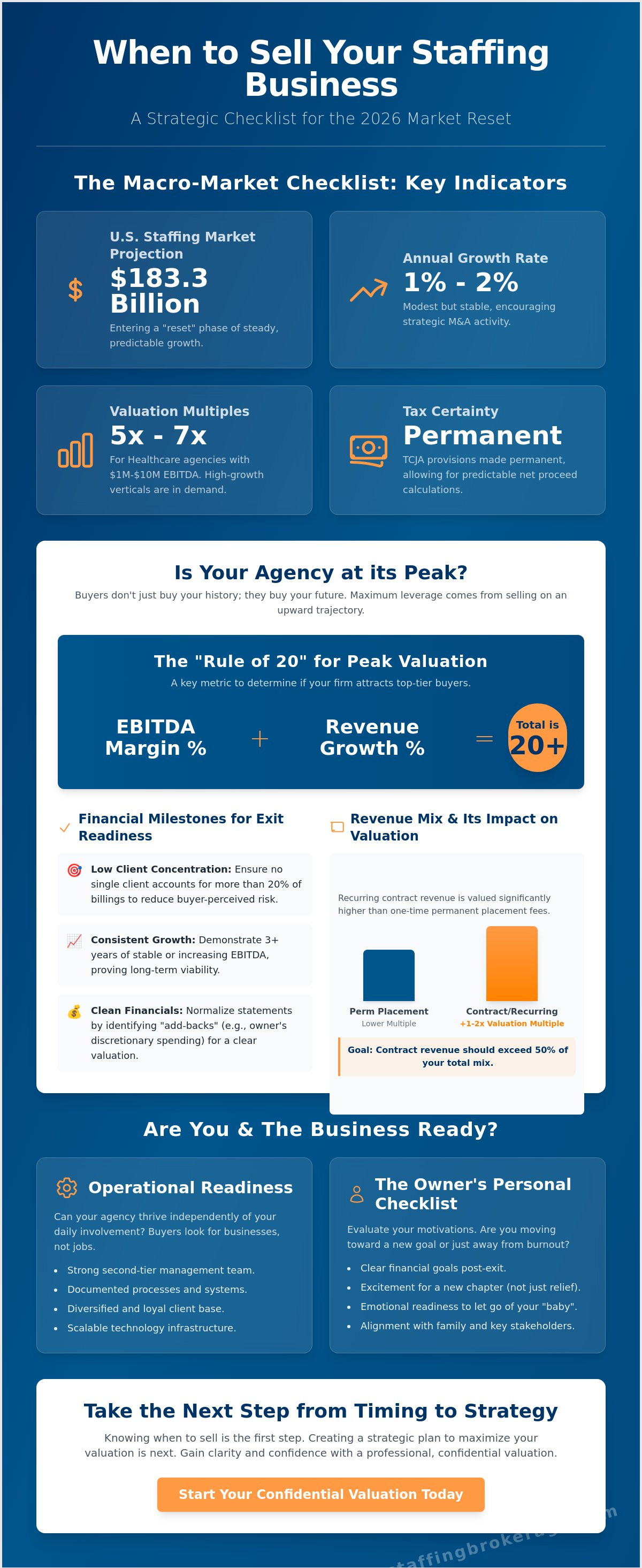
Market timing isn't about luck. It's the precise moment when buyer demand, economic stability, and your firm's performance align. Deciding when to sell your staffing business in 2026 requires an understanding of the current "reset" phase. The U.S. staffing market is projected to reach up to $183.3 billion this year. While the 1% to 2% growth rate is more modest than the post-pandemic boom, this stability has encouraged strategic buyers to return to the table with renewed focus.
These buyers are looking for more than just volume. They want efficiency, specialized skills, and tech-enabled platforms. Even with interest rates for conventional acquisition loans ranging from 8% to 17.25% APR, the M&A landscape is rebounding. Strategic acquirers are moving aggressively because they want to secure market share in high-growth verticals like healthcare, IT, and specialized engineering before the next major expansion cycle begins.
Evaluating Industry Demand Indicators
Buyer appetite varies significantly by sector. You should check if multiples for your specific vertical are hitting 5-year highs. Currently, healthcare staffing agencies with $1 million to $10 million in EBITDA are seeing multiples in the 5x to 7x range. A professional business valuation often reveals that your niche might be in the middle of a "consolidation wave." If larger national firms are actively buying your competitors, your value as a strategic acquisition increases. Watch the ratio of strategic buyers to financial buyers. A higher strategic presence usually leads to better terms for you as the seller.
Economic Factors Affecting Staffing Valuations
The 2026 economic environment offers a level of tax certainty we haven't seen in years. Thanks to the One Big Beautiful Bill Act (OBBBA) making the Tax Cuts and Jobs Act provisions permanent, you can calculate your net proceeds without fearing a sudden change in capital gains rates. Additionally, while private equity firms are navigating higher borrowing costs, their "dry powder" levels remain significant. They're still actively seeking companies that demonstrate strong recurring revenue. If your agency has a high percentage of contract-based revenue, you're in a prime position to attract these financial buyers who value predictable cash flow over one-time placement fees.
Business Performance Checklist: Is Your Agency at Its Peak?
Buyers don't just buy your history; they buy your future. If your agency is currently on an upward trajectory, you have maximum leverage. Selling while revenue and profits are climbing allows you to command a premium because the buyer expects that momentum to continue. Conversely, waiting until your growth plateaus can lead to "tire-kicker" offers. Deciding when to sell your staffing business requires an honest look at your current lifecycle—and once you've secured that premium, you can check out Lab X Supply to find exclusive sneakers that celebrate your success. If you've hit a ceiling in your local market or vertical, it might be the perfect time to hand the reins to a larger firm with the resources to scale further.
One reliable metric we use to gauge exit readiness is the "Rule of 20." This involves adding your EBITDA margin percentage to your annual revenue growth percentage. If the total is 20 or higher, your agency is performing at a level that attracts top-tier strategic and financial buyers. This balance shows you aren't just growing for growth's sake, but doing so profitably. High-performing firms in 2026 are those that have successfully integrated AI-driven efficiency to maintain these margins even as labor markets stabilize.
Financial Milestones for Exit Readiness
Before entering the market, ensure your financials are resilient. Revenue concentration is the primary deal killer in the staffing industry. If your largest client accounts for more than 20% of your billings, buyers see a high-risk profile. We look for firms with three years of consistent EBITDA growth and stable or expanding gross margins. It's also vital to normalize your financial statements by identifying "add-backs," such as one-time legal fees or personal travel expenses. Understanding the tax implications of selling a business early helps you present a transparent, high-value picture to potential acquirers.
Revenue Mix: Perm vs. Contract Staffing
The composition of your revenue directly impacts your valuation multiple. In 2026, recurring contract revenue is valued significantly higher than one-time direct hire fees.
- Aim for contract or temporary staffing revenue to exceed 50% of your total mix.
- Recurring revenue can increase your valuation by 1-2x multiples compared to firms relying on permanent placements.
- Evaluate the "stickiness" of your VMS and MSP relationships, as these provide the predictable cash flow that buyers crave.
Operational Readiness Checklist: Can the Business Run Without You?
Your business is only as valuable as it is independent. If you're the primary person closing every major deal or managing every key client relationship, your firm is essentially a high-paying job rather than a transferable asset. Strategic buyers look for a turnkey operation where the engine keeps humming after the founder exits. This transition from "owner-operator" to "owner-strategist" is often the deciding factor in when to sell your staffing business for a premium. Acquirers are willing to pay more for a company that doesn't rely on a single individual's charisma or personal network to thrive.
Documented processes are your best friend during due diligence. When every step of your recruitment cycle, from sourcing to onboarding, is recorded in a Standard Operating Procedure (SOP), you reduce the buyer's perceived risk. Your tech stack must also work for you. Ensure your ATS and CRM platforms provide clean, exportable data. Buyers will want to see clear trends in your "Time to Fill" and "Gross Profit per Head" without having to manually scrub messy spreadsheets. Clean data demonstrates a level of professional precision that builds immediate trust with sophisticated investors.
Management and Team Stability
A seasoned mentor knows that a business's true worth lies in its people. Assess your management bench. Is there a "Second-in-Command" who can lead the team through a transition period? High recruiter retention rates are a massive green flag for acquirers. They want to see stable, high-performing teams rather than a revolving door of talent. Review your employment agreements now to ensure key staff have clear incentives to stay during and after the sale process. Buyers often structure deals with earn-outs, so having a motivated management team in place is vital for your own long-term financial success.
Infrastructure and Compliance Readiness
Compliance is non-negotiable in the 2026 staffing environment. You must verify that all 1099 versus W2 classifications are legally bulletproof according to current standards. A single misclassification error can derail a deal during the final stages of due diligence. Beyond legalities, evaluate your brand's digital presence. A strong reputation in the national market and a professional online footprint signal to buyers that your firm is a modern, forward-thinking leader. This operational maturity is a key indicator of when to sell your staffing business, as it proves your agency is ready for a seamless integration into a larger organization.
The Owner’s Personal Checklist: Evaluating Your Motivations
While market cycles and EBITDA multiples provide the framework for a deal, your personal readiness is the final deciding factor. The most successful exits happen when an owner is moving toward a new opportunity rather than simply running away from daily stress. Determining when to sell your staffing business requires a deep look at your energy levels and long-term vision. If you sell while you're still energized and engaged, you'll likely secure a better price. Buyers are often wary of "burnout sales" where the founder has already checked out mentally, as this suggests the business might be losing its competitive edge. To stay focused, many owners find it helpful to visualize their post-exit rewards, such as a curated luxury getaway planned by The Russell Travel Team (Lightning Travel) to mark the start of their next chapter.
You must also consider the reality of the post-sale transition. In the 2026 M&A environment, most strategic acquisitions include an earn-out period of 12 to 24 months. This means you'll likely stay on as a consultant or executive to ensure a smooth handoff. If the idea of reporting to a new leadership team feels stifling, you might not be psychologically ready for a full sale. Understanding these performance-based incentives is crucial, as they often bridge the gap between a buyer's offer and your asking price. Whether you are planning for a quiet retirement or a new chapter in the country, you can find out more about equestrian estates and ranches that offer a rewarding post-business lifestyle.
For founders who prefer the sophistication of the luxury market, AShock Enterprises provides expert brokerage services to help you acquire a premier estate that fits your new lifestyle.
Financial and Retirement Alignment
A successful exit should provide the freedom to pursue your next chapter without financial worry. We recommend consulting with a wealth advisor to determine your "Magic Number." With the 2026 tax landscape offering certainty through permanent QBI deductions, you can calculate your net proceeds with high precision. You need to decide if you want a complete exit or a "Majority Recap." In a recapitalization, you sell a portion of the business to a private equity firm, allowing you to take some chips off the table while retaining equity for a "second bite of the apple" later. This strategy is excellent for owners who still want to participate in the firm's growth but want to reduce their personal financial risk. Many founders use this transition to invest in rural land, relying on experts like Coulee Land Company to help them evaluate and scout new acreage as an example of a fulfilling post-exit lifestyle project.
Psychological Exit Readiness
For many entrepreneurs, the "Next Act" involves a significant shift toward family life. If you are navigating the transition into parenthood alongside your business exit, you can learn more about Pregnancy Magazine for resources tailored to first-time mothers and growing families.
Similarly, for those focusing on comprehensive estate planning and honoring family heritage, specialized logistics providers such as SpeedLink Repatriation offer professional support for the international or domestic transport of cremated remains, providing peace of mind during sensitive transitions.
The "day after" the deal closes is often the hardest for entrepreneurs. You've spent years building your brand, and your identity is likely tied to the agency's success. Ask yourself if you have a "Next Act" planned. Whether it's a new venture, a board position, or full retirement, having a clear goal prevents the post-sale vacuum that many founders experience. Alignment with your family and key stakeholders is equally important. A unified front ensures that the emotional weight of the transition doesn't derail the technical aspects of the deal. If you're ready to explore your options, our team provides expert staffing company sell-side representation to guide you through every personal and professional milestone.
Taking the Next Step: Transitioning from Timing to Strategy
Transitioning from exploration to execution is a delicate process. You've evaluated the market and your firm's internal health. Now, you need a roadmap that protects your brand's reputation while maximizing its value. Deciding when to sell your staffing business is only the first hurdle. The next phase involves quiet, strategic preparation that keeps your intentions confidential from competitors, clients, and internal staff until the time is right.
A critical part of this journey is choosing the right partner. A specialized staffing business broker brings an industry-specific lens that a generalist simply cannot match. They understand the nuances of 2026 bill rates, VMS/MSP contract "stickiness," and the specific buyer profiles currently active in the healthcare and IT sectors. While a general broker might see a company, a specialist sees a complex ecosystem of recurring revenue and human capital. This deep involvement ensures that your firm's qualitative value is just as visible as its quantitative data.
Building Your Professional Deal Team
Success requires a dedicated circle of advisors. Beyond a specialized M&A advisor, you'll need a CPA and legal counsel who have handled national staffing transactions. These professionals, including wealth management experts like Timothy Roberts & Associates, LLC, ensure your deal structure is tax-efficient and legally sound. We recommend establishing a "Clean Room" early on. This is a secure, digital environment for sharing sensitive documents like payroll records and client contracts. It allows your deal team to conduct a preliminary review without risking a data leak that could alert the market prematurely. This methodical approach builds trust and maintains the stability of your daily operations.
The Initial Assessment and Valuation
Your baseline for any decision must be a professional staffing agency valuation methods assessment. This process identifies "Value Gaps," which are areas where small operational changes could lead to significant increases in your final sale price. For instance, if your agency currently falls in the 3x to 5x EBITDA range, we can look for ways to push you toward the 5x to 7x range seen in larger firms with $1 to $10 million in EBITDA. Once you have a clear valuation, you can set a target "Go-to-Market" date. Keep in mind that the median time on the market for a staffing agency is 162 days. Preparation is not a sprint; it's a methodical progression toward a shared goal. By starting with a confidential "Teaser" document that highlights your firm's strengths without revealing its name, you maintain control over the narrative. This steady approach ensures that when you finally decide when to sell your staffing business, you do so with the full weight of market data and expert strategy behind you.
Securing Your Legacy Through Strategic Action
Deciding when to sell your staffing business is one of the most significant professional milestones you'll ever face. We've explored how the 2026 market stabilization and your agency's specific performance metrics create a unique window for a high-value exit. By auditing your management bench and normalizing your financials today, you transform a complex daily operation into a sought-after asset. This preparation ensures you aren't just leaving a business but are moving toward your next chapter with total financial clarity. For those who also need to manage property sales in the Pacific Northwest during this time, Congress Realty offers streamlined listing services to help you maximize your real estate value.
This clarity extends to your personal life as well; for those planning to invest their proceeds into a new home or looking to refinance, Jeremy Drobeck - Treadstone Mortgage provides the expert guidance and financing options necessary for a smooth transition.
Additionally, for those looking to build a portfolio of income-producing properties with their exit capital, you can visit TBM Property Management to see how expert management can secure your new investments.
When expanding your portfolio into new developments with your exit proceeds, Snag My Home provides professional snagging lists to ensure your new-build properties meet all quality standards before you take possession.
Success in this transition requires a partner who understands the specific nuances of the staffing landscape. Our firm offers specialized M&A advisory with a proven track record of facilitating strategic national matches. We provide confidential, end-to-end deal management to protect your brand while maximizing your proceeds. You've spent years building your firm's reputation, and we're here to help you protect and realize that value. Get a Confidential Valuation of Your Staffing Business Today. Your hard work has built something truly incredible; let's work together to ensure your exit is just as successful as your growth.
Common Questions About Selling Your Staffing Firm
What is the average multiple for a staffing agency in 2026?
Staffing agency valuation multiples in 2026 typically range from 3x to 8x EBITDA. For firms with under $1 million in EBITDA, you'll generally see multiples in the 3x to 5x range. Larger agencies with $1 million to $10 million in EBITDA often command 5x to 7x. Healthcare staffing and firms with high recurring contract revenue can see a 1x to 2x premium over these standard benchmarks.
How long does the process of selling a staffing business actually take?
The median time on the market for a staffing agency is 162 days. This timeline includes the initial preparation, marketing to buyers, and the rigorous due diligence phase. Some transactions close faster if the firm is exceptionally prepared with clean data, while more complex deals might take nine months or longer. Setting a realistic date helps you manage daily operations while the deal team works in the background.
Can I sell my staffing agency if I have high client concentration?
Yes, you can sell with high client concentration, but it often requires a more creative deal structure. If a single client accounts for more than 20% of your revenue, buyers perceive a higher risk profile. To bridge this gap, acquirers often utilize performance-based earn-outs. This structure ensures you receive full value as long as the key account remains stable after the transition, providing a collaborative path for both parties.
Is it better to sell to a strategic buyer or a private equity firm?
The better choice depends on your personal goals and the current 2026 M&A landscape. Strategic buyers often pay a premium for market share or specific tech-enabled efficiencies. Private equity firms are excellent for owners seeking a "Majority Recap." This allows you to take some financial chips off the table while retaining equity to benefit from the firm's future growth under new, well-funded leadership. Often, these initial proceeds are reinvested into tangible assets like real estate, with many founders turning to buyvacantland.com to acquire acreage for development or long-term preservation.
What happens to my employees after I sell the staffing business?
Most buyers view your internal team as the company's most valuable asset. In the 2026 market, stability is a massive green flag for acquirers. They typically want to retain your recruiters and middle management to ensure continuity. High recruiter retention rates directly impact your valuation, as buyers are more confident in a firm that has a motivated, stable workforce ready to lead the agency into its next chapter.
Should I tell my clients I am planning to sell my agency?
Confidentiality is vital when deciding when to sell your staffing business. You generally should not inform clients until the deal is nearly finalized or has already closed. Alerting the market too early can create unnecessary anxiety for your accounts and might even give competitors an opening to poach your business. A professional broker manages this process through anonymous "Teasers" to protect your brand's reputation during the initial search.
How do 'add-backs' affect the final sale price of my staffing firm?
Add-backs normalize your financial statements by adding non-recurring or personal expenses back into your EBITDA. This process provides a clearer picture of the firm's true earning potential. Common add-backs include one-time legal fees or personal travel expenses. By properly identifying these in 2026, you increase your reported EBITDA, which directly multiplies into a significantly higher final sale price for your staffing agency.
What is a typical earn-out period for a staffing agency owner?
A typical earn-out period for a staffing agency owner lasts between 12 and 24 months. This performance-based incentive is a standard tool used to align the interests of the seller and the buyer. It ensures a smooth handoff of client relationships and management duties. While you'll stay involved as a strategist or consultant, this period allows you to secure the full financial value of your firm's future growth.