
Selling Your Niche Staffing Agency: A Strategic Guide to Maximizing Exit Value in 2026
With 27,000 staffing firms competing in a fragmented U.S. market, you might worry that your specialized focus limits your pool of potential buyers. The reality in 2026 is exactly the opposite. If you plan to sell niche staffing agency assets this year, your specialization is actually your most powerful lever for a premium valuation. Strategic buyers are actively seeking the rare candidate pools and deep industry expertise you've built, often paying 1x to 2x higher multiples for firms with strong recurring contract revenue.
You've worked hard to establish your legacy, so it's natural to feel protective of your client relationships and employee trust during a transition. We know that the M&A process can feel overwhelming when you're balancing daily operations with complex due diligence. This guide will show you how to transform your market position into a competitive advantage that attracts the right strategic partners. You'll discover the specific metrics driving 2026 valuations and learn a methodical approach to securing a confidential sale that honors your history while maximizing your exit value.
Key Takeaways
- Understand why specialized talent scarcity creates significant enterprise value and higher valuation multiples in the 2026 market.
- Identify the "Gold Standard" metrics for your specific vertical that turn niche expertise into a measurable financial premium.
- Learn how to position your firm to sell niche staffing agency assets to strategic buyers who prioritize specialized candidate access over simple volume.
- Follow a structured roadmap to de-risk your operation and ensure your business valuation accurately reflects your specialized market position.
- Discover why specialized M&A advisory is the key to protecting your legacy and securing a smooth transition for your clients and staff.
The Niche Premium: Why Specialized Staffing Agencies Command Higher Multiples in 2026
In the 2026 M&A market, the definition of a niche staffing agency has evolved. It’s no longer just about picking a broad vertical like healthcare or IT. It’s about owning a specific, high-demand skill set that larger competitors struggle to source independently. When you decide to sell niche staffing agency assets, you aren't just selling a book of business. You're selling a "moat." Large, generalist firms often use these acquisitions as strategic entry points into complex markets where they lack the internal expertise to compete. This shift from volume-based recruitment to specialized skill-access has fundamentally changed how buyers view enterprise value. For a foundational employment agency overview, it's clear that the role of the recruiter has transitioned from a generalist matchmaker to a specialized talent consultant.
Scarcity is the primary driver of value. With approximately 27,000 staffing companies operating in the U.S., the market is highly fragmented. Most of these firms compete on price in generalist sectors. However, niche agencies that focus on rare candidate pools create a level of scarcity that buyers are willing to pay for. These firms don't just fill seats; they provide access to talent that is otherwise unreachable. This specialized focus transforms your agency from a commodity service provider into a strategic partner, which is exactly what premium buyers look for during a transition.
Understanding the Valuation Gap
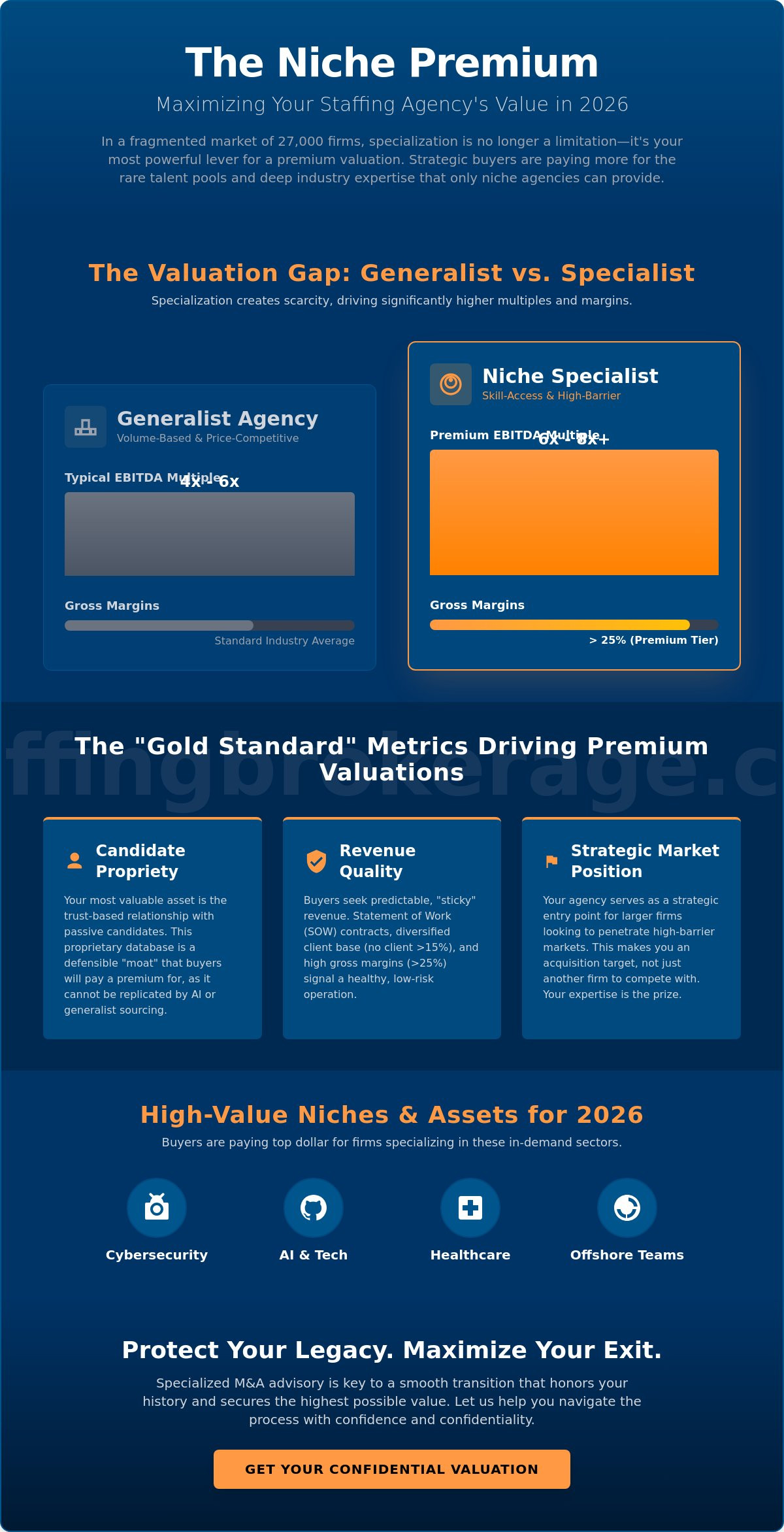
The financial data from 2026 confirms a widening spread between generalist and specialized firms. While a typical clerical or light industrial agency might see EBITDA multiples in the 4x to 6x range, niche firms frequently command 6x to 8x, or even higher. It’s common for specialized agencies to maintain gross margins that are 5% to 10% higher than their generalist counterparts. Buyers prioritize these "high-barrier" niches because they offer protection against economic cycles and downward pricing pressure. If your firm consistently delivers stable gross margins above 25%, you’re positioned in a premium tier that attracts both private equity and strategic corporate buyers. This is why it is vital to prepare early if you want to sell niche staffing agency operations for the highest possible price.
The Role of Candidate Propriety
Your candidate database is your most tangible asset in a sale. In an era where AI-driven tools can scrape public profiles in seconds, the true value lies in human-centric relationships with "passive" candidates. These are the professionals who aren't on job boards but will answer your call because of years of built-up trust. Buyers see this proprietary access as a hedge against technology. While AI handles the administrative heavy lifting, your agency’s ability to navigate the nuances of a specialized field remains irreplaceable. This deep candidate propriety ensures that your revenue is defensible and your market position is secure, making your firm an incredibly attractive target for acquisition.
Sector-Specific Value Drivers: IT, Healthcare, and Professional Services
Every vertical has its own "Gold Standard" metrics that dictate its worth in the M&A market. While generalist firms often struggle with high client turnover, niche firms thrive on the "stickiness" of their accounts. Buyers aren't just looking at your bottom line; they're evaluating the quality of your revenue. For instance, Statement of Work (SOW) contracts are typically valued higher than simple staff augmentation because they imply a deeper, project-based integration with the client. If you want to sell niche staffing agency assets at a premium, you must demonstrate that your revenue is both predictable and diversified. Ideally, your top ten clients should account for 30% to 40% of your revenue, with no single client exceeding 15%.
IT and Technical Staffing Multiples
In 2026, the high-water marks for technical staffing are found in cybersecurity and AI-specialized desks. Buyers pay a significant premium for agencies that maintain a "bench" of ready-to-deploy talent, as this reduces the lead time for new placements. Additionally, having established offshore or nearshore capabilities can increase your sale price. These models provide a diversified talent supply chain that many domestic-only buyers are eager to acquire to stay competitive in a global market. For agencies serving the manufacturing sector, showcasing established relationships with on-the-ground sourcing and procurement partners like Buying Office Asia can further demonstrate the strength of your international delivery model.
Healthcare and Locum Tenens Considerations
The U.S. locum tenens market is projected to reach $9.8 billion in 2026. This growth supports premium valuations for agencies that specialize in temporary physician and specialized nursing placements. For healthcare firms with over $5 million in annual EBITDA, valuation multiples can reach as high as 14x. Regulatory compliance is a major value-add here. Holding a Joint Commission certification or having a robust, automated credentialing process de-risks the acquisition, making your firm much more attractive to strategic buyers who are wary of legal and operational hurdles.
Engineering and Professional Services
Engineering firms are prime targets for large architecture and construction conglomerates because of their long-term project cycles. These cycles create the revenue predictability that financial buyers crave. If your agency holds a pool of candidates with high-level security clearances, your enterprise value increases significantly. These "cleared" talent pools are difficult and time-consuming to build from scratch, giving you a defensible market position that justifies a higher EBITDA multiple. Before you begin the process, obtaining a professional business valuation and assessment can help you identify which of these specific drivers are most prominent in your current operation.
The Strategic Match: Finding Buyers Who Value Niche Expertise
Identifying the right buyer is just as critical as the valuation itself. In the rebounding M&A market of 2026, two distinct groups are actively looking for acquisitions: financial buyers and strategic buyers. While a financial buyer primarily focuses on your EBITDA and cash flow stability, a strategic buyer looks for how your specific expertise completes their own business puzzle. When you prepare to sell niche staffing agency assets, your goal is to find a partner who views your specialized candidate pool as a missing link in their service offering. These buyers often pay a premium because acquiring your firm is faster and more reliable than trying to build a specialized desk from scratch.
We often see "adjacency buyers" entering the fold. These are companies in related fields, such as a large IT consultancy or a healthcare management group, that need a staffing arm to support their primary operations. By acquiring your niche agency, they gain immediate access to the talent they previously had to outsource. This cross-selling potential creates a level of value that isn't always visible on a standard balance sheet. It's about finding a partner who understands that your human capital is the engine behind their next phase of growth.
The Strategic Buyer Advantage
Strategic buyers calculate "synergy value," which often exceeds the standard market multiple. They look at how your firm can reduce their overhead or expand their reach into a high-demand vertical. For example, a global staffing firm might view your local healthcare agency as a "bolt-on" acquisition that provides an immediate foothold in the lucrative locum tenens market. When you negotiate with these entities, you aren't just selling your past performance. You're selling the future revenue they can't capture without you. This allows you to negotiate based on the scarcity of your talent pool rather than just your historical earnings.
Private Equity and the Roll-Up Strategy
Private equity (PE) firms are increasingly active in 2026, utilizing "platform" and "roll-up" strategies to consolidate fragmented niches. A PE firm might acquire a high-performing agency to serve as a platform, then buy smaller "add-on" firms to scale quickly. This model often includes the "second bite of the apple." In this scenario, you might sell a majority stake but retain a portion of equity. As the PE firm grows the combined entity and eventually sells it to a larger buyer, your remaining equity could lead to a significant second payout. This path is ideal if you want to stay involved in a leadership role while de-risking your personal wealth.
Preparation for a Niche Exit: A 5-Step Roadmap to Market Readiness
Preparing for an exit is a methodical process that requires precision. It begins with a deep dive into your current standing. Before you approach the market to sell niche staffing agency assets, you need an objective baseline. A professional business valuation specifically for the staffing sector is the first essential step. This isn't just about looking at last year's tax returns. It's about quantifying the value of your specialized candidate pools and your standing within your specific vertical.
Once you have a clear valuation, you must address the "Owner-Dependency" trap. Many niche firms are built on the personal reputation and deep industry contacts of the founder. If the business can't function without your daily involvement, its value to a buyer drops significantly. You need to transition those key relationships to your senior recruiters and document every specialized sourcing workflow. This ensures that the "secret sauce" of your agency stays with the business after the keys are handed over.
Operational De-risking
Your recruiters must be the face of the niche expertise. Buyers look for teams that can maintain high-margin placements without the founder's oversight. You should also audit your client contracts. Ensure they include "assignment" clauses that allow the contract to remain valid after a sale. This protection of recurring revenue is a major driver of those 1x to 2x higher multiples we discussed earlier. A buyer's confidence is built on the stability of the team they are inheriting.
Financial Hygiene for Staffing Firms
Financial cleanup in a niche agency involves more than just balancing the books. You need to normalize your EBITDA by identifying non-recurring expenses. Pay close attention to your burden rates and VMS/MSP fees. Buyers want to see gross margin trends by specific job category to confirm that your niche is as profitable as you claim. Research shows that firms with stable gross margins above 25-30% command significantly higher valuations. Factors like workers' compensation history and insurance premiums also impact the final check, so ensure these records are pristine.
The final steps involve creating a Confidential Information Memorandum (CIM) and launching a discrete marketing phase. Your CIM shouldn't just list numbers; it should tell the story of your niche and why it's a strategic asset for a buyer. When you're ready to sell niche staffing agency operations, our team provides expert staffing company sell-side representation to guide you through every stage of this roadmap.
Maximizing Your Legacy: Why Specialized M&A Advisory Matters
General business brokers often struggle to capture the full value of a specialized firm. They might understand basic accounting, but they don't speak the language of niche recruitment. They often overlook the value of a proprietary candidate database or the stability of high-margin contract revenue we've discussed throughout this guide. When you choose to sell niche staffing agency assets, you need an advisor who understands the difference between a generalist placement and a high-barrier technical desk. We ensure that your valuation reflects the rarity of your market position, not just your trailing earnings.
Confidentiality is the cornerstone of a successful exit. In the staffing world, your employees and clients are your greatest assets. If news of a sale leaks prematurely, it can trigger a wave of uncertainty that devalues the firm before the deal is even signed. We manage the process with a steady hand, utilizing a discrete, national marketplace of pre-qualified buyers. This allows us to find the right strategic partner without alerting your competitors or disrupting your daily operations. Our team provides the expert staffing company sell-side representation needed to protect your reputation while you move toward your next chapter.
The Advisor Advantage
Exiting a business you've spent years building is an emotional journey. It's more than a transaction; it's the culmination of your life's work. Our role is to act as your reliable ally, managing the complexities of negotiation while you focus on running your business. We bridge the "Value Gap" by highlighting the strategic synergies that generalist brokers often miss. By accessing our national database of pre-qualified staffing buyers, you aren't just waiting for an offer. You're choosing the best possible fit for your legacy and your team.
Your Next Steps with Staffing Brokerage
We believe in a collaborative approach that starts with a clear understanding of your personal and professional goals. Our process is methodical and transparent, ensuring you feel informed at every stage of the transition. We focus on finding a "Strategic Fit" that respects the culture you've built while maximizing your financial outcome. Schedule your confidential valuation with Staffing Brokerage today. Our deep industry expertise is the key to a smooth transition that secures your future and honors the business you've created.
Secure Your Future and Protect Your Legacy
The 2026 staffing market offers a unique window of opportunity for specialized firm owners. By focusing on your firm's scarcity and proprietary candidate pools, you can move beyond standard multiples to achieve a truly premium exit. We've explored how identifying sector-specific drivers and finding the right strategic match can transform your years of hard work into significant enterprise value. When you decide to sell niche staffing agency operations, the difference lies in having a partner who understands the nuances of your vertical.
Staffing Brokerage brings specialized M&A expertise exclusively to the staffing industry. We combine a national reach with a personalized, "steady hand" approach to ensure your confidentiality remains intact while we match you with the ideal strategic buyer. Our proven track record is built on transparency and a commitment to your long-term success. Don't leave your valuation to chance or a generalist broker who might overlook the true worth of your niche.
Get a Confidential Valuation of Your Niche Staffing Agency
We're here to guide you through every step of this collaborative journey. Let's work together to achieve a smooth transition that honors the legacy you've built; and if you're looking to celebrate your team's shared history with commemorative apparel, check out Adorb Custom Tees.
Frequently Asked Questions
How much is my niche staffing agency worth in 2026?
Valuations in 2026 typically range from 4x to 8x EBITDA, though specialized sectors often see much higher figures. For example, healthcare staffing firms with over $5 million in annual EBITDA can command multiples between 4x and 14x. Beyond EBITDA, buyers also look at revenue multiples, which generally fall between 0.3x and 1.0x of annual revenue. Your specific value will depend on your gross margins, the percentage of recurring contract revenue, and your growth prospects within your vertical.
How long does it typically take to sell a specialized recruitment firm?
The typical timeline to complete a sale ranges from six to nine months. This period allows for thorough preparation, a discrete marketing phase, and the complex due diligence process. While niche firms often attract strategic buyers more quickly because of their rare talent pools, the closing process requires a methodical approach to ensure all client contracts and compliance records are in order. Starting your preparation early helps maintain a steady pace throughout the transition.
What is an "earn-out" and is it common in niche staffing sales?
An earn-out is a contingent payment structure where a portion of the purchase price is paid after the closing based on the firm's future performance. It's very common in niche staffing sales because it helps bridge the gap between a buyer's risk and a seller's valuation expectations. For specialized firms, earn-outs often ensure that the owner remains involved during a transition period to transfer deep industry relationships and specialized sourcing workflows to the new leadership team.
How do I maintain confidentiality so my recruiters don’t leave during the sale?
Maintaining absolute discretion requires a methodical approach that starts with a "blind" teaser. This document describes your firm's highlights without revealing its name or specific location. When you prepare to sell niche staffing agency assets, you should only share identifying details with pre-qualified buyers who have signed strict non-disclosure agreements. This protects your internal culture and ensures that your recruiters and clients remain focused on daily operations until the deal is finalized.
What is the "Niche Premium" and how do I qualify for it?
The "Niche Premium" refers to the higher valuation multiples that specialized firms command over generalist agencies. You qualify for this premium by demonstrating a high-barrier skill set, such as cybersecurity or specialized nursing, where talent is scarce. Buyers pay more for firms that maintain stable gross margins above 25% and have a high percentage of recurring contract revenue. This premium reflects the strategic value of your proprietary candidate relationships and your defensible market position.
Can I sell my agency if I have high revenue concentration with one client?
You can certainly sell your agency with high client concentration, though it often influences the deal's structure. Buyers generally prefer a diversified base where no single client exceeds 15% of total revenue. If one client accounts for a larger share, a buyer might mitigate their risk by increasing the earn-out portion of the sale or requiring longer-term contract guarantees. Highlighting the "stickiness" and long-term history of that relationship can help maintain a strong valuation.
Do I need a specialized broker, or will a general business broker work?
A specialized M&A advisor is essential for capturing the true value of a staffing firm. General brokers often lack the industry-specific knowledge to quantify the value of a locum tenens desk or a Joint Commission certification. An advisor who speaks the language of recruitment understands how to position your niche expertise to strategic buyers. This specialized focus ensures you don't leave money on the table and helps you find a partner who values your legacy.
What are the biggest red flags for buyers in niche staffing acquisitions?
The biggest red flags for buyers include high owner dependency and declining gross margins. If the founder is the only person holding key client relationships, the business is seen as a higher risk. Other concerns include poor documentation of worker compensation history, lack of assignable client contracts, and high internal staff turnover. Buyers look for a steady, transferable operation with documented workflows and a senior recruitment team that can maintain the niche expertise after the sale.