
Identifying and Attracting Qualified Buyers for Staffing Agencies in 2026
The most qualified buyer for your staffing agency isn't necessarily the one with the largest bank account. Instead, it's the strategic partner whose service gaps are perfectly filled by your specific niche and geographic reach. You've spent years building a unique culture and a reputation for excellence, so it's natural to feel anxious about "tire-kickers" wasting your time or a competitor discovering your plans. You deserve a high-multiple exit that respects your legacy while ensuring total confidentiality throughout the process.
Finding qualified buyers for staffing agencies in 2026 requires a methodical approach to vetting and categorization, especially as the market rebounds with 35 transactions recorded in the first quarter alone. This guide provides a comprehensive resource to help you identify and attract serious, well-funded national buyers who are ready to close. We'll walk through how to categorize potential suitors, understand current valuation multiples, and implement a strategic vetting process that protects your business interests from the first conversation to the final signature.
Key Takeaways
- Learn to define a truly qualified buyer in the 2026 market by identifying partners with both the financial capacity and the strategic intent to close.
- Discover the differences between strategic and financial buyers to determine which profile aligns with your goals for company culture and future growth.
- Understand why sourcing qualified buyers for staffing agencies requires a national reach and access to proprietary industry relationships.
- Move beyond the proof of funds to vet potential acquirers based on their past acquisition performance and operational compatibility.
- Gain insights into how professional sell-side representation ensures a confidential and steady transition toward a high-multiple exit.
Defining the Landscape of Qualified Buyers for Staffing Agencies
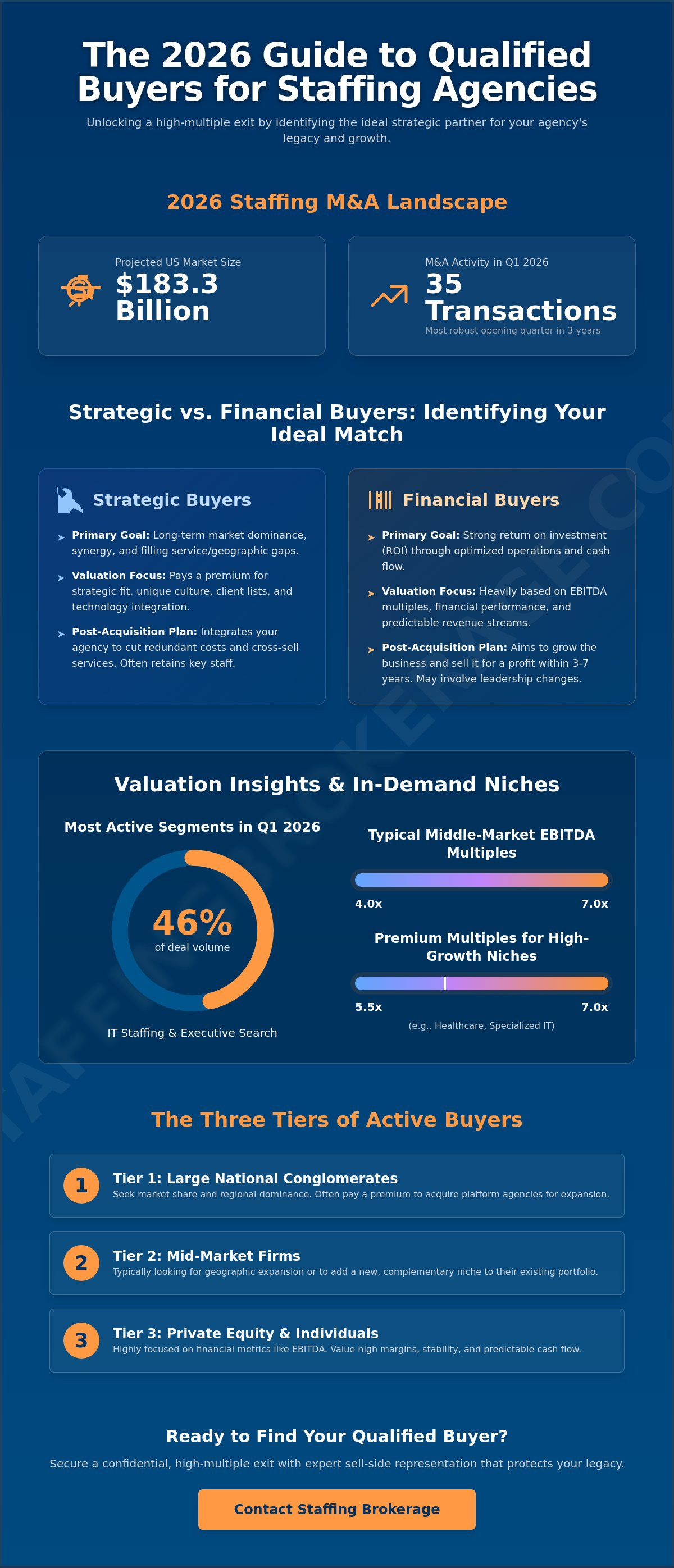
A qualified buyer in the 2026 market is more than just a source of capital. They are entities with a clear vision for growth and the operational maturity to absorb your team without damaging the culture you've built. Identifying qualified buyers for staffing agencies involves looking past the balance sheet to find a partner who understands the intrinsic value of your recruiters and client list. With the US staffing industry projected to reach a total market size of $183.3 billion this year, the pool of interested parties is growing, but not every suitor is prepared to close a complex deal.
The staffing sector remains a high-demand target because it serves as a critical solution to persistent labor volatility. While the industry is seeing a modest 2% growth rate, M&A activity is surging. The first quarter of 2026 alone saw 35 transactions, marking the most robust opening quarter in three years. This demand is driven by two primary factors: the scarcity of specialized talent and the urgent need for technological integration. Buyers are no longer just looking for "bolt-on" acquisitions to add a few local accounts. They are increasingly seeking "platform" acquisitions, where your agency serves as the foundation for a larger national or regional expansion strategy.
The Three Tiers of Active Buyers in 2026
Understanding who is looking at your business helps you tailor your preparation. Tier 1 consists of large national conglomerates. These buyers seek market share and often pay a premium for agencies that help them dominate a specific region. Tier 2 includes mid-market firms. These organizations are typically looking for geographic expansion or to add a new niche to their existing portfolio. Finally, Tier 3 involves private equity search funds and high-net-worth individuals. These buyers are often focused on the EBITDA multiples of middle-market firms, which currently range from 4.0x to 7.0x depending on the segment.
Why Your Niche Dictates Your Buyer Pool
Your specific area of expertise determines which qualified buyers for staffing agencies will come to the table. IT staffing and executive search are currently the most active segments, accounting for 46% of Q1 deal volume. If you operate in healthcare or high-growth IT niches, you're likely to attract strategic buyers willing to pay multiples at the higher end of the 5.5x to 7.0x range. Light industrial and clerical firms remain steady consolidation plays for larger groups looking for volume. Meanwhile, specialized professional services are prime targets for financial buyers who value the high margins and stability of those placements. Knowing where you fit in this hierarchy is the first step toward a successful sell-side representation process.
Strategic vs. Financial Buyers: Identifying Your Ideal Match
Choosing the right partner for your exit is a decision that shapes the future of your employees and your personal legacy. In the current M&A environment, qualified buyers for staffing agencies generally fall into two distinct categories: strategic and financial. Each brings a different set of priorities, valuation methods, and long-term goals to the table. Understanding these differences helps you determine which path aligns with your vision for the company you've worked so hard to build.
Strategic buyers are typically larger staffing firms or conglomerates already operating in your space. They aren't just looking for cash flow. They're looking for synergy. This might mean acquiring your agency to gain access to a specific geographic region where they have white space or to bring in a specialized recruitment team that handles high-growth niches. Because these buyers can often cut redundant back-office costs or cross-sell your services to their existing clients, they're often willing to pay a premium. If you're looking for staffing company sell-side representation to navigate these complex negotiations, focusing on these synergistic matches is often the key to a high-multiple exit.
The Strategic Buyer Advantage: Synergistic Value
Strategic buyers prioritize long-term market dominance over immediate returns. They value your agency’s unique culture and established client relationships because these assets are difficult to build from scratch. In 2026, we're seeing these buyers pay close attention to technological integration. If your agency has successfully implemented AI-driven sourcing or advanced screening automation, you become a much more attractive target for a national firm looking to modernize its own operations. This strategic fit often leads to smoother transitions for your internal staff.
The Financial Buyer Perspective: Growth and Scale
Financial buyers, such as private equity firms, view your agency through the lens of EBITDA multiples and future exit potential. They're actively seeking platform agencies they can use to launch a roll-up strategy. They acquire a high-performing agency like yours and then buy smaller bolt-on firms to increase total value. These buyers are incredibly disciplined during due diligence. They'll scrutinize your margins, client concentration, and recurring revenue streams to ensure the investment meets their strict return profiles.
The maturity of your agency often dictates which buyer is more qualified for your specific situation. A highly automated agency with a strong, independent management team is a perfect platform for a financial buyer. Conversely, a smaller, niche-focused firm might find its best match in a strategic buyer looking to expand its service offerings. Deal structures in 2026 frequently include earn-outs or deferred consideration to bridge valuation gaps. A steady hand and a clear strategy will help you identify which buyer type offers the best fit for your agency's next chapter.
The Search Process: How M&A Advisors Source National Buyers
A local search is often the quickest way to alert your competitors that your agency is on the market. In the specialized world of staffing, a regional approach is rarely sufficient to identify the most qualified buyers for staffing agencies. You need a reach that extends across the country to find strategic partners who value your specific niche, whether that's IT staffing or light industrial segments. A national search typically takes between six to nine months in the current market. This timeline ensures every potential suitor is thoroughly vetted before they ever see your company name.
Working with a specialized advisor provides access to proprietary databases that a general business broker simply doesn't possess. These databases track the acquisition history and current "buy boxes" of national conglomerates and private equity groups. This precision allows us to contact decision-makers directly. We skip the entry-level gatekeepers and move straight to those with the authority to sign a letter of intent. With analysts forecasting between 85 and 100 deals for the full year of 2026, staying ahead of the competition requires this level of direct, intentional outreach.
The Power of the 'Blind Profile' (Teaser)
Confidentiality is our highest priority. We begin the outreach process by creating a "Blind Profile" or teaser. This document highlights your agency's strengths without revealing its identity. We focus on key performance indicators like your gross margins, your stable revenue mix, and your impressive recruiter tenure. By presenting these metrics first, we filter out "tire-kickers" early. Only after a buyer signs a strict non-disclosure agreement and demonstrates their financial capacity do we share more sensitive details. This steady, methodical approach protects your business during the most vulnerable stage of the process.
Leveraging National M&A Networks
A specialized broker understands the nuances of the staffing industry, from the impact of new pay transparency regulations to the rising demand for IT staffing firms. These firms made up a significant portion of Q1 2026 transactions. We use these insights to position your business within private networks and at industry-specific conferences where high-level deals are often initiated. If you are ready to sell my staffing agency, a structured outreach plan is the most reliable way to create a competitive bidding environment. This competition is what ultimately drives up your valuation and ensures you find a partner who respects your agency's legacy.
Vetting and Qualifying Buyers: Beyond the Proof of Funds
Receiving a Letter of Intent (LOI) is an exciting milestone, but it's not a guarantee of a successful exit. True qualified buyers for staffing agencies must demonstrate more than just a healthy balance sheet. They need the operational maturity to handle the complexities of our industry, from complex and evolving labor regulations to the nuances of VMS and MSP contracts. Vetting a buyer is about protecting your legacy and ensuring your team has a stable home after the transition is complete.
A buyer's financial capacity is the first hurdle, but don't stop at a proof of funds letter. In the current economic climate, interest rates play a significant role in a buyer's ability to cross the finish line. As of June 2026, SBA 7(a) variable rates sit between 9.75% and 13.25%, while conventional bank loans can reach as high as 17.25%. If a buyer is heavily reliant on debt financing, these high rates can lead to "retracing," where the buyer attempts to lower the purchase price during due diligence because their lending costs increased. You need a partner who has the capital ready or the banking relationships to withstand market fluctuations.
The Buyer Qualification Checklist
- Closing History: Ask for a list of completed acquisitions in the staffing sector. A high percentage of LOIs that fail to reach the closing table is a major red flag.
- Operational Experience: Does the buyer understand your specific niche? A buyer who doesn't grasp the difference between locum tenens and per diem nursing, for example, will struggle to manage a healthcare staffing firm effectively.
- Debt vs. Equity: Determine how much of the purchase price is coming from cash on hand versus third-party financing. Higher equity usually means a faster, more certain closing.
Assessing Strategic Alignment and Post-Close Vision
Your recruiters are the lifeblood of your agency. If a buyer lacks cultural competency, your top performers might head for the door the moment the deal is announced. Ask potential qualified buyers for staffing agencies exactly how they plan to integrate your staff and whether they intend to keep your local office locations open. Some buyers want to absorb your accounts into their existing infrastructure, while others want you to remain as a standalone brand. Neither is inherently wrong, but the choice should align with your goals for the company's future.
You should also have a clear conversation about your own role during the transition. Many buyers expect a founder to stay on for six to twelve months to ensure a smooth handoff, often tied to an earn-out structure. If you're looking for a clean break, you need to identify that early in the vetting process. For a steady-hand approach to this complex evaluation, consider engaging professional staffing company sell-side representation to help you separate the serious suitors from the "tire-kickers."
Partnering with Staffing Brokerage to Secure a Strategic Exit
The journey toward a strategic exit is one of the most significant milestones in your professional life. It's a process that requires more than just financial expertise. It demands a partner who understands that your agency is the result of years of dedication, relationship-building, and hard work. At Staffing Brokerage, we serve as your steady-hand guide, ensuring that every step of the transition is handled with the highest level of integrity. We don't view these as simple transactions. We frame them as collaborative journeys where your success and your agency's legacy are the primary focus.
Identifying qualified buyers for staffing agencies is a specialized skill that combines data-driven analysis with a deep understanding of human capital. With analysts forecasting between 85 and 100 deals for the full year of 2026, the market is competitive. To stand out and secure a high-multiple exit, you need more than a listing. You need a strategist who can articulate your agency’s unique value proposition to national buyers who are ready to pay for quality and specialization.
Our Methodical Approach to Buyer Matching
Our process is intentional and transparent. We move beyond the surface-level transaction to ensure long-term value for both you and the buyer. By leveraging our association with the SI Staffing national network, we provide you with a reach that few independent firms can match. This network allows us to tap into a curated pool of active acquirers who are specifically looking for the stability and growth potential your agency offers. We prioritize strategic fit over a quick sale, focusing on buyers who respect your company culture and have a clear plan for your team's future.
Start Your Collaborative Journey Today
Early preparation is the most effective way to attract highest-tier buyers. Whether you are looking for immediate staffing company sell-side representation or simply want to understand your current market position, the first step is a professional business valuation and assessment. Understanding where your agency sits within the current 4x to 8x EBITDA multiple range allows us to build a roadmap that maximizes your eventual exit price. We provide the clarity you need to make informed decisions without the pressure of aggressive sales tactics.
If you're ready to explore what the next chapter looks like for you and your business, we're here to help. Our team provides the precision and alignment necessary to navigate the complexities of the 2026 M&A market. We invite you to contact Staffing Brokerage for a confidential consultation to begin your strategic development session. Together, we can find the partner who honors your past while securing your financial future.
Charting Your Path to a Successful Staffing Agency Exit
The 2026 M&A market offers significant opportunities for owners who are prepared to navigate its complexities with a clear strategy. You now understand how to distinguish between strategic and financial suitors and why a national search is essential for maintaining confidentiality. Success isn't just about the final number. It's about finding a partner who values your recruiters and respects the culture you've built over the years. Identifying qualified buyers for staffing agencies requires a steady hand and a deep understanding of industry-specific valuation drivers, from niche specialization to technological integration.
Staffing Brokerage provides the specialized end-to-end M&A advisory you need to achieve a high-multiple strategic match. We combine strict confidentiality protocols with a proven track record of successful transactions to ensure your legacy remains secure. You don't have to navigate this transition alone. Our team is ready to act as your dedicated guide, helping you move from initial valuation to a shared sense of accomplishment at the closing table.
Secure your strategic exit with Staffing Brokerage's national buyer network. Your hard work has built a valuable asset, and we're committed to helping you realize its full potential through a partnership built on trust and integrity. Let's start this collaborative journey together.
Frequently Asked Questions
What defines a 'qualified buyer' for a staffing agency in 2026?
A qualified buyer is an entity with immediate liquid capital, a proven track record of staffing acquisitions, and a strategic vision that aligns with your niche. In the current market, they must also demonstrate the operational maturity to handle new regulations like California’s SAFE Act. These buyers aren't just looking at your revenue; they're looking for a platform or a bolt-on that enhances their existing service ecosystem.
How do I find a strategic buyer without my competitors finding out?
Confidentiality is maintained through the use of a "blind profile" that highlights your metrics without revealing your identity. We only share sensitive details after a buyer signs a strict non-disclosure agreement and passes our initial vetting process. By focusing on a national search, we target qualified buyers for staffing agencies outside your local geography, which significantly reduces the risk of local market leaks.
What is the difference between a financial buyer and a strategic buyer?
Financial buyers, such as private equity firms, focus on ROI and EBITDA multiples to grow the business for a future exit. Strategic buyers are usually larger staffing firms looking for synergies, such as geographic expansion or specialized talent pools. Strategic buyers often pay higher premiums because they can integrate your team into their existing infrastructure to create immediate cost savings and cross-selling opportunities.
Do I need a business broker to find qualified buyers for my agency?
While you can search independently, specialized sell-side representation provides access to proprietary databases of qualified buyers for staffing agencies that aren't available to the public. A broker acts as a steady-hand guide, managing the vetting process and shielding you from "tire-kickers." This partnership allows you to focus on maintaining your agency's value while we handle the complex negotiations and due diligence phases.
How long does it typically take to find a buyer and close a staffing deal?
A typical national buyer search and closing process in 2026 takes between six to nine months. This timeline includes preparing a professional business valuation, marketing the blind profile, and navigating the due diligence phase. Rushing this methodical process can lead to lower valuations or unfavorable deal structures, so we focus on a steady pace that ensures a successful, high-multiple exit.
What metrics do qualified buyers look for first in a staffing agency?
Buyers prioritize stable gross margins, ideally above 25%, and a diversified client base with low concentration. They also look closely at the percentage of recurring contract revenue and your internal recruiter tenure. In 2026, high-value transactions are increasingly emphasizing your agency's level of technological integration, including how you use AI for sourcing and screening specialized talent in IT or healthcare segments.
How can I verify if a buyer actually has the funds to close the transaction?
You verify financial capacity by requiring a formal Proof of Funds or a highly confident letter from a lending institution early in the qualification stage. We also analyze the buyer's closing history and current debt-to-equity ratios. With SBA 7(a) variable rates reaching up to 13.25% as of June 2026, ensuring a buyer has the liquid capital to withstand high financing costs is a critical part of our vetting process.
Will a qualified buyer always require me to stay on for an earn-out period?
Most buyers prefer the founder to stay on for six to twelve months to ensure a smooth transition of client and recruiter relationships. While not every deal requires a long-term earn-out, these structures are common in 2026 to bridge valuation gaps and ensure post-close stability. The specific requirements usually depend on the strength of your existing management team and the buyer's long-term operational vision.