
How to Finance a Staffing Agency Acquisition: A Strategic 2026 Guide
In a financial landscape where the Prime rate has stabilized at 6.75%, the most expensive mistake you can make is assuming traditional bank loans are your only path to ownership. You might feel the weight of 2026's economic uncertainty, especially when calculating how to handle a target company's massive weekly payroll without over-leveraging your future. It's natural to worry about securing capital for an asset-light business when lenders seem more discerning than ever.
We understand these pressures and are here to act as your steady guide through the complexities of how to finance a staffing agency acquisition. This strategic guide provides a clear roadmap of the most effective debt, equity, and creative financing structures available today. You'll discover how to use a target agency's own accounts receivable to fund the buy and how to structure seller notes that align everyone's interests for long-term success. From navigating SBA 7(a) requirements to utilizing mezzanine debt, we will help you build a capital stack that ensures a smooth transition and sustainable growth.
Key Takeaways
- Master the art of leveraging "asset-light" business models by using a target agency's accounts receivable as your primary collateral.
- Discover exactly how to finance a staffing agency acquisition using a mix of SBA loans and asset-based lending tailored for the 2026 market.
- Bridge the gap between your offer and the seller's price by structuring seller notes and earn-outs that align everyone's long-term interests.
- Prepare for the "Day 1" payroll crunch with a clear plan for working capital that keeps your temporary staff paid on time.
- Build a sustainable capital stack that balances manageable debt with the flexibility needed to scale your new agency effectively.
Understanding the Landscape of Staffing Agency Acquisition Financing
Acquiring a staffing firm is a significant milestone that requires a sophisticated approach to capital. Unlike purchasing a manufacturing plant with heavy machinery, the value of a staffing agency lies in its intangible assets: its candidate database, client contracts, and historical performance. When you explore how to finance a staffing agency acquisition, you aren't just looking for a single loan. You are building a "capital stack" that typically combines senior debt, equity injections, and deferred payments like seller notes or earn-outs.
This process is part of the broader world of Mergers and acquisitions (M&A), where the goal is to create a seamless transition that preserves the target company's culture while fueling growth. Because staffing agencies are "asset-light" but "AR-heavy," traditional lenders often hesitate. They can't repossess a recruiter's expertise if things go south. However, the massive volume of accounts receivable (AR) provides a unique opportunity for specialized lenders who understand the industry's cash flow cycles.
Matching your financing terms to the business lifecycle is vital for long-term stability. A short-term bridge loan might get you through the closing, but it won't support a three-year expansion plan. We view this phase as the beginning of a collaborative journey. By aligning the interests of the buyer, the seller, and the financial partners, we can structure a deal that feels like a win for everyone involved.
Why Staffing Acquisitions Require Specialized Funding
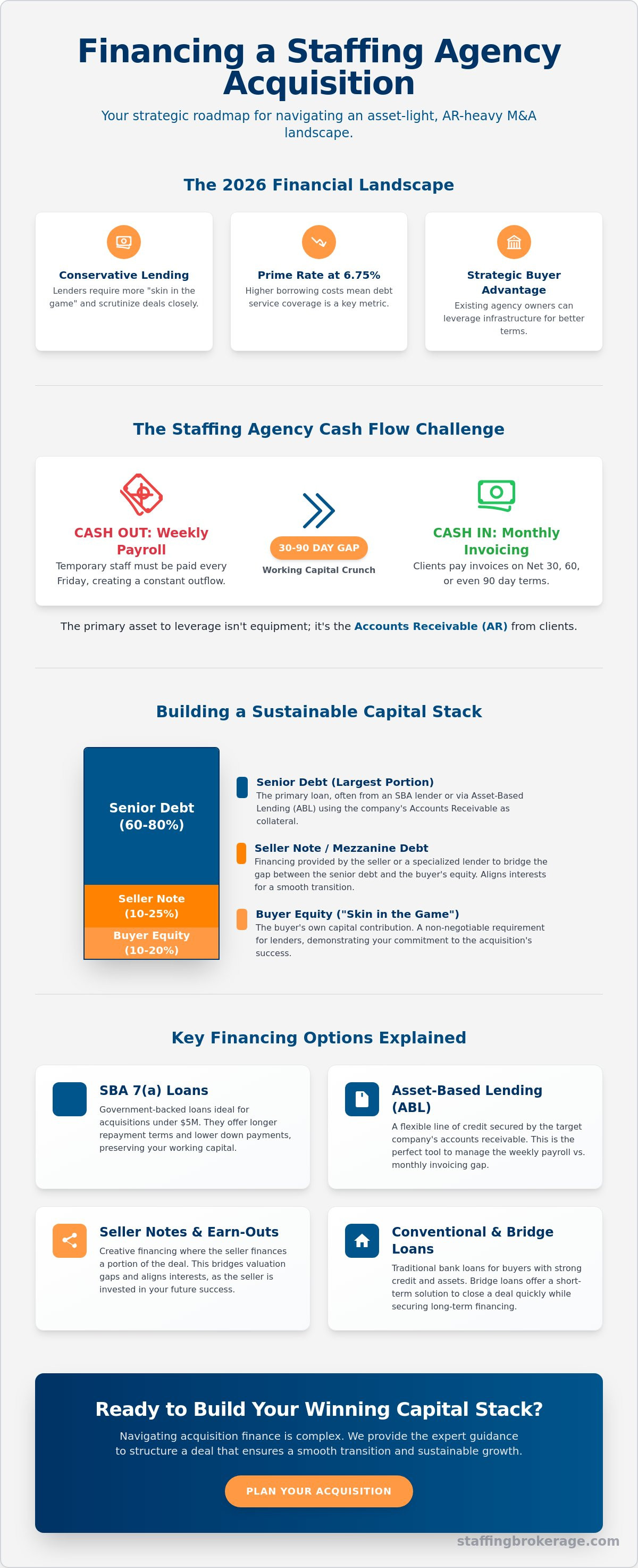
The staffing industry operates on a unique financial heartbeat. Many sectors, particularly light industrial or high-volume clerical, function on high volume but relatively low margins. The most significant hurdle for any new owner is the "weekly payroll vs. monthly billing" challenge. You must pay your temporary workforce every Friday, yet your clients might not pay their invoices for 30, 60, or even 90 days. This gap requires a financing structure that prioritizes working capital over long-term fixed asset loans.
Your ability to secure this funding is deeply tied to the staffing company valuation. A higher valuation, often driven by specialized niches like healthcare or IT, can expand your borrowing capacity by demonstrating stronger, more predictable cash flows to potential lenders.
The 2026 Economic Outlook for Staffing M&A
As of June 2026, the market has shifted away from the "easy money" era. With the Prime rate sitting at 6.75%, debt service coverage ratios are under tighter scrutiny. Lenders have become more conservative, requiring buyers to show significant "skin in the game" through equity or structured seller participation.
This environment gives a distinct advantage to strategic buyers. If you already own an agency, you can often leverage your existing infrastructure to reduce overhead, making the acquisition's cash flow more attractive to a bank. Whether you're a first-time buyer or a seasoned veteran, success in 2026 depends on viewing the transaction as a collaborative journey between you, the seller, and your advisors.
Debt Financing Options: SBA Loans and Asset-Based Lending
Securing the right debt structure is often the most critical step in determining how to finance a staffing agency acquisition. While the 2026 lending environment requires more precision than previous years, several robust options exist for buyers who present a clear growth strategy. For most acquisitions valued under $5 million, SBA 7(a) loans remain the primary vehicle. These government-backed loans offer longer repayment terms and lower down payments than traditional commercial products, making them an excellent choice for preserving your initial capital.
For larger or mid-market acquisitions, Asset-Based Lending (ABL) and conventional term loans take center stage. Conventional loans are typically reserved for buyers with significant existing assets or firms with a long history of stable EBITDA. If you need to move quickly to beat out a competitor, bridge financing can provide a temporary solution. These short-term loans allow you to close the deal today while your permanent, long-term funding is being finalized. Each of these paths requires a steady hand and a deep understanding of how lenders view the staffing sector's unique risks.
Leveraging the Power of SBA 7(a) Loans
The SBA 7(a) program is particularly friendly to staffing acquisitions because it allows for the financing of "goodwill." Since staffing agencies are asset-light, a large portion of the purchase price is based on future earnings and client relationships rather than physical equipment. In 2026, you'll typically need a 10% equity injection. Under current rules, you can often provide 5% in cash while the seller provides the other 5% through a note on full standby.
With the June 2026 Prime rate at 6.75%, a loan over $250,000 might carry an APR around 9.0%. It's important to remember that these loans require a personal guarantee. This commitment underscores the collaborative nature of the deal, as both you and the lender are fully invested in the agency's future success. If you're feeling uncertain about these requirements, our team is here to provide professional guidance throughout the application process.
Asset-Based Lending (ABL) for Staffing Firms
Asset-Based Lending is a powerful tool that turns the target company’s accounts receivable into an immediate source of liquidity. Unlike a standard term loan, an ABL structure provides a revolving line of credit based on the value of your outstanding invoices. This is often the preferred choice for staffing company buy-side advisory when dealing with mid-market firms that have high weekly payroll demands.
There are key differences between ABL and factoring that you should consider:
- Control: ABL typically allows you to maintain control over your collections and customer relationships.
- Cost: ABL usually offers lower interest rates than traditional factoring because it's structured as a line of credit.
- Scalability: As your agency grows and your AR increases, your available credit limit grows along with it.
By using the target agency's own assets to secure the deal, you reduce the pressure on your personal cash reserves. This structure ensures that you have the working capital necessary to meet payroll from day one while maintaining the flexibility to pursue new contracts immediately after closing.
Creative Financing: Seller Notes and Earn-Outs
Traditional bank loans are powerful, but they rarely tell the whole story of a successful deal. When you're determining how to finance a staffing agency acquisition, you'll likely find that a combination of debt and creative structures provides the most stable foundation. Seller notes and earn-outs aren't just ways to bridge a pricing gap. They are strategic tools that ensure the seller remains invested in your success long after the papers are signed. By incorporating these elements, you transform a simple transaction into a collaborative journey toward growth.
Most senior lenders in 2026 view seller participation as a requirement rather than an option. They want to see that the seller has "skin in the game," which reduces the bank's risk and ensures a smoother transition of client relationships. A seller note functions as a form of mezzanine debt, sitting between your primary bank loan and your own equity. This structure signals to everyone involved that the business is healthy and the seller believes in its continued performance under your leadership.
The Strategic Advantage of Seller Notes
A seller note is essentially a loan from the seller to the buyer. It often fills the space between what the bank is willing to lend and the total purchase price. In the current market, seller note interest rates typically range from 8.75% to 10.75%, based on the June 2026 Prime rate of 6.75%. While this might seem higher than senior debt, the terms are often more flexible. You can negotiate interest-only periods or longer amortization schedules that preserve your cash flow during the critical first year of ownership.
Sellers often find these notes attractive because they allow for tax deferral. Instead of paying capital gains on the entire purchase price on day one, they can spread the tax liability over several years. This alignment of financial interests helps you build a partnership based on transparency and mutual benefit. It's a steady hand approach that benefits both parties.
Structuring Earn-Outs to Mitigate Risk
Staffing agencies are built on people and relationships, which can feel volatile during a change in ownership. Understanding Earnouts is essential for protecting your investment if a major client or key recruiter leaves shortly after the sale. An earn-out ties a specific portion of the purchase price to future performance metrics, such as Revenue, EBITDA, or client retention rates over 12 to 24 months.
When you structure an earn-out, clarity is your best friend. Common pitfalls usually involve vague language about what constitutes "expenses" or "net income." We recommend focusing on Gross Profit or Revenue targets, as these are harder to manipulate through accounting changes. By setting realistic KPIs, you protect yourself from overpaying for a business that might see a temporary dip in performance. This methodical approach ensures you aren't just learning how to finance a staffing agency acquisition, but how to do so with precision and confidence.
Managing Post-Acquisition Cash Flow and Working Capital
Closing the deal is only half the battle. The real test begins the first Friday after you take the keys. In the staffing industry, the "Day 1" payroll crunch is a high-stakes reality. You must pay your temporary employees immediately, but your clients' payments are likely weeks away. Understanding how to finance a staffing agency acquisition must include a plan for this immediate cash outflow. Without it, you risk damaging your reputation with your most valuable asset: your workforce.
Choosing between factoring and payroll funding is a pivotal decision for a newly acquired firm. Factoring involves selling your invoices at a discount for immediate cash. Payroll funding is often more comprehensive, frequently covering payroll taxes and workers' compensation filings. Both options provide the liquidity needed to survive the gap between payroll and collections. Sellers who know how to maximize value when selling a staffing company maintain pristine accounts receivable records to ensure these facilities are easy for a buyer to secure.
Securing Your Working Capital Facility
Your acquisition loan and your working capital line shouldn't exist in silos; they need to be perfectly coordinated. Lenders will look closely at your concentration limits during the underwriting process. If a single client represents 50% of your revenue, a lender may limit your borrowing base against those specific invoices to mitigate risk. It's vital to set up your treasury management and payroll systems weeks before the close. If you need help evaluating your options, our buy-side advisory services can help you align your financing with your operational needs.
The Working Capital Adjustment Process
A "Working Capital Peg" or target is a standard feature in most purchase agreements. This mechanism ensures the seller leaves enough "gas in the tank" for you to operate on day one. If the actual Net Working Capital (NWC) at closing is lower than the agreed-upon peg, the purchase price is adjusted downward. Conversely, if it's higher, you may owe the seller an additional payment.
Handling aged AR is a critical part of this transition phase. Most lenders won't advance funds against invoices older than 90 days. You and the seller must decide how to handle these accounts during the financing stage. This methodical approach to working capital ensures that your collaborative journey doesn't hit an avoidable roadblock in the first month of ownership. By focusing on these details, you secure the long-term stability of your new agency and ensure you know exactly how to finance a staffing agency acquisition from start to finish.
Structuring the Deal for Strategic Fit and Long-Term Stability
Success in the 2026 market requires a capital stack that balances risk with opportunity. While you've learned the technical steps of how to finance a staffing agency acquisition, the final structure must prioritize your agency's long-term health over short-term savings. A typical high-performing stack often includes a 5% buyer cash injection, a 5% seller note on full standby to meet SBA requirements, and a senior debt facility covering the remaining 90%. We often see buyers chase the lowest possible interest rate, but the cheapest money isn't always the best. If a loan comes with restrictive covenants that limit your ability to hire key recruiters or invest in new technology, that "cheap" money could actually stifle your growth.
A seasoned M&A advisor acts as the steady hand throughout these complex negotiations. We coordinate between your lenders, attorneys, and accountants to ensure every piece of the puzzle fits perfectly. This collaborative journey depends on maintaining goodwill with the seller during the final stages of the deal. If you approach financial discussions with transparency and respect, you'll find it much easier to transition client relationships and retain top internal talent after the close. Financing is simply the engine that powers your strategic vision, and we are here to help you tune it for maximum performance.
Balancing Leverage and Operational Flexibility
Staffing is inherently cyclical, and over-leveraging your new acquisition can be a recipe for stress during a market dip. You should aim for a healthy Debt Service Coverage Ratio (DSCR) that allows for fluctuations in your weekly payroll demands. If the macroeconomy shifts post-acquisition, a flexible financing structure gives you the room to pivot without the immediate threat of a loan default. We help you stress-test your projections against various economic scenarios to ensure you don't just close the deal, but thrive in the years that follow. Maintaining this breathing room is essential for scaling your business with confidence.
The Staffing Brokerage Approach to Strategic Acquisitions
At Staffing Brokerage, we view every acquisition as a major milestone in your professional journey. We help you navigate how to finance a staffing agency acquisition by connecting you with financial partners who truly understand the staffing industry's unique accounts receivable landscape. Our focus remains on integrity and finding a strategic fit that benefits both the buyer and the seller. We believe that a successful deal is one where both parties feel valued and the business is positioned for its next chapter of growth. If you're ready to take the next step toward ownership, we invite you to reach out for a confidential consultation to discuss your acquisition goals and explore the possibilities for your future.
Building Your Future with a Strong Financial Foundation
You now have a clear roadmap for your next big step. Success isn't just about finding the right target; it's about building a capital stack that supports your vision without compromising your operational agility. By balancing senior debt with creative seller participation and a robust working capital line, you ensure your agency can handle the high-volume demands of a 2026 workforce. We've explored how to finance a staffing agency acquisition by looking beyond simple interest rates to find the strategic fit that fuels long-term stability.
This transition is a collaborative journey, and having the right partner makes all the difference. Staffing Brokerage provides specialized M&A advisory for the staffing industry, backed by a proven track record of successful national transactions. Our team brings deep expertise in complex deal structuring and valuation to every partnership, ensuring your interests are protected at every turn. Ready to grow? Explore our Staffing Company Buy-Side Advisory services today. Your future in the staffing industry is bright, and we're here to help you reach it with confidence.
Frequently Asked Questions
Can I finance a staffing agency acquisition with no money down?
No, you generally cannot secure an acquisition with zero capital in the current lending environment. As of 2026, SBA rules require a minimum 10% equity injection for business acquisitions. You can typically satisfy this by providing 5% in cash while the seller provides the remaining 5% through a note on full standby. Lenders want to see this "skin in the game" to ensure you are fully committed to the agency's long-term success.
What is the typical interest rate for a staffing business acquisition loan in 2026?
Interest rates depend on your specific loan structure, but SBA 7(a) loans over $250,000 are currently hovering around 9.0% APR. This is based on the June 2026 Prime rate of 6.75% plus a standard lender spread. If you are pursuing a conventional bank loan for a larger firm, rates typically range from 8% to 17.25% depending on your credit profile and the agency's historical EBITDA. Understanding how to finance a staffing agency acquisition requires looking at these benchmarks to build an accurate debt service model.
How long does it take to secure financing for a staffing firm purchase?
You should expect the financing process to take between 60 and 90 days from the initial application to the closing date. While some creative bridge loans can close faster, traditional debt structures require a methodical approach to due diligence, valuation assessments, and underwriting. We recommend starting the conversation with lenders as soon as you have a signed Letter of Intent to ensure your working capital is ready for the first payroll cycle.
Do I need staffing industry experience to get an SBA loan for an acquisition?
Direct industry experience is highly preferred by lenders, but it is not always a strict requirement if you have strong transferable management skills. Banks look for a "steady hand" who can manage a large, distributed workforce and maintain complex client relationships. If you don't have a staffing background, you can often strengthen your application by ensuring key members of the existing management team stay on board after the transition.
What is the difference between a strategic buyer and a financial buyer in terms of financing?
Strategic buyers already own a staffing agency and can often leverage their existing infrastructure to create synergies, which makes them very attractive to lenders. Financial buyers are typically individuals or private equity groups who rely solely on the target agency's standalone cash flow to service the debt. Learning how to finance a staffing agency acquisition as a strategic buyer often involves using your current company’s assets to secure more favorable terms or higher borrowing limits.
How does an earn-out affect the total amount I can borrow from a bank?
Earn-outs don't usually count toward your senior debt, but they play a vital role in reducing the amount of cash you need at closing. By tying a portion of the purchase price to future performance, you lower your initial loan amount and keep your Debt Service Coverage Ratio healthy. Lenders view earn-outs as a positive sign because they align the seller's interests with your own during the critical first year of ownership.
Will a lender finance the purchase of a staffing agency with high client concentration?
Yes, but you should expect the lender to apply a "haircut" or lower advance rate to the receivables from those specific clients. If one client accounts for more than 25% of total revenue, the bank may limit the borrowing base to mitigate the risk of that client leaving. In these scenarios, we often help buyers structure a larger earn-out or seller note to protect the investment against a sudden drop in volume.
What happens to the existing factoring agreement when a staffing agency is sold?
The existing factoring agreement is typically paid off and terminated at the closing table using the proceeds from your new financing facility. It is essential to coordinate this transition with both the old and new lenders to ensure there is no gap in funding. We work closely with our clients to align these moving parts so that your temporary staff and recruiters are paid on time without any operational hiccups.